YouTube为美国创作者启用PYUSD稳定币支付功能:报道

cointelegraphОпубликовано 2025-12-12Обновлено 2025-12-12

Введение

据报道,视频分享巨头YouTube已允许美国创作者通过PayPal的稳定币PYUSD接收付款。PayPal加密业务负责人表示,该功能目前仅对美国用户开放,YouTube无需直接处理加密货币,从而降低了复杂性。PayPal与YouTube合作已久,此前已支持用户通过其支付服务进行打赏和广告分成。 此举被视为YouTube对加密货币态度转暖的标志,可能推动稳定币的大规模采用。PYUSD于2023年中推出,目前市值达39亿美元,自年初以来从约5亿美元大幅增长。自9月初以来,其增长显著加速,部分原因是集成至Spark借贷市场和Bitfinex的机构级稳定币区块链。分析师认为,随着主流机构加速拥抱加密货币,稳定币将在2025年迎来爆发式增长。

据报道,视频分享巨头YouTube已允许美国创作者通过PayPal的稳定币PYUSD接收付款。

《财富》杂志周四报道称,PayPal加密业务负责人May Zabaneh表示该功能已上线,但目前仅限美国用户使用。今年早些时候,该公司就集成了接收方通过PYUSD收款的功能,YouTube最终选择向其创作者开放这一选项。

"我们构建的妙处在于YouTube无需接触加密货币,这样我们就能帮助消除这种复杂性,"她表示。

PayPal与YouTube有着长期合作关系,该平台多年来一直允许用户通过其服务进行支付,同时也将其用于创作者AdSense的收益结算。

在数字资产逐渐成为主流之际,YouTube可能正在对加密货币转变态度——尽管其曾有暗中限制加密内容的历史。考虑到YouTube平台的规模,这一举措也可能对稳定币的采用带来潜在利好。

相关阅读:Visa试点法币支持的稳定币支付业务面向美国企业

随着主流企业、机构和政府纷纷将加密资产与传统金融整合,稳定币市场在过去一年呈现爆发式增长。

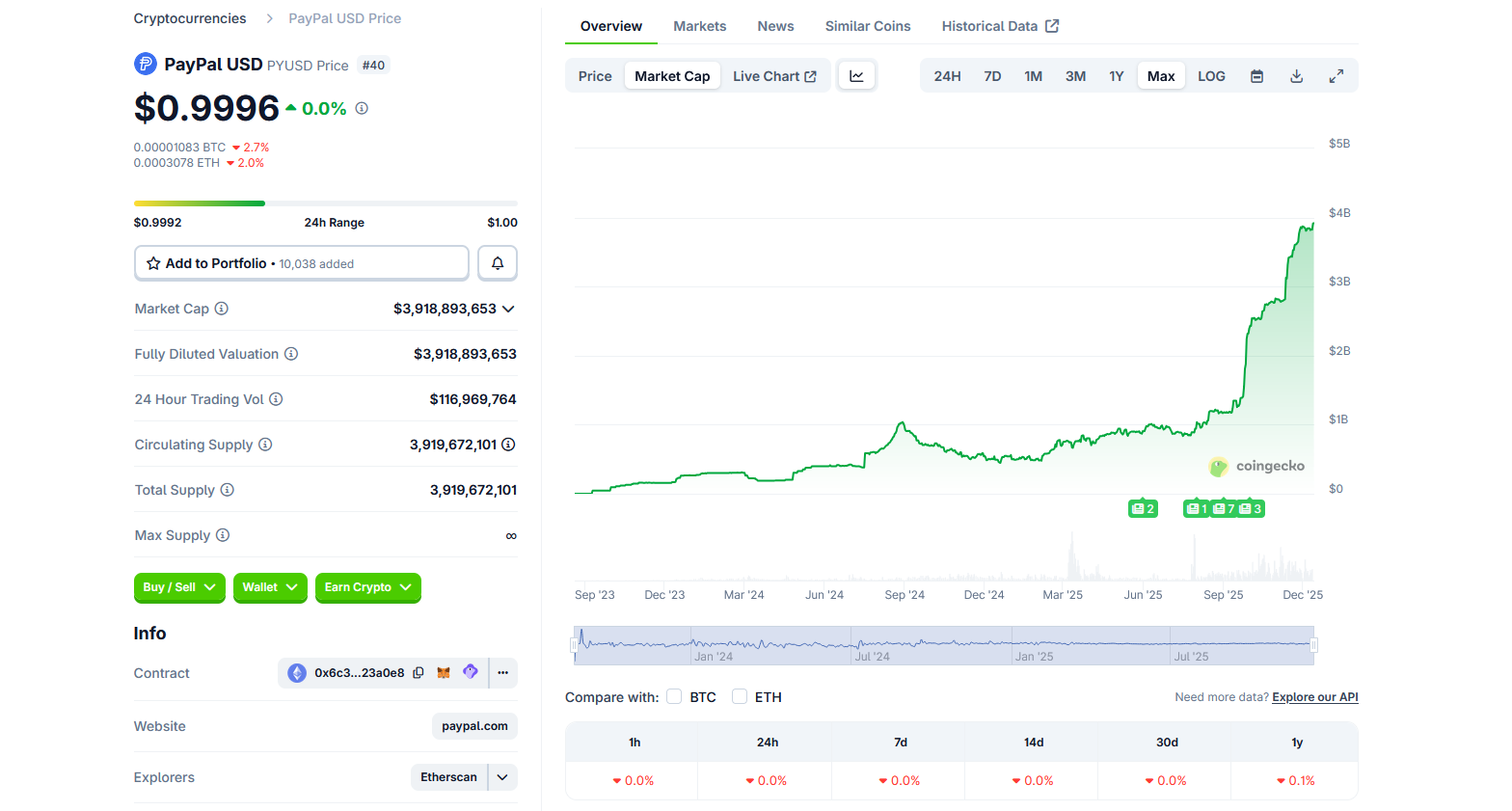
PYUSD于2023年年中推出,根据CoinGecko数据,目前市值为39亿美元。自年初以来其市值大幅飙升,从1月份的约5亿美元一路增长。

PYUSD市值走势 数据来源:CoinGecko

PYUSD的大部分增长发生在9月初之后,当时其市值约为10亿美元。在该月份,PYUSD成功整合进Spark借贷市场和Bitfinex的Stable(机构级稳定币区块链)。
杂志特写:2025年全球拥抱资产类别,稳定币将迎来爆发式增长

Связанные с этим вопросы

QYouTube为美国创作者启用了哪种稳定币的支付选项?

AYouTube为美国创作者启用了PayPal的稳定币PYUSD作为支付选项。

QPayPal的加密货币负责人是谁?

APayPal的加密货币负责人是May Zabaneh。

Q根据CoinGecko数据,PYUSD当前的市场市值是多少?

A根据CoinGecko数据,PYUSD当前的市场市值是39亿美元。

QPYUSD的市场市值从2025年1月至今增长了多少?

APYUSD的市场市值从2025年1月的约5亿美元增长到当前的39亿美元,增长了约34亿美元。

Q文章中提到PYUSD在9月份的增长与哪些平台的整合有关?

APYUSD在9月份的增长与整合Spark的借贷市场和Bitfinex的Stable(机构级稳定币区块链)有关。

Похожее

OpenAI's Hyperliquid Pre-IPO Pricing Venture: Why Did It Last Only Half a Year?

The article discusses the rise and fall of Pre-IPO pricing markets on the Hyperliquid blockchain. Trade.xyz, an anonymous team, successfully built the largest pre-market for SpaceX (SPCX) by launching a contract with a clear anchor: the eventual Nasdaq listing price. This provided inherent price stability and validation. In contrast, Ventuals, a team backed by Paradigm, failed despite holding exclusive contracts for highly sought-after companies like OpenAI and Anthropic. Its key mistake was its pricing mechanism. For companies with no near-term IPO date, Ventuals' oracle relied partly on opaque private market transactions and, critically, partly on its own contract's moving average price. This created a self-referential feedback loop where prices were artificially propped up and detached from genuine supply and demand, leading to illiquid markets. Ventuals shut down after nine months, settling positions at final prices of $1,341.80 for OpenAI and $1,618.90 for Anthropic. Ironically, some employees and late-stage investors of these very companies reportedly used these flawed Ventuals prices for valuation reference, highlighting the acute demand for any price signal in illiquid private markets. The article concludes that while demand for pre-IPO trading is real and growing, with players like Coinbase now entering the space, the fundamental challenge remains: without a public listing to provide a definitive price anchor, these markets struggle to establish truly accurate and liquid pricing. The need for a transparent, self-correcting market is the critical lesson from Ventuals' failure.

marsbit1 мин. назад

OpenAI's Hyperliquid Pre-IPO Pricing Venture: Why Did It Last Only Half a Year?

marsbit1 мин. назад

With Daily Active Users Reaching 3-4 Times That of the Industry's Second Place, Which Crack in the Office Agent Market Has Tencent's WorkBuddy Torn Open?

Tencent's AI office assistant, WorkBuddy, has achieved daily active users (DAU) 3-4 times that of the industry's second-place product, primarily driven by non-technical users like HR, operations, and administrative staff. Its rapid growth, starting with a public beta in March 2026, highlights a key strategic divergence from competitors like OpenAI's Codex and Anthropic's Claude Code. Unlike those tools, which originated as developer-focused assistants (in command lines or IDEs) and are now expanding towards office scenarios, WorkBuddy was built from the ground up for non-technical office workers. Its development was user-driven, initiated after腾讯云's team observed non-technical employees using their CodeBuddy coding tool for general tasks. WorkBuddy's design is defined by three core decisions aimed at lowering barriers: 1) Using natural language instead of technical concepts, so users describe their goal without needing to understand prompts or agents. 2) Providing pre-packaged "Skill" templates for common office tasks like data processing, content creation, and research. 3) Natively integrating into existing腾讯 ecosystems like腾讯 Docs and WeChat, making the agent a seamless part of the user's workflow rather than a separate tool. This "scenario encapsulation" approach, prioritizing the shortest path for users to get work done, contrasts with the "underlying capability" focus of Codex and Claude, which offer more flexibility but require more technical setup. Analysts confirm WorkBuddy's leading market position in China by mid-2026, with massive user and request growth following its launch. Recognizing the same trend of surging non-technical adoption, OpenAI and Anthropic are now pivoting their products with features like role-based plugins (Codex) and a simplified desktop interface (Claude Cowork). However, adapting tools built for developers requires significant changes to interaction models and integrations. WorkBuddy currently holds an estimated six-month lead in delivering a complete solution for non-technical office users. Its recently launched enterprise version aims to solidify this advantage. The competition underscores two valid paths: embedding agent capabilities directly into familiar work environments versus building powerful, general-purpose agents that users must learn to access. WorkBuddy's early success demonstrates the effectiveness of the former strategy for mainstream office adoption.

marsbit9 мин. назад

With Daily Active Users Reaching 3-4 Times That of the Industry's Second Place, Which Crack in the Office Agent Market Has Tencent's WorkBuddy Torn Open?

marsbit9 мин. назад

Dalio's Latest Warning: Don't Get Carried Away by AI, Real Returns on US Stocks in the Next 5-10 Years Could Be -5% to -10%

Ray Dalio, founder of Bridgewater Associates, warns investors against excessive concentration in AI stocks. He argues the current market, dominated by a few AI giants, mirrors historical patterns where revolutionary new technologies lead to high risk, volatility, and uncertainty. While acknowledging AI's transformative potential, Dalio emphasizes that most investors fail at this stage of the cycle by over-concentrating in a handful of leading companies. He cites inherent risks: companies cannot accurately forecast investment needs or external shocks (e.g., monetary policy, geopolitics, taxes), face potential disruption from future technologies and international competition (notably from China), and experience significant price swings. Dalio's core advice is diversification, calling it his "Holy Grail of Investing." He presents a mathematical case that a well-diversified portfolio of 15-20 uncorrelated, good bets offers a superior risk-adjusted return compared to a concentrated position. Dalio also offers a cautious outlook, suggesting U.S. stocks may deliver real returns of -5% to -10% over the next 5-10 years based on valuation and bubble indicators. He concludes that in the face of high uncertainty, the prudent strategy is not to avoid betting entirely, but to avoid large, concentrated bets where one lacks sufficient informational edge. Instead, investors should build a strategically balanced, diversified portfolio.

marsbit1 ч. назад

Dalio's Latest Warning: Don't Get Carried Away by AI, Real Returns on US Stocks in the Next 5-10 Years Could Be -5% to -10%

marsbit1 ч. назад

Торговля

Спот
Фьючерсы

Популярные статьи

Как купить US

Добро пожаловать на HTX.com! Мы сделали приобретение Talus Network (US) простым и удобным. Следуйте нашему пошаговому руководству и отправляйтесь в свое крипто-путешествие.Шаг 1: Создайте аккаунт на HTXИспользуйте свой адрес электронной почты или номер телефона, чтобы зарегистрироваться и бесплатно создать аккаунт на HTX. Пройдите удобную регистрацию и откройте для себя весь функционал.Создать аккаунтШаг 2: Перейдите в Купить криптовалюту и выберите свой способ оплатыКредитная/Дебетовая Карта: Используйте свою карту Visa или Mastercard для мгновенной покупки Talus Network (US).Баланс: Используйте средства с баланса вашего аккаунта HTX для простой торговли.Третьи Лица: Мы добавили популярные способы оплаты, такие как Google Pay и Apple Pay, для повышения удобства.P2P: Торгуйте напрямую с другими пользователями на HTX.Внебиржевая Торговля (OTC): Мы предлагаем индивидуальные услуги и конкурентоспособные обменные курсы для трейдеров.Шаг 3: Хранение Talus Network (US)После приобретения вами Talus Network (US) храните их в своем аккаунте на HTX. В качестве альтернативы вы можете отправить их куда-либо с помощью перевода в блокчейне или использовать для торговли с другими криптовалютами.Шаг 4: Торговля Talus Network (US)С легкостью торгуйте Talus Network (US) на спотовом рынке HTX. Просто зайдите в свой аккаунт, выберите торговую пару, совершайте сделки и следите за ними в режиме реального времени. Мы предлагаем удобный интерфейс как для начинающих, так и для опытных трейдеров.

514 просмотров всегоОпубликовано 2025.12.11Обновлено 2026.06.02

Как купить US

Обсуждения

Добро пожаловать в Сообщество HTX. Здесь вы сможете быть в курсе последних новостей о развитии платформы и получить доступ к профессиональной аналитической информации о рынке. Мнения пользователей о цене на US (US) представлены ниже.

活动图片