Cardano Founder Slams ‘Clickbait’ Reports He Blamed ADA Users

bitcoinistОпубликовано 2025-11-05Обновлено 2025-11-05

Введение

Charles Hoskinson issued a rebuttal on November 3, rejecting circulating headlines that claimed he blamed Cardano’s users for the network’s...

Trusted Editorial content, reviewed by leading industry experts and seasoned editors. Ad Disclosure

Charles Hoskinson issued a rebuttal on November 3, rejecting circulating headlines that claimed he blamed Cardano’s users for the network’s decentralized finance shortfall. In a brief video, the Cardano founder said media outlets misrepresented his prior comments about participation patterns across the ecosystem, stressing that his point was a structural “mismatch” between who stakes and governs versus who takes part in DeFi—not blame.

“I never once blamed anyone from the Cardano ecosystem for the DeFi [woes],” Hoskinson said, naming The Crypto Basic as an example of outlets whose framing he called fundamentally inaccurate. “I’m sorry crypto media that you guys are […] and you just want clickbait headlines. You guys have to cut this the […] out.” He added that there is “not a single person in the Cardano ecosystem who I am blaming for our DeFi situation right now.”

Cardano’s DeFi Gap Is A Participation Mismatch

Hoskinson’s core claim is numerical and directional rather than accusatory. He argued there is a demonstrable divergence between Cardano’s high participation in staking and governance and its lower participation in DeFi protocols, which depresses total value locked. “I pointed out in a video that there is a mismatch between the people who participate in staking and governance and the people who participate in DeFi. And if there was proportionality there… our TVL would be at least five to 10 billion,” he said. He characterized the recent headlines as “materially wrong and factually wrong” because they attributed intent—“blaming users”—that he explicitly disavowed.

The founder anchored his point in a specific user count comparison. Some third-party measurements, he said, “are asserting that Cardano has only 10,000 to 50,000 actual users when there’s 1.3 million who are using staking.” For Hoskinson, that delta underscores that Cardano “has a large population, a large wallet base, and a lot of users as evidenced by the enormous level of participation in both governance and staking,” even if those participants are not currently “deploying to the other side of the aisle, to the TVL side, to the DeFi side.”

He repeatedly emphasized that diagnosing the participation gap is an ecosystem responsibility, not a morality play. “I’m not blaming them for not participating,” he said. “Never once said it’s their fault and they’re bad people and they’ve done something wrong.” Instead, he called for a frank community conversation about the drivers behind users’ choices. “It could be slippage. It could be fees. It could be user experience. It could be yields. It could be safety concerns. It could be education. There could be 150,000 different reasons for that. But we as an ecosystem have to have that discussion.”

The remedy, in his view, is a coordinated governance agenda rather than a media narrative. He urged Cardano stakeholders to treat the participation gap as a 2026 workstream and to fund targeted initiatives through delegated authority. “We as an ecosystem have to ask why that mismatch exists and how can we correct that mismatch… as a 2026 governance agenda, and get some delegated authority funding and effort to correct that,” he said. If the proportionality problem were addressed, Hoskinson argued, “that alone can get our TVL up 5 billion to 10 billion,” potentially placing Cardano “in the top ranks of TVL, the top five to top 10.”

The dispute originated, he said, when media took a narrow, data-driven observation about where Cardano users allocate capital and translated it into a blame narrative. “People say something very specific, very targeted, and then it gets misinterpreted, and then everybody judges you based upon the headlines,” he said. “I’m not going to allow the crypto media to go ahead and put words in my mouth.” He reiterated the same point multiple times for emphasis: “I did not blame the Cardano ecosystem. I did not blame the Cardano users for anything. I was very careful, guarded, and specific in the things that I said.”

Hoskinson coupled the clarification with a broader critique of crypto media practices. “If you continue to broadcast, you’re lying to people,” he said, adding, “I expect that from the crypto media because they are scum. They do lie. Everything’s sensational. Everything’s clickbait.” He framed his intervention as a corrective to prevent a headline cycle from hardening into accepted fact: “The record has been corrected.”

Beyond media criticism, the practical substance of his message focused on mobilizing existing users rather than conjuring new ones. “We have the users. We have the capital,” he said. “For some reason, those users with their capital are not participating in DeFi.” While he acknowledged having personal “suspicions” and hearing “frustrations” from ecosystem participants, he stopped short of diagnosing root causes, instead calling for an open, data-first process to “systematically chip away” at barriers that deter stakers and governance participants from crossing into DeFi activity.

Across the video, Hoskinson’s throughline never deviated: the issue is proportional participation by an already large user base. “There is a mismatch between the people participating in staking and governance—of which it’s seven figures over a million people—and the people participating in DeFi,” he said. “We have to get to the bottom of that mismatch as an ecosystem… But I’m not blaming the Cardano users for that mismatch. I’m not saying it’s their fault. I’m not saying that they did something wrong.”

At press time, ADA traded at $0.538.
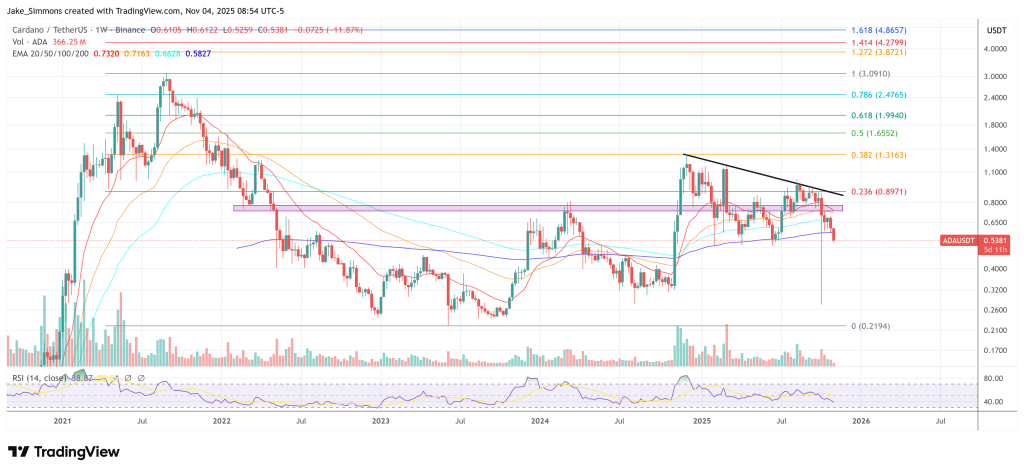
Cardano price
ADA drops below the EMA200, 1-week chart | Source: ADAUSDT on TradingView.com
Featured image created with DALL.E, chart from TradingView.com
Editorial Process for bitcoinist is centered on delivering thoroughly researched, accurate, and unbiased content. We uphold strict sourcing standards, and each page undergoes diligent review by our team of top technology experts and seasoned editors. This process ensures the integrity, relevance, and value of our content for our readers.

Jake Simmons has been a Bitcoin enthusiast since 2016. Ever since he heard about Bitcoin, he has been studying the topic every day and trying to share his knowledge with others. His goal is to contribute to Bitcoin's financial revolution, which will replace the fiat money system. Besides BTC and crypto, Jake studied Business Informatics at a university. After graduation in 2017, he has been working in the blockchain and crypto sector. You can follow Jake on Twitter at @realJakeSimmons.

Похожее

Google CEO Admits Lagging Behind in Coding

Google CEO Sundar Pichai acknowledged in a recent interview that Google's Gemini AI models are currently "lagging behind" in coding capabilities, particularly for complex, long-horizon tasks requiring advanced developer expertise. He noted the field is advancing at an "unprecedented" pace, where 30-60 days now brings changes equivalent to five years in the past. Pichai expressed that achieving Artificial General Intelligence (AGI) now seems closer than previously imagined due to rapid progress. While highlighting strengths in text, multimodal, and reasoning tasks, Pichai admitted competitors like Anthropic and OpenAI have focused more intently on coding. He emphasized Google's commitment to catching up, citing internal tools like Antigravity 2.0 and the newly released Gemini 3.5 Flash, which aims to address previous shortcomings. Regarding Google Search's AI-driven overhaul, Pichai stated changes will be gradual to align with user needs, not disrupt the core search experience or its advertising model. He addressed public AI anxiety as understandable, given the technology's potential to reshape jobs and society, but remained optimistic about AI augmenting human capabilities and creating new opportunities. Pichai stressed the need for broad societal dialogue and responsible development as AI approaches more advanced, potentially recursive self-improvement stages. He affirmed Google's long-term commitment to leading in AI while navigating its profound implications responsibly.

marsbit1 ч. назад

Google CEO Admits Lagging Behind in Coding

marsbit1 ч. назад

The Paradox of Automation: The Stronger the AI, the Busier Humans Become

The Paradox of Automation: The more powerful AI becomes, the more work humans have to do. This article, based on observations from AI-heavy company Every, argues that while AI agents automate tasks like coding, writing, and customer service, they don't eliminate human jobs. Instead, they transform work and create *more* demand for human expertise. AI commoditizes "yesterday's human capabilities" by cheaply generating code, text, and images from past data. This leads to an abundance of similar, generic outputs. Consequently, what becomes scarce and valuable is human judgment in the present moment: knowing *what* is worth doing, *why*, and *how* to do it well. The article identifies two collaboration models: "Agent employees" for delegated tasks and "human-AI collaboration" within tools like Claude Code for complex work. In both cases, humans are essential to set direction, judge quality, and maintain systems. As AI makes execution cheap, human roles shift from executors to designers, reviewers, and meaning-makers. The author addresses "benchmark anxiety" by explaining that AI excels within specific, human-defined problem "frames." As AI masters one frame (e.g., code rewriting), new, more complex frames emerge (e.g., deciding *when* to rewrite). This creates an ongoing cycle where AI chases the frames, but humans remain the "framers." Even with advanced AGI, this dynamic may persist as long as AI lacks true human-like agency and self-directed purpose. The core paradox holds: automation amplifies the need for the very human judgment it seems to replace.

marsbit2 ч. назад

The Paradox of Automation: The Stronger the AI, the Busier Humans Become

marsbit2 ч. назад

a16z: 7 Charts to Understand How Tokenization is Changing the Nature of Assets

"a16z: 7 Charts on How Tokenization is Changing the Nature of Assets" Tokenized Assets (or Real-World Assets - RWA) are transforming asset forms, liquidity, and financial system construction. The market recently surpassed $30 billion, stabilizing around $34 billion (excluding stablecoins), representing a tenfold increase in less than two years, driven by clearer regulations, mature institutional infrastructure, and increased financial institution adoption. The primary driver of recent growth is tokenized U.S. Treasury bonds. These offer investors efficient, flexible digital access to yield-bearing assets and improve institutional operations like settlement and collateral management. Other asset classes show varied growth: asset-backed credit leads, followed by niche financial assets (e.g., reinsurance, mining notes), while venture capital took longer to scale. Market segmentation shows high concentration. In commodities, tokenized gold dominates (~$5 billion), as its standardized, storable nature fits tokenization well. Bonds are the largest category ($15.2B), but only ~5% are used in DeFi protocols. Conversely, smaller niches like reinsurance tokens see high (~84%) on-chain utilization, highlighting a core industry divide: most current tokenized assets are merely digitized records for easier holding/transfer, lacking the "composability" (free combination/interaction) that is key to blockchain-native finance. The ecosystem is distributed across multiple blockchains, with Ethereum hosting over half the value ($15.7B), followed by BNB Chain, Solana, and others. Future market size predictions vary widely (e.g., $2-$30 trillion by 2030+), but all indicate massive potential from the current small base. Tokenized assets currently represent minuscule fractions of their global counterparts (e.g., 0.01% of global bonds). The current phase focuses on digitizing straightforward assets. The next challenge is to bring more complex financial components on-chain and deeply integrate tokenized assets into composable, internet-native financial infrastructure.

链捕手3 ч. назад

a16z: 7 Charts to Understand How Tokenization is Changing the Nature of Assets

链捕手3 ч. назад

a16z: How Tokenization is Transforming the Nature of Assets in 7 Charts

"Tokenized Assets: How Tokenization Changes the Nature of Assets" by a16z Crypto The market for tokenized assets, excluding stablecoins, has grown from under $3 billion two years ago to over $340 billion today. US Treasury bonds are the primary growth driver, allowing investors to hold yield-bearing assets digitally and enabling more efficient settlement. Other key sectors include private credit (growing fastest), commodities (dominated by gold), and niche financial assets. However, the market remains concentrated in tokenized US Treasuries and gold. A critical insight is that most tokenized assets currently lack "composability." While the total market is large, only a small fraction is actively used within DeFi protocols. For instance, only about 5% of tokenized bonds and a low percentage of tokenized gold are utilized on-chain. In contrast, assets like reinsurance and private credit tokens show much higher on-chain usage rates (84% and 33%, respectively). This highlights a divide: many tokenized assets are merely digital records on a blockchain without enabling new, programmable financial applications. The Pantera Capital Token Native Index indicates over 70% of tokenized assets have minimal on-chain native functionality. Ethereum remains the dominant blockchain for tokenized assets (over $150B), but the ecosystem is diversifying across chains like BNB Chain, Solana, and Stellar, based on factors like cost and compliance. Major institutions forecast massive future growth, with predictions for the tokenized asset market ranging from $2 trillion to over $30 trillion by the early 2030s. However, compared to the global financial system (e.g., ~$140T bonds, multi-trillion dollar gold market), tokenized assets currently represent a tiny fraction (0.01% or less). The conclusion is that while tokenization has begun by digitizing and streamlining settlement for simpler assets, the next phase involves bringing more complex financial instruments on-chain and deeply integrating them into composable, internet-native financial infrastructure.

Odaily星球日报3 ч. назад

a16z: How Tokenization is Transforming the Nature of Assets in 7 Charts

Odaily星球日报3 ч. назад

The Revived Codex, Carrying OpenAI's Hopes for IPO

This article analyzes the intense recent development of OpenAI's Codex, positioning it as a crucial component for OpenAI's impending IPO. Over the past two months, Codex has seen a rapid series of major updates focused on integrating into real enterprise workflows. Key new features include enhanced context capture (Appshots, file previews, built-in browser), long-running task execution ("Goal Mode"), remote operation (phone control, lock-screen access), and enterprise management tools (plugin sharing, access tokens, automated risk review). These updates aim to make Codex a comprehensive AI workbench that can "see the scene, push tasks, and manage risks." The author argues that while ChatGPT proves OpenAI's massive user base and API provides foundational revenue, Codex represents OpenAI's clearest path to demonstrating tangible, high-value commercial viability. It targets developers and engineering teams—a segment already accustomed to paying for efficiency gains in costly software development cycles. This is critical because, despite higher overall revenue, OpenAI's adjusted operating margins remain deeply negative, highlighting the challenge of outrunning immense compute costs. The pressure is amplified by competitor Anthropic's success with Claude Code, which has shown that a focused approach on high-value enterprise and developer workflows can lead to a path toward profitability. Codex's aggressive evolution is thus seen as OpenAI's strategic move to capture a similar enterprise-ready, revenue-generating narrative essential for its market debut. In essence, "ChatGPT proved OpenAI has users. Codex needs to prove OpenAI is a business that can make money."

marsbit4 ч. назад

The Revived Codex, Carrying OpenAI's Hopes for IPO

marsbit4 ч. назад

Торговля

Спот
Фьючерсы

Популярные статьи

Как купить ADA

Добро пожаловать на HTX.com! Мы сделали приобретение Cardano (ADA) простым и удобным. Следуйте нашему пошаговому руководству и отправляйтесь в свое крипто-путешествие.Шаг 1: Создайте аккаунт на HTXИспользуйте свой адрес электронной почты или номер телефона, чтобы зарегистрироваться и бесплатно создать аккаунт на HTX. Пройдите удобную регистрацию и откройте для себя весь функционал.Создать аккаунтШаг 2: Перейдите в Купить криптовалюту и выберите свой способ оплатыКредитная/Дебетовая Карта: Используйте свою карту Visa или Mastercard для мгновенной покупки Cardano (ADA).Баланс: Используйте средства с баланса вашего аккаунта HTX для простой торговли.Третьи Лица: Мы добавили популярные способы оплаты, такие как Google Pay и Apple Pay, для повышения удобства.P2P: Торгуйте напрямую с другими пользователями на HTX.Внебиржевая Торговля (OTC): Мы предлагаем индивидуальные услуги и конкурентоспособные обменные курсы для трейдеров.Шаг 3: Хранение Cardano (ADA)После приобретения вами Cardano (ADA) храните их в своем аккаунте на HTX. В качестве альтернативы вы можете отправить их куда-либо с помощью перевода в блокчейне или использовать для торговли с другими криптовалютами.Шаг 4: Торговля Cardano (ADA)С легкостью торгуйте Cardano (ADA) на спотовом рынке HTX. Просто зайдите в свой аккаунт, выберите торговую пару, совершайте сделки и следите за ними в режиме реального времени. Мы предлагаем удобный интерфейс как для начинающих, так и для опытных трейдеров.

2.2k просмотров всегоОпубликовано 2024.03.29Обновлено 2025.07.02

Как купить ADA

SNEK: ведущий мемкоин на блокчейне Cardano, открывающий новую эпоху для экосистемы Cardano

SNEK - это дефляционный мемкоин, выпущенный на блокчейне Cardano. Он создаёт децентрализованную культурную и развлекательную ценность за счёт участия глобального сообщества.

2.1k просмотров всегоОпубликовано 2025.10.15Обновлено 2025.10.15

SNEK: ведущий мемкоин на блокчейне Cardano, открывающий новую эпоху для экосистемы Cardano

Неделя обучения по популярным токенам 8: запуск основной сети Ouroboros Leios для ADA ожидается в 2026 году

Основная сеть Ouroboros Leios для ADA, как ожидается, будет запущена в 2026 году, а хардфорк до версии протокола 11 запланирован на I квартал 2026 года.

1.9k просмотров всегоОпубликовано 2026.02.10Обновлено 2026.02.12

Неделя обучения по популярным токенам 8: запуск основной сети Ouroboros Leios для ADA ожидается в 2026 году

Обсуждения

Добро пожаловать в Сообщество HTX. Здесь вы сможете быть в курсе последних новостей о развитии платформы и получить доступ к профессиональной аналитической информации о рынке. Мнения пользователей о цене на ADA (ADA) представлены ниже.

活动图片