Solana Just Solved Its Biggest Data Problem, Says Helius CEO

bitcoinistОпубликовано 2025-10-29Обновлено 2025-10-29

Введение

Helius says it has re-engineered how Solana’s historical data is stored and retrieved, introducing a new archival backend and an...

Trusted Editorial content, reviewed by leading industry experts and seasoned editors. Ad Disclosure

Helius says it has re-engineered how Solana’s historical data is stored and retrieved, introducing a new archival backend and an RPC method that collapses today’s multi-call workflows into a single request.

CEO Mert Mumtaz framed the change in sweeping terms: “today, Solana changes forever… we’ve solved the biggest data/RPC problem that exists,” he wrote, arguing that the status quo—historical queries hitting Google Bigtable—has been “slow,” “expensive,” and “inflexible.”

What This Means For Solana

Mumtaz highlighted the practical pain point every Solana indexer or wallet developer knows: getting the “first tx for a Solana address without looping back endlessly” and pulling the “most recent 100 txs for an address” both require chaining calls and traversals that can balloon into “thousands of RPC calls.” “Not anymore,” Mumtaz said.

At the heart of the release is a Helius-exclusive RPC method, getTransactionsForAddress, backed by a distributed archival storage layer that the company claims is “1,000x faster, more flexible, and more scalable.” Functionally, the method merges today’s common two-step pattern—getSignaturesForAddress to enumerate signatures, then getTransaction to hydrate details—into one call that can return fully decoded transactions, with bidirectional time ordering and range filters by slot or timestamp.

Helius’ documentation spells out that it enables reverse search without back-traversal and supports pagination tuned for large, active accounts. The company also emphasizes that this is not a core Solana RPC addition; it’s a proprietary extension available on Helius nodes, priced at 100 credits per request on Developer plans and above.
Performance claims span both the new method and legacy endpoints, with Helius saying getBlock, getTransaction, and getSignaturesForAddress are now “10x faster,” while the archival system under the hood delivers the headline throughput improvements for historical queries.

The framing is squarely aimed at eliminating Bigtable-bound latency spikes and reducing call counts by “100x” alongside “10x lower latency” and “1000x less code.” Those assertions track with common developer complaints documented across Solana forums about slow historical hydration on busy addresses, but the hard numbers here are Helius’ own benchmarks.

The strategic context matters. Solana’s on-chain activity continues to skew toward high-throughput consumer and payments use cases, which punish inefficient data access patterns.

The launch landed the same day the first US spot Solana ETF went live on the NYSE—Bitwise’s BSOL. According to Bloomberg’s senior ETF analyst Eric Balchunas, BSOL recorded a volume of $56 million on day one. “BSOL’s $56m is the MOST of any launch this year.. More than XRPR, SSK, Ives and $MNU. And what’s amazing is it seeded with $220m. It could have invested seed on Day One, which would have resulted in $280m-ish, would be even more than ETHA’s debut. Strong start either way,” Balchunas wrote.

Another macro backdrop piece: Western Union announced plans to introduce a dollar-backed stablecoin, USDPT, on Solana, issued by Anchorage Digital Bank, with availability targeted for the first half of 2026.

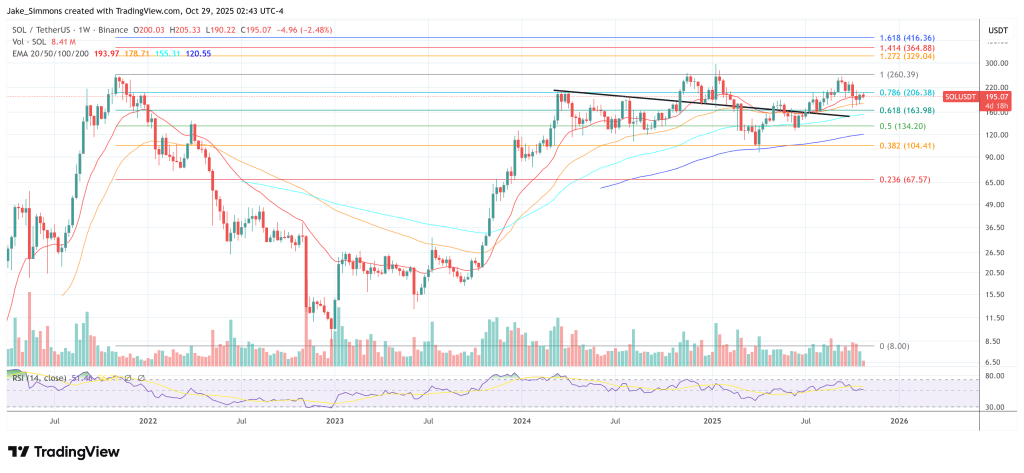
At press time, SOL traded at $195.
Solana price
Solana price remains below the 0.786 Fib, 1-week chart | Source: SOLUSDT on TradingView.com
Featured image created with DALL.E, chart from TradingView.com
Editorial Process for bitcoinist is centered on delivering thoroughly researched, accurate, and unbiased content. We uphold strict sourcing standards, and each page undergoes diligent review by our team of top technology experts and seasoned editors. This process ensures the integrity, relevance, and value of our content for our readers.

Jake Simmons has been a Bitcoin enthusiast since 2016. Ever since he heard about Bitcoin, he has been studying the topic every day and trying to share his knowledge with others. His goal is to contribute to Bitcoin's financial revolution, which will replace the fiat money system. Besides BTC and crypto, Jake studied Business Informatics at a university. After graduation in 2017, he has been working in the blockchain and crypto sector. You can follow Jake on Twitter at @realJakeSimmons.

Похожее

DeFi Has Reached Its Most Dangerous Moment: The Real Vulnerabilities Are Not in the Code

DeFi in Peril: The Real Vulnerability Isn't in the Code April 2026 marked a paradigm shift in DeFi security, with over $625 million lost across 30 incidents—the worst month in crypto history by event count. Crucially, none of the major exploits (Drift Protocol: $285M, KelpDAO: $292M, Wasabi Protocol: $4.5M) resulted from smart contract vulnerabilities. Instead, failures occurred in the operational "plumbing": social engineering to compromise multi-signature councils, a single-point-of-failure 1-of-1 bridge validator, and stolen admin private keys. These events expose a fundamental misalignment: the industry's security model has long focused on code audits, while the actual attack surface has shifted to privileged access points and off-chain infrastructure. The article introduces the term "OpenFi" to describe this reality: permissionless, on-chain, yet operationally dependent on trusted third parties (admins, validators, oracles) at key junctures. The KelpDAO exploit vividly demonstrated asymmetric "contagion risk." A configuration error in a smaller protocol triggered a panic, causing approximately $13.2 billion in outflows from larger, unaffected protocols like Aave within 48 hours, as users fled uncertain collateral. The core dilemma is the double-edged sword of centralization. Operational levers like emergency councils (e.g., Arbitrum freezing stolen funds post-KelpDAO) enable crisis response but also create catastrophic attack surfaces if compromised (e.g., Drift). The path forward demands radical honesty: protocols must clearly disclose their trust assumptions, operational levers, and failure modes. The industry must treat operational security (key management, configurations, incident response) with the same rigor as code security. Survival depends on building systems whose risks can be understood, priced, and insured, moving beyond the outdated "code is law" mantra to a mature model of disclosed and managed trust.

链捕手7 ч. назад

DeFi Has Reached Its Most Dangerous Moment: The Real Vulnerabilities Are Not in the Code

链捕手7 ч. назад

Vitalik's Article Emphasizes Ethereum Must Be 'Amazing', But Foundation Is Not the Center

Vitalik Buterin has published a lengthy response to recent community criticism directed at the Ethereum Foundation (EF). Acknowledging a sense of "unease," he addresses concerns about the EF's strategic direction, its perceived disconnect from ETH's price performance, and calls for its reduced central role. Vitalik rejects the notion that the EF should be the central governing body of Ethereum, framing it instead as one "node with a clear mandate" among many within the ecosystem. He highlights the EF's limited ETH holdings (≈0.16% of supply) compared to other blockchain foundations and states it will no longer sell significant amounts of ETH. Its future focus will be on long-term, critical projects that align with Ethereum's core values of censorship-resistance and decentralization, which might not otherwise happen. A core argument is that Ethereum must be "amazing," but not by merely chasing higher transaction speeds at the cost of decentralization. He proposes focusing on the "CROPS" dimensions: creating a Cryptographically provable, Reliable, Open, Private, and Secure network. This includes pursuing goals like a formally verifiable, bug-free Ethereum client and minimizing protocol-level reliance on intermediaries. The article concludes by noting that while Vitalik clarifies the EF's refocused role, he does not directly address community suggestions for creating a new organization explicitly aligned with ETH's economic interests. This "alignment gap" is presented as a key challenge for Ethereum's future.

链捕手7 ч. назад

Vitalik's Article Emphasizes Ethereum Must Be 'Amazing', But Foundation Is Not the Center

链捕手7 ч. назад

Galxe: How a Quest Platform Evolved into Web3's Growth Infrastructure

Galxe, once perceived as a simple Web3 quest platform, has evolved into a core growth infrastructure within the Web3 ecosystem. It addresses a fundamental Web3 growth dilemma: the lack of a mature, systematic user acquisition and retention system akin to Web2's advertising and analytics platforms. While users complete quests (social tasks, on-chain interactions) for rewards, Galxe's true innovation lies in transforming these fragmented, one-off actions into lasting, verifiable identity credentials. This process of *behavioral assetization* creates a persistent record of a user's activities across projects and chains. For users, their wallet accumulates a valuable history that can unlock future access and rewards, fostering a "profile-building" mentality. For projects, Galxe provides a pre-screened user pool with rich behavioral data, enabling targeted outreach to users based on their specific on-chain history and community engagement. Galxe employs a gamefied growth path, guiding users from low-friction social tasks into deeper, valuable on-chain interactions through a structured progression of quests. This solves the incentive-behavior mismatch common in Web3, filtering users by their willingness to engage. Beyond quests, products like Passport (identity verification) and Starboard (community analytics) position Galxe as a comprehensive growth operating system. The platform's defensible advantage is its self-reinforcing data and network flywheel: more projects attract more users, enriching behavioral data; richer data enables better user targeting, attracting more projects. Ultimately, Galxe is shifting Web3's growth logic from short-term "reward-driven" traffic towards a long-term "identity-driven" relationship model, where a user's accumulated on-chain履历 becomes a core asset.

marsbit7 ч. назад

Galxe: How a Quest Platform Evolved into Web3's Growth Infrastructure

marsbit7 ч. назад

Торговля

Спот
Фьючерсы

Популярные статьи

Обсуждения

Добро пожаловать в Сообщество HTX. Здесь вы сможете быть в курсе последних новостей о развитии платформы и получить доступ к профессиональной аналитической информации о рынке. Мнения пользователей о цене на SOL (SOL) представлены ниже.

活动图片