Why Solana, Not XRP, Just Won The Spot ETF Race, Multicoin’s Counsel Explains

bitcoinistОпубликовано 2025-10-28Обновлено 2025-10-28

Введение

The path cleared for Solana to list a spot ETF in the US on Tuesday, while XRP remains on the...

Trusted Editorial content, reviewed by leading industry experts and seasoned editors. Ad Disclosure

The path cleared for Solana to list a spot ETF in the US on Tuesday, while XRP remains on the sidelines, and the decisive factor was not market cap or politics but mechanics. In a late-night breakdown, Multicoin Capital’s general counsel Greg Xethalis mapped the five boxes an issuer must tick to launch during an SEC shutdown—and why Bitwise and Canary were in position to move while (by extension) XRP issuers were not.

“To launch, you need: ‘33 Act — Effective Registration Statement on Form S-1. ‘34 Act — 19b-4 Approval (obviated by CBTS Generic Listing Standards), Trading Rules Letter (obviated by GLS), Filed Registration Statement on Form 8-A. The 5th is an Exchange has to be willing to certify your 8-A and actually let you launch,” he wrote, adding, “as a 15-year exotic ETP lawyer, I can tell you this is a little uncharted waters.”

Here’s Why Solana Is Listing Today And XRP Isn’t

The uncharted part is the interplay between Section 8(a) of the 1933 Act—which allows an S-1 to become effective automatically 20 days after filing if the issuer does not include a delaying amendment—and the willingness of exchanges to rely on that auto-effectiveness during a period when the SEC staff is not accelerating registrations.

He underscored the normal practice: “To keep an S-1 from going auto-effective, issuers file what’s called a delaying amendment that prevents the S-1 from going auto-effective and allows the SEC to decide when to accelerate effectiveness.” In ’40 Act ETF land, he added, “this is the frustrating BXT amendment filing, but in 1933 Act land, you just say ‘don’t take this effective’.”

The strategic break came when Bitwise flipped that convention. “On Oct 8, Bitwise was the first to file SOL without a delaying amendment,” Xethalis wrote. “Their filing was complete with comments all done & an auto-effective date of Oct 27 5PM.” With the statutory timer running, the final uncertainty shifted from law to market practice. “But then came the waiting game. Would the exchanges list products that were not taken effective through SEC acceleration. This is not a legal question — these products are fully legally processed — it’s a question of practice and norms.”

Exchanges answered with action. “The NYSE has determined that they are pleased to list Bitwise Staking Solana ETF, and the NASDAQ is doing the same for Canary Litecoin and Canary HBAR,” Xethalis reported. “As a result, BSOL will trade on NYSE tomorrow and LTCC and HBR will trade on NASDAQ.”

That single paragraph collapses months of speculation about whether generic listing standards truly obviate individualized rule filings for commodity-based digital asset trusts and whether an auto-effective S-1, paired with a Form 8-A, is sufficient to list in the absence of staff acceleration. In Xethalis’s telling, the answer is yes, so long as an exchange is willing to “certify your 8-A and actually let you launch.”

The same logic explains why Solana is first across the line while XRP remains in the queue. Xethalis does not cast this as a merits determination on either asset. It is sequencing and completeness. Bitwise’s Solana trust had cleared comments and deliberately avoided a delaying amendment, starting the 20-day clock, then met the ’34 Act requirements and secured an exchange willing to certify and list.

Parallel efforts tied to XRP have not hit the same alignment. He notes that “Grayscale Solana Trust filed an S-1 that will go effective tomorrow night, but they haven’t yet filed an 8-A and may not be ready to go on Wednesday as they don’t have the 8-A related checks.”

The point generalizes to XRP: without the Form 8-A and an exchange prepared to certify and post a listing notice, an otherwise effective S-1 remains a necessary but insufficient condition for trading, and without removing the delaying amendment and letting the 20-day clock run on a final, comment-cleared document, there is no auto-effectiveness to begin with.

Xethalis also clarifies the backdrop that made any of this feasible. In his earlier breakdown he reminded readers that for a host of spot products—he lists Litecoin, Solana, XRP, BCH, AVAX and others—“19b-4 [deadlines] were obviated by [the] CBTS Generic Listing Standards (GLS).”

That change removes the bespoke rule-change bottleneck that historically governed whether an exchange could list a new commodity-based ETP. It does not negate the rest of the process; it simply moves the gating items to the issuer’s S-1 posture, the 8-A registration of the class, and the exchange’s listing certification under its now-generic standard. In short, once GLS exists, execution becomes a choreography problem. Bitwise and Canary hit their marks first; their products go live first.

The upshot is that Solana, not XRP, “won the race” this week because its issuer embraced auto-effectiveness at the right moment, finished the SEC dialogue in time to make the 20-day window meaningful, and had an exchange ready to certify and list. XRP’s status is not foreclosed by policy or politics in Xethalis’s account; it is a matter of the fifth checkmark being in place alongside the others.

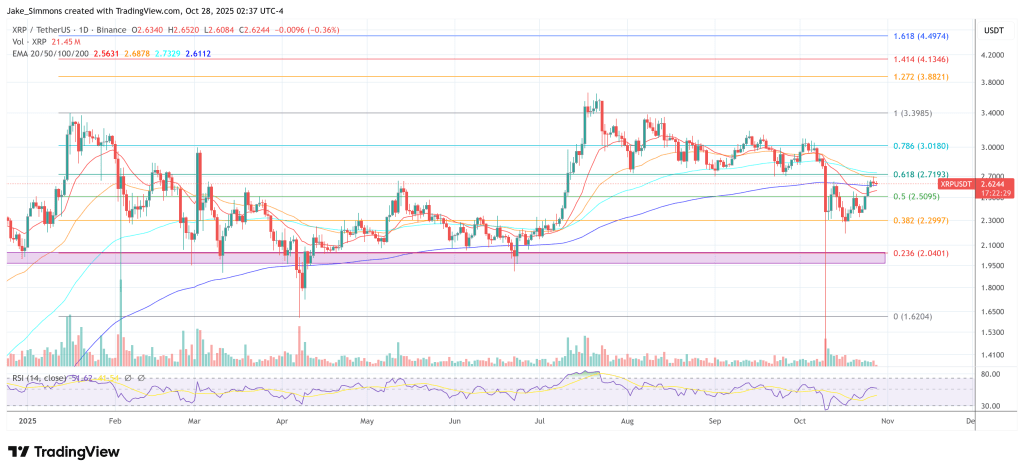
At press time, XRP traded at $2.62.
XRP price
XRP faces the 0.618 Fib, 1-day chart | Source: XRPUSDT on TradingView.com
Featured image created with DALL.E, chart from TradingView.com
Editorial Process for bitcoinist is centered on delivering thoroughly researched, accurate, and unbiased content. We uphold strict sourcing standards, and each page undergoes diligent review by our team of top technology experts and seasoned editors. This process ensures the integrity, relevance, and value of our content for our readers.

Jake Simmons has been a Bitcoin enthusiast since 2016. Ever since he heard about Bitcoin, he has been studying the topic every day and trying to share his knowledge with others. His goal is to contribute to Bitcoin's financial revolution, which will replace the fiat money system. Besides BTC and crypto, Jake studied Business Informatics at a university. After graduation in 2017, he has been working in the blockchain and crypto sector. You can follow Jake on Twitter at @realJakeSimmons.

Похожее

On-chain Analyst: Why Are Most Zcash Transactions Still Traceable?

Title: Why Most Zcash Transactions Remain Traceable Zcash, a privacy-focused cryptocurrency launched in 2016, was designed to offer anonymity by hiding transaction details like sender, receiver, and amount using zero-knowledge proof technology (zk-SNARKs). However, in practice, a significant portion of ZEC transactions are still traceable on-chain. The key reason is Zcash's dual-address system. It features transparent addresses (t-addresses), which work like standard Bitcoin addresses with all data public, and shielded addresses (z-addresses) that encrypt transaction details. There are four transaction types with varying privacy levels: fully transparent (t→t), partially shielded (t→z and z→t), and fully private (z→z). Despite its privacy capabilities, most real-world Zcash activity involves transparent addresses, primarily because major exchanges and institutions use them for regulatory compliance. As a result, blockchain analytics platforms like Arkham can track and attribute a substantial volume of Zcash transactions. Arkham reports it has identified entities behind over $420 billion in ZEC transaction volume. Case studies highlight this traceability: the U.S. government holds seized Zcash from a dark web case, visible via its transparent wallet, and individual traders' profitable moves are trackable from purchase to exchange deposit. In conclusion, Zcash's privacy is not inherent but user-dependent. While purely shielded (z→z) transactions remain cryptographically private, the prevalence of transparent address usage makes much of the network's activity traceable. The actual privacy protection offered depends entirely on how users choose to transact.

marsbit37 мин. назад

On-chain Analyst: Why Are Most Zcash Transactions Still Traceable?

marsbit37 мин. назад

From Power Infrastructure to Token Economy: The 'Seven-Layer Cake' of the AI Industry Chain

From Power Grid to Token Economy: The AI Industry's "Seven-Layer Cake" The AI industry is shifting from a "model-centric" paradigm focused on massive training to a "token-centric" industrial era driven by inference demand. This new phase revolves around the production, distribution, scheduling, and consumption of tokens—the units of computation used by AI agents for every interaction and task. The article proposes a "seven-layer cake" framework for the AI economy: 1. **Power**: The foundational energy source, with competition shifting to securing stable, low-cost electricity. 2. **AIDC (AI Data Centers)**: Large-scale "Token factories." A trend toward smaller, modular, and regionally deployed AI Factories is emerging for efficiency and proximity to users. 3. **GPU**: The core production hardware for tokens. While NVIDIA dominates, competition exists from AMD, ASIC makers, and Chinese chipmakers, with a growing focus on inference efficiency. 4. **LLMs**: The "engines" that generate tokens. The competition is evolving beyond model size to prioritize factors like token cost, inference efficiency, and operational synergy with infrastructure. 5. **Token Distribution**: The "grid" that allocates and rents out compute resources, led by cloud giants and specialized AI-native platforms. 6. **Token Optimization & Intelligent Scheduling**: The critical "brain" layer that intelligently routes tasks (e.g., to local, cloud, or edge models) for optimal cost, latency, and privacy—maximizing the value of each token. 7. **AI Agents & Models**: The end consumers of tokens. The vision involves billions of AI agents working and interacting concurrently, consuming vast amounts of tokens. Currently, the industry faces fragmentation and inefficiencies between these layers. The true "mass adoption era" of AI will begin only when this seven-layer infrastructure is fully integrated and operates as a cohesive, intelligent network—transforming AI from a software tool into a global industrial system spanning energy, hardware, and compute logistics.

marsbit58 мин. назад

From Power Infrastructure to Token Economy: The 'Seven-Layer Cake' of the AI Industry Chain

marsbit58 мин. назад

Semiconductors up 78% annually, software down 12% annually: The 'Liquidity Siphon' is playing out within tech stocks

Semiconductor ETFs like SOXX have surged 78.5% year-to-date, while software ETFs like IGV have dropped 12.5%, creating a record performance gap exceeding 90 percentage points. This reflects a major "liquidity suction" within tech stocks, with capital flooding into semiconductors as software faces selling pressure. Driving the semiconductor boom are staggering capital expenditure plans from hyperscalers like Microsoft, Alphabet, Amazon, and Meta, whose combined 2026 capex is projected near $700 billion. This fuels demand for chips, with companies like SanDisk (up 426%), Intel (up 222%), and Micron (up 154%) leading the S&P 500. In contrast, major software firms like Microsoft, Adobe, and Salesforce are all down over 17% year-to-date. The software sector faces a dual challenge: capital is being redirected to semiconductors, and the rise of AI agents like Claude Code threatens traditional SaaS business models, triggering a narrative of AI displacement. Key unanswered questions remain: How long can hyperscalers sustain their massive capex, given potential free cash flow pressures? And will capital eventually rotate back into the deeply oversold software sector? While some analysts warn of a potential semiconductor bubble akin to the dot-com era, the sector's powerful momentum continues, making market timing exceptionally difficult.

marsbit58 мин. назад

Semiconductors up 78% annually, software down 12% annually: The 'Liquidity Siphon' is playing out within tech stocks

marsbit58 мин. назад

Торговля

Спот
Фьючерсы

Популярные статьи

Как купить S

Добро пожаловать на HTX.com! Мы сделали приобретение Sonic (S) простым и удобным. Следуйте нашему пошаговому руководству и отправляйтесь в свое крипто-путешествие.Шаг 1: Создайте аккаунт на HTXИспользуйте свой адрес электронной почты или номер телефона, чтобы зарегистрироваться и бесплатно создать аккаунт на HTX. Пройдите удобную регистрацию и откройте для себя весь функционал.Создать аккаунтШаг 2: Перейдите в Купить криптовалюту и выберите свой способ оплатыКредитная/Дебетовая Карта: Используйте свою карту Visa или Mastercard для мгновенной покупки Sonic (S).Баланс: Используйте средства с баланса вашего аккаунта HTX для простой торговли.Третьи Лица: Мы добавили популярные способы оплаты, такие как Google Pay и Apple Pay, для повышения удобства.P2P: Торгуйте напрямую с другими пользователями на HTX.Внебиржевая Торговля (OTC): Мы предлагаем индивидуальные услуги и конкурентоспособные обменные курсы для трейдеров.Шаг 3: Хранение Sonic (S)После приобретения вами Sonic (S) храните их в своем аккаунте на HTX. В качестве альтернативы вы можете отправить их куда-либо с помощью перевода в блокчейне или использовать для торговли с другими криптовалютами.Шаг 4: Торговля Sonic (S)С легкостью торгуйте Sonic (S) на спотовом рынке HTX. Просто зайдите в свой аккаунт, выберите торговую пару, совершайте сделки и следите за ними в режиме реального времени. Мы предлагаем удобный интерфейс как для начинающих, так и для опытных трейдеров.

1.4k просмотров всегоОпубликовано 2025.01.15Обновлено 2025.03.21

Как купить S

Sonic: Обновления под руководством Андре Кронье – новая звезда Layer-1 на фоне спада рынка

Он решает проблемы масштабируемости, совместимости между блокчейнами и стимулов для разработчиков с помощью технологических инноваций.

2.3k просмотров всегоОпубликовано 2025.04.09Обновлено 2025.04.09

Sonic: Обновления под руководством Андре Кронье – новая звезда Layer-1 на фоне спада рынка

HTX Learn: Пройдите обучение по "Sonic" и разделите 1000 USDT

HTX Learn — ваш проводник в мир перспективных проектов, и мы запускаем специальное мероприятие "Учитесь и Зарабатывайте", посвящённое этим проектам. Наше новое направление .

1.8k просмотров всегоОпубликовано 2025.04.10Обновлено 2025.04.10

HTX Learn: Пройдите обучение по "Sonic" и разделите 1000 USDT

Обсуждения

Добро пожаловать в Сообщество HTX. Здесь вы сможете быть в курсе последних новостей о развитии платформы и получить доступ к профессиональной аналитической информации о рынке. Мнения пользователей о цене на S (S) представлены ниже.

活动图片