30% of Ethereum Supply Now Locked as Whales Accumulate Amid ETH Price Weakness

bitcoinistОпубликовано 2026-02-13Обновлено 2026-02-13

Введение

Approximately 30% of Ethereum's total supply is now locked in staking contracts, reaching a record high in the proof-of-stake ecosystem. Despite recent ETH price weakness, with values trading below $2,000, staking activity continues to rise, with 36.6 million ETH currently staked. This trend is largely driven by institutional and whale accumulation, effectively reducing liquid supply. The locked supply may constrain immediate selling pressure and could amplify future price movements if demand increases. Analysts note that this structural shift, combined with ongoing accumulation, might set the stage for a new phase in Ethereum’s market cycle despite current price challenges.

Ethereum’s network dynamics are shifting in a way that could reshape its market structure. On-chain data shows that roughly 30% of all Ethereum (ETH) supply is now locked in staking contracts, marking a record high for the protocol’s proof-of-stake ecosystem.

Related Reading: Bitcoin Is ‘No Longer Digital Gold,’ Deutsche Bank Strategist Says

Even as ETH prices have struggled, trading below the $2,000 level in recent sessions, activity around staking continues to rise. According to analytics data, about 36.6 million ETH is currently staked, meaning a significant portion of the circulating supply is effectively removed from liquid markets.

The increase in staked supply appears to be driven in part by institutional and whale accumulation. Large entities such as BitMine and others have been adding to their staked holdings, while smaller wallets have also shown interest in locking up ETH for validator rewards.
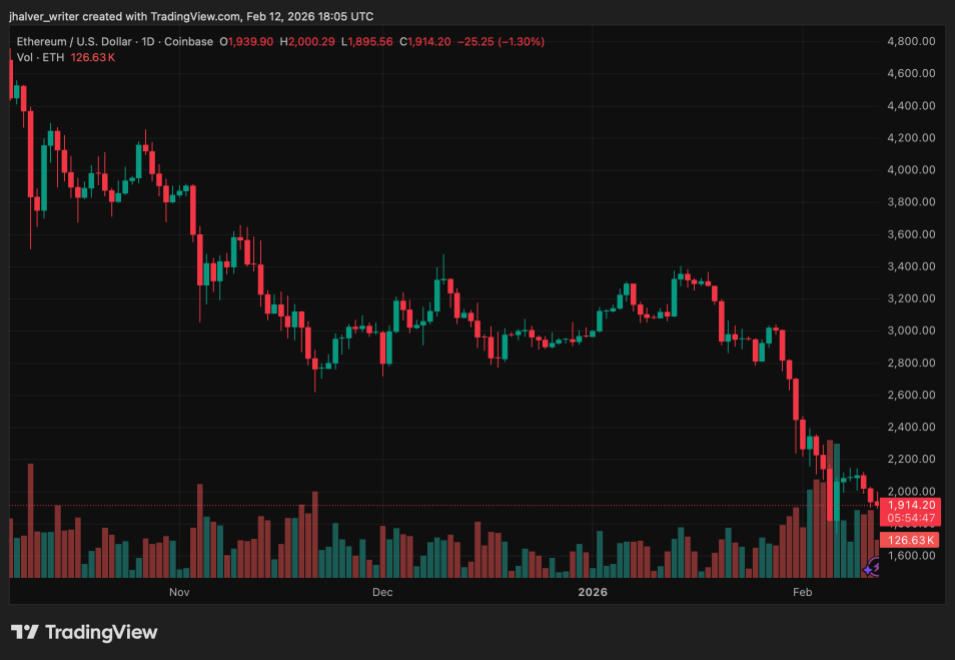
ETH's price trends to the downside on the daily chart. Source: ETHUSD chart on Tradingview

Ethereum Staking Demand and Supply Impact

The record staking ratio, now above 30% of total supply, shows a structural change in Ethereum’s supply dynamics. Validators locking ETH must commit to long lead times before withdrawing, and the current exit queue remains minimal relative to new stakes.

From a liquidity perspective, staking removes tens of billions of dollars worth of ETH from active circulation. Reduced liquidity could amplify price moves if demand resurges, but it also raises questions about near-term volatility amid current macroeconomic conditions and broader crypto market pressures.

Recent price weakness has seen ETH trade below key support levels, with analysts noting a mix of technical vulnerability and potential for renewed accumulation at lower levels.

Whale behavior also underscores this theme. On-chain metrics show that larger holders have been modifying their exposure, with some reducing reserves while others increase positions, particularly via staking channels that minimize selling pressure.

Market Outlook on ETH Price Amid Locked Supply

Ethereum’s price action remains sensitive to broader market drivers, including macroeconomic data and liquidity flows within the crypto sector. However, the growing share of staked ETH alters the supply picture: with nearly one-third of tokens locked, immediate sell pressure may be constrained.

Analysts suggest that this supply tightening, combined with whale accumulation, could play a significant role in price behavior if market sentiment shifts.

Related Reading: Bitcoin Buying Spree May Continue With New Preferred Stock Plan: Strategy CEO

The convergence of record staking levels and targeted accumulation creates a backdrop in which Ethereum’s fundamental network engagement strengthens even as prices lag, setting the stage for a potentially different phase in the asset’s market cycle.

Cover image from ChatGPT, ETHUSD chart on Tradingview

Связанные с этим вопросы

QWhat percentage of Ethereum's total supply is currently locked in staking contracts?

AApproximately 30% of Ethereum's total supply is currently locked in staking contracts, marking a record high for the protocol.

QHow much ETH is currently staked according to the analytics data mentioned?

AAbout 36.6 million ETH is currently staked according to the analytics data.

QWhat are two major factors driving the increase in staked ETH supply?

AThe increase is driven by institutional and whale accumulation, with large entities like BitMine adding to their staked holdings, and smaller wallets showing interest in validator rewards.

QHow does staking ETH impact market liquidity and potential price movements?

AStaking removes tens of billions of dollars worth of ETH from active circulation, which could amplify price moves if demand resurges but also raises questions about near-term volatility.

QWhat potential effect does the record staking level combined with whale accumulation have on ETH's price behavior?

AThe supply tightening combined with whale accumulation could play a significant role in price behavior if market sentiment shifts, potentially setting the stage for a different phase in Ethereum's market cycle.

Похожее

Telegram Takes Direct Control of TON, Social Traffic Reshapes Public Chain Narrative

Telegram's founder, Pavel Durov, has announced a major shift in the development of The Open Network (TON). Telegram will now become the core driver of TON, replacing the TON Foundation and becoming its largest validator. The focus will be on technical upgrades over the next few weeks, including slashing network fees by six times to near-zero and improving finality time to 0.6 seconds. This move signifies a deeper integration between Telegram and TON, moving beyond just providing a user base. The goal is to transform Telegram's vast social traffic and built-in features—like Mini Apps, payments, and bots—into sustainable, on-chain usage scenarios. The reduced fees and faster speeds are crucial for enabling the small, frequent transactions typical of social interactions. While this promises stronger execution and product alignment, it raises questions about centralization. Durov argues Telegram's involvement will attract more validators, enhancing decentralization, but the outcome remains to be seen. Additionally, TON's high annual staking reward of 18.8% aims to retain capital within the ecosystem. The key challenge for TON is no longer just leveraging Telegram's entry point, but becoming an invisible, seamless infrastructure layer within Telegram's daily use. Its success hinges on converting viral attention into lasting, embedded utility.

Odaily星球日报9 мин. назад

Telegram Takes Direct Control of TON, Social Traffic Reshapes Public Chain Narrative

Odaily星球日报9 мин. назад

OpenAI Post-Training Engineer Weng Jiayi Proposes a New Paradigm Hypothesis for Agentic AI

OpenAI engineer Weng Jiayi's "Heuristic Learning" experiments propose a new paradigm for Agentic AI, suggesting that intelligent agents can improve not just by training neural networks, but also by autonomously writing and refining code based on environmental feedback. In the experiment, a coding agent (powered by Codex) was tasked with developing and maintaining a programmatic strategy for the Atari game Breakout. Starting from a basic prompt, the agent iteratively wrote code, ran the game, analyzed logs and video replays to identify failures, and then modified the code. Through this engineering loop of "code-run-debug-update," it evolved a pure Python heuristic strategy that achieved a perfect score of 864 in Breakout and performed competitively with deep reinforcement learning (RL) algorithms in MuJoCo control tasks like Ant and HalfCheetah. This approach, termed Heuristic Learning (HL), contrasts with Deep RL. In HL, experience is captured in readable, modifiable code, tests, logs, and configurations—a software system—rather than being encoded solely into opaque neural network weights. This offers potential advantages in explainability, auditability for safety-critical applications, easier integration of regression tests to combat catastrophic forgetting, and more efficient sample use in early learning stages, as demonstrated in broader tests on 57 Atari games. However, the blog acknowledges clear limitations. Programmatic strategies struggle with tasks requiring long-horizon planning or complex perception (e.g., Montezuma's Revenge), areas where neural networks excel. The future vision is a hybrid architecture: specialized neural networks for fast perception (System 1), HL systems for rules, safety, and local recovery (also System 1), and LLM agents providing high-level feedback and learning from the HL system's data (System 2). The core proposition is that in the era of capable coding agents, a significant portion of an AI's learned experience could be maintained as an auditable, evolving software system.

marsbit1 ч. назад

OpenAI Post-Training Engineer Weng Jiayi Proposes a New Paradigm Hypothesis for Agentic AI

marsbit1 ч. назад

Your Claude Will Dream Tonight, Don't Disturb It

This article explores the recent phenomenon of AI companies increasingly using anthropomorphic language—like "thinking," "memory," "hallucination," and now "dreaming"—to describe machine learning processes. Focusing on Anthropic's newly announced "Dreaming" feature for its Claude Agent platform, the piece explains that this function is essentially an automated, offline batch processing of an agent's operational logs. It analyzes past task sessions to identify patterns, optimize future actions, and consolidate learnings into a persistent memory system, akin to a form of reinforcement learning and self-correction. The article draws parallels to similar features in other AI agent systems like Hermes Agent and OpenClaw, which also implement mechanisms for reviewing historical data, extracting reusable "skills," and strengthening long-term memory. It notes a key difference from human dreaming: these AI "dreams" still consume computational resources and user tokens. Further context is provided by discussing the technical challenges of managing AI "memory" or context, highlighting the computational expense of large context windows and innovations like Subquadratic's new model claiming drastically longer contexts. The core critique argues that this strategic use of human-centric vocabulary does more than market products; it subtly reshapes user perception. By framing algorithms with terms associated with consciousness, companies blur the line between tool and autonomous entity. This linguistic shift can influence user expectations, tolerance for errors, and even perceptions of responsibility when systems fail, potentially diverting scrutiny from the companies and engineers behind the technology. The article concludes by speculating that terms like "daydreaming" for predictive task simulation might be next, continuing this trend of embedding the idea of an "inner life" into computational processes.

marsbit1 ч. назад

Your Claude Will Dream Tonight, Don't Disturb It

marsbit1 ч. назад

Торговля

Спот
Фьючерсы

Популярные статьи

Manyu: восходящая мем-звезда на Ethereum, готовая открыть новую эру культуры Shiba

Manyu - это мемтокен на Ethereum, который приносит децентрализованную культурную и развлекательную ценность через вирусное влияние в соцсетях и вовлечённость сообщества.

1.9k просмотров всегоОпубликовано 2025.11.27Обновлено 2025.11.27

Manyu: восходящая мем-звезда на Ethereum, готовая открыть новую эру культуры Shiba

Неделя обучения по популярным токенам 14: Glamsterdam — самое ожидаемое обновление Ethereum в 2026 году

Ordinals/Runes по-прежнему стимулируют доходы от комиссий за блоки и активность разработчиков, рассматриваются как отправная точка «нативной эмиссии активов» в сети.

1.2k просмотров всегоОпубликовано 2026.04.29Обновлено 2026.04.29

Неделя обучения по популярным токенам 14: Glamsterdam — самое ожидаемое обновление Ethereum в 2026 году

Обсуждения

Добро пожаловать в Сообщество HTX. Здесь вы сможете быть в курсе последних новостей о развитии платформы и получить доступ к профессиональной аналитической информации о рынке. Мнения пользователей о цене на ETH (ETH) представлены ниже.

活动图片