2026 Opening with Millions in Profit: 'God of War' Vida Reviews the Entire Trading Process of the BROCCOLI714 Incident

比推Опубликовано 2026-01-01Обновлено 2026-01-01

Введение

In January 2026, crypto trader Vida profited over $1 million during the BROCCOLI714 incident, which involved a suspected hacked market maker account on Binance. Vida’s pre-existing $200,000 long position in BROCCOLI714 and a $500,000 funding rate arbitrage position were already in place. Alert systems triggered when the token’s price surged abnormally and a massive spot-contract price gap emerged. Recognizing the order book showed a highly unusual $26 million in buy orders—indicating a hack or system error rather than legitimate market activity—Vida quickly closed his arbitrage positions for a $300,000 gain. He then capitalized on the volatility by adding long positions in Binance perpetual contracts during a brief “reduce-only” lift and later selling his holdings for $1.5 million as signs of the attacker’s withdrawal emerged. Anticipating a crash once Binance risk controls intervened, Vida opened $400,000 in short positions around $0.065 and closed near $0.02, further boosting profits. Key factors included his automated alert systems, real-time order book analysis, collaboration with other traders, and correctly predicting the attacker’s exit strategy.

Vida : Born after 2000, founder of Equation News, skilled in program trading. He has shared stories of making tens of millions of dollars in the crypto market.

Preliminary Context: At 01:23 AM Beijing Time on January 1, 2026, Equation News monitored: A market maker's Binance account was highly suspected to be compromised. The potential attacker was疑似 using approximately $10 million to $20 million from the account to集中 pump the price of the BROCCOLI714-USDT trading pair on the Binance spot market.

Below is the full text by Vida:

《Review: Making $1 Million in the Recent BROCCOLI714 Hack Incident》

Preconditions and Infrastructure:

- I had a long-term accumulated position of $200,000 in BROCCOLI714 at a cost of 0.016, purchased around early November this year. It included both spot and contract holdings. After buying, I was trapped and too afraid to even look at it.

- The market maker's manipulation style in October-November was to rapidly pump the price within a few hours and then immediately dump with a large bearish candle. So, I set up an alert for my small-cap holdings that would wake me up if the price increased by over 30% within 1800 seconds.

- I also had a Binance perpetual contract funding rate arbitrage position for BROCCOLI714USDT with an average entry price of around 0.015 and a size of $500,000.

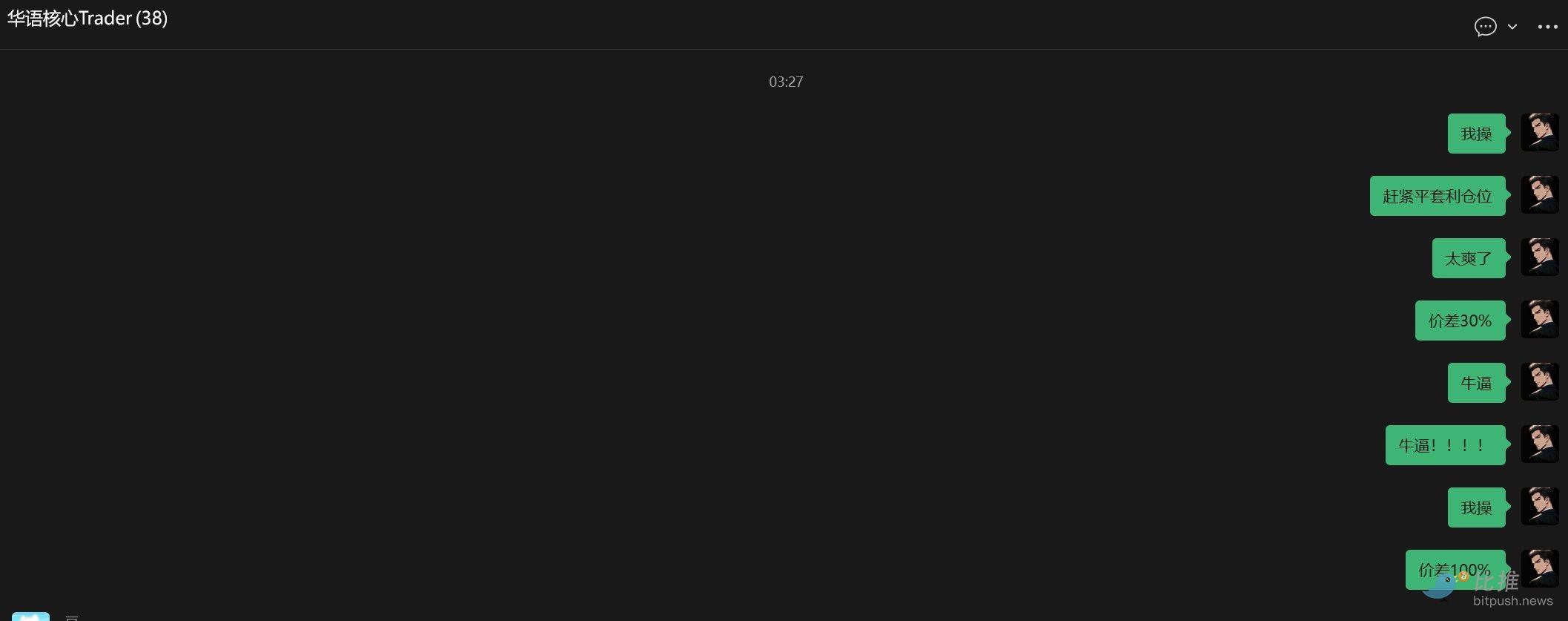
When the huge spot-contract price disparity occurred: My short-term surge alert program and my spot-contract spread alert program were both疯狂 alarming > prompting me to focus fully and rush to my computer to start working.

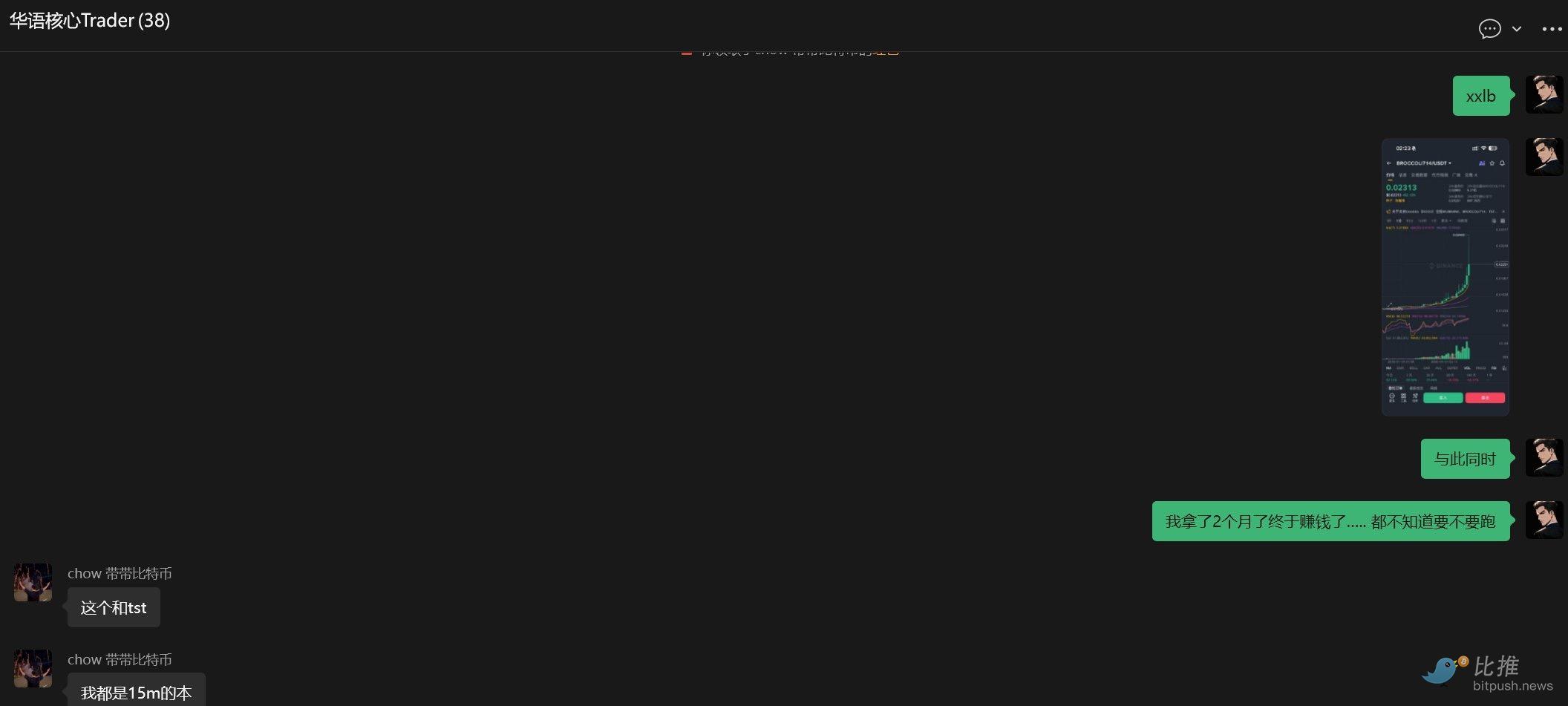
I第一时间 mentioned this situation in a core Chinese group on带带:

- My first reaction was to quickly close my funding rate arbitrage position. Because my original $500,000 arbitrage hedge position had become $800,000 in spot value and $500,000 in contracts. I immediately closed all arbitrage positions to lock in a profit of $300,000.

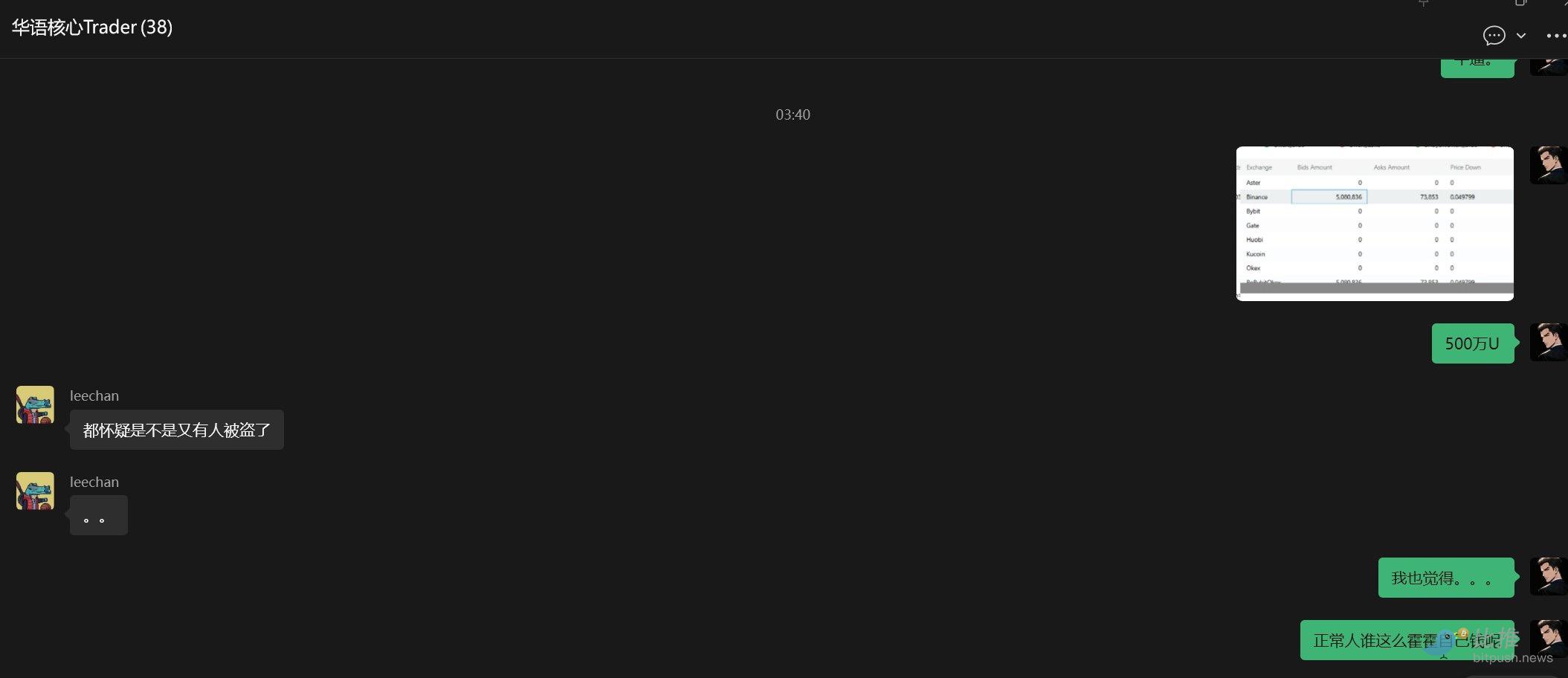
– But upon second thought, it felt very反常 because historically, no market maker would pump the spot market so violently regardless of the spread. I took a look at the order book depth and was震惊 to find that the bid-side 10% depth on Binance spot had $5 million in buy orders, while the contract side's bid 10% depth was only $50,000. Someone suggested a suspected Binance account hack, which I also found reasonable.

– I looked at the order book on the Binance main site again and was shocked to find that for BROCCOLI714, a coin with a market cap of $40m at the time, there were $26 million in bid orders. From this, I inferred that it must be either a hacked account or a market maker program bug, because no market maker would be foolish enough to play charity like this in the spot market.

- Seeing that the hacker had $26 million in ammunition on the spot order book, I knew his goal was to pump the spot market > lift the contract price > exit his position on the contracts.

So I monitored the changes in Binance's order book on one screen. I knew that as long as the hacker didn't withdraw the $20 million in buy orders on the spot market, the price of BROCCOLI714 would keep rising.

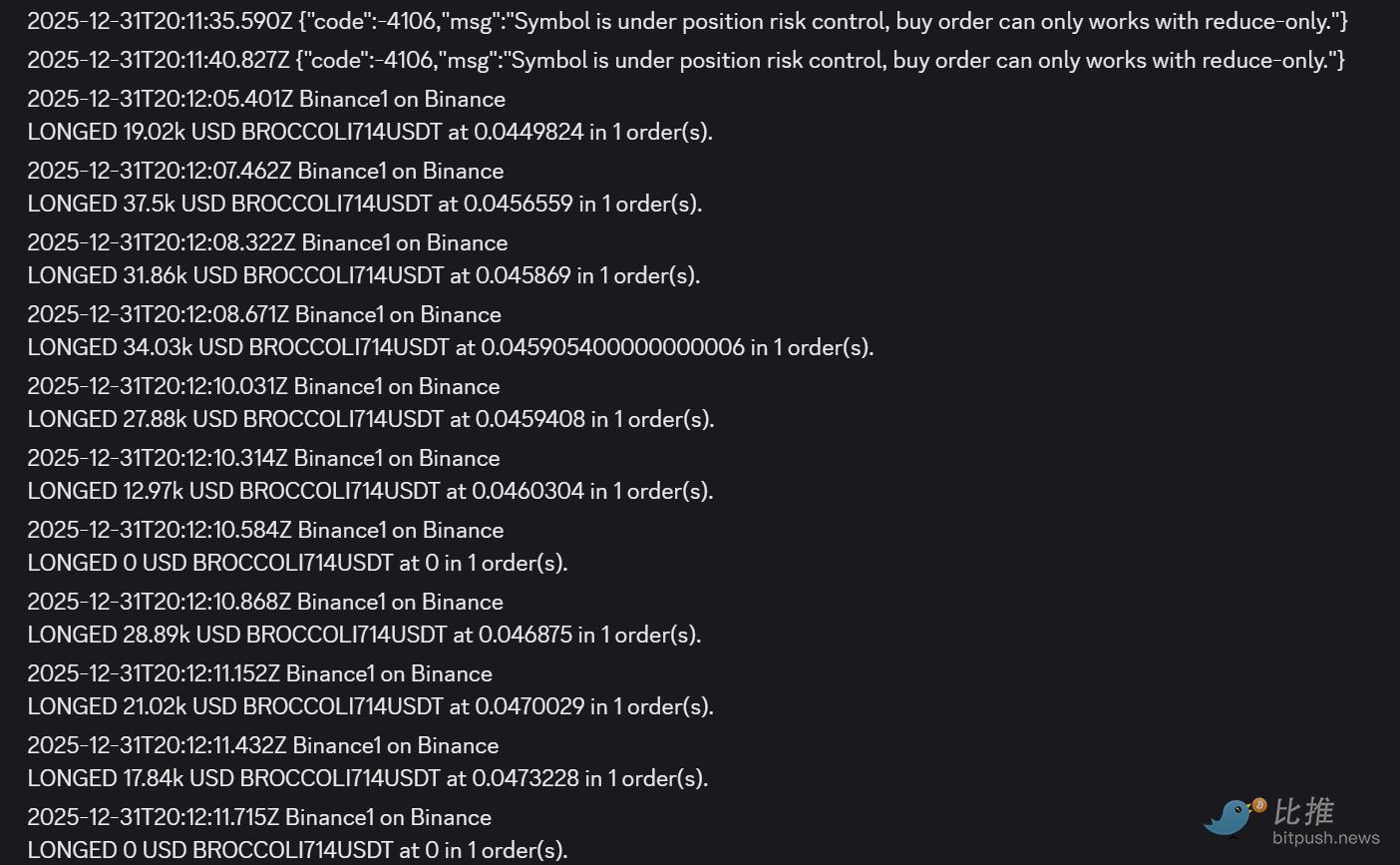
My first thought at this point was to go long on Binance contracts, but I found that the Binance contracts had already triggered the "circuit breaker protection mechanism" (reduce-only mode).

At that time, BROCCOLI spot was already at 0.07, while Binance contracts were capped at 0.038 by the circuit breaker mechanism, and Bybit contracts had risen to 0.055. So I chose to attempt a long position on the Binance BROCCOLI714USDT perpetual contract every 5-10 seconds on my trading terminal. If the order succeeded, it meant the circuit breaker period was over, meaning the Binance contract would pump.

I successfully蹲守到 this opportunity and added approximately $200,000 in long positions at a contract entry cost of 0.046.

- I knew this incident was必然 caused by a hacker or a market maker program bug, and the short-term surge was too high. The final outcome would inevitably be a complete mess.

So I kept watching the Binance spot order book.

The hacker withdrew his orders once midway, leading me to believe he had been sanctioned by Binance's risk control department. So, at Beijing Time 2026-01-01 04:20:52.732, I started using my trading program to疯狂 sell > liquidate all my previously held + later added long BROCCOLI714 spot and contract positions regardless of cost.

My original $200,000 accumulated position + the later added $200,000 roughly cashed out to $1.5 million. (A lot of the original accumulated position was opened in the contract market, so I didn't capture as much premium)

After being scared off by the hacker's withdrawal of buy orders at 4:21, the不讲武德 hacker挂回 the buy orders about 1 minute later and directly pumped the price to 0.15.

But I knew he would eventually be sanctioned by Binance's risk control department. And once his account was risk-controlled > bids withdrawn > broccoli would crash, it was just that the staff might be lazy at 1.1 AM so he hadn't been risk-controlled yet.

So I kept a close eye on the order book.

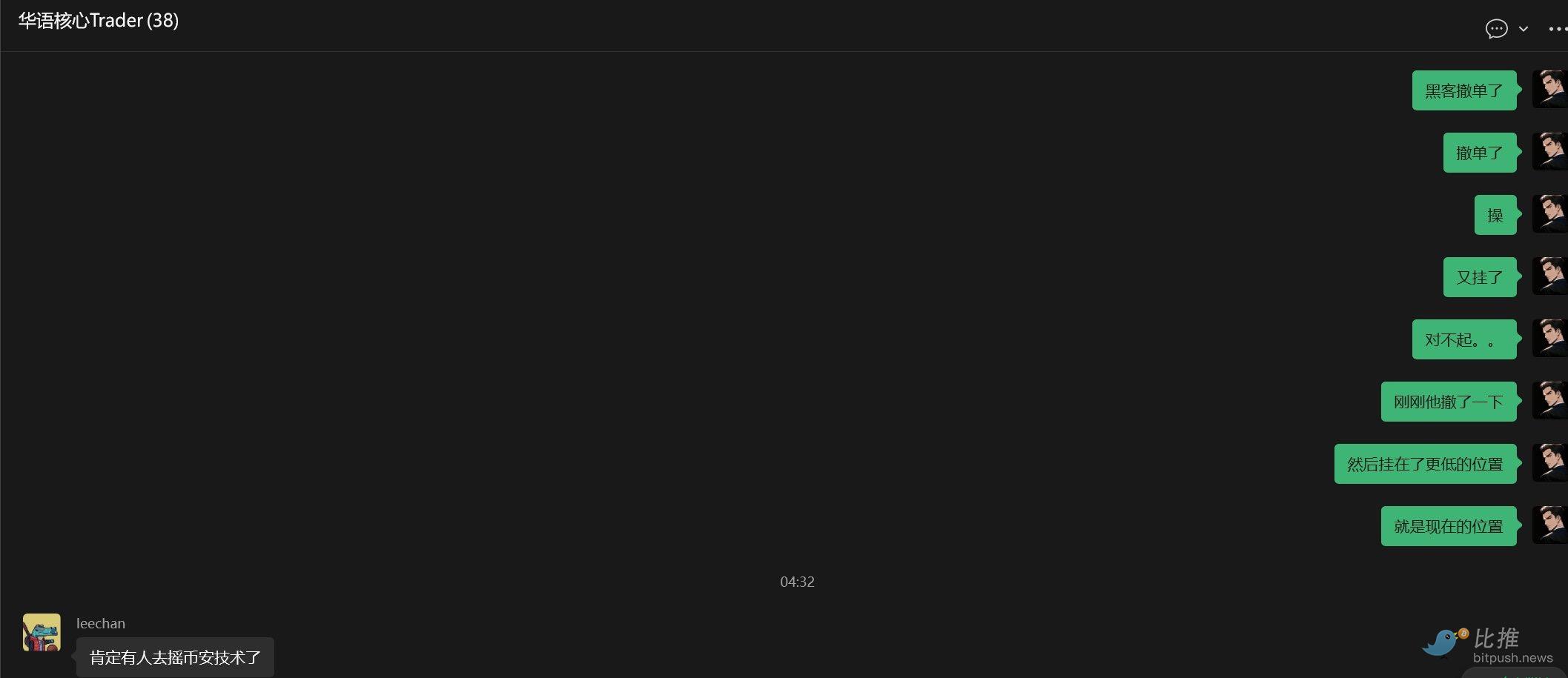
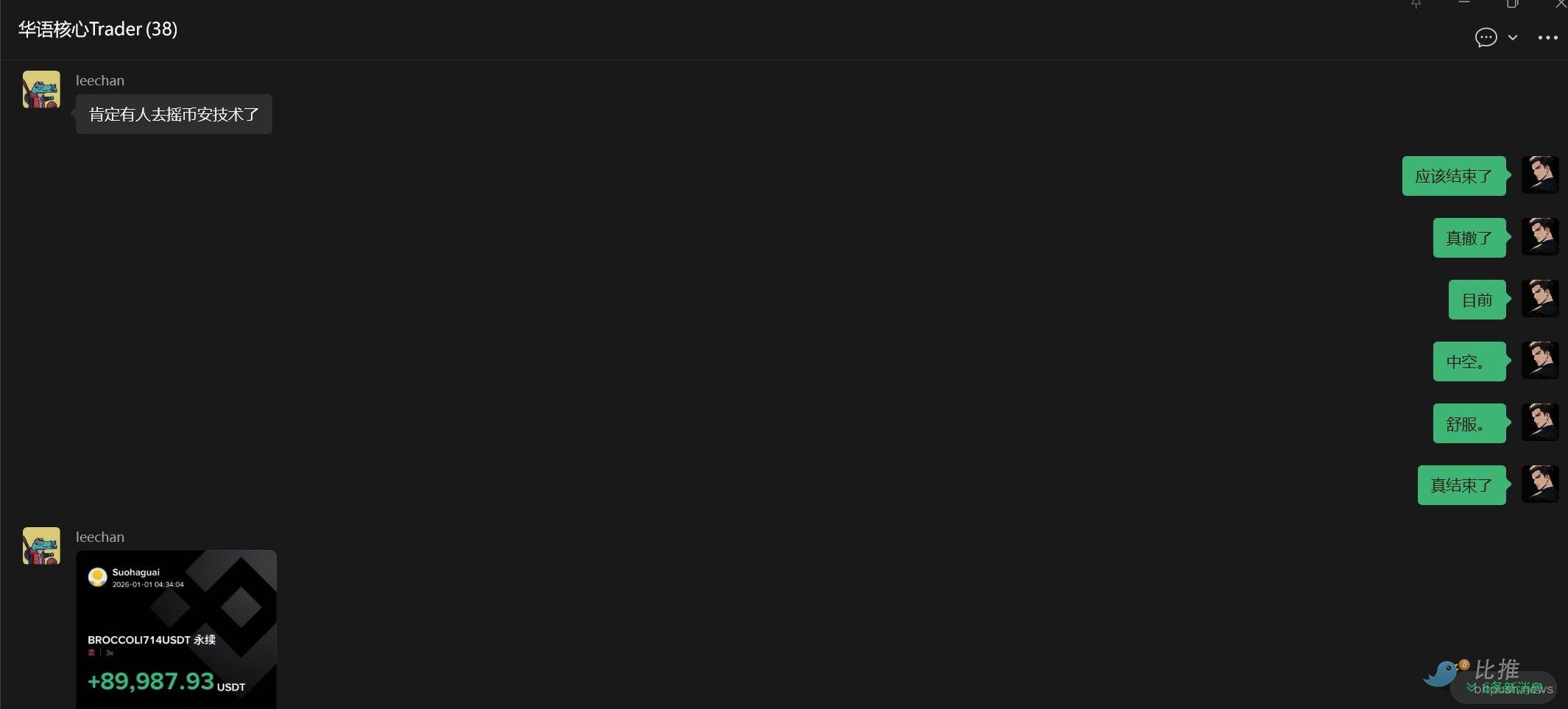
Later, at 4:31, I noticed the hacker really withdrew all the bids. At 4:32, they were completely withdrawn. And this time, they didn't reappear for a long time + group friends said someone probably contacted Binance tech, and he was likely sanctioned.

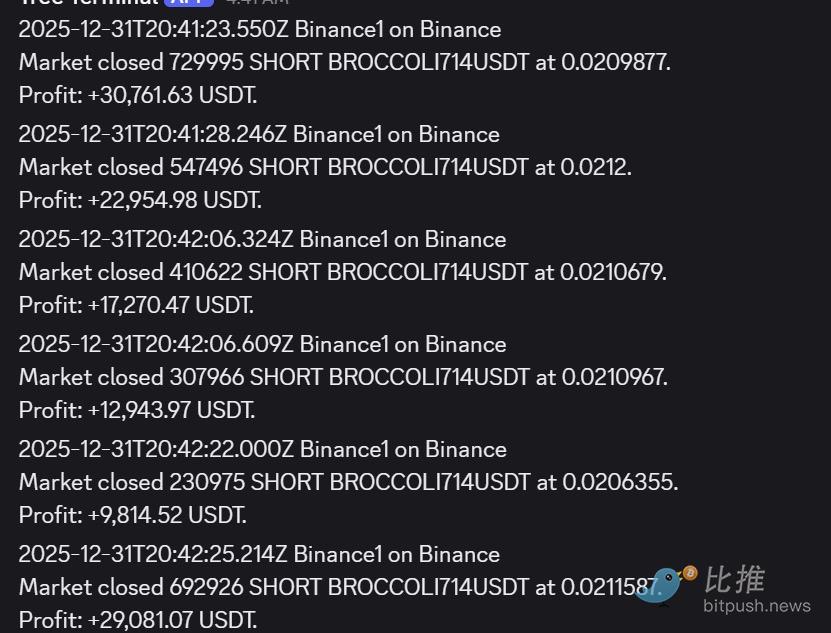
So I started shorting. I opened roughly $400,000 in short positions on Binance contracts at an average cost of around 0.065. The final closing price was approximately 0.02.

Revisiting why I was able to seize this opportunity:

1. Price anomaly alerts for small-cap strategies
- I set up short-term price surge alerts for small-cap strategies. As long as a held small-cap coin experiences an ultra-large price increase in a short time, it triggers a mandatory alert, 100% guaranteed to wake me up. – In the funding rate arbitrage strategy, I also set up monitoring: once a huge spread between spot and contract is detected, it triggers a mandatory alert.

2. Identifying反常 price action and verifying the order book
When I saw clearly反常 price action, the first thing I did was look at the order book to judge how much ammunition the "market maker" actually had. The result: For a coin with only a $30 million market cap, there were $20 million USDT in bids on the Binance spot side. From this, I judged this couldn't be normal market maker manipulation, but more like hacker behavior or a market maker's system bug (no market maker would pump the spot so recklessly and foolishly regardless of cost).

3. Still need to communicate more with experts. Brainstorming among several experts often helps figure out the entire剧本玩法 in the first moment.

4. I was very clear about the second phase玩法:
Wait for the hacker to be sanctioned by Binance's risk control department and withdraw the bid orders, then蹲守 this opportunity to short. So after completing the first phase of selling, I kept staring at the order book, waiting for this opportunity to appear. I waited over ten minutes and really managed to蹲守到 it.

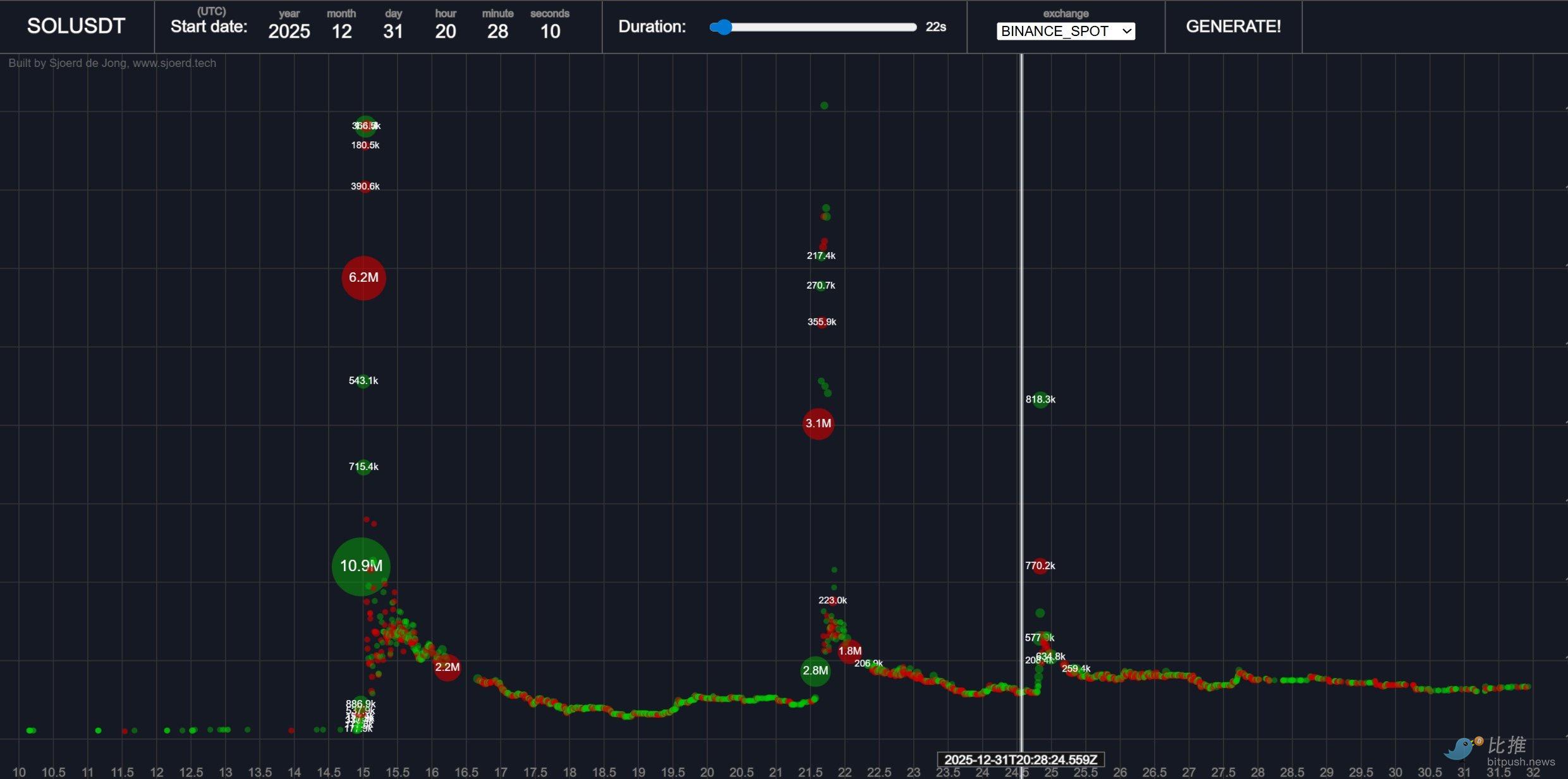
One behavior made me guess the BROCCOLI714 hacker was probably wrapping up, because at Beijing Time 4:28:15, he不计成本 bought SOLUSDT spot, pumping it by about 5% >>> which triggered my pre-set alert again, letting me know.

I guessed that his account might have been partially restricted by Binance from placing new orders in the BROCCOLI714 market, so he狗急跳墙 and bought SOL instead.

结果真的 (Sure enough), 3 minutes later the BROCCOLI price collapsed.


Twitter:https://twitter.com/BitpushNewsCN

Bitpush TG Discussion Group:https://t.me/BitPushCommunity

Bitpush TG Subscription: https://t.me/bitpush

Original article link:https://www.bitpush.news/articles/7599510

Связанные с этим вопросы

QWhat was the initial position and cost basis of Vida's long-term BROCCOLI714 holdings?

AVida had a long-term BROCCOLI714 position with a cost basis of $0.016, totaling $200,000, which was accumulated in early November.

QWhat two types of alerts did Vida have set up that helped him detect the unusual market activity?

AHe had two alerts: one for a price increase of over 30% within 1800 seconds for his small-cap holdings, and another for a significant spot-contract price difference in his funding rate arbitrage strategy.

QWhat observation in the order book led Vida to conclude this was not normal market maker activity but likely a hack or bug?

AHe observed that for a coin with a market cap of around $40 million, there was an unusually large bid of $26 million USDT on the Binance spot order book, which no rational market maker would place.

QWhy did Vida decide to short BROCCOLI714 after initially selling his long positions?

AHe anticipated that the hacker's buy orders would eventually be withdrawn after being sanctioned by Binance's risk control department, causing the price to crash, which would create an opportunity to profit from a short position.

QWhat final clue suggested to Vida that the hacker was being restricted and that the BROCCOLI714 price was about to collapse?

AThe hacker made an irrational large purchase of SOLUSDT, spiking its price by 5%, which Vida interpreted as the hacker being blocked from trading BROCCOLI714 and acting out of desperation. The price of BROCCOLI714 collapsed shortly after.

Похожее

$30 Billion DeFi Capital Exodus: LayerZero Stumbles, Chainlink Feasts

Following the major DeFi security incident involving Kelp DAO, a significant migration of funds is underway from the cross-chain protocol LayerZero to Chainlink's CCIP (Cross-Chain Interoperability Protocol). Over $30 billion in Total Value Locked (TVL) from protocols like Kelp DAO, Solv Protocol, Re, and Tydro has moved to Chainlink in the past week, driven by security concerns. LayerZero is facing a severe trust crisis after the attack. Initially denying responsibility, LayerZero Labs has now issued a public apology, acknowledging management oversights. These include a vulnerable "1/1" single-node configuration for its Decentralized Verification Network (DVN) and past misuse of a multi-signature wallet by a team member. The protocol's weekly bridge volume has slumped to near-historic lows of around $470 million. In contrast, Chainlink is experiencing a surge in adoption and activity. Its independent active addresses recently hit multi-month highs, and whales have been accumulating LINK tokens. Beyond DeFi, Chainlink is securing partnerships with traditional finance giants like DTCC, European stock exchange operator SIX Group, and asset manager Amundi. While LayerZero has announced security upgrades—such as migrating to stronger multi-signature configurations and developing a second DVN client—and contributed to a rescue fund, the event underscores that security is becoming a decisive competitive factor as DeFi matures.

marsbit34 мин. назад

$30 Billion DeFi Capital Exodus: LayerZero Stumbles, Chainlink Feasts

marsbit34 мин. назад

The $13 Trillion Repo Market Is Quietly Being Rewritten by Blockchain

The $13 trillion repurchase agreement (repo) market, a crucial artery for global short-term funding, is experiencing a significant transformation through blockchain technology. After years of limited impact in finance, blockchain is finding substantial adoption in repo transactions. Major institutions like JPMorgan Chase, HSBC, and Broadridge are deploying tokenized repo platforms, with daily volumes already reaching tens of billions of dollars. Traditional repo markets operate with fixed hours, rely on intermediaries, and involve manual, time-consuming processes. Tokenized repos, by contrast, use blockchain to create digital tokens representing cash and securities collateral. This enables near-instantaneous settlement, 24/7 trading, automated execution, and enhanced auditability. The key drivers for adoption include maturing technology, more receptive regulators, and growing client recognition of tangible benefits like reduced operational friction and capital efficiency. Analyses, such as one from Broadridge, indicate that moving a portion of repo activity onto blockchain can significantly reduce a bank's required liquidity buffers, potentially freeing up billions in capital. The infrastructure is also seen as foundational for a future of round-the-clock trading for traditional assets. Challenges remain, including the existence of fragmented blockchain networks, the need for stress testing under extreme market conditions, and the loss of operational flexibility compared to manual processes. However, the industry consensus is that these are implementation hurdles. Tokenized repo has moved beyond pilot stages to become one of blockchain's most concrete and impactful applications in traditional finance, marking a pivotal shift in how a core market functions.

marsbit35 мин. назад

The $13 Trillion Repo Market Is Quietly Being Rewritten by Blockchain

marsbit35 мин. назад

From Gas Limit to 'Keyed Nonces', How to Understand the Next Step in Ethereum Scalability?

Ethereum’s scalability efforts are shifting toward a user-centric approach—focusing not only on higher TPS, but on translating technical upgrades into lower costs, smoother operations, and better wallet experiences. Two recent developments highlight this direction: - **Raising the Gas Limit to 200 million**: Following the Fusaka upgrade that increased it to 60 million, a consensus has formed around a potential future increase to 200 million. This would boost Ethereum’s execution capacity, but it is planned alongside other upgrades—such as ePBS, Block-Level Access Lists (BAL), and EIP-8037—to manage state growth and keep node operation viable for average participants. - **Keyed Nonces (EIP-8250)**: This proposal aims to improve how transactions are queued. Instead of a single linear nonce per account, it introduces multiple independent nonce domains. This prevents different types of transactions—such as private payments, session keys, or batch operations—from blocking each other. Vitalik Buterin views this as a foundational step toward better privacy support and more flexible state scalability. Together, these upgrades are part of a broader move to push complexity from wallets, DApps, and relays back into the protocol layer. For everyday users, this means future Ethereum interactions could become less congested, more intuitive, and safer—especially as core improvements in account abstraction, cross-L2 interoperability, and node decentralization continue to progress. Ultimately, Ethereum is evolving to handle not just more transactions, but more varied and complex on-chain use cases while preserving its decentralized foundation.

marsbit57 мин. назад

From Gas Limit to 'Keyed Nonces', How to Understand the Next Step in Ethereum Scalability?

marsbit57 мин. назад

Торговля

Спот
Фьючерсы
活动图片