Former New York Fed Expert: Powell May Announce $45 Billion Bond Purchase Plan

深潮Published on 2025-12-08Last updated on 2025-12-08

Abstract

Former New York Fed expert Mark Cabana predicts that, in addition to the widely anticipated 25 basis point rate cut, Fed Chair Powell will announce a $45 billion per month Treasury bill purchase program at the upcoming December FOMC meeting. This plan, set to begin in January 2026, aims to inject liquidity and prevent a further surge in repo market rates. Cabana warns that markets are underestimating the scale of the Fed's balance sheet actions, as money market rates indicate bank reserves are no longer "abundant." The move is seen as necessary to address liquidity shortages caused by previous quantitative tightening. UBS also forecasts a similar $40 billion monthly purchase program. The policy shift comes amid a critical leadership transition at the Fed, with Powell's term ending and expectations rising for Kevin Hassett to potentially succeed him.

Author: Zhang Yaqi

Source: Wall Street News

As the Federal Reserve's December 10th policy meeting approaches, the market is not only focused on the widely anticipated interest rate cut but also on a potential major balance sheet expansion plan, according to senior Wall Street strategists.

Recently, Mark Cabana, a former New York Fed repo expert and now a rates strategist at Bank of America, predicted that, in addition to the widely expected 25 basis point rate cut, Fed Chair Jerome Powell will announce a plan next Wednesday to purchase $45 billion per month in Treasury bills (T-bills). This bond-buying operation is set to be implemented in January 2026, aiming to inject liquidity into the system and prevent a further surge in repo market rates.

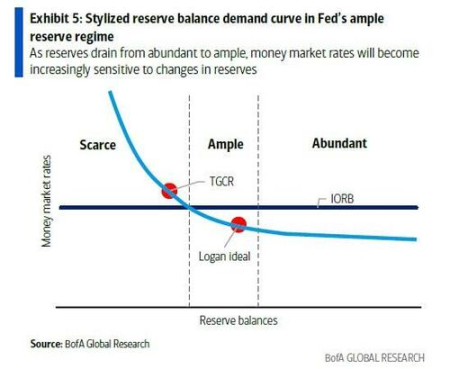
Cabana warned in a report that while the interest rate market has reacted tepidly to the rate cut, investors are generally "underestimating" the scale of the Fed's actions regarding its balance sheet. He pointed out that current money market rates indicate that reserves in the banking system are no longer "abundant," and the Fed must restart purchases of securities to fill the liquidity gap. Meanwhile, UBS's trading desk has made a similar prediction, expecting the Fed to begin purchasing about $40 billion in Treasury bills per month starting in early 2026 to maintain stability in the short-term interest rate market.
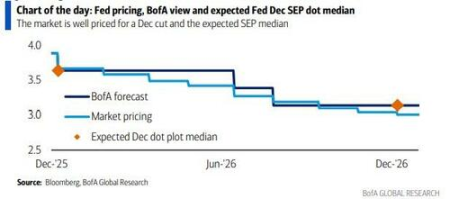
This potential policy adjustment comes at a critical time of impending leadership transition at the Fed. With Powell's term nearing its end and market expectations rising that Kevin Hassett might succeed him as Fed Chair, next week's meeting is not only about short-term liquidity but will also set the tone for the monetary policy path in the coming year.

Former New York Fed Expert Predicts: $45 Billion Monthly Purchases

Although market consensus is locked in on a 25 basis point rate cut next week, Mark Cabana believes the real variable lies in balance sheet policy. In his weekly report titled "Hasset-Backed Securities," he noted that the size of the RMP (Reserve Management Purchases) the Fed is likely to announce could be as high as $45 billion per month, a prediction that significantly exceeds current general market expectations.

Cabana detailed the composition of this figure: the Fed needs to purchase at least $20 billion monthly to cope with the natural growth of its liabilities, plus an additional $25 billion to reverse the reserve drain caused by previous "excessive quantitative tightening." He expects purchases of this magnitude to continue for at least 6 months. This announcement is expected to be included in the Fed's implementation note, with detailed operation sizes and frequency published on the New York Fed's website, focusing purchases on the Treasury bill market.

As previously reported by Wall Street News, since the balance sheet peaked at nearly $9 trillion in 2022, the Fed's quantitative tightening (QT) policy has reduced its size by approximately $2.4 trillion, effectively draining liquidity from the financial system. However, even with QT halted, signs of funding stress remain evident.

The clearest signals come from the repo market. As the short-term financing hub of the financial system, overnight reference rates in the repo market, such as the Secured Overnight Financing Rate (SOFR) and the Tri-Party General Collateral Rate (TGCR), have frequently and sharply breached the upper limit of the Fed's policy rate corridor in recent months. This indicates that reserve levels in the banking system are sliding from once "abundant" to "ample," with a risk of further moving towards "scarce." Given the systemic importance of the repo market, this situation is considered intolerable for the Fed in the long term, as it could weaken the transmission efficiency of monetary policy.

Against this backdrop, recent comments from Fed officials have also hinted at the urgency for action. New York Fed President John Williams stated that "we expect to reach ample reserve levels before long," while Dallas Fed President Lorie Logan noted that "I expect it will be appropriate to resume balance sheet growth before long." Cabana interprets "before long" as referring to the December FOMC meeting.

Auxiliary Tool Aimed at Smoothing Year-End Volatility

In addition to the long-term purchase plan, to address the impending year-end funding volatility, Bank of America also expects the Fed to announce term repo operations lasting 1-2 weeks. Cabana believes the pricing for these operations could be set at par with or 5 basis points above the Standing Repo Facility (SRF) rate, aiming to trim tail risks in the year-end funding market.

Regarding administered rates, although clients have inquired about the possibility of lowering the Interest on Reserve Balances (IORB), Cabana believes that simply cutting IORB "solves nothing," as banks generally prefer to hold higher cash buffers following the Silicon Valley Bank (SVB) collapse. He thinks it's more likely that the IORB and SRF rates could be cut synchronously by 5 basis points, but this is not the base case scenario.

Another important context for this meeting is the upcoming personnel changes at the Fed. The market currently views Kevin Hassett as a strong contender for the next Fed Chair. Cabana pointed out that once the new chair is confirmed, the market will price the medium-term policy path more based on guidance from the new appointee.
UBS also agrees with the view that balance sheet expansion is returning. UBS's sales and trading desk noted that by purchasing Treasury bills, the Fed can shorten the duration of its assets, thereby better matching the average duration of the Treasury market. Whether this operation is called RMP or quantitative easing (QE), its ultimate goal is clear: through direct liquidity injection, to ensure the financial market can maintain smooth operation during this critical period of political and economic transition.

Related Questions

QWhat major policy action does former New York Fed expert Mark Cabana predict the Fed will announce, in addition to the widely expected rate cut?

AMark Cabana predicts that Fed Chair Powell will announce a plan to purchase $45 billion per month in Treasury bills (T-bills), set to be implemented in January 2026.

QWhat is the primary goal of the Fed's potential new Treasury bill purchase program according to the article?

AThe primary goal is to inject liquidity into the system to prevent a further surge in repo market rates and to address signs that bank reserves are no longer 'abundant'.

QWhat key signal from the repo market indicates that the banking system's reserve levels are becoming less ample?

AKey short-term funding rates like the Secured Overnight Financing Rate (SOFR) and the Tri-Party General Collateral Rate (TGCR) have frequently and sharply breached the upper limit of the Fed's policy rate corridor.

QWhat additional short-term tool does Bank of America expect the Fed to announce to handle year-end funding volatility?

ABank of America expects the Fed to announce term repo operations lasting 1-2 weeks, priced at or 5 basis points above the Standing Repo Facility (SRF) rate, to mitigate tail risks in the year-end funding market.

QHow does the article connect the Fed's potential policy actions to the upcoming leadership change?

AThe article states that the upcoming FOMC meeting is happening as Chair Powell's term nears its end, with expectations that Kevin Hassett may succeed him. The meeting's decisions will set the tone for monetary policy in the coming year, and the new Treasury purchases aim to ensure market stability during this period of political and economic transition.

Related Reads

STRC Breaks Below $95: Why Does It Continue to Depeg? Is There Default Risk?

"STRC Falls Below $95: Why the Persistent Depegging and Is There Default Risk?" The article discusses the recent decline in the price of STRC, a perpetual preferred stock issued by Strategy (MSTR) designed to trade around a $100 par value. As of publication, STRC traded at $94.65, raising market concerns. STRC is described as a high-yield cash flow product, offering an 11.50% annual dividend paid monthly. Its "preferred" status grants it priority over common stock for dividends and in liquidation. Key reasons cited for the price depegging include: 1. **Bitcoin's Price Drop:** MSTR's assets are heavily tied to Bitcoin (BTC), which fell over 21% from its recent high, pressuring all Strategy-related products. 2. **Competitive Pressure:** Rival Strive Asset Management's similar product, SATA, offers daily dividends and has maintained its $100 par value with a ~13% yield. In response, Strategy has proposed changing STRC's dividend frequency from monthly to bi-weekly, pending shareholder vote. 3. **Technical Selling:** A break below $100 may have triggered algorithmic selling and stop-losses, exacerbating the decline. Regarding default risk, the analysis suggests it is currently low. Strategy founder Michael Saylor confirmed the June 2026 dividend rate remains at 11.50% with no cuts or suspensions. The company's massive reserve of 843,706 BTC provides a significant backstop for its obligations. Industry opinions are mixed. Some analysts view the BTC holdings as reliable support for dividends, while critics like Peter Schiff warn of potential dividend cuts leading to price crashes and lawsuits. Others highlight inflation risk and the company's ability to reduce dividends without a formal default. In summary, STRC's drop is attributed to BTC volatility, competition, and technical factors. While immediate default risk appears contained, the product faces challenges from market conditions and competitive dynamics.

marsbit27m ago

STRC Breaks Below $95: Why Does It Continue to Depeg? Is There Default Risk?

marsbit27m ago

AI Trading Cools, South Korean Stocks Plunge 1.8%, Spot Gold Rises 1%, Bitcoin Dives

A sell-off in AI-related stocks, triggered by Broadcom's disappointing earnings forecast, sent shockwaves through global markets. South Korea's KOSPI led Asia's decline, plunging 1.8% as the risks from concentrated chip stock gains and surging leveraged investments came to the fore. The tech-heavy Nasdaq 100 futures fell 0.5% following Broadcom's 14% after-hours plunge, which signaled a slower-than-expected transition to AI clients. This pullback extended Wall Street's weakness, halting the S&P 500's nine-day rally amid hawkish Fed signals and renewed Middle East tensions. South Korean authorities convened an emergency meeting, pledging "immediate measures" against market volatility and warning of record-high stock margin debt. The adjustment rippled across assets: Bitcoin fell to around $64,000, its lowest since February, while safe-haven gold rose 1% on bargain hunting. Oil prices dipped on Middle East ceasefire news. Market analysts noted the sell-off was driven by profit-taking after massive gains, particularly in chip stocks like Samsung and SK Hynix, which now dominate the KOSPI. Wall Street banks are divided on Korea's outlook, with Goldman Sachs raising its target while Citigroup and others warn of overvaluation and a potential bubble. Bridgewater's Ray Dalio noted that great technological shifts often create bubbles. Meanwhile, Fed officials' hints at potential future rate hikes added to the cautious mood ahead of key U.S. jobs data.

华尔街日报53m ago

AI Trading Cools, South Korean Stocks Plunge 1.8%, Spot Gold Rises 1%, Bitcoin Dives

华尔街日报53m ago

Seeking Alpha's Hot Article: Why Might the U.S. Stock Market Crash in June?

In a recent Seeking Alpha article, financial professor and analyst Damir Tokic argues that the US stock market may be poised for a significant crash in June 2026. The core thesis centers on a "mega-bubble" in equities, particularly within the technology sector, which has driven the S&P 500 to near-record valuations, with a Shiller P/E ratio exceeding 40—a level comparable to the 2000 dot-com bubble. Tokic identifies two primary catalysts for a potential collapse. First, he points to unsustainable market exuberance fueled by what he terms the "Trump Stimulus"—massive AI capital expenditure by tech giants, which he believes is politically driven and cannot last. Second, and more urgently, he highlights the escalating Iran war as a critical threat. The ongoing closure of the Strait of Hormuz has created a severe global energy supply crunch. Strategic petroleum reserves are projected to hit critically low operational levels by June, potentially causing oil prices to spike above $200 per barrel and triggering a severe, supply-driven inflationary shock. This scenario, Tokic warns, would force the Federal Reserve's hand. Despite currently maintaining a dovish bias, the Fed would likely be compelled to officially pivot to a hawkish stance at its June FOMC meeting to combat soaring inflation and bond yields. He contends that such a shift—or even a failure to act, which would destroy Fed credibility—could be the trigger that punctures the market bubble. The resulting downturn, he concludes, could rival the bear markets of 2000 and 2008, advising investors to prepare for a major correction.

marsbit1h ago

Seeking Alpha's Hot Article: Why Might the U.S. Stock Market Crash in June?

marsbit1h ago

Trading

Spot
Futures

Hot Articles

Discussions

Welcome to the HTX Community. Here, you can stay informed about the latest platform developments and gain access to professional market insights. Users' opinions on the price of MAY (MAY) are presented below.

活动图片