Ripple expands European footprint with AMINA stablecoin payment partnership

cointelegraphPublished on 2025-12-12Last updated on 2025-12-12

Abstract

Ripple Payments has partnered with Swiss bank AMINA to provide its payment infrastructure, enabling more efficient, faster, and lower-cost transactions using the Ripple USD (RLUSD) stablecoin. This collaboration strengthens Ripple’s presence in Europe, leveraging AMINA’s regulatory standing under Swiss and EU frameworks. The partnership addresses friction faced by crypto-native businesses in traditional banking, particularly in cross-border stablecoin transactions. Ripple aims to bridge fiat and blockchain systems, supporting seamless payments. This move is part of Ripple’s broader strategy to integrate blockchain into traditional finance, following recent expansions in Asia-Pacific and regulatory approvals in Singapore and Abu Dhabi for RLUSD.

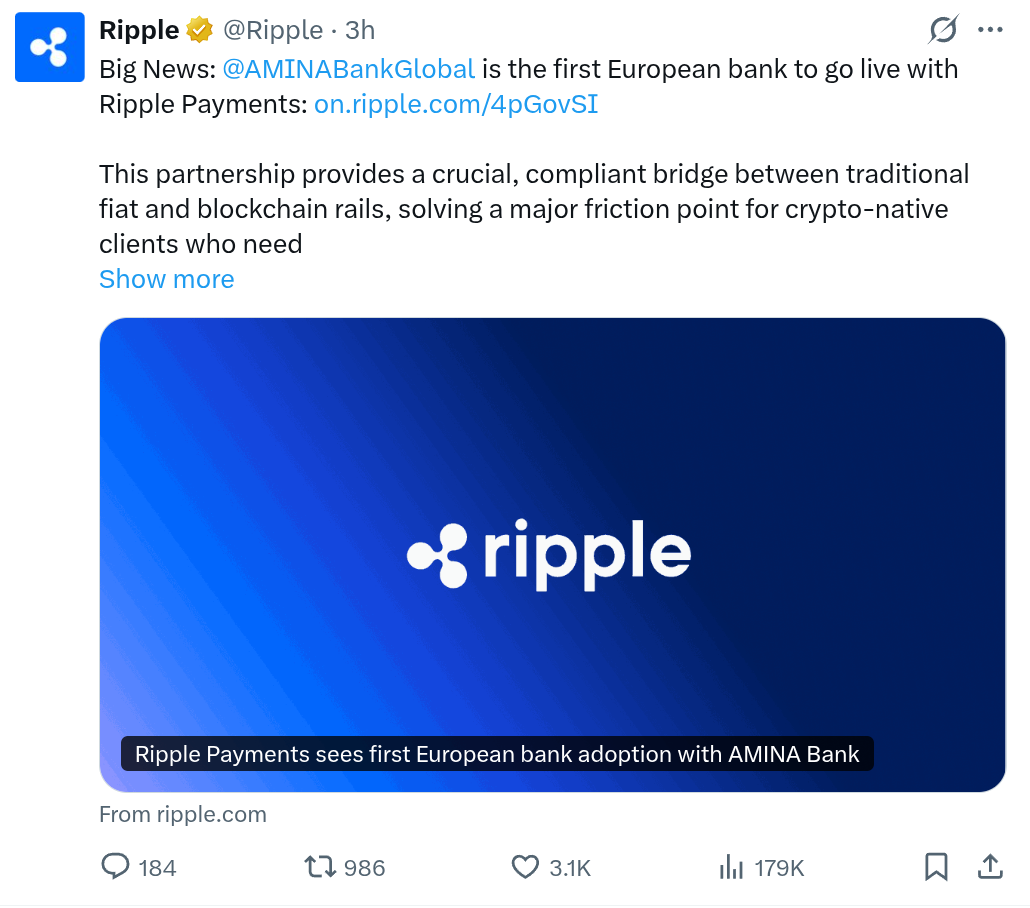
The payments subsidiary of blockchain services company Ripple has partnered with Swiss bank Amina to provide it with access to its payment infrastructure.

According to a Friday Ripple Payments announcement, the company will allow Amina to “settle transactions more efficiently without relying on traditional payment infrastructure, making transactions faster, lower cost, and with increased reliability and transparency.” This builds on a previous relationship between the companies, with the bank’s integration of the Ripple USD (RLUSD) stablecoin happening back in July.

The move also reinforces Ripple’s presence in Europe, with Amina being a Swiss Financial Market Supervisory Authority-regulated financial institution. The bank’s Austrian subsidiary also holds a license under the European Union’s Markets in Crypto-Assets Regulation (MiCA) granted by Austria’s Financial Market Authority in October.

Amina chief product officer Myles Harrison said “native web3 businesses often run into friction when working with legacy banking systems,” adding that stablecoins can help solve those issues. “This is particularly the case for cross-border stablecoin transactions which traditional banks are yet to widely adopt.”

Related: Community expects first US spot XRP ETF to launch on Thursday

Banks need crypto services for crypto companies

Harrison explained that the bank’s clients “need payment infrastructure that can handle both fiat and stablecoin rails simultaneously,” which traditional banking networks cannot provide for. Ripple Payments, on the other hand, allowed Amina to offer such services, which led to “reducing cross-border friction and helping our crypto-native clients maintain their competitive edge.”
Source: Ripple

Ripple’s managing director for the United Kingdom and Europe Cassie Craddock said that the collaboration lets Amina “serve as the on-ramp for digital asset innovators into traditional financial infrastructure.” He added that Ripple Payments provides a “bridge between fiat and blockchain” that enables seamless stablecoin payments.

Related: Canary Capital filing signals spot XRP ETF set for launch this week

Ripple onboards traditional finance onchain

This is just the latest partnership in which Ripple injected blockchain capabilities into an institution engaged in traditional finance. According to mid-November reports, the company is spending about $4 billion to combine prime trading, treasury tools, payments, and custody to take on traditional finance.

Ripple’s ambitions are also global. Earlier this month, Ripple Labs received approval from Singapore’s central bank to expand its payment activities. This enables the company to offer regulated token services, end-to-end payments and growth across Asia-Pacific.

At the end of November, RLUSD was also cleared for use by institutions in Abu Dhabi after winning recognition as an Accepted Fiat-Referenced Token by the local watchdog.


Related Reads

Two Companies Capture 90% of AI Startup's $80 Billion ARR

The AI startup landscape is highly concentrated, with OpenAI and Anthropic capturing 89% of an estimated $80 billion in annualized revenue among 34 leading companies. OpenAI, with $24-25B in revenue, primarily drives growth through ChatGPT's consumer subscriptions, while Anthropic, exceeding $30B, focuses on enterprise API integration and has rapidly grown its U.S. enterprise market share from under 1% to 34.4% in under two years. The remaining 32 companies share just 11% of the revenue, facing intense pressure as resources, talent, and market attention consolidate around the two giants. This creates a self-reinforcing cycle where higher revenue fuels greater compute investment and model improvement. Despite their dominance, both leaders face challenges. OpenAI is navigating significant legal disputes and partnership tensions, while Anthropic operates under the high expectations of its massive backers like Amazon. Historical parallels in tech infrastructure (e.g., search engines, mobile OS) suggest such oligopolistic tendencies are common due to scale, network effects, and high switching costs, indicating the market could become even more concentrated. However, the rapid pace of AI innovation leaves room for disruption. For other players, the strategic path forward is not direct competition with the giants but specialization in vertical domains where general-purpose models fall short—such as legal, medical, or industrial applications—building indispensable, niche solutions.

marsbit6m ago

Two Companies Capture 90% of AI Startup's $80 Billion ARR

marsbit6m ago

Silicon Bull, Carbon Bear: The Wealth Code of 2026 is Only 'Chips' and 'Light'

The article, titled "Silicon Bull, Carbon Bear: In 2026, the Wealth Code Lies Only in 'Chips' and 'Optics'", discusses the extreme market divergence in 2026 driven by the AI investment frenzy. Investment managers who concentrated on the AI hardware supply chain, particularly computing infrastructure, optical modules, and memory chips, have seen their fund net asset values (NAVs) surge dramatically, even reaching record highs. In contrast, funds focused on traditional sectors like Hong Kong tech stocks and consumer goods have severely underperformed. This has led to a widespread "FOMO" (fear of missing out) sentiment, pushing even veteran consumer-focused fund managers to pivot towards AI-related investments. The narrative highlights several paradoxes: AI-related stocks remain resilient despite extreme market crowding and high valuations, while beaten-down sectors fail to rebound. The author dubs this split market "Silicon Bull, Carbon Bear," suggesting a bull market only for those invested in silicon-based tech (AI hardware) and a bear market for carbon-based traditional economy sectors. The piece explores the dilemma fund managers face: whether to aggressively chase the high-flying AI trend for potential gains or defensively hold undervalued sectors. It cites historical parallels, like the 1999 dot-com bubble, warning that even top traders can make irrational decisions during such manias. Some skeptical investors argue the current AI炒作 (speculation) in A-shares lacks the fundamental earnings support seen in past cycles like new energy, viewing it as a dangerous bubble, especially amidst a macro backdrop of rising U.S. bond yields. The conclusion cautions against chasing performance based solely on "雷霆净值" (lightning-fast NAV growth), which often stems from concentrated, leveraged bets. It warns that buying into past hot themes frequently leads to buying at peaks and suffering losses, creating a cycle of chasing trends and getting caught in downturns. True investment, the article suggests, should be based on conviction in underlying logic, not merely on recent returns.

marsbit25m ago

Silicon Bull, Carbon Bear: The Wealth Code of 2026 is Only 'Chips' and 'Light'

marsbit25m ago

Trading

Spot
Futures
活动图片