Singapore Shuts Down Bsquared’s Crypto Payment Operations – Details

bitcoinistPublished on 2026-05-21Last updated on 2026-05-21

Abstract

Singapore's central bank, the Monetary Authority of Singapore (MAS), has revoked the Major Payment Institution License of crypto firm Bsquared Technology. The decision followed an on-site inspection that uncovered significant compliance failures, including poor risk management, mishandling of conflicts of interest, and violations of outsourcing rules. Crucially, MAS found that Bsquared provided false or misleading information on multiple occasions, from its initial license application through the inspection process. The firm, which held the license for just 16 months, must now produce a closure certificate confirming all customer funds have been returned. MAS is also reviewing the conduct of the company's key officers, indicating potential individual consequences. This rare license revocation highlights Singapore's strict regulatory enforcement for its crypto sector, emphasizing that maintaining high standards is a priority for the financial hub.

Bsquared Technology Pte Ltd has no auditors to answer to yet — but it will. Singapore’s central bank has ordered the crypto firm to produce a closure certificate confirming that all customer funds have been returned. The company told regulators it holds no outstanding customer assets.

A License Gone In 16 Months

The Monetary Authority of Singapore revoked Bsquared’s Major Payment Institution License on Wednesday after an on-site inspection turned up a range of problems.

Regulators found gaps in how the company managed risk and handled conflicts of interest. There were also failures to follow the central bank’s outsourcing rules.

Worse, officials said Bsquared had given false or misleading information to MAS on multiple occasions — starting from when it first applied for the license and continuing through the inspection itself. The firm, also known as BSQ, had held the license for just 16 months.
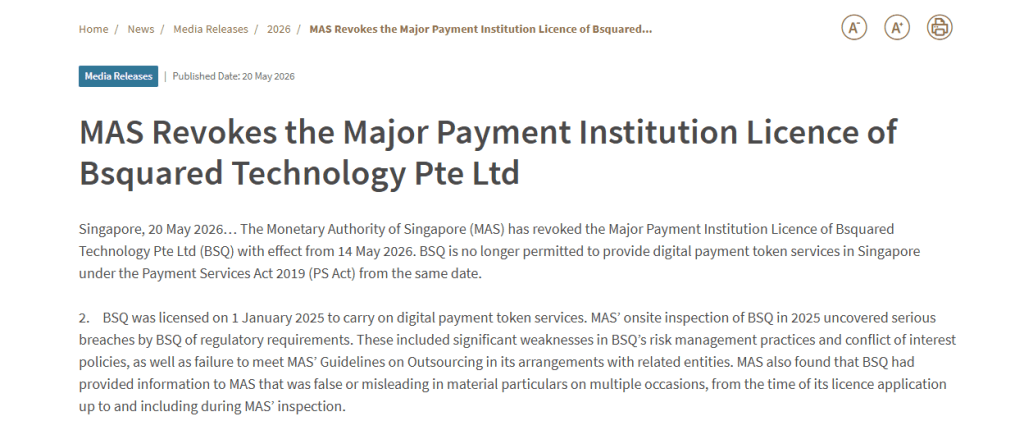
MAS pulls the plug on Bsquared’s crypto operations. Source: MAS

MAS Not Done With Bsquared

The central bank made clear that revoking the license is not the end of the matter. MAS said it is now reviewing the conduct of the company’s key officers, signaling that individuals within the firm could face separate consequences.

Singapore has licensed 37 entities to offer digital payment token services. Revocations are rare. The action against Bsquared puts other operators on notice that the regulator will move against firms that fall short — or mislead — authorities.
Image: Fintech News Singapore

A Hub That Holds Its Standards

Singapore has built a reputation as one of Asia’s leading centers for crypto business. Coinbase and Ripple maintain regional offices there. Crypto.com has its global headquarters in the city-state.

Bitcoin is currently trading at $76,845. Chart: TradingView

That standing has come partly from how seriously regulators treat licensing requirements. Last year, MAS rejected an application from AmazingTech, the operator of Tokenize Xchange, and the Commercial Affairs Department later launched a probe into the company.

The Bsquared revocation fits a pattern: Singapore wants the business, but not at the cost of oversight.

Beyond Payments, Deeper Integration

The city-state has also been expanding its digital asset ambitions in other areas. Singapore Gulf Bank recently launched a service letting institutional clients mint and redeem stablecoins directly through their bank accounts via the Solana blockchain.

Featured image from KOLN, chart from TradingView

Trending Cryptos

Related Questions

QWhat specific reasons did the Monetary Authority of Singapore give for revoking Bsquared's license?

AThe Monetary Authority of Singapore revoked Bsquared's license after an on-site inspection revealed deficiencies in risk management and conflict-of-interest handling, failures to comply with outsourcing rules, and, most significantly, that the firm had provided false or misleading information to MAS on multiple occasions.

QWhat must Bsquared Technology Pte Ltd do following the license revocation, according to MAS?

AFollowing the license revocation, Bsquared must produce a closure certificate confirming that all customer funds have been returned. The company has stated to regulators that it holds no outstanding customer assets.

QBesides revoking the company's license, what further action is MAS considering regarding Bsquared?

AMAS is reviewing the conduct of Bsquared's key officers, indicating that individuals within the firm could face separate consequences for their actions.

QHow does the article describe Singapore's approach to regulating crypto and digital payment token services?

AThe article describes Singapore as a leading crypto hub that maintains strict regulatory standards. It licenses firms seriously, revokes licenses for non-compliance or misconduct, and aims to attract business without compromising oversight, as shown by the Bsquared case and the prior rejection of AmazingTech's application.

QWhat example does the article give of Singapore expanding its digital asset services beyond payments?

AThe article cites Singapore Gulf Bank launching a service that allows institutional clients to mint and redeem stablecoins directly through their bank accounts using the Solana blockchain, demonstrating expansion into deeper digital asset integration.

Related Reads

The Fall of Zapper: An Act of God or a Human Error?

The Fall of Zapper: A Post-Mortem of a DeFi Pioneer In July 2026, Zapper, a once-dominant DeFi portfolio tracker, announced its shutdown. Born in 2020 from a merger, Zapper capitalized on the DeFi Summer boom, reaching 2 million monthly users and processing over $13B in transactions, backed by $16.5M in funding from investors like Framework Ventures and Coinbase Ventures. Its core "Zap" feature simplified complex multi-step DeFi operations. Despite its early success, Zapper failed to build a sustainable business model. Revenue from DEX aggregation was minimal due to fierce competition, while maintaining its multi-chain data infrastructure was costly. Furthermore, the DeFi landscape shifted: capital consolidated around top protocols, reducing the need for complex portfolio tracking across numerous platforms. Zapper's user base and core demand eroded. The company attempted multiple pivots, including an NFT-based points system, a social app (Chainchat), and plans for a ZAP token protocol. However, these initiatives—often focused on creating new, speculative C端需求 rather than solving existing pain points—ultimately failed. Critics argue Zapper remained trapped in a "blockchain purist" mindset, prioritizing costly, non-revenue-generating features over its competitive DEX aggregator. Unlike competitor DeBank, which successfully pivoted to its Rabby Wallet, Zapper lacked a diversified revenue stream. Its closure highlights the peril for tooling projects that fail to adapt to market shifts and monetize effectively, serving as a cautionary tale for the industry.

Foresight News22m ago

The Fall of Zapper: An Act of God or a Human Error?

Foresight News22m ago

Trading

Spot

Hot Articles

Discussions

Welcome to the HTX Community. Here, you can stay informed about the latest platform developments and gain access to professional market insights. Users' opinions on the price of S (S) are presented below.

活动图片