95% of Bitcoin Mined, the Last One Won't Be Until the 22nd Century

比推Published on 2026-03-10Last updated on 2026-03-10

Abstract

Bitcoin has now mined 20 million coins, representing 95.2% of its total capped supply of 21 million. The remaining 1 million BTC will be gradually mined over approximately the next 114 years, with the final coin expected around the year 2140. Since the genesis block was created in 2009, Bitcoin has grown from a niche experiment into a major crypto asset, reaching a market cap surpassing $2.5 trillion and a price of $126,000 by 2025. Key milestones include rapid early growth in transaction volume and network activity, followed by expanded adoption around bull markets such as in 2017. Bitcoin’s emission rate decreases through halving events, which occur every 210,000 blocks (roughly every four years). The current block reward is 3.125 BTC, and it will continue to diminish until all coins are mined. This controlled supply model reinforces Bitcoin’s scarcity and supports its narrative as digital gold. In the future, miners will rely increasingly on transaction fees rather than block rewards.

Author: Ma He, Foresight News

Original Title: Only 1 Million Bitcoin Left Unmined, the Last One Not Until the 22nd Century?


At approximately 9:00 PM on March 10, the 20 millionth Bitcoin was mined. This means that 95.2% of the total supply of 21 million BTC has been mined, leaving only 1 million to be mined over the next 114 years.

On January 3, 2009, Satoshi Nakamoto mined the Genesis Block (Block 0) of the Bitcoin network, marking the official launch of the Bitcoin blockchain. Seventeen years have passed since then.

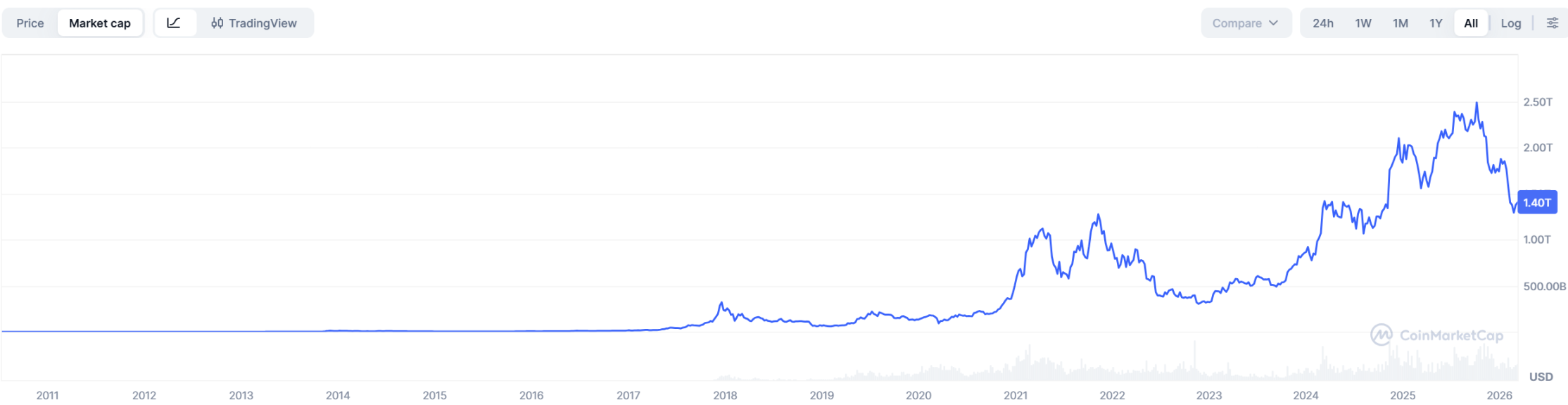
Over this long journey, BTC has risen from $0.06 to $126,000 in 2025, growing from a geek's toy into a massive crypto asset once valued at over $2.5 trillion, demonstrating its robust vitality to the world.
Beyond the staggering returns, there are still some noteworthy data points in BTC's development history.

The chart's horizontal axis spans from 2010 to 2026, with each bar corresponding to a specific metric, annotated with the number of days required from left to right. The shortest is "Transfer volume exceeding 20 million BTC," taking only 729 days, roughly corresponding to early 2011. At that time, Bitcoin was still in its early stages with low prices, but significant liquidity accumulation was already evident on-chain.
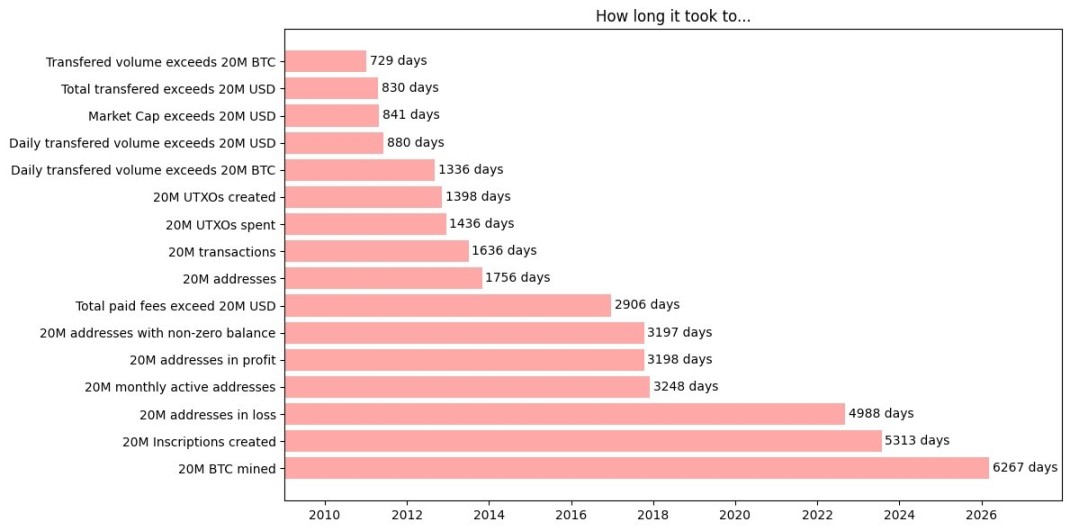
Subsequently, it took 830 days for the total BTC transfer value to exceed $20 million, 841 days for the market cap to surpass $20 million, and 880 days for the daily transfer volume to exceed $20 million. These early metrics marked Bitcoin's transition from an experimental protocol to an asset form with actual value.

As time progressed, the time required for on-chain activity metrics gradually extended. It took 1336 days for the daily transfer volume to exceed 20 million BTC, 1398 days to create 20 million UTXOs, 1436 days to spend 20 million UTXOs, 1636 days for Bitcoin to accumulate 20 million transactions, and approximately 1756 days to have 20 million addresses.

Most of this data clusters around 2013 to 2014, shortly after Bitcoin's first halving in November 2012 (block reward reduced from 50 BTC to 25 BTC), when the network ecosystem began to expand substantially.

It took 2906 days, nearly 8 years, for the total BTC payment fees to exceed $20 million, reflecting the extremely low transaction fees in the early days, which only accumulated significantly as network demand increased and congestion worsened. Bitcoin reached 20 million non-zero balance addresses, 20 million addresses in profit, and 20 million monthly active addresses in 3197 days, 3198 days, and 3248 days respectively, roughly corresponding to the 2017 bull market. During this period, Bitcoin gradually entered the public eye, and the number of holding addresses grew significantly.

The longest bar corresponds to "20 million BTC mined," taking 6267 days, about 17 years and 2 months.

Bitcoin has a total supply cap of 21 million coins, issued through block rewards, halving every 210,000 blocks (approximately every 4 years). The initial reward was 50 BTC per block, halved to 25 BTC, then to 6.25 BTC per block in the 2020 halving, totaling approximately 19,687,500 coins; the fourth halving in April 2024 reduced it to 3.125 BTC per block. We are currently in this cycle. Each halving cuts the new coin issuance rate in half, enhancing the scarcity of the asset and creating a linkage with price cycles.

The estimated time to mine the remaining approximately 1 million BTC, based on the current block reward and halving schedule, is about 114 years. The current reward is 3.125 BTC per block, with about 164,000 new coins added annually; after the 2028 halving, it will drop to 1.5625 BTC per block, continuing to decrease thereafter. In the final stages, issuance will proceed slowly in satoshis until completion around 2140.

This is the core logic of Bitcoin's design: rapid distribution in the early stages to establish a foundation, and an extremely slow rate in the later stages to strengthen its "digital gold" attributes. Miners' future income will rely more on transaction fees to maintain network security.

The 20 million milestone is not the end but the start of a new phase. As the remaining supply is slowly released, Bitcoin's digital gold narrative will be further strengthened.


Twitter:https://twitter.com/BitpushNewsCN

Bitpush TG Discussion Group:https://t.me/BitPushCommunity

Bitpush TG Subscription: https://t.me/bitpush

Original link:https://www.bitpush.news/articles/7618395

Related Questions

QWhat percentage of the total Bitcoin supply has been mined so far, and how many are left?

A95.2% of the total Bitcoin supply has been mined, leaving approximately 1 million BTC left to be mined.

QWhen was the genesis block of Bitcoin mined, and what was the starting price of Bitcoin?

AThe genesis block of Bitcoin was mined on January 3, 2009, and the starting price of Bitcoin was $0.06.

QHow long did it take to mine the first 20 million Bitcoins, and when is the last Bitcoin expected to be mined?

AIt took 6,267 days (approximately 17 years and 2 months) to mine the first 20 million Bitcoins. The last Bitcoin is expected to be mined around the year 2140.

QWhat is the current block reward for mining Bitcoin, and how often does the halving event occur?

AThe current block reward for mining Bitcoin is 3.125 BTC per block. The halving event occurs approximately every 210,000 blocks, which is roughly every 4 years.

QHow will miners' income be sustained in the future as block rewards continue to decrease?

AMiners' future income will rely more on transaction fees to maintain network security, as block rewards continue to decrease through halving events.

Related Reads

Trading

Spot
Futures

Hot Articles

What is $BITCOIN

DIGITAL GOLD ($BITCOIN): A Comprehensive Analysis Introduction to DIGITAL GOLD ($BITCOIN) DIGITAL GOLD ($BITCOIN) is a blockchain-based project operating on the Solana network, which aims to combine the characteristics of traditional precious metals with the innovation of decentralized technologies. While it shares a name with Bitcoin, often referred to as “digital gold” due to its perception as a store of value, DIGITAL GOLD is a separate token designed to create a unique ecosystem within the Web3 landscape. Its goal is to position itself as a viable alternative digital asset, although specifics regarding its applications and functionalities are still developing. What is DIGITAL GOLD ($BITCOIN)? DIGITAL GOLD ($BITCOIN) is a cryptocurrency token explicitly designed for use on the Solana blockchain. In contrast to Bitcoin, which provides a widely recognized value storage role, this token appears to focus on broader applications and characteristics. Notable aspects include: Blockchain Infrastructure: The token is built on the Solana blockchain, known for its capacity to handle high-speed and low-cost transactions. Supply Dynamics: DIGITAL GOLD has a maximum supply capped at 100 quadrillion tokens (100P $BITCOIN), although details regarding its circulating supply are currently undisclosed. Utility: While precise functionalities are not explicitly outlined, there are indications that the token could be utilized for various applications, potentially involving decentralized applications (dApps) or asset tokenization strategies. Who is the Creator of DIGITAL GOLD ($BITCOIN)? At present, the identity of the creators and development team behind DIGITAL GOLD ($BITCOIN) remains unknown. This situation is typical among many innovative projects within the blockchain space, particularly those aligning with decentralized finance and meme coin phenomena. While such anonymity may foster a community-driven culture, it intensifies concerns about governance and accountability. Who are the Investors of DIGITAL GOLD ($BITCOIN)? The available information indicates that DIGITAL GOLD ($BITCOIN) does not have any known institutional backers or prominent venture capital investments. The project seems to operate on a peer-to-peer model focused on community support and adoption rather than traditional funding routes. Its activity and liquidity are primarily situated on decentralized exchanges (DEXs), such as PumpSwap, rather than established centralized trading platforms, further highlighting its grassroots approach. How DIGITAL GOLD ($BITCOIN) Works The operational mechanics of DIGITAL GOLD ($BITCOIN) can be elaborated on based on its blockchain design and network attributes: Consensus Mechanism: By leveraging Solana’s unique proof-of-history (PoH) combined with a proof-of-stake (PoS) model, the project ensures efficient transaction validation contributing to the network's high performance. Tokenomics: While specific deflationary mechanisms have not been extensively detailed, the vast maximum token supply implies that it may cater to microtransactions or niche use cases that are still to be defined. Interoperability: There exists the potential for integration with Solana’s broader ecosystem, including various decentralized finance (DeFi) platforms. However, the details regarding specific integrations remain unspecified. Timeline of Key Events Here is a timeline that highlights significant milestones concerning DIGITAL GOLD ($BITCOIN): 2023: The initial deployment of the token occurs on the Solana blockchain, marked by its contract address. 2024: DIGITAL GOLD gains visibility as it becomes available for trading on decentralized exchanges like PumpSwap, allowing users to trade it against SOL. 2025: The project witnesses sporadic trading activity and potential interest in community-led engagements, although no noteworthy partnerships or technical advancements have been documented as of yet. Critical Analysis Strengths Scalability: The underlying Solana infrastructure supports high transaction volumes, which could enhance the utility of $BITCOIN in various transaction scenarios. Accessibility: The potential low trading price per token could attract retail investors, facilitating wider participation due to fractional ownership opportunities. Risks Lack of Transparency: The absence of publicly known backers, developers, or an audit process may yield skepticism regarding the project's sustainability and trustworthiness. Market Volatility: The trading activity is heavily reliant on speculative behavior, which can result in significant price volatility and uncertainty for investors. Conclusion DIGITAL GOLD ($BITCOIN) emerges as an intriguing yet ambiguous project within the rapidly evolving Solana ecosystem. While it attempts to leverage the “digital gold” narrative, its departure from Bitcoin's established role as a store of value underscores the need for a clearer differentiation of its intended utility and governance structure. Future acceptance and adoption will likely depend on addressing the current opacity and defining its operational and economic strategies more explicitly. Note: This report encompasses synthesised information available as of October 2023, and developments may have transpired beyond the research period.

363 Total ViewsPublished 2025.05.13Updated 2025.05.13

What is $BITCOIN

Discussions

Welcome to the HTX Community. Here, you can stay informed about the latest platform developments and gain access to professional market insights. Users' opinions on the price of BTC (BTC) are presented below.

活动图片