Kelp DAO Hack: Aave DAO Proposes To Contribute 25,000 ETH To Recovery Efforts

bitcoinistPublished on 2026-04-25Last updated on 2026-04-25

Abstract

Aave DAO has proposed contributing 25,000 ETH from its treasury to a coordinated recovery effort following a major exploit on Kelp DAO. The attack, which occurred on April 18, targeted Kelp's rsETH Ethereum LayerZero adapter, resulting in a loss of approximately 163,183 ETH. Through frozen assets, recovered funds, and expected liquidations, over half the deficit has been covered, but a gap of roughly 75,081 ETH remains. A coalition named "DeFi United," including pledges from EtherFi, Lido, Ethena, and a credit line from Mantle, is mobilizing to restore the system. Aave's anchored contribution is a key part of this effort to reintroduce liquidity and fully back the affected tokens.

Aave DAO has unveiled a proposal to deploy 25,000 ETH from its treasury to support a coordinated recovery effort following the recent Kelp DAO exploit. The move forms part of a broader “DeFi United” initiative aimed at restoring user funds and stabilizing affected lending markets.

On April 18, KelpDAO suffered a major attack targeted at its rsETH Ethereum LayerZero adapter, allowing a hacker to drain assets and break the backing relationship between locked ETH collateral and minted tokens across chains. The breach triggered a cascading liquidity and solvency challenge across DeFi platforms that integrated rsETH and its wrapped variant.

Over $160,000 ETH Gap Remains As Exploit Recovery Efforts Gain Traction

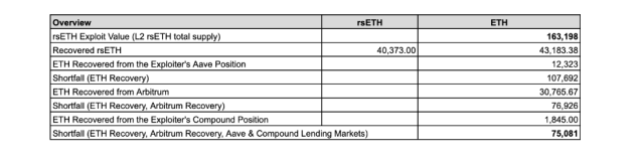
According to the Aave DAO governance proposal, the attacker stole 152,577 rsETH, which is approximately 163,183 ETH based on prevailing conversion rates. Since then, coordinated intervention by ecosystem participants has substantially reduced the gap. Kelp DAO managed to freeze 40,373 rsETH, equivalent to roughly 43,168 ETH. Additionally, the Arbitrum Security Council recovered 30,766 ETH that the attacker still held on its platform.
Source: Aave DAO

Notably, further recoveries are expected through liquidation processes on lending platforms. The attacker’s positions on Aave could yield up to 12,323 ETH, while an additional 1,845 ETH may be recovered from positions on Compound. In total, these efforts account for approximately 87,955 ETH, i.e, just over half of the original deficit. Despite this progress, a funding gap of roughly 75,081 ETH remains, resulting in a further coordinated capital injection to fully restore backing.

Aave DAO Steps In With 25,000 ETH Commitment As Coalition Mobilizes

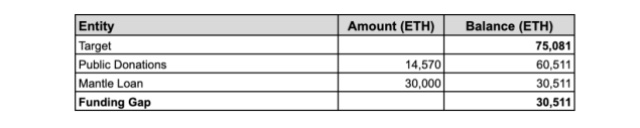
To bridge the remaining deficit, the DeFi United coalition is combining donations, credit facilities, and treasury support. So far, ecosystem contributors including EtherFi, Lido, and Ethena have pledged 14,570 ETH, while Mantle has extended a credit facility of up to 30,000 ETH.
Source: Aave DAO

Aave DAO’s proposal to contribute 25,000 ETH represents a cornerstone of this recovery stack. Notably, the contribution is “anchored,” meaning it will not be reduced by future donations. Instead, any additional funds raised will be used to repay borrowed capital, thereby limiting Aave’s long-term exposure.

The plan requires approximately 120,015 ETH (excluding 43,168 ETH immediately frozen by Kelp DAO) to be reintroduced into the LayerZero lockbox to fully restore system integrity. However, a portion of expected recoveries remains illiquid, prompting the need for short-term loan financing from ecosystem partners.

Total crypto market cap valued at $2.57 trillion on the daily chart | Source: TOTAL chart on Tradingview.com

Related Questions

QWhat is the total amount of ETH that was stolen in the Kelp DAO exploit, and what is the remaining funding gap after recovery efforts?

AThe attacker stole 152,577 rsETH, which is approximately 163,183 ETH. After recovery efforts, including frozen funds and liquidations, a funding gap of roughly 75,081 ETH remains.

QWhat is the role of the 'DeFi United' initiative mentioned in the proposal?

AThe 'DeFi United' initiative is a coordinated effort aimed at restoring user funds and stabilizing affected lending markets by combining donations, credit facilities, and treasury support from various ecosystem participants.

QHow much ETH has Aave DAO specifically proposed to contribute, and what is the nature of this contribution?

AAave DAO has proposed to contribute 25,000 ETH from its treasury. This contribution is 'anchored,' meaning it will not be reduced by future donations and any additional funds raised will be used to repay borrowed capital to limit Aave's long-term exposure.

QWhich other major ecosystem participants have pledged support, and what are their contributions?

AEcosystem contributors including EtherFi, Lido, and Ethena have collectively pledged 14,570 ETH. Additionally, Mantle has extended a credit facility of up to 30,000 ETH.

QWhat specific mechanism of the KelpDAO protocol was targeted in the attack on April 18?

AThe attack targeted KelpDAO's rsETH Ethereum LayerZero adapter, which allowed the hacker to drain assets and break the backing relationship between locked ETH collateral and minted tokens across chains.

Related Reads

U.S. Stock Market Trend: Nasdaq Plunges 3.5% Intraday Before a Remarkable Recovery, All Eyes on CPI Tomorrow

"US Stock Market Trends: Nasdaq Plunges 3.5% Before Dramatic Recovery, Eyes on Tomorrow's CPI" On Tuesday, US markets experienced a wild swing. The Nasdaq initially surged nearly 0.7% before plummeting to a 3.5% intraday loss following a post by Donald Trump on Truth Social. He stated that Iran had shot down a US Apache helicopter in the Strait of Hormuz and that the US "must...respond." The index, however, staged a remarkable recovery in the final two hours, closing down only 0.97%, as subsequent remarks from Trump and Vice President Vance suggested a potential Iran deal within days. The S&P 500 fell 0.26%, while the Dow Jones gained 0.17%, supported by its non-tech components. This incident marked the first loss of a US military asset since tensions with Iran escalated in late February. Despite the event, crude oil prices fell sharply (WTI -3.93%) due to expectations of a near-term deal, OPEC+ plans to increase output, and fears that strong jobs data could lead to Fed rate hikes. Market attention is now laser-focused on the May CPI data release Wednesday morning. This report is seen as critical evidence for whether hot job growth is fueling inflation and will heavily influence expectations for the Federal Reserve's upcoming meeting. A hotter-than-expected reading could trigger further sell-offs, particularly in tech, while a cooler print could spark a significant rebound. The article notes a clear sector rotation, with money flowing out of tech (Nasdaq down over 5% in a week) into defensive sectors like healthcare and consumer staples. Other assets like gold and Bitcoin also remain under pressure. The overarching sentiment is one of "war fatigue," with markets desperately awaiting concrete results from the prolonged Iran negotiations rather than reacting to each new headline.

marsbit6m ago

U.S. Stock Market Trend: Nasdaq Plunges 3.5% Intraday Before a Remarkable Recovery, All Eyes on CPI Tomorrow

marsbit6m ago

Second Only to GPUs and Memory: MLCCs Are Becoming the Next Billion-Dollar Windfall for AI Computing Power

After GPU and memory, MLCC (Multi-Layer Ceramic Capacitors) is emerging as the next critical component in AI compute, potentially a multi-billion-dollar market. The article highlights a significant, industry-wide price increase for MLCCs, driven not by inventory cycles but by a fundamental, structural demand surge from AI and automotive sectors. AI servers require exponentially more MLCCs than traditional servers—from 2,000 to over 350,000 units per high-end AI rack—primarily to stabilize power for increasingly powerful, low-voltage GPUs. A key AI server's MLCC cost can reach thousands of dollars, making it the third-largest cost component after GPUs and memory. This demand is compounded by the automotive shift to EVs and advanced ADAS. Supply, however, struggles to keep up. Manufacturing high-end MLCCs involves extreme precision and faces six major barriers: proprietary technology, long customer certification cycles (12-18 months for AI), high capital intensity, patent thickets, specialized talent, and massive scale. Industry capacity grows at only ~10% annually, creating a persistent supply-demand gap projected to last until 2030. Three companies dominate this high-end market. **Murata** (40% global share) is the stable leader. **Samsung Electro-Mechanics** offers the highest growth elasticity with aggressive expansion. **Taiyo Yuden** is the purest MLCC play. While their current P/E ratios appear high, they are expected to compress rapidly as earnings surge, powered by significant pricing power and operational leverage. Key risks include a potential slowdown in AI capex, high valuations, competition from Chinese manufacturers in lower tiers, yen appreciation, and consumer electronics weakness. The article concludes that MLCCs are transforming from a commoditized component into a strategic, capacity-constrained asset essential for the AI-powered future.

marsbit36m ago

Second Only to GPUs and Memory: MLCCs Are Becoming the Next Billion-Dollar Windfall for AI Computing Power

marsbit36m ago

The First to Bring an AI OS to 1.4 Billion People Might Actually Be WeChat?

WeChat has introduced a significant AI update, allowing mini-program developers to integrate their services with WeChat AI. Developers can choose an "automatic mode," where WeChat AI autonomously analyzes and operates mini-programs without additional coding, or a "development mode" for creating customized skills. This move effectively transforms WeChat's vast ecosystem—including millions of mini-programs, WeChat Pay, and official accounts—into an execution layer for AI. The technical documentation reveals that WeChat's approach aligns with industry standards like MCP (Model Context Protocol) and incorporates practical lessons from AI-agent development. Key design principles include a clear "attention weight" system for API calls and a "fact + action" response structure to ensure reliable operations. Unlike Apple's Siri, which struggles with third-party app integration, WeChat's centralized control over mini-program code provides a "God's-eye view," enabling seamless AI orchestration across services. This development revives the concept of "WeChat OS," where the app could function as a natural-language-operated platform for daily tasks—from booking flights to ordering food—all within a chat interface. While challenges remain in areas like payment security and user trust, WeChat's existing service network and massive user base position it uniquely to advance AI agents from conversation to actionable assistance, potentially making complex tasks feel effortless for its 1.432 billion monthly active users.

marsbit1h ago

The First to Bring an AI OS to 1.4 Billion People Might Actually Be WeChat?

marsbit1h ago

Trading

Spot
Futures

Hot Articles

How to Buy DAO

Welcome to HTX.com! We've made purchasing DAO Maker (DAO) simple and convenient. Follow our step-by-step guide to embark on your crypto journey.Step 1: Create Your HTX AccountUse your email or phone number to sign up for a free account on HTX. Experience a hassle-free registration journey and unlock all features.Get My AccountStep 2: Go to Buy Crypto and Choose Your Payment MethodCredit/Debit Card: Use your Visa or Mastercard to buy DAO Maker (DAO) instantly.Balance: Use funds from your HTX account balance to trade seamlessly.Third Parties: We've added popular payment methods such as Google Pay and Apple Pay to enhance convenience.P2P: Trade directly with other users on HTX.Over-the-Counter (OTC): We offer tailor-made services and competitive exchange rates for traders.Step 3: Store Your DAO Maker (DAO)After purchasing your DAO Maker (DAO), store it in your HTX account. Alternatively, you can send it elsewhere via blockchain transfer or use it to trade other cryptocurrencies.Step 4: Trade DAO Maker (DAO)Easily trade DAO Maker (DAO) on HTX's spot market. Simply access your account, select your trading pair, execute your trades, and monitor in real-time. We offer a user-friendly experience for both beginners and seasoned traders.

2.3k Total ViewsPublished 2024.03.29Updated 2026.06.02

How to Buy DAO

Discussions

Welcome to the HTX Community. Here, you can stay informed about the latest platform developments and gain access to professional market insights. Users' opinions on the price of DAO (DAO) are presented below.

活动图片