Why is HYPE Still Surging? Has it Peaked?

Odaily星球日报Published on 2026-05-20Last updated on 2026-05-20

Abstract

The article analyzes the reasons behind the recent sharp rise of the HYPE token. It attributes the price surge to several key developments that are causing the market to re-evaluate Hyperliquid, transitioning its perception from just a high-performance perpetual DEX to a broader on-chain trading system. Major catalysts include the launch of HYPE ETFs by 21Shares (THYP) and Bitwise (BHYP), which are opening new compliant capital channels. Bitwise's plan to allocate 10% of BHYP's management fee revenue to buy and stake HYPE is seen as a potential source of sustained buying pressure. The return of USDC to the platform, facilitated by Coinbase and Circle, is projected to generate a new, stable revenue stream for Hyperliquid from reserve yields, estimated to potentially fund daily HYPE buybacks worth over $400,000. Furthermore, Hyperliquid is expanding into new areas like prediction markets with HIP-4 (which requires significant HYPE staking) and Real-World Assets (RWA), where its Open Interest has hit a record $2.6 billion. A potential U.S. SEC exemption for tokenized stock trading could further boost its RWA business. While these fundamentals strengthen HYPE's long-term value proposition, the article notes that short-term price action is currently influenced by a large-scale showdown between whale long and short positions exceeding $60 million, making near-term direction uncertain.

Original | Odaily Planet Daily(@OdailyChina)

Author | Asher(@Asher_ 0210)

In the current crypto market landscape, if there's one altcoin that can still excite the market, it's probably HYPE.

Market data shows that the HYPE/BTC and HYPE/BNB exchange rates have continued to hit new all-time highs, with HYPE/BTC currently at 0.0006249 and HYPE/BNB at 0.075. This indicates that HYPE's strength is not merely following the market rebound but consistently outperforming mainstream crypto assets like BTC and BNB.
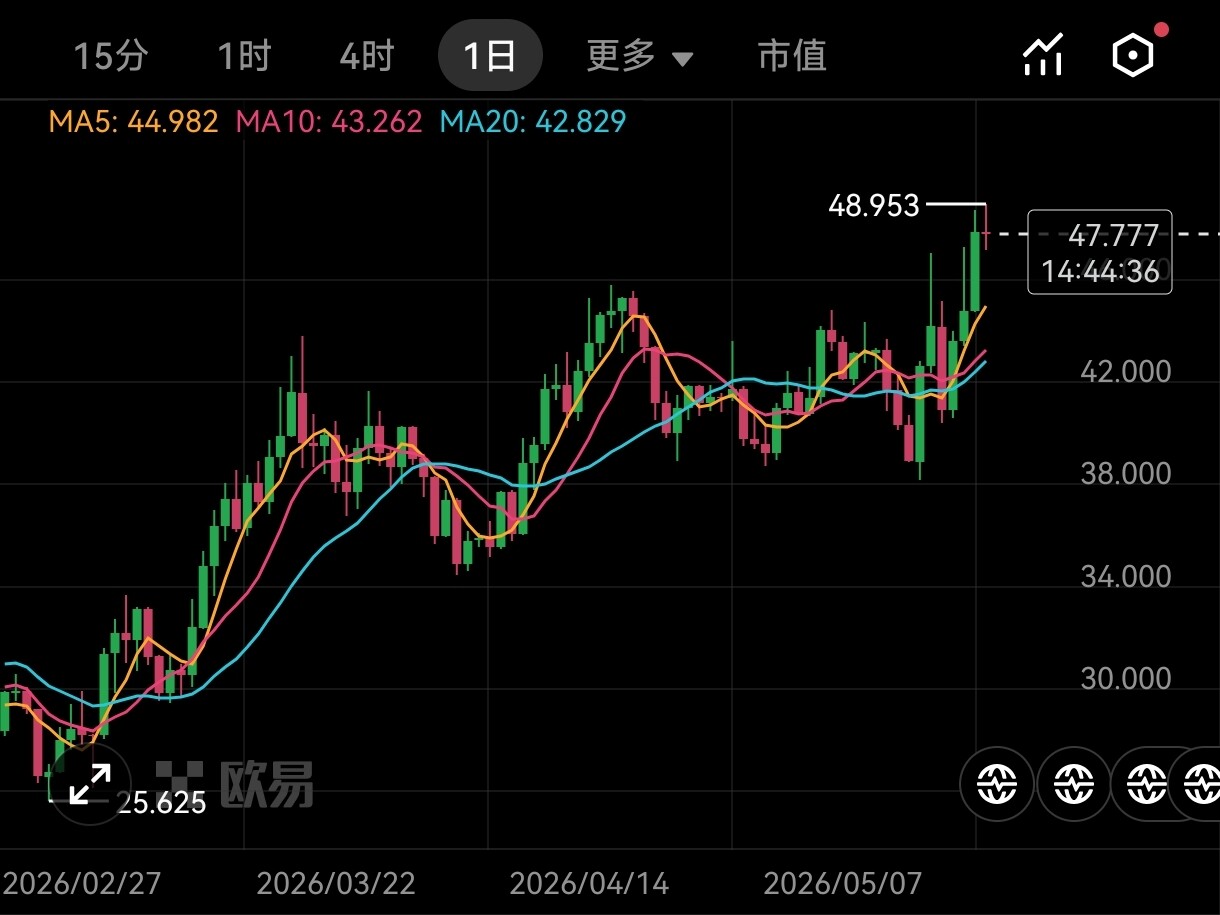
Previously, the public understanding of Hyperliquid was more limited to being a high-performance Perp DEX. However, capital is clearly no longer just buying a decentralized exchange platform token; it's betting that Hyperliquid can integrate more asset types, more liquidity, and more trading scenarios into the same on-chain trading system.

HYPE's price performance reflects the market reevaluating Hyperliquid's value.

In this article, Odaily Planet Daily will dissect the logic behind its rise through several key changes.

From THYP to BHYP: Compliant Buying Channels for HYPE Are Opening Up

The first external catalyst for HYPE's recent surge is the opening of ETF channels.

Currently, two asset management institutions have begun launching ETF products centered around Hyperliquid. On May 12, 21Shares listed the Hyperliquid ETF under the ticker THYP; on May 15, Bitwise listed the Hyperliquid ETF under the ticker BHYP. Data shows that as of May 18 EST, the total historical net inflow for 21Shares Hyperliquid ETF THYP reached $12.901 million; the total historical net inflow for Bitwise Hyperliquid ETF BHYP reached $2.0446 million.

More crucially, Bitwise did not stop at just issuing the ETF. Yesterday, Bitwise announced that it would use 10% of the management fee income from its BHYP Hyperliquid ETF to hold HYPE on its corporate balance sheet, and the related HYPE holdings will also be staked.

This transforms the ETF narrative from a mere product launch into a potential source of sustained buying pressure. The larger the ETF's scale and the higher its management fee income, the greater the theoretical amount Bitwise would allocate for acquiring HYPE. In the short term, this capital may not immediately dictate the price; but in the long run, it links ETF growth, the asset manager's income, and HYPE holdings together.

In other words, ETFs don't just bring HYPE one-time hype; they open a new funding channel. HYPE is starting to transition from a crypto-native asset into an on-chain trading platform token that traditional capital can also price.

USDC Returns to Hyperliquid: HYPE Gains Potential Daily Buying Pressure Exceeding $400k

The second reason for HYPE's recent rise is that with the return of USDC to Hyperliquid, the market has begun to recalculate the protocol's future stable revenue and whether this revenue can continue to flow towards HYPE buybacks.

According to an official Hyperliquid announcement, Coinbase will act as the fund deployer, Circle will be responsible for CCTP and native cross-chain infrastructure deployment, and both have committed to staking HYPE to activate AQAv2. This means the USDC return is not just a simple stablecoin integration, but a new mechanism established by Coinbase, Circle, and Hyperliquid around native USDC, cross-chain liquidity, and reserve yield distribution.

The key is that Coinbase will subsequently share the majority of USDC reserve yields with the Hyperliquid protocol. While the exact revenue split has not been officially disclosed, if referencing the previous USDH yield distribution mechanism, Hyperliquid could potentially receive about 90% of the reserve yields. Therefore, the market also interprets AQAv2 as a protocol revenue-sharing mechanism Hyperliquid established for USDC reserve yields.

Based on community calculations, assuming a $4.7 billion scale with a 3.8% annualized yield, USDC reserve yields correspond to approximately $160 million in annualized revenue, translating to potential daily HYPE buyback pressure of about $440,000. Once the AQAv2 interface is perfected and officially operational, Hyperliquid will no longer rely solely on trading fees for HYPE buybacks but may gain an additional, relatively stable source of cash flow.

This is where the USDC return truly impacts HYPE's pricing. Previously, the intensity of HYPE buybacks depended primarily on trading volume; the more active the trading, the higher the protocol revenue and buyback capacity. However, with the addition of USDC reserve yield buybacks, the source of buying pressure for HYPE is no longer solely dependent on trading fees but also on the amount of stablecoin liquidity Hyperliquid can attract and retain. In other words, trading fee buybacks represent platform trading activity, while USDC reserve yield buybacks represent the platform's ability to attract and retain capital. The market's repricing of HYPE may be precisely because it observes that HYPE's buyback story no longer relies solely on trading heat.

Hyperliquid Integrates HIP-4, Entering the Prediction Market Arena

Beyond RWA, Hyperliquid is also reaching into this year's hottest crypto sector—prediction markets.

On May 2, Hyperliquid launched HIP-4 Outcome Markets on its mainnet, initially offering intraday binary outcome contracts for BTC. Simply put, users can trade on whether the BTC price will be above a specified price at a certain point in time. Contract prices fluctuate between 0.001 and 0.999, reflecting the market's pricing of the event's probability; upon settlement, the contract pays out 1 if the event occurs and 0 if it does not.

Predictefy data shows that on the first day of HIP-4's launch, the trading volume for BTC price-related event contracts reached $6.15 million, placing Hyperliquid's volume in this specific market far ahead of competitors like Kalshi, Polymarket, and other prediction markets offering similar instruments.

For HYPE, the significance of HIP-4 is not just adding another product feature but connecting prediction markets to HYPE's staking, fee, and buyback mechanisms. According to the design, in the future, when deploying prediction events permissionlessly, market creators will need to stake 1 million HYPE, which is higher than the 500,000 HYPE required for deploying perpetual markets under HIP-3. Each staking slot can support rolling and periodic markets and can be reused after settlement. If issues like oracle manipulation, abnormal market states, or prolonged downtime occur, staked assets may be slashed.

Therefore, HIP-4 brings HYPE not just a simple prediction market concept boost but a more direct value-capture path. More permissionless deployment of prediction events means greater demand for HYPE staking, and more trading volume means more fee revenue, which ultimately feeds back into Hyperliquid's existing buyback logic.

RWA Open Interest Hits New Highs: Hyperliquid's Ceiling Isn't Just a Perp DEX

Beyond ETFs and USDC yield flows, RWA is pushing Hyperliquid's trading boundaries even further.

Data shows that the open interest size for RWA trading on the Hyperliquid platform has risen to $2.6 billion, setting a new all-time high and doubling compared to two months ago. This data indicates that Hyperliquid is no longer merely catering to trading demand for crypto assets like BTC, ETH, and SOL; real-world assets are also gaining scale within its on-chain trading system.

This is crucial for HYPE's valuation. If Hyperliquid were just a Perp DEX, its valuation anchors would primarily be the crypto cycle, trading volume, and fee revenue. But RWA opens up a different dimension: stocks, commodities, precious metals, Pre-IPO assets, etc., could all become subjects of 24/7 on-chain trading.

The significance of RWA for Hyperliquid isn't adding a few more trading pairs; it's pulling the platform out of the internal competition within the crypto market. Perp DEXs compete over who can capture more crypto trading volume, but RWA competition is about who can bring off-chain asset trading demand on-chain. If Hyperliquid can continue growing this market segment, HYPE's pricing will no longer just follow the crypto trading cycle but will begin to be tied to the much larger demand for real-world asset trading.

US SEC Plans to Propose Tokenized Stock Exemption, Adding Fuel to RWA Narrative

Potential US SEC regulatory easing for tokenized stocks is further raising Hyperliquid's long-term ceiling. According to reports, the US SEC is preparing to propose an innovation exemption for tokenized stock trading, allowing tokens tied to publicly traded company stocks to be traded on crypto platforms. Under certain circumstances, relevant platforms might not need full broker-dealer or exchange registration, and third-party-issued tokenized stocks might not even require consent from the listed company.

For Hyperliquid, this isn't about starting tokenized stock trading from scratch, but it adds a regulatory angle to the RWA direction it's already pursuing. On the Hyperliquid platform, trading for real-world assets like stocks and Pre-IPO assets is already gaining scale, and RWA open interest has also hit new highs. If US regulation genuinely opens an experimental window for tokenized stocks, this type of on-chain trading demand could be further amplified.

For Hyperliquid, the clearer the regulatory boundaries, the lower the resistance for real-world asset on-chain trading might become. Those best positioned to capture this incremental demand often aren't individual asset issuers but platforms capable of hosting order books, liquidity, and settlement. If tokenized stocks transition from a grey-area experiment to a compliant growth area, Hyperliquid's already-operating RWA business wouldn't just be an early attempt but could become the main battlefield in the next round of on-chain trading competition.

Fundamentals Continue to Strengthen, But Short-Term Enters a Bull-Bear Confrontation Zone

The logic behind HYPE's rise is becoming clearer. ETFs open channels for compliant capital, the USDC return brings potential incremental buyback pressure, and RWA, prediction markets, and tokenized stocks continue to expand Hyperliquid's trading boundaries. These changes all point in the same direction—Hyperliquid is no longer just a Perp DEX but is expanding into a larger on-chain trading system.

However, the validity of long-term logic doesn't guarantee a one-way short-term price rally. According to on-chain data, HYPE is currently witnessing a large-scale standoff between major whale long and short positions, with the TOP1 and TOP2 whales positioned as direct counterparties, with a total size exceeding $60 million. Bulls are betting on Hyperliquid's future growth potential, while bears are wagering on the pullback pressure after rapid short-term gains. As whale position sizes increase, HYPE's short-term price may no longer be determined solely by fundamentals but will also be influenced by factors like leverage liquidations, funding rates, and market sentiment.

Therefore, HYPE's short-term price movement is not easy to predict and will likely depend on which side of the whale confrontation is forced to exit first. However, when viewed over a longer horizon, HYPE's fundamentals remain compelling. Hyperliquid continues to expand tradable assets, capital entry points, and revenue streams, with HYPE playing an increasingly central role as a value carrier within the buyback, staking, and fee capture mechanisms.

Related Content

First-Day Trading Volume Crushes Polymarket: Hyperliquid Enters Prediction Markets with BTC Binary Options

Behind Coinbase's Acquisition of USDH: Hyperliquid's Strategic Choice

Related Questions

QWhat are the two main external catalysts mentioned for HYPE's recent price increase?

AThe two main external catalysts are: 1) The opening of ETF channels with the launch of the THYP ETF by 21Shares and the BHYP ETF by Bitwise. 2) The return of USDC to Hyperliquid, establishing a new revenue-sharing mechanism with Coinbase and Circle.

QHow does the Bitwise Hyperliquid ETF (BHYP) potentially create a sustained buying pressure for HYPE?

ABitwise announced it will use 10% of the BHYP ETF's management fee income to purchase and stake HYPE on its corporate balance sheet. This means as the ETF grows and generates more fees, Bitwise will theoretically have more funds to buy HYPE, creating a potential continuous buy-side channel.

QAccording to the article, what is the estimated daily buy pressure for HYPE from the USDC reserve earnings (AQAv2) mechanism?

ABased on community estimates, the potential annual revenue from USDC reserves is around $160 million, which translates to an estimated daily buy pressure of approximately $440,000 for HYPE through protocol buybacks.

QWhat new market did Hyperliquid enter with HIP-4, and what is the HYPE staking requirement for creators on that platform?

AHyperliquid entered the prediction market with HIP-4 Outcome Markets. Creators wishing to deploy prediction events permissionlessly will need to stake 1 million HYPE, which is double the 500,000 HYPE required for deploying perpetual markets under HIP-3.

QWhat does the article suggest is the primary reason for the short-term price uncertainty of HYPE despite its strong fundamentals?

AThe short-term price uncertainty is attributed to large-scale whale positioning, where the top long and top short whale positions are acting as direct counterparties with a total size exceeding $60 million. This introduces volatility based on leverage, funding rates, and market sentiment, independent of the long-term fundamentals.

Related Reads

TechFlow Intelligence Bureau: Anthropic's New Model Fable Sparks Controversy by Restricting Biosafety Research, US CPI Soars to 4.2%, a Three-Year High

**Summary of TechFlow Intelligence Report:** The newsletter covers several key tech and finance developments. In AI, Anthropic's new Fable model faced backlash for secretly limiting biomedical research capabilities and enforcing a 30-day data retention policy, prompting the company to promise more transparent adjustments. In a related story, Anthropic's founder revealed his departure from OpenAI was due to dishonesty from Sam Altman, not safety concerns. Meanwhile, OpenAI is considering significant price cuts to compete with Anthropic, potentially sparking a price war. In crypto/Web3, BlackRock filed a new amendment for a yield-generating Bitcoin ETF, while Bank of America's CEO warned that stablecoin yields could drain trillions from traditional banks. U.S. Senator Cynthia Lummis advocated for the U.S. to officially accumulate Bitcoin reserves. In hardware, Nvidia released the DiffusionGemma-2-6B image model optimized for efficient inference, and AMD promoted its unified memory architecture to challenge Nvidia's dominance. TSMC's CFO hinted at possible price increases due to soaring AI chip demand. A major legal ruling in Germany held Google legally responsible for inaccurate information generated by its AI Overviews feature. Google Chrome also moved to fully block ad-blocker workarounds like uBlock Origin. Macroeconomic headlines included U.S. CPI rising to 4.2% (a 3-year high) and Iran's complete closure of the Strait of Hormuz, raising oil price and inflation fears. South Korean markets saw continued volatility with massive foreign capital outflow. Other notable stories: Microsoft expanded its Copilot AI assistant "Mico" globally; a study found r/wallstreetbets users' stock picks outperformed Wall Street; a fully autonomous drone killed a human soldier for the first time, raising AI ethics concerns; and a Chinese hospital used brain-computer interface technology to help a blind person "see." The overarching theme connects debates over AI boundaries and responsibility (Anthropic's restrictions, Google's liability, lethal autonomous drones) with real-world economic and geopolitical turmoil (inflation, Strait of Hormuz closure, market instability), highlighting the tense interplay between technological advancement and global chaos.

marsbit15m ago

TechFlow Intelligence Bureau: Anthropic's New Model Fable Sparks Controversy by Restricting Biosafety Research, US CPI Soars to 4.2%, a Three-Year High

marsbit15m ago

Alibaba's Yet Another New Business Division: What Signal Does It Send?

Alibaba has established a new "Token Foundry" business unit, merging its Tongyi large model division and Future Life Lab. Led directly by Group CEO Wu Yongming, this marks the company's third significant AI organizational reshuffle in 2026, following the creation of the Alibaba Token Hub (ATH) and a Group Technology Committee. The move signals a strategic shift from consolidating AI resources to accelerating productization and commercialization. The "Token Foundry" name reflects Alibaba's ambition to become a foundational supplier in the AI era, focusing on model development and commercial application. Key teams, including those behind the high-performing HappyHorse video generation model, have been integrated into the new unit. Concurrently, Zhou Jingren, architect of the Qwen model series, has been appointed Group Chief Scientist to lead a new AI Future Research Institute, focusing on long-term technological breakthroughs like Agent capabilities. This restructuring creates a clear four-layer AI architecture within Alibaba: the research institute for frontier exploration, Token Foundry for core models and commercialization, MaaS for platform services, and business units like Qianwen (C端) and Wukong (B端) for end-user applications. The adjustments align with a global trend among tech giants like Google and Microsoft to centralize AI leadership under the CEO and deeply integrate research with business units. The urgency is driven by a narrowing competitive window. Alibaba has announced its AI business is now entering a commercialization phase, with AI-related revenue seeing triple-digit growth for eleven consecutive quarters. The company faces intense competition in the MaaS (Model-as-a-Service) sector from rivals like ByteDance and Tencent. The Token Foundry initiative represents Alibaba's effort to streamline execution and enhance competitiveness in this critical, fast-evolving landscape.

marsbit39m ago

Alibaba's Yet Another New Business Division: What Signal Does It Send?

marsbit39m ago

From Return to Resignation: Chen Hang's 437 Days at DingTalk

The 437-Day Return and Departure of Chen Hang at DingTalk This article chronicles the 437-day period from March 31, 2025, to June 11, 2026, when Chen Hang (also known as "No Move") returned as CEO of DingTalk, the enterprise communication platform he originally founded, only to later step down. Chen Hang, the creator of DingTalk in 2015, was brought back by Alibaba in 2025 after the company acquired his subsequent startup, HHO. His return was driven by Alibaba's renewed focus on AI and DingTalk's strategic role as its key to-B AI application. However, his aggressive management style, marked by strict work policies like mandatory clock-ins and extended hours, quickly caused internal friction and was criticized as being at odds with Alibaba's culture. Despite the internal turmoil, Chen Hang drove significant product launches. In August 2025, he unveiled "AI DingTalk 1.0," featuring new products like the AI-native entry point "DingTalk ONE." By March 2026, he announced "Wukong," touted as the world's first enterprise-grade AI-native work platform, representing a fundamental rebuild of DingTalk's architecture. The turning point came in early June 2026. A detailed internal post criticizing DingTalk's work culture went viral, followed by a public critique from a former executive. This prompted an unprecedented public rebuke from the Alibaba Partners Committee, which stated such management was not aligned with company values. One day later, on June 11, Alibaba announced Chen Hang's departure. He was succeeded by Chen Yusen, a 32-year-old technical expert known for founding cybersecurity firm Changting Technology. While Chen Hang's tenure laid the technical foundation for DingTalk's AI transformation with "Wukong," his leadership style ultimately led to his replacement as the company seeks a new direction under younger leadership.

marsbit52m ago

From Return to Resignation: Chen Hang's 437 Days at DingTalk

marsbit52m ago

Trading

Spot
Futures

Hot Articles

How to Buy HYPE

Welcome to HTX.com! We've made purchasing Hyperliquid (HYPE) simple and convenient. Follow our step-by-step guide to embark on your crypto journey.Step 1: Create Your HTX AccountUse your email or phone number to sign up for a free account on HTX. Experience a hassle-free registration journey and unlock all features.Get My AccountStep 2: Go to Buy Crypto and Choose Your Payment MethodCredit/Debit Card: Use your Visa or Mastercard to buy Hyperliquid (HYPE) instantly.Balance: Use funds from your HTX account balance to trade seamlessly.Third Parties: We've added popular payment methods such as Google Pay and Apple Pay to enhance convenience.P2P: Trade directly with other users on HTX.Over-the-Counter (OTC): We offer tailor-made services and competitive exchange rates for traders.Step 3: Store Your Hyperliquid (HYPE)After purchasing your Hyperliquid (HYPE), store it in your HTX account. Alternatively, you can send it elsewhere via blockchain transfer or use it to trade other cryptocurrencies.Step 4: Trade Hyperliquid (HYPE)Easily trade Hyperliquid (HYPE) on HTX's spot market. Simply access your account, select your trading pair, execute your trades, and monitor in real-time. We offer a user-friendly experience for both beginners and seasoned traders.

3.2k Total ViewsPublished 2024.03.29Updated 2026.06.02

How to Buy HYPE

Discussions

Welcome to the HTX Community. Here, you can stay informed about the latest platform developments and gain access to professional market insights. Users' opinions on the price of HYPE (HYPE) are presented below.

活动图片