Why Bitcoin Still Acts Like A Risk Asset Despite Safe-Haven Claims

bitcoinistPublished on 2026-04-26Last updated on 2026-04-26

Abstract

Bitcoin possesses inherent qualities of a safe-haven asset, such as being portable and censorship-resistant. However, it continues to trade like a risk asset, correlating with indices like the NASDAQ during periods of uncertainty. Analysts attribute this to its lack of widespread acceptance by large capital pools, a process that may take another decade. Currently, Bitcoin is showing technical weakness with a bearish market structure shift and a rejection from a monthly fair value gap, suggesting a higher probability of a breakdown and a potential move lower. The broader downside thesis remains intact unless BTC breaks out of its current pattern with strength.

Bitcoin was built with many of the qualities typically associated with a safe-haven asset: it is portable, censorship-resistant, and independent of traditional financial systems. In theory, those characteristics make a compelling case for BTC as a refuge in times of instability, particularly in a world facing geopolitical tensions, inflation risks, and growing uncertainty around legacy institutions.

How Long It Might Take For Bitcoin To Be Widely Accepted

The idea that most Bitcoiners believe Bitcoin is already a full-fledged safe-haven asset misses an important nuance. Crypto analyst Willy Woo has mentioned on X that when an asset is independent of the system and thrives even if the system collapses, there are certain properties that should be expected of a true safe-haven asset. Meanwhile, BTC clearly carries these properties.

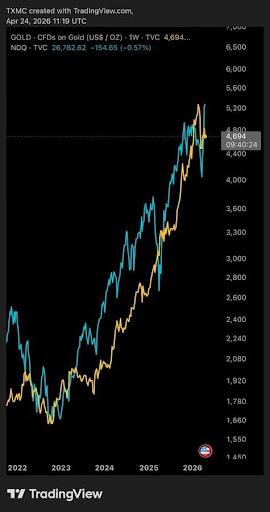
In extreme scenarios, such as war, a seed phrase can preserve wealth across borders. Despite its characteristics, Bitcoin still tends to trade like a risk asset during periods of uncertainty and war. BTC is sensitive to uncertainty, trading like the NASDAQ Composite.

Willy explained that this is because the large capital pools don’t acknowledge their properties, and BTC is considered new and untested. It will take another decade for BTC to gain market acceptance as a safe-haven. When BTC does, it will compete with gold market capitalization as a dominant store of value in the modern financial system.

Source: Chart from Willy Woo on X

Bitcoin is showing clear signs of weakness after forming a bearish market structure shift (MSS) at the highs. Instead of continuing its uptrend, the price has now broken back into its previous range, marking it the first real loss of momentum since the rally began. According to ctm_trader, this shift clearly shows that the price is losing its strength and has now turned to a potential retest of the lower boundary of the channel.

However, with the MSS at the highs, most liquidity is sitting below the current price levels, while long positions heavily outweigh shorts. The probability of a breakdown is much higher than the probability of continuation. For market makers, this is a perfect opportunity for a long squeeze as there is a massive market imbalance right now.

What The Monthly FVG Rejection May Be Signaling

A similar trade setup that has repeated multiple times throughout this bear market may be setting up once again. Crypto trader Minga highlighted that BTC price is still trading inside the bear-flag rising wedge structure and currently rejecting from the monthly fair value gap (FVG).

As long as BTC remains within this pattern and continues to reject the FVG, the broader downside thesis remains intact. Every push into resistance has looked more like a relief rally than true strength.

With momentum shifting back toward the downside, the market is likely preparing for another leg lower. Meanwhile, this structure setup will remain clean until BTC breaks out of the formation and reclaims resistance with strength.

BTC trading at $77,784 on the 1D chart | Source: BTCUSDT on Tradingview.com

Related Questions

QWhat are the key characteristics that make Bitcoin theoretically a safe-haven asset?

ABitcoin is portable, censorship-resistant, and independent of traditional financial systems.

QAccording to Willy Woo, why does Bitcoin currently trade like a risk asset instead of a safe-haven?

ABecause large capital pools do not acknowledge its safe-haven properties, and it is still viewed as new and untested.

QWhat is the significance of the bearish market structure shift (MSS) mentioned in the article?

AIt signals a loss of momentum, a break back into the previous price range, and a higher probability of a price breakdown than continuation.

QWhat does the rejection from the monthly Fair Value Gap (FVG) indicate for Bitcoin's price?

AIt suggests that the broader downside thesis remains intact and that pushes into resistance are more like relief rallies than true strength.

QHow long does analyst Willy Woo estimate it will take for Bitcoin to be widely accepted as a safe-haven asset?

AHe estimates it will take another decade for Bitcoin to gain market acceptance as a safe-haven asset.

Related Reads

Korean Youth, Making a 'Last Stand' in an Epic Bull Market

South Korea is experiencing an unprecedented stock market boom in the first half of 2026, with the KOSPI index doubling in six months, driven primarily by tech giants Samsung Electronics and SK Hynix. This "epic bull run," tied to the semiconductor cycle, has sparked a nationwide frenzy for stock trading. The country, with a population of just over 50 million, now has over 105 million securities accounts. The article, from the perspective of a Chinese national living in Seoul, explores how this speculative fever reflects deeper societal anxieties among Korean youth. Facing stagnant wages, high costs of living, housing pressures, and rigid social stratification, many young people see the volatile market as a "last chance" to alter their predetermined life trajectories and escape financial precarity. Stories include a young office worker investing her meager savings, a couple delaying marriage due to financial pressures, and a seasoned trader navigating exclusive social circles where market information is currency. However, the boom also exposes and exacerbates existing inequalities. While some achieve windfalls, others face devastating losses, with borrowing to invest reaching record highs. The narrative contrasts the illusion of equal opportunity with the harsh reality that the ability to absorb risk is unevenly distributed. Ultimately, the market frenzy is portrayed not as a solution, but as a symptom of a generation's struggle against a system offering limited upward mobility, where daily life is a precarious balance of bills, debts, and societal expectations.

marsbit5m ago

Korean Youth, Making a 'Last Stand' in an Epic Bull Market

marsbit5m ago

Young South Koreans, Making a 'Last-Ditch Effort' in an Epic Bull Market

This article explores how an unprecedented stock market boom in South Korea during the first half of 2026, driven by the semiconductor industry, is transforming the lives of ordinary people, particularly the youth. The KOSPI index doubled in six months, fueled by giants Samsung and SK Hynix, leading to a frenzy of retail investing. With over 105 million stock accounts in a population of just over 50 million, a sense of "FOMO" (fear of missing out) is pervasive. Through the perspective of Li Yuning, a Chinese woman living in Seoul, the piece follows several young Koreans who see the market as a last chance to escape stifling economic pressures, high housing costs, and narrow social mobility. Individuals like Minji, a low-paid office worker, and Junho, saving for marriage, invest their limited savings, while experienced traders like Suhu navigate exclusive social circles. The narrative reveals that this speculative fever stems less from greed and more from deep-seated anxiety about being left behind in a society with growing wealth inequality and rigid class structures. However, the boom also exposes stark social divides. It exacerbates wealth gaps, as those with family support or existing capital fare better. The pressure to succeed is immense, with stories of devastating losses leading to personal tragedy. Ultimately, the article suggests the牛市 acts as a pressure valve and a temporary illusion of opportunity in a system where traditional paths to advancement seem increasingly closed, leaving young people to gamble on the market as a final, desperate bid for a better future.

链捕手11m ago

Young South Koreans, Making a 'Last-Ditch Effort' in an Epic Bull Market

链捕手11m ago

Doubao Charges More than GPT, While DeepSeek Slashes Prices Dramatically: Who Will Win?

The article discusses the divergent pricing strategies of two major Chinese AI companies. In May, Doubao (by ByteDance) began testing fees, with its professional tier priced higher than ChatGPT Plus. Meanwhile, DeepSeek permanently cut prices for its V4-Pro API to a quarter of the original, setting new global lows. Doubao, with high user traffic from ByteDance apps like TikTok, leads in monthly active users but faces massive compute costs from its free model. Its move to a freemium model targets heavy users, aiming to balance scale and monetization amid substantial investments. DeepSeek's price cut is attributed to architectural innovations that slash inference costs, adaptation to domestic hardware reducing dependency, and engineering optimizations. It focuses on the enterprise (B2B) market, aiming to become a leading model base. Both companies are currently unprofitable. The article contrasts their approaches with Anthropic, which is profitable by primarily serving enterprises with high-value use cases like coding and agents. It argues that sustainable AI business models require integrating AI into real workflows to deliver tangible ROI, rather than just offering chat services. DeepSeek's recent $7 billion funding round, including investments from Tencent, is noted to bolster its B2B position. The ultimate winner will be the player that successfully transforms AI into measurable returns, whether through consumer productivity ecosystems or enterprise platforms.

marsbit20m ago

Doubao Charges More than GPT, While DeepSeek Slashes Prices Dramatically: Who Will Win?

marsbit20m ago

Promised Year of Crypto IPOs? Only One Went Public in Six Months, Down 70%

The much-anticipated wave of crypto IPOs in 2026 has failed to materialize, with market conditions worsening dramatically. While SpaceX prepares for the largest IPO in history, raising $75 billion at a $1.75 trillion valuation, the crypto sector faces a frozen pipeline. The sole crypto IPO success this year, BitGo, serves as a cautionary tale. After launching on the NYSE in January at $18, its stock has plummeted approximately 70%. Other major contenders have stalled or delayed. Kraken, which secretly filed in late 2025, has put its plans on ice, seeing its valuation drop 33% to $13.3 billion. Consensys has postponed its filing until autumn at the earliest, and Bitpanda is poised to miss its self-imposed H1 deadline for a Frankfurt listing. This widespread retreat is driven by a severe liquidity crunch. Bitcoin has fallen below $60,000, with capital being diverted to AI stocks and the massive SpaceX offering. The poor performance of earlier crypto listings like Gemini and the stagnant price of Coinbase further dampen investor appetite. A key underlying pressure is the impending US midterm elections in November, which could alter the currently favorable regulatory landscape. Companies had hoped to go public during this window of policy certainty, but challenging market dynamics have overridden those plans. The transparency that comes with being a public company is now seen as a potential liability rather than a benefit in a down market. The industry's fate now hinges on a few critical watchpoints: whether Kraken restarts its process in H2, if Consensys files in the fall, and if SpaceX's debut can revitalize market liquidity. Otherwise, the promised "crypto IPO year" will likely be pushed beyond the election.

marsbit35m ago

Promised Year of Crypto IPOs? Only One Went Public in Six Months, Down 70%

marsbit35m ago

Trading

Spot
Futures

Hot Articles

What is $BITCOIN

DIGITAL GOLD ($BITCOIN): A Comprehensive Analysis Introduction to DIGITAL GOLD ($BITCOIN) DIGITAL GOLD ($BITCOIN) is a blockchain-based project operating on the Solana network, which aims to combine the characteristics of traditional precious metals with the innovation of decentralized technologies. While it shares a name with Bitcoin, often referred to as “digital gold” due to its perception as a store of value, DIGITAL GOLD is a separate token designed to create a unique ecosystem within the Web3 landscape. Its goal is to position itself as a viable alternative digital asset, although specifics regarding its applications and functionalities are still developing. What is DIGITAL GOLD ($BITCOIN)? DIGITAL GOLD ($BITCOIN) is a cryptocurrency token explicitly designed for use on the Solana blockchain. In contrast to Bitcoin, which provides a widely recognized value storage role, this token appears to focus on broader applications and characteristics. Notable aspects include: Blockchain Infrastructure: The token is built on the Solana blockchain, known for its capacity to handle high-speed and low-cost transactions. Supply Dynamics: DIGITAL GOLD has a maximum supply capped at 100 quadrillion tokens (100P $BITCOIN), although details regarding its circulating supply are currently undisclosed. Utility: While precise functionalities are not explicitly outlined, there are indications that the token could be utilized for various applications, potentially involving decentralized applications (dApps) or asset tokenization strategies. Who is the Creator of DIGITAL GOLD ($BITCOIN)? At present, the identity of the creators and development team behind DIGITAL GOLD ($BITCOIN) remains unknown. This situation is typical among many innovative projects within the blockchain space, particularly those aligning with decentralized finance and meme coin phenomena. While such anonymity may foster a community-driven culture, it intensifies concerns about governance and accountability. Who are the Investors of DIGITAL GOLD ($BITCOIN)? The available information indicates that DIGITAL GOLD ($BITCOIN) does not have any known institutional backers or prominent venture capital investments. The project seems to operate on a peer-to-peer model focused on community support and adoption rather than traditional funding routes. Its activity and liquidity are primarily situated on decentralized exchanges (DEXs), such as PumpSwap, rather than established centralized trading platforms, further highlighting its grassroots approach. How DIGITAL GOLD ($BITCOIN) Works The operational mechanics of DIGITAL GOLD ($BITCOIN) can be elaborated on based on its blockchain design and network attributes: Consensus Mechanism: By leveraging Solana’s unique proof-of-history (PoH) combined with a proof-of-stake (PoS) model, the project ensures efficient transaction validation contributing to the network's high performance. Tokenomics: While specific deflationary mechanisms have not been extensively detailed, the vast maximum token supply implies that it may cater to microtransactions or niche use cases that are still to be defined. Interoperability: There exists the potential for integration with Solana’s broader ecosystem, including various decentralized finance (DeFi) platforms. However, the details regarding specific integrations remain unspecified. Timeline of Key Events Here is a timeline that highlights significant milestones concerning DIGITAL GOLD ($BITCOIN): 2023: The initial deployment of the token occurs on the Solana blockchain, marked by its contract address. 2024: DIGITAL GOLD gains visibility as it becomes available for trading on decentralized exchanges like PumpSwap, allowing users to trade it against SOL. 2025: The project witnesses sporadic trading activity and potential interest in community-led engagements, although no noteworthy partnerships or technical advancements have been documented as of yet. Critical Analysis Strengths Scalability: The underlying Solana infrastructure supports high transaction volumes, which could enhance the utility of $BITCOIN in various transaction scenarios. Accessibility: The potential low trading price per token could attract retail investors, facilitating wider participation due to fractional ownership opportunities. Risks Lack of Transparency: The absence of publicly known backers, developers, or an audit process may yield skepticism regarding the project's sustainability and trustworthiness. Market Volatility: The trading activity is heavily reliant on speculative behavior, which can result in significant price volatility and uncertainty for investors. Conclusion DIGITAL GOLD ($BITCOIN) emerges as an intriguing yet ambiguous project within the rapidly evolving Solana ecosystem. While it attempts to leverage the “digital gold” narrative, its departure from Bitcoin's established role as a store of value underscores the need for a clearer differentiation of its intended utility and governance structure. Future acceptance and adoption will likely depend on addressing the current opacity and defining its operational and economic strategies more explicitly. Note: This report encompasses synthesised information available as of October 2023, and developments may have transpired beyond the research period.

363 Total ViewsPublished 2025.05.13Updated 2025.05.13

What is $BITCOIN

Discussions

Welcome to the HTX Community. Here, you can stay informed about the latest platform developments and gain access to professional market insights. Users' opinions on the price of BTC (BTC) are presented below.

活动图片