Why Bitcoin Is Struggling Under Trump’s New Regime: Analyst

bitcoinistPublished on 2025-12-28Last updated on 2025-12-28

Abstract

Despite initial expectations, Bitcoin's performance under President Trump's second term has been mixed. While reaching a new all-time high after his January inauguration, the market has largely consolidated with a bearish undertone. Analysis from XWIN Research Japan highlights key differences from the post-2016 election rally. Unlike 2016’s low-inflation, low-rate environment that fueled a sustained bull run, 2025 began with high interest rates and tighter financial conditions. Bitcoin’s larger market size and broader investor base have also reduced the immediate impact of political events on price. The Bitcoin SOPR Ratio (LTH-SOPR/STH-SOPR) further indicates caution: long-term holders are taking limited profits, while short-term holders are selling at a loss. This typically signals an extended period of supply-demand adjustment. Although downside may be limited if long-term holder dominance continues, significant upside appears constrained. A recovery would require steady ETF inflows and reduced selling by long-term holders. Until then, Bitcoin may remain stagnant or decline further. Currently, BTC is trading around $87,623.

Against widespread expectations, the second term of Donald Trump as the US President has yielded a positive effect on Bitcoin’s price. While the flagship cryptocurrency has recorded an all-time high since Trump’s inauguration in January, the market has mostly been in consolidation and range-bound phase, with the broader picture still taking on a bearish form. Crypto analysis page XWIN Research Japan recently offered a comparative analysis with the post-election euphoria seen in 2016, to explain why the post-2024 price action is without enthusiasm.

Analyst Explains Why Bitcoin’s Structure Differs Sharply From 2016

In the Quicktake post on CryptoQuant, the research and education institution draws a critical comparison between the 2016 and 2024 post-election periods. Just after Trump’s victory in 2016, the crypto market operated within a low-inflation and low-interest-rate environment, one that is ideal for a market with growing liquidity. Also, the crypto market’s relatively small size allowed for quick accumulation of speculative liquidity. Hence, the market was able to get sufficient capital to serve as fuel for a prolonged, yet powerful, uptrend.

However, early 2025 saw a different market environment and dynamic. The year began and extended into a high-rate period, where financial conditions increasingly became crippling. Also, the larger market size (compared to the post-2016 election market), alongside increased participation among several investors, has structurally reduced the stand-alone importance of political events on price movements. Simply put, policy implementations can barely move Bitcoin’s price alone, especially when encumbered by more liquidity constraints.

LTH-SOPR Ratio Further Reflects Caution

XWIN Research Japan also references data obtained from the Bitcoin SOPR Ratio (LTH-SOPR/STH-SOPR), which reinforces the cautious stance among investors following Trump’s second inauguration. The Bitcoin SOPR Ratio deciphers market sentiment by comparing whether long-term holders are realizing profits more aggressively than short-term holders, serving as an important indicator of whether a price trend is driven by institutional conviction or speculative trading.

According to the research team, Bitcoin’s long-term holders (LTHs) are realizing their limited profits. Short-term holders, on the other hand, are trading within red territory. Historically, this condition is typically found when the market is about to embark on a prolonged journey of demand-supply adjustments.
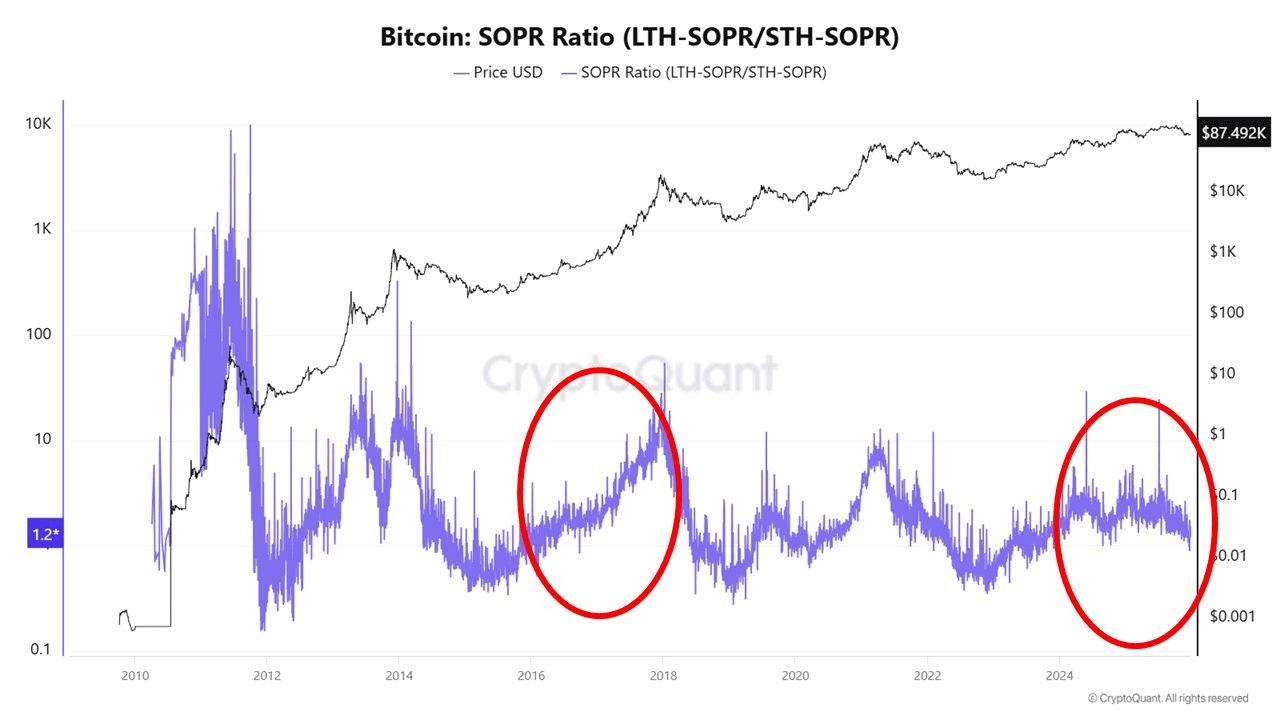
Source: CryptoQuant

Based on historical data, it becomes clear that Bitcoin is currently within a fundamentally bearish structure. Although XWIN Research elucidates that “as long as long-term holders maintain relative dominance and short-term holder selling is absorbed, downside may be supported,” but this came with a caveat that upside leadership would likely also remain restricted.

The analytics group further conjectures that a stable growth of Bitcoin ETF inflows, alongside a clear depreciation in LTH distribution, would be pivotal in rescuing BTC from its downward spiral. Until these happen simultaneously, bitcoin might remain in its current state of inertia, or — in the worst case — dive further south. At press time, Bitcoin holds a valuation of about $87,623, recording a slight 0.5% loss since the past week, and a 0.6% ascent since the last 24 hours, according to CoinMarketCap data.

BTC trading at $87,637 on the daily chart | Source: BTCUSDT chart on Tradingview.com

Trending Cryptos

Related Questions

QAccording to the analyst, why is Bitcoin's price action after the 2024 election different from the post-2016 election euphoria?

AThe market environment is fundamentally different. In 2016, the market operated in a low-inflation, low-interest-rate environment ideal for liquidity growth, and the crypto market's small size allowed for quick speculative capital accumulation. In contrast, 2025 began in a high-rate period with crippling financial conditions, and the larger market size has structurally reduced the standalone impact of political events on price.

QWhat does the Bitcoin SOPR Ratio (LTH-SOPR/STH-SOPR) indicate about current market sentiment?

AThe ratio indicates a cautious stance among investors. It shows that long-term holders (LTHs) are realizing limited profits, while short-term holders (STHs) are trading at a loss. This condition historically occurs when the market is about to enter a prolonged period of demand-supply adjustments.

QWhat two key factors does the analytics group suggest are needed to rescue BTC from its downward spiral?

AThe two pivotal factors are a stable growth of Bitcoin ETF inflows and a clear depreciation in long-term holder (LTH) distribution. Both need to happen simultaneously for a recovery.

QWhat is the current fundamental structure of the Bitcoin market, as per the historical data presented?

ABased on historical data, Bitcoin is currently within a fundamentally bearish structure.

QWhat is the caveat to the analyst's statement that the downside may be supported?

AThe caveat is that while the downside may be supported as long as LTHs maintain dominance and STH selling is absorbed, upside leadership would also likely remain restricted.

Related Reads

Global Stock Market's Storm Center: South Korea's Stock Market De-leveraging Is Largely Complete

Storm's Eye: South Korean Market De-leveraging Nears Completion The recent sharp correction in South Korean equities, with the KOSPI index dropping 32% from its June high, has been a key trigger for global tech stock volatility. The core driver was not a fundamental shift but a forced de-leveraging process within the market's unique structure, which is now largely complete. Two main leverage channels amplified the sell-off: 1. **Leveraged ETFs:** Their size, proportionally four times larger than in the U.S., peaked near $50 billion. Their mandatory daily rebalancing mechanism created a vicious cycle of "price drop → forced selling → further drop." Approximately 75% of this excess has been unwound, shrinking to $26 billion, with regulatory curbs now blocking new inflows. 2. **Hedge Fund Leverage:** Using swaps to magnify exposure, hedge funds saw their net long positioning fall by over 50% from peak levels. The most intense phase of this institutional de-leveraging is over. In contrast, **retail margin debt** poses minimal systemic risk. At 0.5% of market cap, it is far lower than in the U.S. or China, lacks automatic triggers, and is concentrated in smaller stocks. The conclusion: the high-leverage structures most prone to "chain-reaction selling" have been substantially cleared. The market is transitioning from a liquidity-driven crash to one priced more on fundamentals. The article argues that the AI trend—centered on Korean memory chips—remains intact. This episode represents a painful but necessary clearing of crowded trades, not the end of the AI revolution. For investors, the key question is conviction in the long-term AI direction; if the trend is real, current volatility is a cost of entry, not a terminal risk.

链捕手1h ago

Global Stock Market's Storm Center: South Korea's Stock Market De-leveraging Is Largely Complete

链捕手1h ago

Trading

Spot

Hot Articles

Discussions

Welcome to the HTX Community. Here, you can stay informed about the latest platform developments and gain access to professional market insights. Users' opinions on the price of S (S) are presented below.

活动图片















