TON/GRAM price prediction – Telegram’s Gram wallet rollout lifts token: Can the rally continue?

ambcryptoPublished on 2026-07-22Last updated on 2026-07-22

Abstract

Telegram founder Pavel Durov announced the rollout of a native, non-custodial Gram wallet across the messaging app, describing it as potentially the largest deployment of a non-custodial wallet in history. The move aims to bring instant, zero-fee crypto transactions to Telegram's over one billion users, integrating digital assets directly into the platform. The news triggered a more than 7% price increase for TON/GRAM, pushing the token to around $1.53. However, it remains below its May peak near $2.80, facing immediate resistance around $1.60. Analysts suggest a break above this level could improve sentiment toward $1.80, while a failure to hold gains might see a retest of support near $1.40.

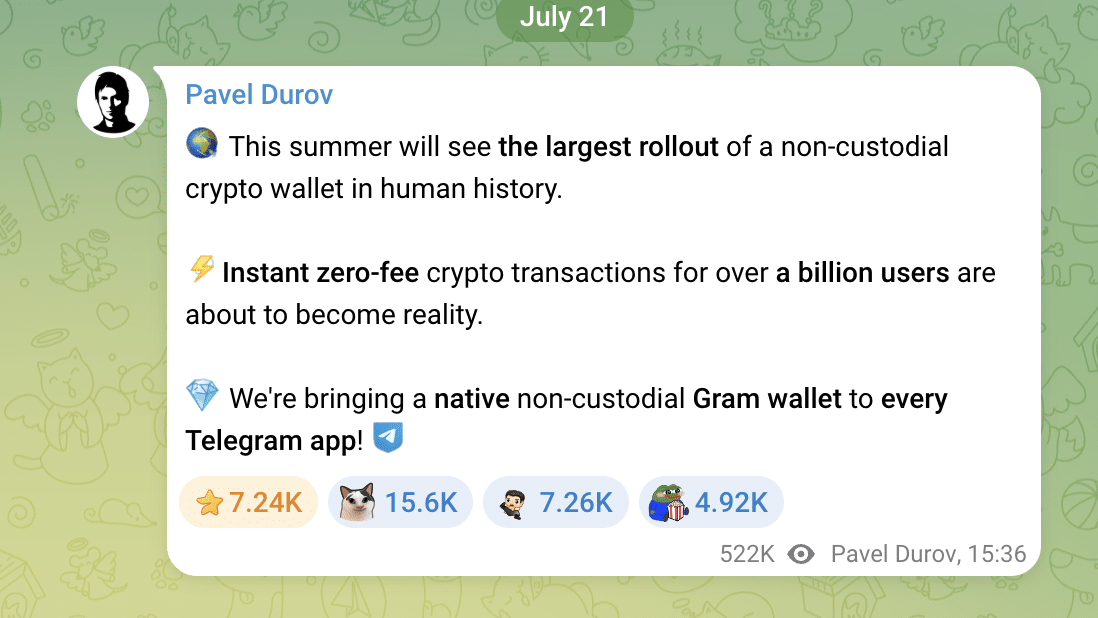
TON, which is set to be rebranded as Gram [GRAM], gained more than 7% after Telegram founder Pavel Durov unveiled plans to roll out a native non-custodial Gram wallet across the messaging platform.

Durov described the initiative as “the largest rollout of a non-custodial crypto wallet in human history”. He said the wallet would bring instant zero-fee crypto transactions to Telegram’s more than one billion users.

Telegram expands its crypto ambitions with native Gram wallet

In a Telegram post, Durov said every Telegram app would receive a native, non-custodial Gram wallet, allowing users to send and receive crypto without relying on a custodial service.

He also said the wallet would enable instant zero-fee crypto transactions, positioning the feature as a major step toward integrating digital assets into Telegram’s messaging ecosystem.
Source: telegram

The announcement follows Telegram’s recent decision to rename TON’s native token to Gram. This signals a clearer distinction between The Open Network [TON] as the blockchain and Gram as the consumer-facing digital currency within Telegram’s ecosystem.

If rolled out as described, the wallet would give Telegram one of the largest built-in crypto distribution channels globally. This exposes self-custody and blockchain payments to an existing user base of more than one billion people.

Why the rollout could matter

Unlike traditional custodial wallets, non-custodial wallets allow users to retain control of their private keys rather than entrusting them to a third party.

Embedding that functionality directly into Telegram could significantly reduce the friction of creating and using a crypto wallet, particularly for users unfamiliar with decentralized applications.

The move also expands Telegram’s broader crypto strategy beyond blockchain infrastructure. It places crypto payments directly inside one of the world’s largest messaging platforms.

Whether widespread adoption follows will depend on user engagement once the feature launches. However, the scale of Telegram’s existing audience suggests the rollout could become one of the largest consumer-facing crypto deployments to date.

TON/GRAM price prediction: Can bulls build on the rebound?

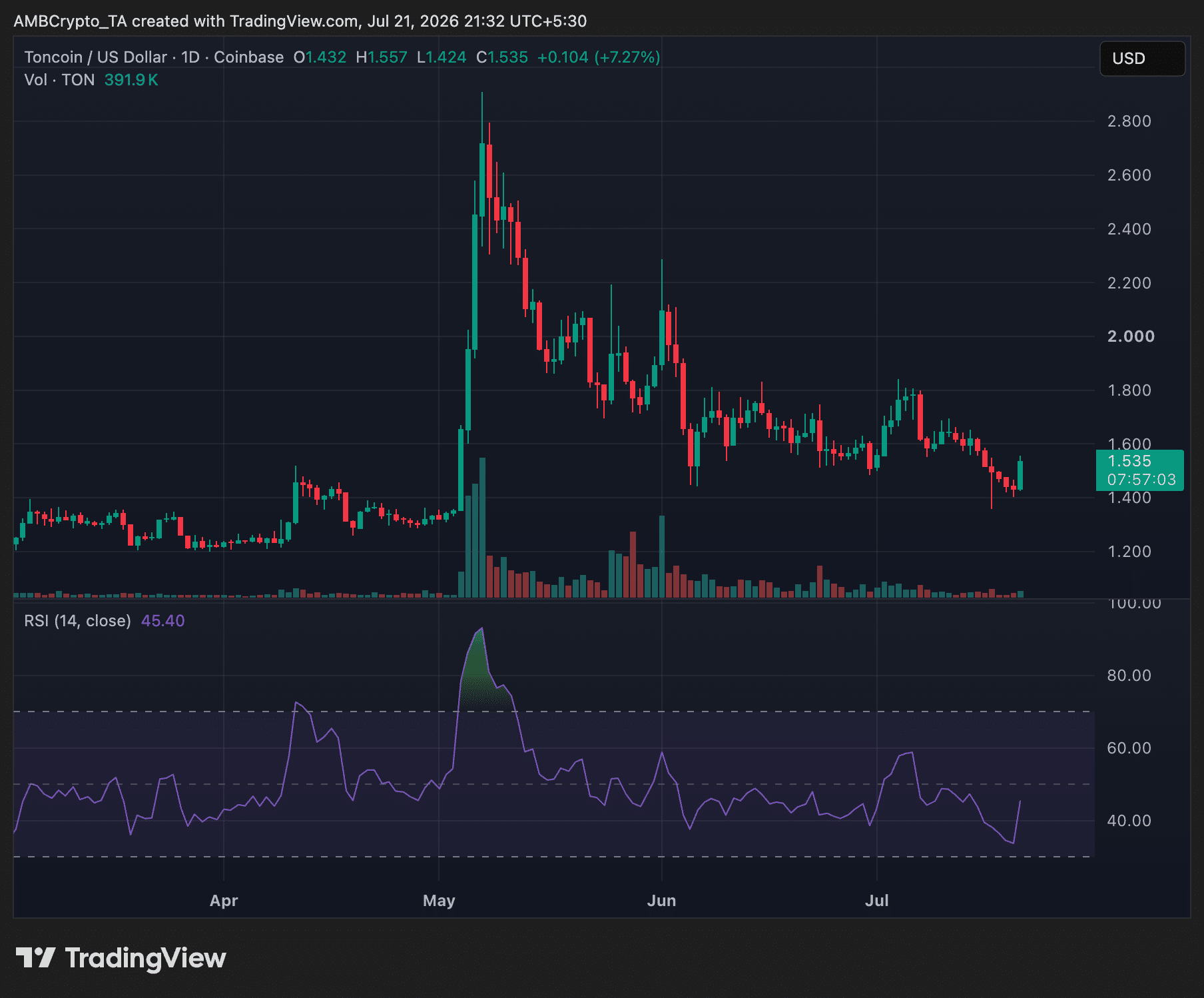
At press time, TON/GRAM traded around $1.53, up roughly 7.3% over the previous 24 hours after bouncing from support near $1.40.

The recovery pushed the daily RSI to around 45, indicating bearish momentum had eased. However, the indicator remained below the neutral 50 level.

Despite the latest rally, TON/GRAM remains well below its May peak near $2.80, suggesting the broader downtrend has yet to reverse.
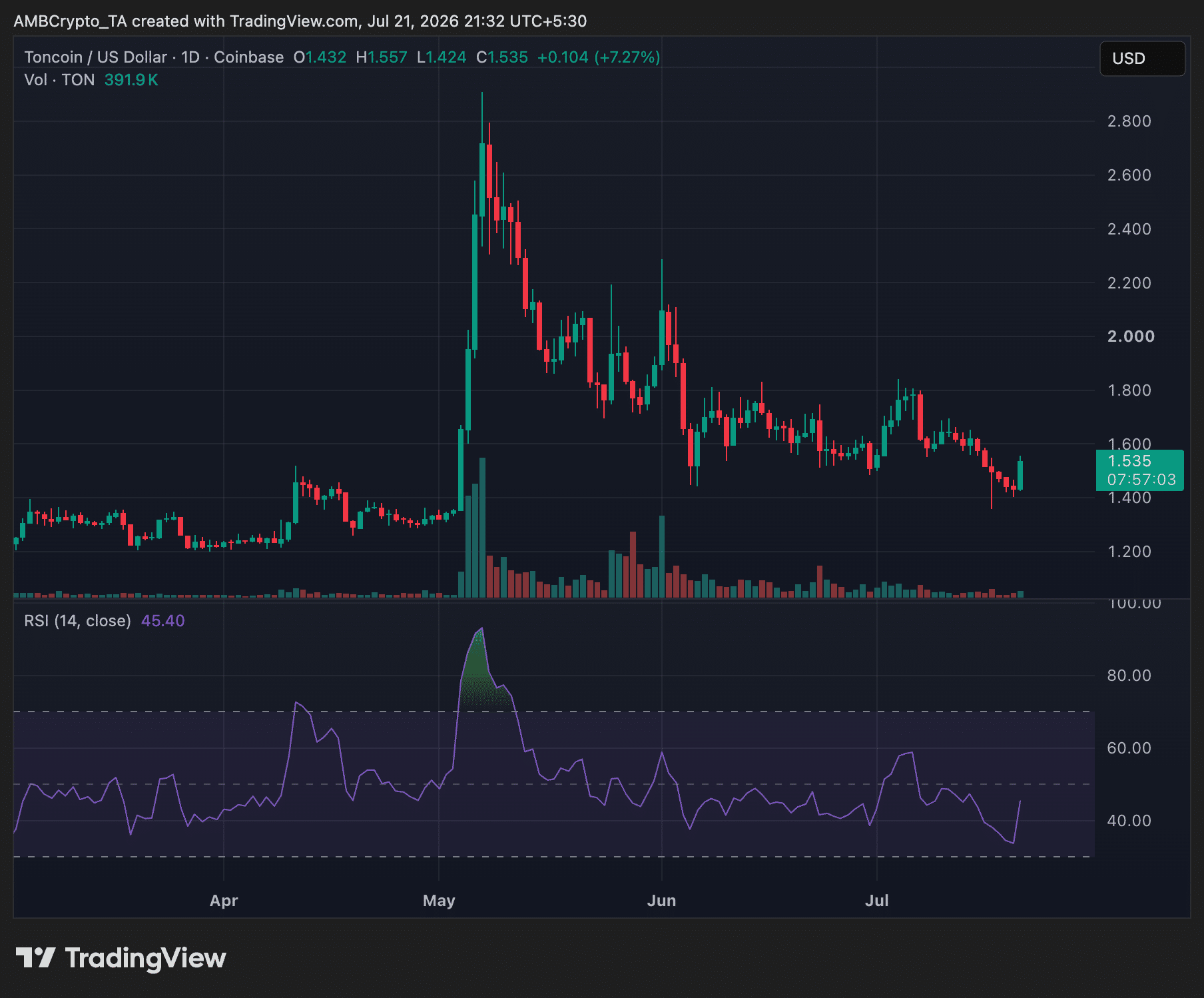
Source: TradingView

The immediate resistance sits around $1.60, where sellers have repeatedly capped recent advances.

A sustained break above that level could improve short-term sentiment and open the path toward $1.80. At the same time, failure to hold recent gains may see the token retest support around $1.40.


Final Summary

  • Pavel Durov announced that Telegram will roll out a native non-custodial Gram wallet to every Telegram app.
  • TON/GRAM rose more than 7% following the announcement. However, the token still faces resistance around $1.60 and remains below its May highs.

Trending Cryptos

Related Questions

QWhat is the main reason behind the 7% price increase of TON/GRAM mentioned in the article?

AThe price increase followed the announcement by Telegram founder Pavel Durov about plans to roll out a native, non-custodial Gram wallet across the Telegram messaging platform to all its users.

QWhat key feature of the new Gram wallet is highlighted by Pavel Durov?

APavel Durov highlighted that the Gram wallet will enable instant zero-fee crypto transactions for Telegram's user base.

QAccording to the article, what is the significance of renaming TON's native token to Gram?

AThe renaming signals a clearer distinction between The Open Network (TON) as the blockchain infrastructure and Gram as the consumer-facing digital currency within Telegram's ecosystem.

QWhat is the immediate resistance level for the TON/GRAM price as per the article's analysis?

AThe immediate resistance level for TON/GRAM is around $1.60, where sellers have repeatedly capped recent price advances.

QWhat broader trend does the article suggest TON/GRAM is still in despite the recent rally?

ADespite the recent rally, the article suggests TON/GRAM remains in a broader downtrend, as it is still well below its May peak near $2.80.

Related Reads

Leverage Flush, ETF Selling Pressure Not Yet Exhausted: The On-Chain Truth Behind the $64K Defense Line

After a month of range-bound trading, crypto markets suffered a brutal deleveraging washout last weekend, with Bitcoin falling roughly 13% in a week and briefly piercing $63,000, marking its sharpest single-day volatility in months. Glassnode's Week 47 Market Pulse report notes that while overheated derivatives leverage has largely been flushed out, continued outflows from spot ETFs are pushing the sector toward a critical threshold, with the aggregate ETF MVRV nearing the 1.0 break-even line. On-chain microdata shows loss pressure concentrated among recent entrants, with short-term holders now underwater overall. Bitcoin hovered near $64,000 on Monday after a weekly close down about 13%. The sell-off began Thursday and accelerated over the weekend, briefly breaking $63,000 on Saturday for the lowest level since late August. The concentrated selling rapidly cleared leveraged positions built up in derivatives over prior weeks. Perpetual futures open interest fell to the lower bound of its statistical range, and funding rates cooled sharply from warning levels back to neutral. Meanwhile, U.S. spot ETF investors extended net outflows, recording withdrawals every trading day last week, with aggregate ETF MVRV sliding to 1.06, extremely close to holders' break-even benchmark. On-chain activity remains relatively robust, with daily active addresses and large transfers holding up, but paper losses fall almost entirely on holders who entered in recent months. Short-term holders have turned fully underwater, and realized losses hit their highest level since July. In derivatives, spot momentum plunged 36.1% to 22.8, the weakest since August. Spot CVD deteriorated from -$51.5M to -$133.7M, with aggressive selling dominant Thursday through Saturday before slowing Sunday. Futures open interest fell 7.2% to $34.2B, also at the range's lower bound. Perpetual CVD widened from -$493M to -$1.4B, reflecting forced liquidations and stop-losses among speculative longs. The 25-delta skew jumped 30.9% to 13.7%, a new put-premium record since August, signaling strong demand for downside hedges. Spot ETF weekly net outflows narrowed slightly to -$995.4M but remain near the range bottom; weekly trading volume fell to $11.5B as institutions stayed defensive. On-chain, entity-adjusted daily transfer volume rose 3.6% to $5.4B near the upper bound, and daily active addresses totaled about 659,700, still healthy. However, realized cap monthly growth nearly stalled, dropping from 0.43% to 0.04%, indicating significantly slower external capital inflows. The STH-to-LTH supply ratio edged up to 15.1%, and hot capital share held at a high 22.0%, showing young coins bought within three months still carry heavy trading weight. The share of supply in profit fell from 60.4% to 55.3%, and STH-NUPL turned negative at -7.4%, historically a typical zone for capitulation-style turnover. Overall, the crash was driven by persistent ETF reduction, speculative long squeeze, and macro risk aversion. Open interest and funding rates have left dangerous overheated levels, clearing much pure leverage risk. Whether ETF net outflows turn positive and whether short-term holder capitulation spreads to long-term believers will determine if $64,000 becomes a solid bottom.

marsbit34m ago

Leverage Flush, ETF Selling Pressure Not Yet Exhausted: The On-Chain Truth Behind the $64K Defense Line

marsbit34m ago

US Stocks Trend (November 17): Nvidia Falls Another 4% to a 52-Week Low, Nasdaq Plunges 2.49%

Nvidia fell another 4.1% to $156.14, hitting a 52-week low, as the chipmaker's troubles deepened. Micron and Intel each dropped over 7%, and the Nasdaq tumbled 2.49%. The selloff spread to financials, industrials and energy, with all three major indexes closing lower. The Dow fell 739.38 points (-1.41%) to 51,608.17, the S&P 500 lost 145.08 points (-1.92%) to 7,416.59, and the Nasdaq dropped 626.52 points (-2.49%) to 24,509.76. The Russell 2000 fell 1.70%. It was the Nasdaq's biggest one-day decline since Nov. 5, and the S&P 500 and Nasdaq have now fallen for three straight sessions, erasing last week's gains. Nine of the S&P 500's 11 sectors declined, with tech and communication services down 2.98% and 2.82%, while consumer staples and utilities edged higher. The VIX jumped 18.7% to 22.91. Nvidia's board is focused on its investigation of Jensen Huang and has not discussed bringing him back as CEO, according to CNBC. The company has hired law firm Wachtell Lipton to investigate whether his conduct endangered national security or company secrets. Treasury Secretary Bessent called for a major overhaul and urged the board to look externally for a new CEO. The Commerce Department's BIS issued an interim final rule closing a loophole allowing Chinese firms to rent Nvidia compute through third-country data centers. Wall Street kept cutting targets: Mizuho lowered its to $220 from $250 and UBS to $240 from $300, both maintaining buy ratings. Mizuho's Vijay Rakesh said the roughly 32% drop from October's high, larger than the Philadelphia Semiconductor Index's 23% decline, reflects a lost "founder premium," with the CEO departure adding six to seven months of management uncertainty. Chip stocks fell broadly: Micron -7.62% to $719.02, Intel -7.07% to $55.47, Marvell and Arm each down over 7%, AMD about -6%, Broadcom about -4%, and the iShares Semiconductor ETF -5%. SanDisk and Lumentum fell over 8%, Dell about 7%, Oracle about 5%. Financials joined the afternoon selloff, with Morgan Stanley, Goldman Sachs and JPMorgan each down over 2%; Caterpillar fell 4.95% and Boeing 3.66% to a 52-week low. Defensive names outperformed: P&G rose 1.90% to a 52-week high, Molina Healthcare jumped 11.27% and Tyson Foods gained 8.72%. The November Empire State manufacturing index came in at 7.8, down 18 points from October and below the 16.7 expected; new orders fell to 3.0 while employment rose to 18.1, the highest since June 2022. The 10-year Treasury yield fell 2.2 basis points to 5.117% and the 2-year dropped 3.1 basis points to 4.821%, a bull steepener. Fed Chair Warsh's remarks focused on AI, warning it could disappoint, with little on monetary policy. WTI crude fell 3.21% to $85.72 a barrel and Brent dropped 3.55% to $92.44, as reports that the U.S. has no immediate plans to strike Iran outweighed support from an Iranian attack on a Bahrain air base and a tanker hitting a mine in the Strait of Hormuz. Gold fell 0.86% to $3,853 an ounce and silver plunged 4.60%. Bitcoin fell as low as $62,000 over the weekend, its lowest since August, and traded around $65,300 after the close. Looking ahead, Nvidia reports fiscal third-quarter results after the bell on Tuesday, with Bloomberg consensus at $2.47 EPS on about $109.15 billion in revenue; interim CEO Colette Kress will host the call, and options pricing implies an 8% move this week. Disney and Home Depot report before the open Tuesday, alongside October retail sales and import price data. Later in the week, Anthropic is expected to price Wednesday and list on Nasdaq Thursday at $70-78 per share, valuing it around $1.4 trillion, and Take-Two's GTA VI launches Thursday.

marsbit40m ago

US Stocks Trend (November 17): Nvidia Falls Another 4% to a 52-Week Low, Nasdaq Plunges 2.49%

marsbit40m ago

Altman Empathizes with Jensen Huang: 'Heroes Have Flaws,' But Does He Support His Return as NVIDIA CEO...

At the Semafor Silicon Valley Summit on November 16, OpenAI CEO Sam Altman publicly addressed Nvidia founder Jensen Huang's resignation as CEO after 33 years, expressing strong personal empathy. Altman called Huang "a hero of mine" and said it's hard to imagine the AI revolution without him, acknowledging that "heroes have flaws." Nvidia's stock fell about 15% within a week, wiping out over $570 billion in market value, and 180,000 people signed a petition urging his reinstatement—echoing Altman's own 2023 board ouster and dramatic return. Altman noted that Nvidia and OpenAI bet on each other early on. On business matters, he dismissed concerns that Nvidia's commitments—including a $105 billion financial guarantee for an OpenAI data center in Ohio—would lose credibility, saying the company is now a massive giant whose backing remains trusted. He also expressed optimism that the AI industry will keep advancing without Huang, given strong market demand and validated AI value. Altman identified scientific research as the next major AI breakthrough area, citing progress in math and physics, and predicted AI will take over repetitive, process-driven enterprise work. He also clarified his controversial memory chip remarks (saying he actually supports consumers upgrading their own PCs), explained that chip demand projections from multiple suppliers overlap even though real data center demand is solid, said OpenAI has not yet launched fully autonomous recursive self-improvement due to safety concerns, and stated OpenAI is in no rush to IPO despite Anthropic's filing, noting investor demand far exceeds quality supply.

marsbit44m ago

Altman Empathizes with Jensen Huang: 'Heroes Have Flaws,' But Does He Support His Return as NVIDIA CEO...

marsbit44m ago

If you lose money helping a friend trade cryptocurrency, will it be deemed fraud?

When friends entrust you with money to trade cryptocurrency on their behalf and the market turns against them, two distinct legal questions arise: whether you must compensate them, and whether your conduct constitutes fraud. These are separate issues. Civil liability depends on the nature of the relationship—whether it was a loan, a委托 investment, or a joint venture—and on the validity of any agreement. Under Chinese policy, virtual currency investment activities are treated as illegal financial activities, and civil acts involving them that violate public order and good morals are void, with losses generally borne by the parties themselves. Courts have reached different outcomes: in one case, an investor's claim for full repayment was rejected because the loss stemmed from market risk; in another, the operator was ordered to bear 20% of the loss for failing to recognize compliance risks, while the investor bore 80%. Fraud, by contrast, requires proof of deceptive conduct and intent to illegally possess the funds—mere trading losses or refusal to repay do not establish fraud. However, fabricating trade records, misappropriating funds, or secretly using leverage contrary to instructions can change the analysis. If a dispute escalates or police become involved, the priority is to preserve complete records of the agreement, fund flows, and trading history, avoid making unauthorized repayment promises, and cooperate truthfully with authorities while seeking professional legal advice.

marsbit44m ago

If you lose money helping a friend trade cryptocurrency, will it be deemed fraud?

marsbit44m ago

Trading

Spot

Hot Articles

How to Buy GRAM

Welcome to HTX.com! We've made purchasing prev. Toncoin (GRAM) simple and convenient. Follow our step-by-step guide to embark on your crypto journey.Step 1: Create Your HTX AccountUse your email or phone number to sign up for a free account on HTX. Experience a hassle-free registration journey and unlock all features.Get My AccountStep 2: Go to Buy Crypto and Choose Your Payment MethodCredit/Debit Card: Use your Visa or Mastercard to buy prev. Toncoin (GRAM) instantly.Balance: Use funds from your HTX account balance to trade seamlessly.Third Parties: We've added popular payment methods such as Google Pay and Apple Pay to enhance convenience.P2P: Trade directly with other users on HTX.Over-the-Counter (OTC): We offer tailor-made services and competitive exchange rates for traders.Step 3: Store Your prev. Toncoin (GRAM)After purchasing your prev. Toncoin (GRAM), store it in your HTX account. Alternatively, you can send it elsewhere via blockchain transfer or use it to trade other cryptocurrencies.Step 4: Trade prev. Toncoin (GRAM)Easily trade prev. Toncoin (GRAM) on HTX's spot market. Simply access your account, select your trading pair, execute your trades, and monitor in real-time. We offer a user-friendly experience for both beginners and seasoned traders.

4.9k Total ViewsPublished 2026.06.15Updated 2026.08.20

How to Buy GRAM

Discussions

Welcome to the HTX Community. Here, you can stay informed about the latest platform developments and gain access to professional market insights. Users' opinions on the price of GRAM (GRAM) are presented below.

活动图片