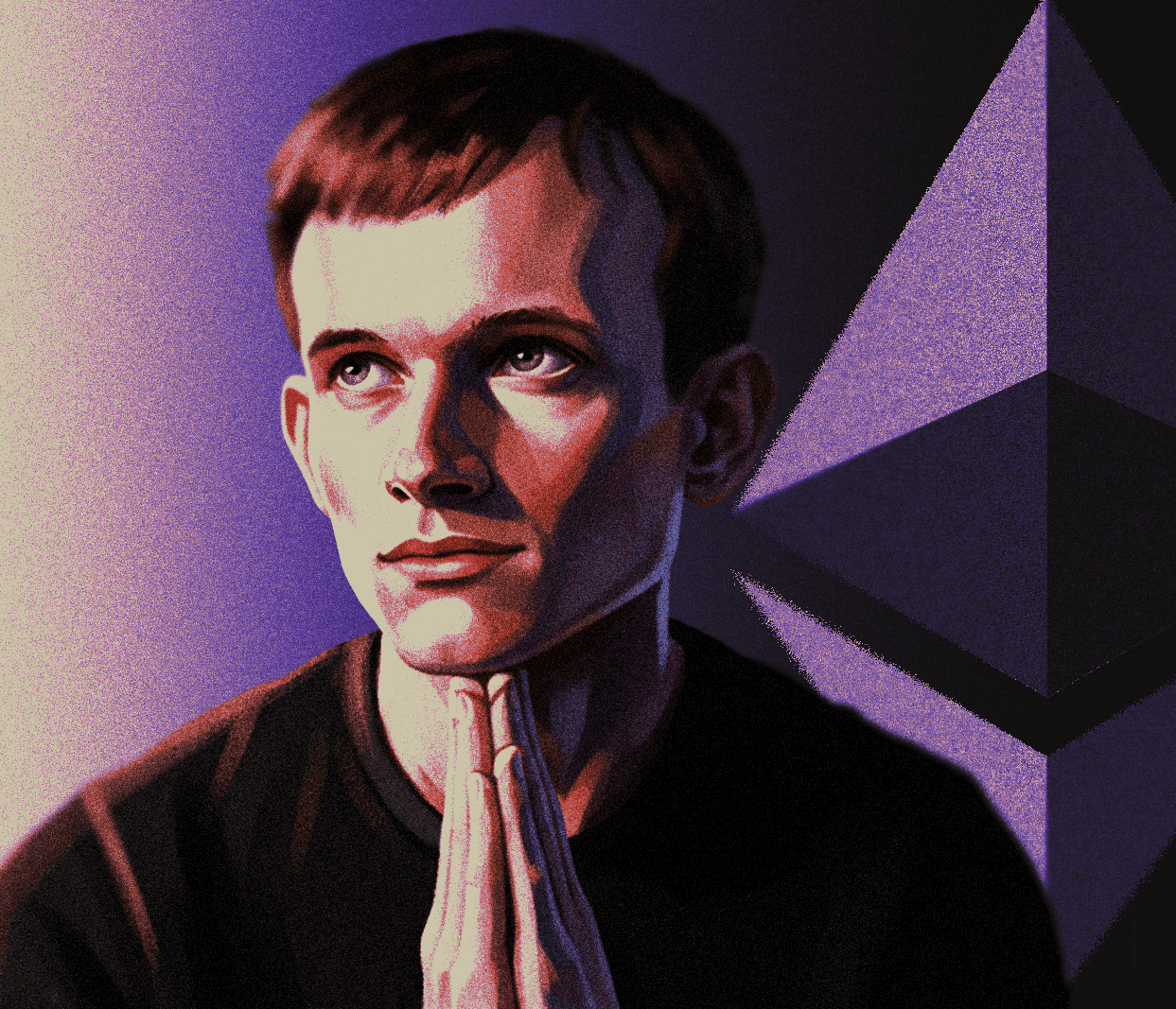
When Vitalik Stops Blogging to Write Sci-Fi

marsbitPublished on 2026-05-28Last updated on 2026-05-28

Abstract

Vitalik Buterin, founder of Ethereum, has announced a pause in his long-form technical blogging to instead write a science fiction novel exploring decentralized governance. The story, set in a fictional nation called Veridia, follows a member of a governance body that uses complex systems like quadratic voting, privacy-preserving audits, and AI-assisted decision-making to guide society through incentive structures rather than outright bans. This creative shift comes at a pivotal moment for the Ethereum ecosystem. The Ethereum Foundation has seen significant internal upheaval in 2026, with at least nine core contributors, including key protocol leaders, departing. Just days before his announcement, Vitalik published a statement addressing this turbulence, framing the Foundation as a "smaller ship" that will now focus on core principles like censorship resistance and security, while moving from a growth-oriented to a sustainability-focused organization. The novel's themes directly mirror Vitalik's long-standing technical interests in governance mechanisms. Community reactions are mixed: some see it as a thoughtful exploration of ideas through narrative, while others view the timing—amidst core team departures and a significant drop in ETH's price—as pointedly symbolic. The move is also interpreted as a personal transition, signaling Vitalik's evolving role from a central executive figure to one of many decentralized thought leaders within the Ethereum ecosystem.

Author: Claude, Deep Tide TechFlow

Deep Tide Introduction: On May 27th, Vitalik Buterin announced on Farcaster that he is pausing his long-form blog writing to focus on creating a science fiction novel centered on decentralized governance. He has completed two chapters so far.

The novel is set in a fictional country called "Veridia," which operates mechanisms like quadratic voting, privacy-protecting audits, and AI-assisted decision-making. The timing of this shift is noteworthy: by 2026, at least 9 core members have already left the Ethereum Foundation, the price of ETH has fallen below the $2,100 mark, and just three days prior, Vitalik himself announced that the Foundation would become a "smaller ship."

Vitalik, the founder of Ethereum, isn't writing technical blogs anymore. He's writing a novel...

On May 27th, Vitalik Buterin posted a brief statement on Farcaster: "Instead of continuing with regular blog posts, I've decided to try writing some sci-fi about decentralized governance," along with a link to the first two chapters on his personal website.

According to a BeInCrypto report on May 27th, this marks a rare formal shift in Buterin's public writing career.

Over the past decade, his long-form articles have essentially constituted first-hand literature for the evolution of Ethereum's ideas, covering nearly all core topics from L2 scaling and DAO governance to quadratic voting. Now, he's chosen to embed these ideas into a fictional narrative instead of continuing with EIP-style technical arguments.

This choice in itself isn't surprising. But the timing is hard not to think about:

Just three days prior, he published a lengthy post on X defending the Foundation's personnel turmoil. Two weeks ago, core leads of the Foundation's protocol team had collectively departed. The price of ETH has fallen more than 57% from its peak near $5,000 in August 2025.

"Veridia" in the Novel: The Governance System of Vitalik's Ideals

We had an AI quickly read the two completed chapters to see what Vitalik really wants to express.

The story of the two chapters takes place in a fictional country called Veridia. The protagonist, Gladias, is a novice member of the "Order of Steering." This organization is the core executive body of Veridia's governance system, responsible for maintaining a sophisticated set of tax and subsidy assessment rubrics, which replace traditional legal prohibitions.

Veridia's governance logic is clear: it almost never directly bans anything. The criminal code is extremely streamlined, replaced by a social governance system driven by tax rate incentives. A band wants to sing violent songs? No one will arrest them, but they might be classified into a higher tax bracket because of it.

The specific operation of this system is worth dissecting, as it's almost a fictionalized presentation of Vitalik's technical blog posts from the past few years:

The "Order of Steering" consists of three types of roles. "Keepers" are responsible for formulating and updating the tax assessment rubrics. "Sentinels" are responsible for auditing the classification of specific enterprises. A panel of 9 is randomly selected via cryptography, divided into three groups for independent deliberation, with the median of their votes taken. "Acolytes" are the reserve pool for Keepers and Sentinels, handling lower-priority audits. The system continuously scores them, and only the top 10% performers get promoted.

Privacy protection is the underlying logic of the entire system. Members of the Order wear uniform "privacy robes" to conceal their identities and are strictly forbidden from leaking audit tasks. Anyone can submit a guess through a decentralized cryptographic network to reveal a member's identity. If correct, the member gets a salary deduction, and the whistleblower gets half as a bounty. The goal of this mechanism is to prevent bribery and external influence.

In the first chapter, the protagonist also participates in another form of public governance: public aesthetic scoring. Citizens are randomly assigned to public goods (like billboards on buses) and score them using sliders. Here, quadratic voting—something Vitalik has championed for years—appears: all votes are automatically normalized so that each person's average score is zero and variance is one. Extreme votes compress your influence on other issues. The novel's line is that this mechanism is mathematically proven optimal—voting intensity should match the intensity of your true feelings, no more, no less.

The second chapter shifts scenes to an underground educational community called Dzego, where two students travel across the city for a physics class. Dzego's survival strategy is summarized in four words: "Rooted but leaderless." Classroom locations are decrypted via an encrypted broadcast announced just before class. The teaching venue is covered in signal-blocking foil, with security protocols frequently switching cryptographic proof systems.

What's Written into the Novel Is What Can't Be Pushed Through in Reality

Looking at the novel's content alone, it's just a cleverly conceived piece of governance sci-fi. But placed back into the context of Ethereum in 2026, the parallels become clear.

The "Order of Steering" in Veridia is a decentralized, anonymous, cryptographically protected governance organization with no single authority, where members are promoted based on performance rankings. In reality, the Ethereum Foundation (EF) in 2026 has experienced its most significant personnel exodus since its inception.

According to a comprehensive tally from a CoinDesk report on May 18th and an Unchained report on May 20th, at least 9 senior contributors have left or announced their impending departure from the Foundation since the start of 2026. Co-Executive Director Tomasz Stańczak resigned in February, serving less than a year; Operations and Writing Lead Josh Stark left in March after 7 years; Protocol Guild founder Trent Van Epps also left in April.

The impact in May was more concentrated.

Protocol Cluster co-leads Tim Beiko and Barnabé Monnot stepped down simultaneously, while Alex Stokes went on indefinite leave. Within the following week, early beacon chain design contributor Carl Beek (7-year tenure) and Julian Ma, core author of the anti-censorship mechanism FOCIL (EIP-7805), also announced their resignations.

On May 24th, just three days before announcing the novel, Vitalik posted a long thread on X responding to this personnel storm. He likened the Foundation to "a smaller ship," stating it would focus on the CROPS framework (Censorship Resistance, Centralization-resistance pressures, Openness, Privacy, Security). He acknowledged that the Foundation's original technical mission was largely complete by 2022, and it was now transitioning from an expansionary to a sustaining organization.

He also revealed that 90% of his net worth is still in ETH and that the Foundation holds only 0.16% of the total ETH supply, worth approximately $408 million.

"The Foundation is choosing to use its remaining resources to pursue longevity rather than breadth, and yes, that means we sell less ETH," Vitalik wrote. Interim Co-Executive Director Bastian Aue (who replaced Stańczak in February) is executing this transition.

Contrast this statement with Veridia's governance system in the novel: in the fiction, there's cryptographically guaranteed decentralized auditing, mathematically proven optimal quadratic voting, and AI-assisted but not human-replacing evaluation systems.

But in reality, the Foundation struggles to retain even its core R&D personnel, with governance discussions focusing on "who is leaving" and "why."

Community Reaction: The Novel Deserves a Serious Read, but the Timing Is Bittersweet

The community's reaction to Vitalik writing sci-fi itself has been relatively positive. A crypto.news report on May 27th commented that Buterin is essentially migrating his thoughts on decentralized governance from whitepapers and blog formats into speculative storytelling, using a fictional world to test the coordination, incentives, and power distribution issues he previously discussed in papers.

BeInCrypto's analysis pointed out that Vitalik has long advocated that quadratic voting and pluralistic mechanisms can dilute the influence of large token holders. The narrative format of the novel gives him space to dramatize these mechanisms within fictional cities and crisis scenarios.

His recent statement describing the Foundation as "one of many nodes" also explains why this announcement was posted on Farcaster rather than a centralized social platform.

However, more critical voices exist.

At a time when the Foundation has just lost almost all core members of its protocol team, the founder's allocation of energy is itself a signal. Vitalik himself laid the groundwork for this in his May 24th X thread—he explicitly stated that his power within the Foundation will continue to diminish, "which is what I want," and that the transition is being executed by Bastian Aue, not by him.

From this perspective, writing sci-fi is also a declaration of a role switch: he is no longer the core executor for the Foundation, but a node of thought within the Ethereum ecosystem.

This also aligns perfectly with Veridia's governance philosophy in the novel. Everything is going as planned.


Related Questions

QWhy did Vitalik Buterin announce he will stop writing regular blogs and start writing a sci-fi novel?

AVitalik Buterin announced he will stop writing regular technical blogs and start writing a sci-fi novel about decentralized governance to explore his ideas on coordination, incentives, and power distribution through speculative storytelling, a shift from his usual EIP-style technical arguments.

QWhat is the name of the fictional country in Vitalik Buterin's sci-fi novel, and what is its core governance principle?

AThe fictional country in Vitalik Buterin's sci-fi novel is called Veridia. Its core governance principle is to rarely prohibit anything directly, instead using a complex tax and subsidy incentive system driven by detailed 'rubrics' to guide societal behavior, replacing traditional legal bans.

QAccording to the article, what significant real-world event in the Ethereum ecosystem is happening concurrently with Vitalik's shift to writing fiction?

AConcurrently with Vitalik's shift to writing fiction, the Ethereum Foundation is experiencing its most severe personnel exodus, with at least 9 core members, including key protocol team leaders, having left or announced their departure in 2026.

QWhat mechanism from Vitalik's previous technical writings is featured in the novel's public aesthetics scoring system?

AThe novel's public aesthetics scoring system features Quadratic Voting, a mechanism Vitalik has long advocated. In the system, votes are normalized so each person's average score is zero with a variance of one, mathematically designed to ensure voting intensity matches the true strength of feeling.

QHow did Vitalik describe the future role of the Ethereum Foundation in his May 24th post, and how does it relate to his new activity?

AIn his May 24th post, Vitalik described the Ethereum Foundation as transforming into a 'smaller ship' focused on sustainability (the CROPS framework) rather than expansion. This shift, alongside his stated desire for his own power within the EF to diminish, contextualizes his move to writing fiction as a symbolic transition from a core executor to a thought leader or 'node' within the ecosystem.

Related Reads

Single-Day Plunge of 30%, Arthur Hayes Suddenly Liquidates: Why Did ZEC Get Exploded by Security Issues?

On June 5th, Zcash founder Zooko Wilcox disclosed a critical soundness vulnerability in the project's latest Orchard privacy pool. This flaw, found in the elliptic curve multiplication constraints, could allow an attacker to create unlimited counterfeit ZEC within the shielded pool, with transactions appearing valid. The vulnerability was discovered in late May by security researcher Taylor Hornby, who utilized Anthropic's new Opus 4.8 AI model for a targeted audit. The Zcash ecosystem had already performed an emergency network upgrade to patch the issue. However, the detailed disclosure triggered severe market panic, causing ZEC's price to plummet over 30% in a single day. Notably, prominent investor Arthur Hayes announced he had sold his entire ZEC position following the news. The incident starkly challenges the "technological trust" narrative central to privacy coins. Despite years of top-tier cryptographic audits, the bug persisted until uncovered with advanced AI-assisted research. This highlights the growing gap between theoretical perfection and practical implementation in privacy technology. The event serves as a industry-wide warning: in an AI-driven security landscape, the assumption that "undiscovered equals safe" is obsolete. It underscores the urgent need for continuous, proactive security practices combining AI audits, formal verification, and rapid response mechanisms.

foresightnews_api54m ago

Single-Day Plunge of 30%, Arthur Hayes Suddenly Liquidates: Why Did ZEC Get Exploded by Security Issues?

foresightnews_api54m ago

Breaking the Curse of DeFi Cascading Liquidations, Vitalik Proposes a New Solution

**Vitalik Buterin Proposes New DeFi Design to Eliminate Forced Liquidations** Ethereum co-founder Vitalik Buterin has published a proposal for a new decentralized finance (DeFi) architecture aimed at removing the automatic liquidation mechanisms prevalent in current lending protocols. The core idea involves creating synthetic assets using options as building blocks, fundamentally avoiding the抵押借贷结构 that triggers forced sell-offs. The proposal responds to a recurring flaw in DeFi: during sharp market downturns, mass自动清算 of under-collateralized positions can exacerbate price declines, creating systemic selling pressure and market instability, as evidenced by recent crypto market volatility. Buterin's model would split an asset like 1 ETH into two option-like derivatives, P and N, pegged to a price index with a set strike price and expiration. At expiry, an oracle determines the settlement price to allocate the underlying ETH between P and N holders. This design eliminates the "cliff" of instant liquidation. Instead, a position's value would gradually drift from its target peg if not actively rebalanced by the user, transferring the rebalancing decision from the protocol to the user or automated tools. A key advantage is the reduced reliance on high-frequency, real-time oracle price feeds, which are vulnerable to manipulation and errors in current systems. The delayed settlement in the options model allows for more robust, fault-tolerant oracle designs. However, significant challenges remain for practical adoption. High transaction costs (slippage) from frequent rebalancing on automated market makers (AMMs) could erode user funds. The model may not be suitable for stablecoins requiring a strict 1:1 dollar peg, as it inherently allows for value drift. Success would depend on developing new liquidity provisioning models and deep markets for these synthetic assets. The proposal represents a fundamental rethinking of DeFi risk management, challenging the industry to explore alternatives to被动集中平仓 rather than merely optimizing existing liquidation processes. It remains a theoretical framework awaiting implementation and testing by development teams.

foresightnews_api57m ago

Breaking the Curse of DeFi Cascading Liquidations, Vitalik Proposes a New Solution

foresightnews_api57m ago

Bitcoin's Decline Marks the Transformation of Crypto

Title: The Decline of Bitcoin Marks the Transformation of Crypto While Bitcoin's price recently fell below $70,000, down approximately 45% from its peak, the broader crypto industry is not following it into decline. Instead, crypto is maturing and evolving beyond its dependence on Bitcoin's price movements. Two of Bitcoin's core functions are being usurped. First, AI has captured its role as the primary speculative asset. AI, with its tangible revenue, explosive demand, and massive capital inflows ($700-830 billion in 2024), is siphoning off the speculative "hot money" that once drove Bitcoin. It also contributes to a sustained high-interest-rate environment, further tightening liquidity for assets like Bitcoin. Second, dollar-pegged stablecoins like USDC and USDT have replaced Bitcoin as the crypto market's foundational currency and primary on/off-ramp. Most trading pairs and on-chain transactions are now settled in stablecoins, severing the historical link where all capital inflows had to pass through Bitcoin first. This decoupling allows projects to thrive based on their own fundamentals rather than Bitcoin's price. Examples include Hyperliquid, an on-chain derivatives exchange with annual revenues of $8-13 billion, and prediction market platform Polymarket, valued at $200 billion with $3.65 billion in annual fees. These projects are evaluated on traditional metrics like revenue and user growth. New opportunities are emerging, particularly around privacy. Privacy coins like Zcash (ZEC) are seeing surging demand, while infrastructure like NEAR enables private, cross-chain asset transfers without requiring users to hold a specific token—privacy becomes a universal service layer. In this new paradigm, stablecoins are the universal cash, various project tokens represent equity, and privacy-enabled cross-chain coordination layers (like NEAR) act as the critical infrastructure connecting a fragmented, multi-chain ecosystem. Bitcoin is now just one asset among many. The era where the entire crypto market moved in lockstep with Bitcoin is over. The industry's health should now be judged by project fundamentals—real revenue, active users, and tokenomics that capture value—and the development of the underlying infrastructure enabling a mature, dollar-denominated crypto economy.

foresightnews_api1h ago

Bitcoin's Decline Marks the Transformation of Crypto

foresightnews_api1h ago

Lightspark CEO: In Ten Years, Bitcoin Will Be as Invisible as TCP/IP, Yet Power Trillions in Daily Transactions

A decade from now, Bitcoin will function like TCP/IP — invisible yet foundational, supporting trillions in daily transactions globally, according to Lightspark CEO David Marcus. In this future, a coffee shop in Lagos receives instant payment, a manufacturer in São Paulo settles an invoice with a supplier in Ho Chi Minh City, and a freelancer in Bangalore gets paid weekly from an Austin startup — all via Bitcoin's settlement layer, with none of the parties consciously interacting with it. This vision parallels the adoption of open protocols: first driven by necessity where existing systems fail, then scaling rapidly as tools mature and economic benefits become clear. The structural shift begins with wallets. Modern non-custodial wallets, like Spark, allow users to hold dollars, local currency, and Bitcoin in a single address, seamlessly switching between them. This eliminates friction and revolutionizes global custody, moving significant deposits to user-controlled keys not by ideology, but by superior utility. As a result, Bitcoin becomes the default savings layer for billions, as its fixed supply and appreciating value make it a rational choice for savers holding it alongside stablecoins in their everyday wallets. Businesses follow a similar path, from small companies in emerging markets to multinational corporations, holding Bitcoin alongside operational stablecoins. The latest trend is direct Bitcoin transactions for commerce. When both parties hold Bitcoin, transacting in it becomes the simplest option — no conversions, no intermediary currency. This starts in niche areas like high-value B2B settlements but grows as infrastructure makes sending Bitcoin as easy as stablecoins. An accelerating force is AI agents. By 2036, AI agents conducting commerce on behalf of individuals and firms will increasingly choose Bitcoin for settlement. Optimizing for speed, finality, and minimal counterparty risk across jurisdictions, they find Bitcoin's global, neutral, and programmable network ideal for netting and settling obligations. Thus, Bitcoin is becoming the native currency for machine commerce, just as it has become a native savings asset for humans. The global monetary system is being rebuilt from the protocol layer: open infrastructure, default self-custody, Bitcoin settling everything underneath, with stablecoins as the interface. Most users won't think about Bitcoin when they transact — and they won't need to.

foresightnews_api1h ago

Lightspark CEO: In Ten Years, Bitcoin Will Be as Invisible as TCP/IP, Yet Power Trillions in Daily Transactions

foresightnews_api1h ago

Trading

Spot
Futures
活动图片