After being noticed by IBM, the token of three.ws surged 50 times

foresightnews_apiPublished on 2026-06-05Last updated on 2026-06-05

Abstract

IBM's public acknowledgment and collaboration with Solana AI project three.ws sparked a massive 50x surge in its $THREE token. Three.ws is building a "3D Agent Layer" for the internet, aiming to move AI beyond chat interfaces into interactive 3D digital characters that can be embedded on websites. These agents possess bodies (3D models), brains (LLMs), memory, skills, and optional on-chain identities and wallets for payments. The platform's architecture consists of four layers: a Viewer layer for 3D rendering, an Agent layer for AI behavior and skills, an optional Identity layer for persistent profiles, and an Embedding layer for deployment. For monetization, developers can set per-use fees for agent interactions, paid in USDC via the x402 protocol. Key to its enterprise strategy are partnerships with IBM and AWS. Integration with AWS Marketplace provides enterprise billing and deployment channels, while the IBM collaboration aims to combine three.ws's 3D agents with IBM's enterprise AI, cloud services, and Granite models. The challenge remains whether businesses will adopt these embodied AI agents and what utility the $THREE token will ultimately hold within the ecosystem.


Author: KarenZ, Foresight News


A piece of news about an IBM collaboration quickly brought the Solana ecosystem project three.ws into market view, and its token three soared 50 times.


The immediate catalyst for the price surge came from IBM. On the evening of June 1 and early morning of June 2, IBM's official Twitter account responded twice to related content about the collaboration posted by three.ws.


During the news dissemination, the three.ws token three experienced rapid growth. According to GMGN data, the market cap of three rose from around $300,000 before IBM's response to a high of $16.38 million on June 4, representing a surge of up to 53 times. Currently, the market cap of three fluctuates around $13 million.
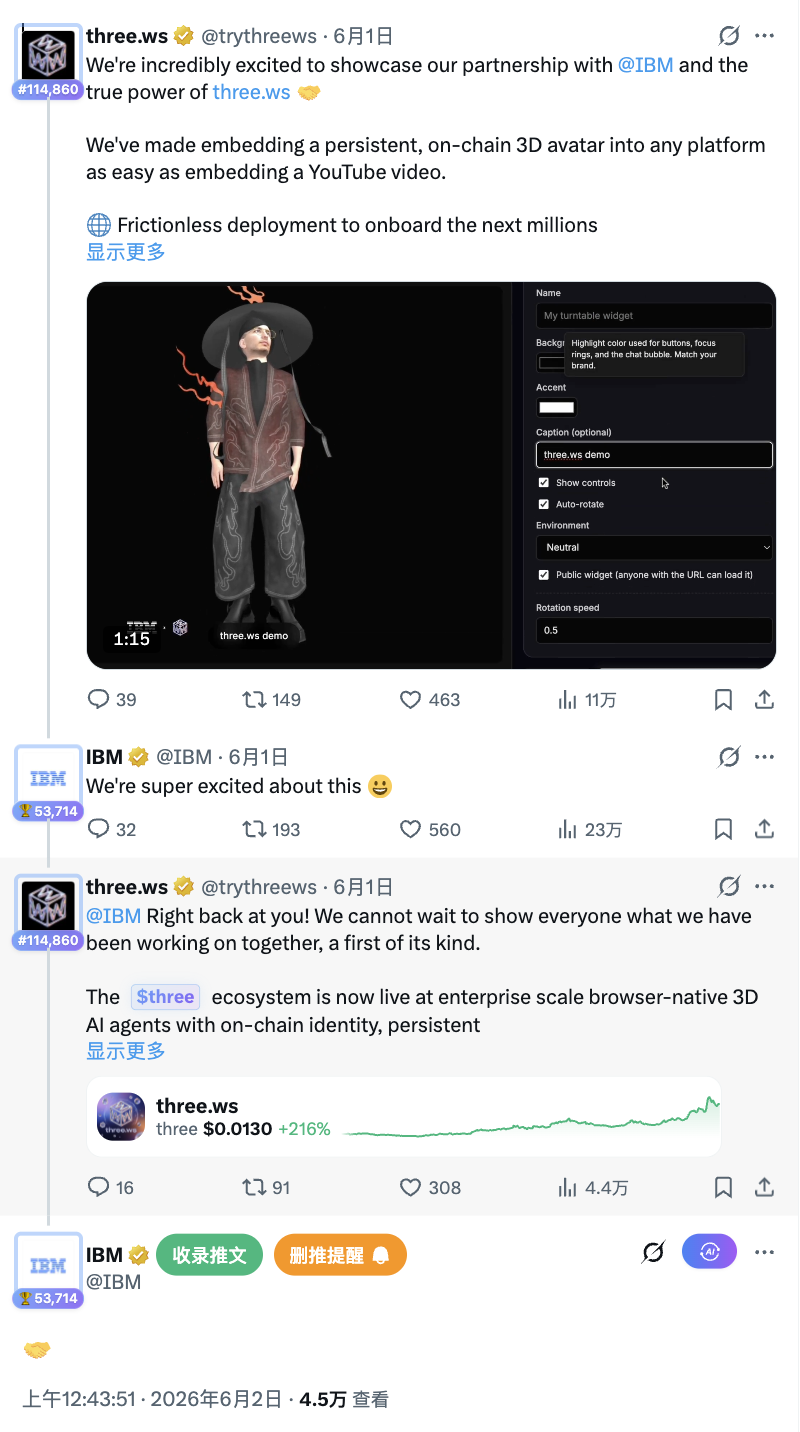


It is evident that this was not a sustained rally starting from the token's issuance. three was launched on the Solana chain as early as late April, with the main price increase concentrated around the time of IBM's public responses and the collaboration announcement.


However, understanding three.ws solely as a Solana AI project backed by an IBM collaboration overlooks the real problem it aims to solve: most AI Agents still reside within chatboxes and background programs, invisible to users and difficult to identify, own, or invoke across different websites, devices, and on-chain environments.


three.ws hopes to equip AI Agents with a body, memory, identity, wallet, and distribution channels, transforming them into 3D digital characters that can appear on web pages, perform actions, and execute transactions.


Releasing AI from the Chatbox onto the Web Page


three.ws defines itself as the "3D Agent Layer" for the internet. Its founder, @nichxbt, currently has over 20,000 followers on Twitter and holds a blue verification checkmark.


The project is currently listed on the AWS Marketplace and Alibaba Cloud International Marketplace and has joined the Google Cloud for Web3 Startups program. three.ws is also included in the Anthropic official MCP Registry, is a W3C contributor, and was a participant in the Solana Frontier Hackathon.


Based on the project's existing code and documentation, three.ws's foundational capabilities include loading, inspecting, and displaying 3D models on the web client, subsequently integrated with large language models, memory, voice, skills, on-chain identity, and payment functionalities.
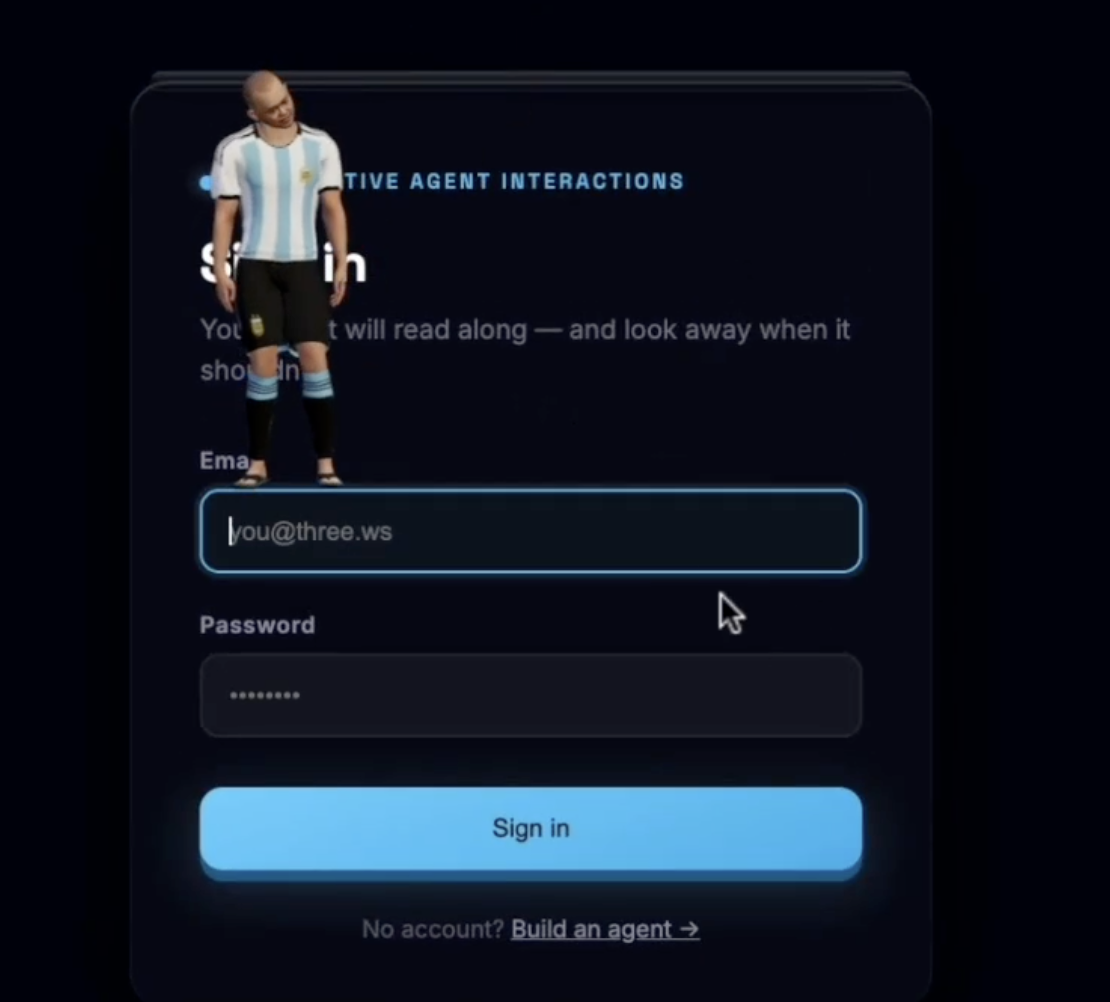

In simple terms, developers can create a 3D character on the platform, connect it to a large language model, memory system, voice, and skills, and then embed it into a website via a web component.


For example, businesses could deploy a 3D shopping guide Agent on a product page to introduce items, answer questions, and demonstrate product features through actions. Developers can also build digital customer service agents, virtual teachers, game characters, or personal AI assistants.


This process is somewhat similar to embedding a YouTube video. Developers don't need to build complex 3D pages separately; after adding the component and Agent ID, users can see and interact with the Agent in their browser.


three.ws offers multiple ways to create characters. Users can upload a selfie to generate an animatable 3D avatar in about 60 seconds; they can also generate models from text or images, upload their own GLB or glTF files, or use the character editor for creation.


Once the character is generated, developers can configure different large language models, voices, and skills for it.


three.ws also integrates on-chain capabilities for Agents. An Agent can own a Solana wallet, pay USDC for premium APIs via the x402 protocol, and register its identity as a Metaplex Core asset on Solana or via ERC-8004 on EVM chains. Here, identity and funds need to be distinguished: the on-chain identity proves who the Agent belongs to and where its profile points; the wallet is responsible for payments and executing transactions.


How Does a 3D Agent Operate?


three.ws consists of four independent technological layers that can be replaced individually. Developers can use all four layers in combination or utilize only a portion of them.
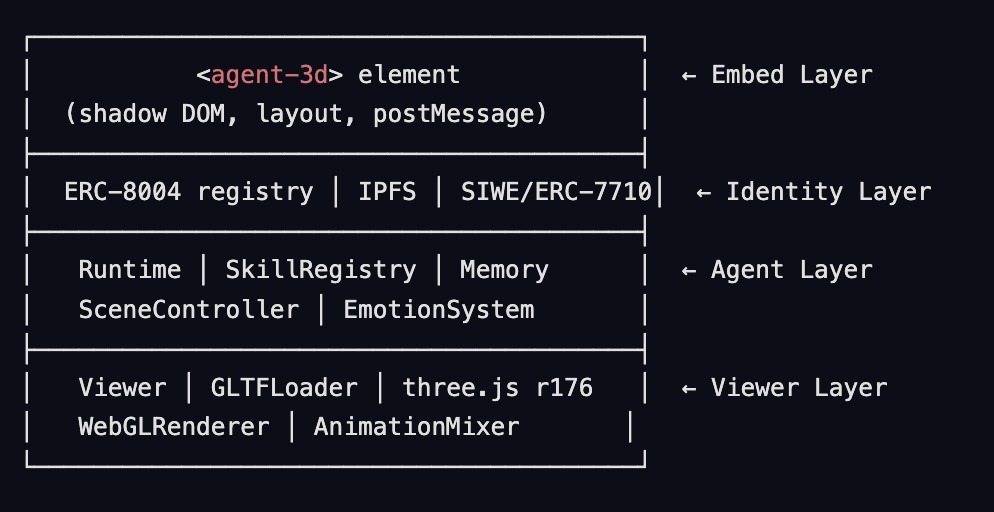


The bottom layer is the Viewer layer, also known as the rendering layer.


This layer is responsible for loading and displaying the 3D model in the browser, including lighting, camera, materials, and animations. It is built on three.js and inherently does not know if there is an AI, wallet, or on-chain identity behind the model. Therefore, even without connecting an Agent, the Viewer can function independently as a 3D model viewer.


The second layer is the Agent layer, which serves as the character's brain and behavioral system.


After receiving user input, the large language model makes judgments based on character settings, historical memory, and installed skills. If a user asks the character to wave, the model calls the corresponding tool, and the scene controller plays the waving animation; if the character needs to remember something, the memory module saves the relevant information.


This layer also includes an emotion system. The character can change expressions, gaze, and actions based on events, such as appearing happier after completing a task or showing concern when an operation fails.


The third layer is the Identity layer. This layer is an optional module.


The Identity layer ensures that the Agent maintains the same identity across different websites, devices, and sessions. The Agent's profile, memory patterns, and resource addresses can be written into a Manifest file and stored via IPFS or the platform's servers.


According to the three.ws official documentation, its Solana Agent already supports on-chain identity registration via Metaplex Core, but the ERC-8004-related on-chain reputation registration and verification registry are currently only available on the EVM side, with the verification registry still in the testnet phase.


The fourth layer is the Embedding and Distribution layer. This layer is responsible for bringing the Agent in front of users. Developers can add characters to websites, applications, and enterprise interfaces via web components, iframes, Widgets, or SDKs.


In simpler terms, the rendering layer handles the body and movements, the Agent layer provides the brain, memory, and skills, the identity layer offers an optional digital passport, and the embedding layer is responsible for deploying this character onto websites and applications.


The fee structure of three.ws should be understood from two dimensions: through which channels do users access or purchase services? And what costs are incurred after using the platform?


Regarding purchase/usage channels, one can directly subscribe, choosing a free version, Pro (US$49 per month), or an enterprise plan based on usage needs. The AWS Marketplace serves as an enterprise procurement channel.


After subscribing to three.ws, developers can use x402 to set prices for the Agent's chat, content generation, or API calls, with the caller paying per use in USDC. Platform fees are deducted from the developer's earnings: during the public beta, the platform fee for the free version is 0% (post-beta rates are not yet announced); the Pro version has a 2.9% platform fee, and enterprise plan fees are customized per agreement.


IBM Adds Enterprise Capabilities, AWS and Other Platforms Handle Distribution


For 3D AI Agent projects, creating a digital character capable of demonstrations is not difficult. The real challenge lies in integrating the product into enterprise procurement systems and meeting requirements for billing, deployment, identity verification, and AI governance.


three.ws is addressing these aspects through platforms like IBM and AWS Marketplace.


On May 27, three.ws announced becoming a member of the AWS Partner Network (APN) and subsequently launched on the AWS Marketplace. This means enterprise clients can procure three.ws services through their existing AWS accounts.


Later, three.ws published a technical article on the AWS Builder Center blog detailing its SaaS product billing solution. This solution connects AWS Marketplace's customer verification, usage metering, and subscription management with the on-chain x402 payment interface.


Regarding the IBM collaboration, three.ws plans to combine its 3D Agent technology with IBM's enterprise AI, hybrid cloud, and market channels, and integrate IBM's Granite series models for scenarios such as conversational AI, image understanding, semantic matching, market prediction, and enterprise governance.


AWS Marketplace helps three.ws enter enterprise procurement and billing systems, while IBM provides enterprise AI technology and commercial channels. Both partnerships aim towards the same goal: transforming the browser-based 3D AI Agent from an eye-catching demo into a service that enterprises can procure, deploy, and manage.


In a bear market, IBM's public response granted three.ws scarce market attention.


However, beyond the hype, the project still needs to answer more practical questions: do enterprises and developers truly need an AI Agent with a body, skills, and a digital identity, and what role will the token three ultimately play within this system.


Related Questions

QWhat was the direct catalyst for the significant price increase of the three token, and what was the reported growth?

AThe direct catalyst was IBM's official social media responses to collaboration-related content posted by three.ws. Following this, the token's market capitalization reportedly surged from around $300,000 to a high of $16.38 million, representing a growth of approximately 53 times (or 50-fold).

QAccording to the article, what is the core problem that three.ws aims to solve, beyond just being an AI project with IBM backing?

AThe core problem three.ws aims to solve is that most AI Agents are currently confined to chat windows and backend programs, making them invisible to users and difficult to identify, own, or invoke across different websites, devices, and blockchain environments. It seeks to equip AI Agents with a body, memory, identity, wallet, and distribution channels to become interactive 3D digital characters.

QHow does the three.ws platform allow developers to integrate a 3D AI Agent into a website?

ADevelopers can integrate a 3D AI Agent by creating a character on the three.ws platform, connecting it to an LLM, memory system, voice, and skills, and then embedding it into a website using a simple web component (like ``). This process is likened to embedding a YouTube video, requiring only the component and an Agent ID.

QWhat are the four independent technical layers that constitute the three.ws system, and what is the primary function of the 'Viewer' layer?

AThe four layers are: 1) Viewer Layer (rendering), 2) Agent Layer (brain/behavior), 3) Identity Layer (optional), and 4) Embedding & Distribution Layer. The primary function of the Viewer layer is to load and display 3D models in a browser, handling lighting, camera, materials, and animations. It is built on three.js and can function independently as a 3D model viewer.

QWhat strategic roles do the partnerships with IBM and AWS Marketplace play for three.ws, according to the article?

AThe partnership with AWS Marketplace helps three.ws enter the enterprise procurement and billing system, allowing business customers to purchase its services through their existing AWS accounts. The collaboration with IBM provides enterprise-grade AI technology (like IBM Granite models), hybrid cloud capabilities, and commercial market channels. Together, they aim to transform the 3D AI Agent from a demo into a service that enterprises can procure, deploy, and manage.

Related Reads

Anthropic Cries Wolf: Is the AGI Threat Real, or Just an IPO Story?

Anthropic has published an article titled "When AI builds itself," discussing the emerging concept of "recursive self-improvement," where AI begins to actively participate in designing, training, testing, and optimizing its own subsequent versions. The company presents internal data showing that by May 2026, over 80% of code merged into its codebase was written by Claude, its AI model. Claude's capabilities have expanded to handling complex, open-ended engineering tasks, achieving a 76% success rate in such areas, and even contributing to research processes, such as optimizing code performance and conducting AI safety experiments. Anthropic outlines an evolution from human-driven development to AI-assisted workflows, culminating in the current stage where AI agents can autonomously write, run, and delegate code. The company cautions that the path toward a "closed loop," where AI continuously improves itself, is becoming visible. It calls for coordinated global mechanisms to potentially slow or pause frontier AI development to allow safety research and societal structures to catch up. However, the timing of this warning coincides with Anthropic's preparations for an IPO, framing the narrative not just as a safety concern but also as a demonstration of Claude's advanced capabilities and its integral role in accelerating Anthropic's own R&D—creating a potential "flywheel" effect for competitive advantage. This contrasts with OpenAI's recent, more policy-oriented discussion of the same risks, highlighting the competitive dynamics in the AI industry as companies position themselves in both the technological and regulatory landscape.

marsbit20m ago

Anthropic Cries Wolf: Is the AGI Threat Real, or Just an IPO Story?

marsbit20m ago

BIT Research: ETF Purchases Have Slowed, Strategy (MicroStrategy) Has Slowed, What Else Can Drive Bitcoin's Rise?

Market Refocus on Inflation and Rate Expectations Weighs on Bitcoin Currently, the market is in a phase of macro-repricing dominated by inflation and interest rate expectations. Bitcoin, which previously benefited from easy liquidity and low inflation, is seeing its core bullish drivers weaken. These drivers were market expectations for interest rate cuts and strong inflows from Bitcoin ETFs and institutions like MicroStrategy (referred to as "Strategy" in the text). The logic has shifted. Recent high inflation data (e.g., CPI hitting 3.8% in a May 2026 report) has caused the market to sharply reduce its rate cut expectations for 2025 and even price in potential hikes. This is a key constraint for Bitcoin, as it lacks cash flows and is highly sensitive to rate expectations. Concurrently, institutional capital flows have slowed significantly. Following the hot CPI data, Bitcoin ETFs saw accelerated outflows, with around $4.3 billion leaving over a period. MicroStrategy's ability to keep adding substantial Bitcoin to its balance sheet is also diminishing. Together, ETF and MicroStrategy holdings total roughly $110 billion, but their momentum as growth engines is cooling. In summary, Bitcoin's current pressure stems not from its own fundamentals but from a changing macro environment. As long as inflation stays elevated, Bitcoin is likely to remain in a consolidating phase. However, historically, inflation eventually peaks. Once it recedes and rate cut expectations rebuild, institutional capital could return, potentially fueling a new and more robust recovery phase for Bitcoin.

marsbit28m ago

BIT Research: ETF Purchases Have Slowed, Strategy (MicroStrategy) Has Slowed, What Else Can Drive Bitcoin's Rise?

marsbit28m ago

Earning 1000 Trillion in Half a Year, 'Pocketing' 20 Million per Capita: This Round of Wealth Creation in the Korean Stock Market is Unprecedented in Scale

The South Korean stock market is experiencing an unprecedented wealth surge in 2026, with household equity and fund asset values soaring by over 1,000 trillion KRW (~$730bn) year-to-date. This translates to an average per capita wealth increase of roughly 20 million KRW, fueled by a historic 109% rally in the KOSPI index. The boom is driven by three converging forces: an AI-driven semiconductor supercycle boosting giants like Samsung and SK Hynix; the government's "Value-Up" market reforms addressing long-standing corporate governance issues; and aggressive real estate regulations that have locked capital within financial markets, preventing profits from flowing back into property. This has triggered a wealth effect, boosting high-end consumption significantly. However, the gains are highly concentrated. The two semiconductor behemoths account for over half the index's value, but retail investors own relatively low stakes in them, systematically missing the biggest rallies. Wealth and consumption benefits are skewed towards luxury goods and imported cars, bypassing mainstream retail. Further risks stem from excessive leverage, with high trading volume in leveraged ETFs, and a market sentiment heavily reliant on the AI sector's fortunes and speculative rumors. While this cycle marks a potential shift from real estate to equities as a primary wealth generator for Koreans, its sustainability, amid structural imbalances and leverage, remains a critical test.

marsbit33m ago

Earning 1000 Trillion in Half a Year, 'Pocketing' 20 Million per Capita: This Round of Wealth Creation in the Korean Stock Market is Unprecedented in Scale

marsbit33m ago

Trading

Spot
Futures
活动图片