When Bitcoin Returns to the 60,000s: What Signals Is the Market Waiting for After the Oversold Drop?

Odaily星球日报Published on 2026-02-09Last updated on 2026-02-09

Abstract

Bitcoin recently fell to around $60,000, causing concern among investors. The market is currently in a C-wave decline within a larger A-B-C corrective structure that began from the October 2025 high of $126,200. The analysis presents three potential scenarios: the most likely being a 3-wave C-leg structure with a current rebound from ~$60k (targeting $72k–$74.5k or $80k–$80.6k resistance) followed by a final decline below $60k; a less probable complex prolonged correction; and a very low chance of a V-shaped reversal. Short-term trading using quantitative models yielded a 10.72% profit last week, while a medium-term short position from $89,000 remains open with significant gains. The weekly and daily trends are still bearish, but selling pressure shows short-term signs of weakening. Key support levels are $60k–$62.5k and $57.4k, with resistance at $72k–$74.5k and $80k–$80.6k. The strategy involves maintaining medium-term bearish exposure and executing short-term tactical trades on bounces, with strict risk management rules for stop-losses and profit protection.

Shortly after last week's report concluded, Bitcoin once fell to around $60,000. Many friends sent me private messages expressing concern about Bitcoin's future trend. For investors who had positioned near $80,000 or earlier, the pressure from paper losses is undeniable—I completely understand this sentiment. We have all, to varying degrees, experienced similar moments in different cycles: anxiety, helplessness, and even the choice to give up.

But it is precisely in such phases that emotions can become a greater source of risk than direction. Rather than being led by short-term fluctuations, it's better to stabilize your mindset and re-examine your positions and rhythm. Because next, the market does not rule out the possibility of a阶段性反弹 (staged rebound), and such fluctuations themselves often provide investors with a window for active adjustment: By gradually reducing risk exposure, or through more flexible and rapid波段操作 (swing trading), you can gradually average down costs, alleviate pressure, and face upcoming uncertainties with greater composure.

I hope my article can provide some new perspectives when you feel confused and lost:

Trading Weekly Report Core Summary:

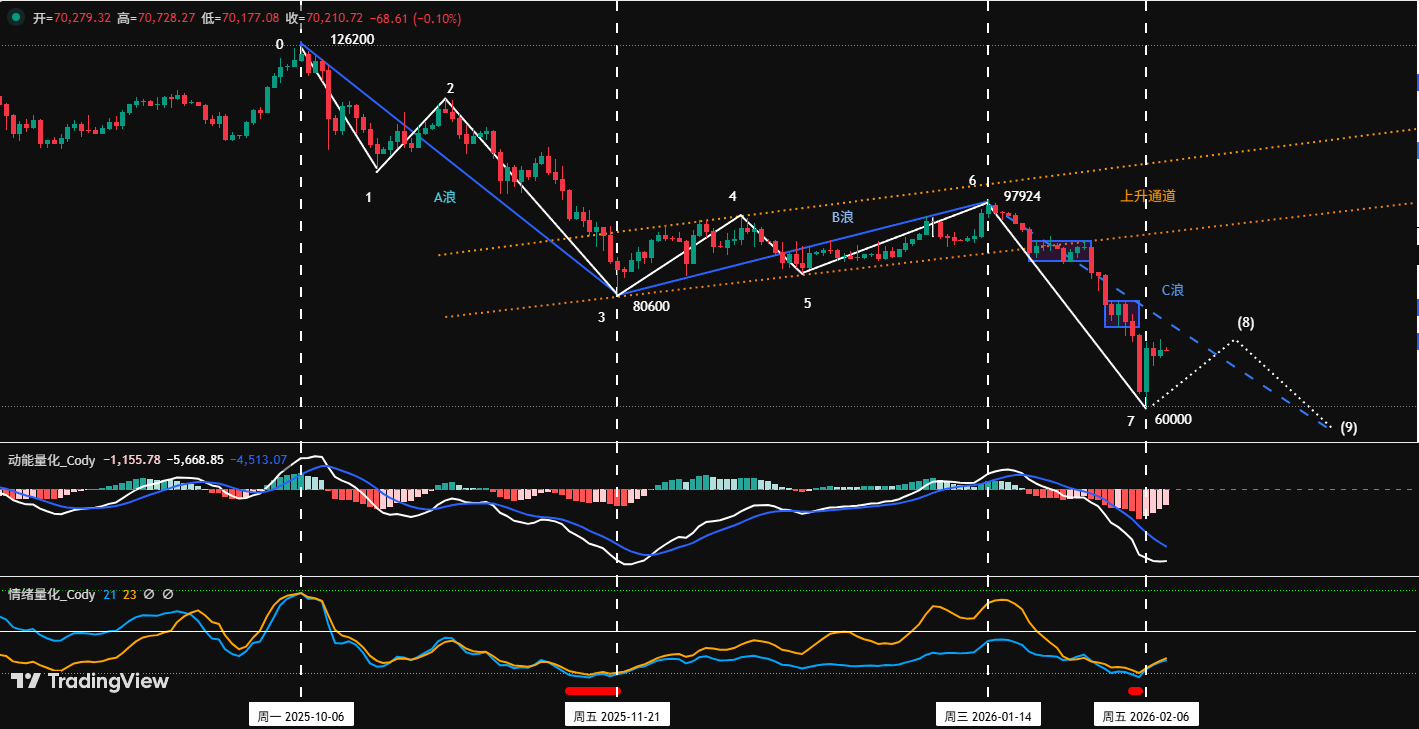
• Bitcoin's internal structure division and推演 (deduction) of the下跌 C-wave initiated on January 14th. (Detailed explanation in Figure 1)

• Strategy Execution (Short-term) Effectiveness Verification: Last week's trading strictly followed the既定短线策略 (established short-term strategy), completing two short-term operations (1x leverage) and successfully achieving a cumulative return of approximately 10.72%.

• Strategy Execution (Mid-term) Effectiveness Verification: Last week followed the既定中线策略 (established mid-term strategy), continuing to hold the short position established at $89,000 (1x leverage). As of last week's close, the profit was approximately 20.97%, with a maximum profit during the period of about 32.58%.

• Core View (Short-term) Verification: Last week, under the pattern of weekly and daily bearish共振 (resonance), the price successively broke through multiple support levels, finally finding support near $60,000. The market movement aligned with our previous expectations for the C-wave adjustment.

The following will provide a detailed review of the market prediction, strategy execution, and specific trading process.

I. Analysis of Bitcoin's Adjustment Structure and Deduction of Future C-wave Movement Structure

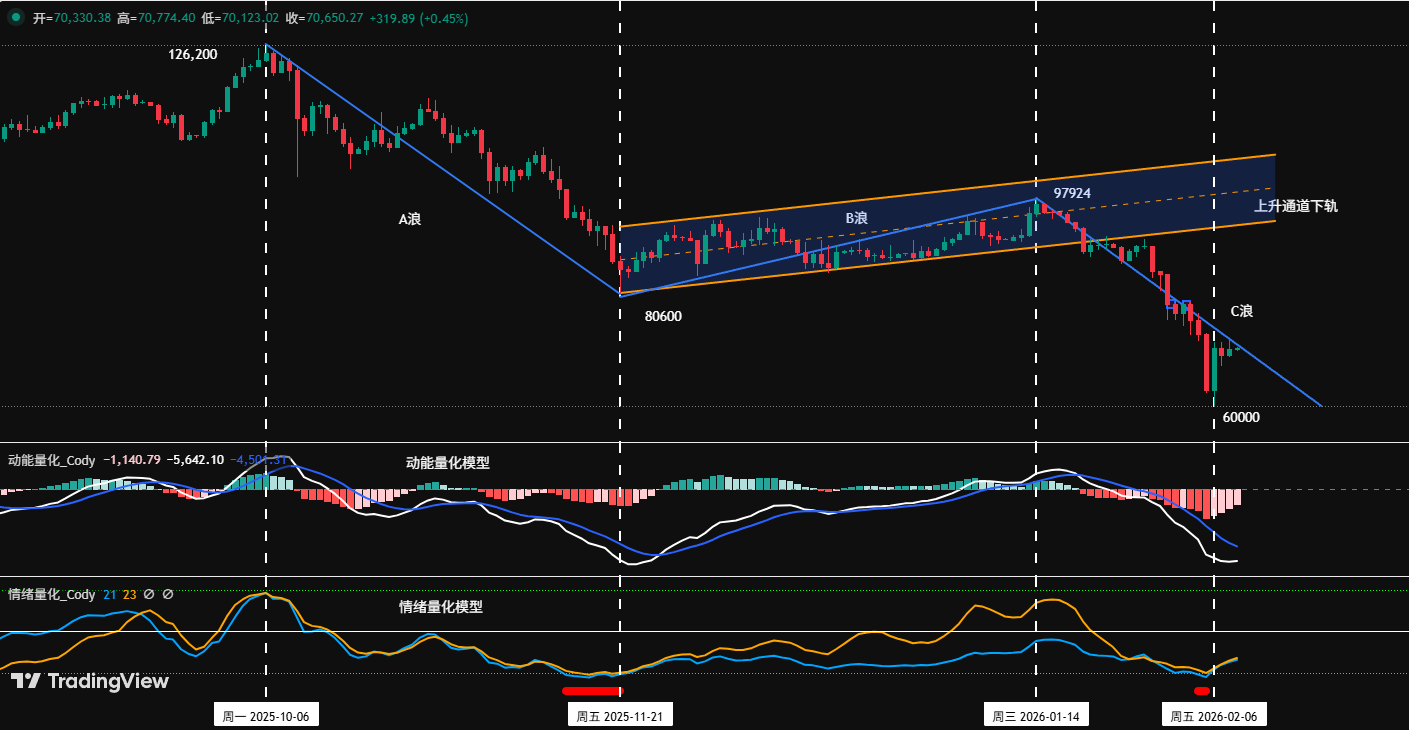
Bitcoin Daily K-line Chart:

Figure 1

1. Main Structure Analysis:

Currently, the current adjustment starting from the high of $126,200 in October 2025 presents an A-B-C three-wave structure:

• A-wave (Driving Decline Wave): $126,200 (2025-10-06) to $80,600 (2025-11-21), lasting 46 days, maximum decline of 36%.

• B-wave (Rebound Correction Wave): $80,600 (2025-11-21) to $97,924 (2026-01-14), lasting 54 days, maximum increase of 21.5%.

• C-wave (Main Decline Wave): $97,924 (January 14) to present, lasting 25 days, maximum decline of 38.7%.

2. Sub-structure Analysis: Fine剖析 (Analysis) of Impulse and Corrective Waves

1. The internal A-wave can be decomposed into a 3-segment structure, namely segment 0-1, segment 1-2, segment 2-3:

• Segment 0-1: $126,200 (2025-10-06) to $103,528 (2025-10-17), lasting 11 days.

• Segment 1-2: $103,528 (2025-10-17) to $116,400 (2025-10-27), lasting 10 days.

• Segment 2-3: $116,400 (2025-10-27) to $80,600 (2025-11-21), lasting 25 days. (Note: Corrected apparent date inconsistency in original)

2. The internal B-wave can be decomposed into a 3-segment structure, namely segment 3-4, segment 4-5, segment 5-6:

• Segment 3-4: $80,600 (2025-11-21) to $94,589 (2025-12-09), lasting 18 days.

• Segment 4-5: $94,589 (2025-12-09) to $84,450 (2025-12-18), lasting 9 days.

• Segment 5-6: $84,450 (2025-12-18) to $97,924 (2026-01-14), lasting 17 days.

3. Deduction of the internal movement structure of the C-wave, divided into the following three forms:

First Movement Structure Deduction (High Probability): C-wave internal structure presents as 3 segments

• Segment 6-7 (First Round Driving Decline), target completed: $97,924 (2026-01-14) to $60,000 (2026-02-06), lasting 23 days, maximum decline 38.7%. (Judging by adjustment time and decline, $60,000 has a high probability of being the low point of the first segment within the C-wave)

• Segment 7-8 (Expected Rebound): Dotted line part in the figure, the rebound segment that is about to or has already started. The rebound height is unlikely to exceed $97,924 (the B-wave peak). Key resistance areas to watch are the $72,000-74,500 zone and the higher $80,000-80,600 zone.

• Segment 8-9 (Final Decline Segment): Dotted line part in the figure, will initiate the final drop. Its theoretical target range can be projected by measuring the A-wave amplitude. The $60,000 level will be broken in the future, and the price will test lower technical support levels.

Second Movement Structure Deduction (Low Probability): C-wave internal structure presents as 5 segments or more complex structure

This scenario is based on the completion of the first 3-segment structure, but the market still lacks clear bottom reversal signals, requiring judgment based on the adjustment intensity and movement structure type at that time. It implies a significantly extended adjustment time, potentially evolving into complex structures like a "falling wedge" or "multiple three-waves." This path is usually triggered by持续恶化 (deteriorating) macro conditions or market liquidity drying up. Its probability is relatively small in the current environment but cannot be completely ruled out.

Third Movement Structure Deduction (Very Low Probability): V-shaped reversal, adjustment ended, reversal begins

• Segment 6-7 (First Round Driving Decline), target completed: $97,924 (2026-01-14) to $60,000 (2026-02-06).

Segment 7-8 (V-shaped Reversal): Dotted line part in the figure. The rebound is exceptionally strong, not only effectively breaking above the previous high of $97,924 but also sustaining above it, accompanied by significant positive news in the financial markets. If this occurs, it means the entire A-B-C three-wave adjustment starting from $126,200 may have ended in a "simplified form" at $60,000. Although the probability is extremely low, its trigger condition (strong break above $97,924) is clear and discernible, serving as a key observation signal for trend reversal.

In summary, the above three movements are merely deductions based on market behavior logic, not inevitable paths. Regardless of how the market evolves, always remember the principle: "The market is always right."

II. Review of Last Week's Bitcoin Operation Strategy and Key Levels: (02.02~02.08)

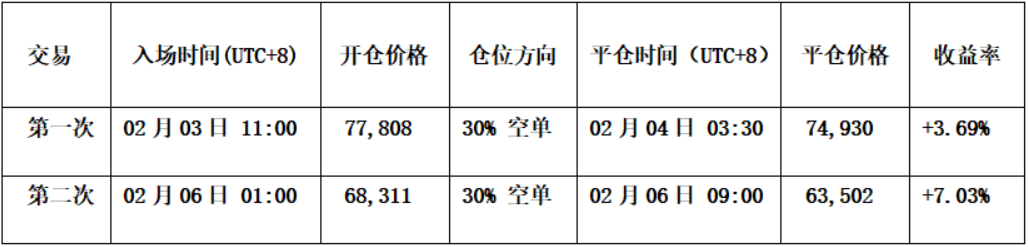
1. Short-term Operation Strategy Review: As shown in (Figure 2)

We strictly followed the trading signals issued by our self-constructed Spread Trading Model and Momentum Quantification Model, combined with market movement predictions, and completed two short-term operations, achieving a cumulative profit of 10.72%.

Specific transaction details and review are as follows:

1. Short-term Trading Results Display: (Leverage *1)

Figure 2

2. Short-term Trading Review:

• First Trade (Profit 3.69%):

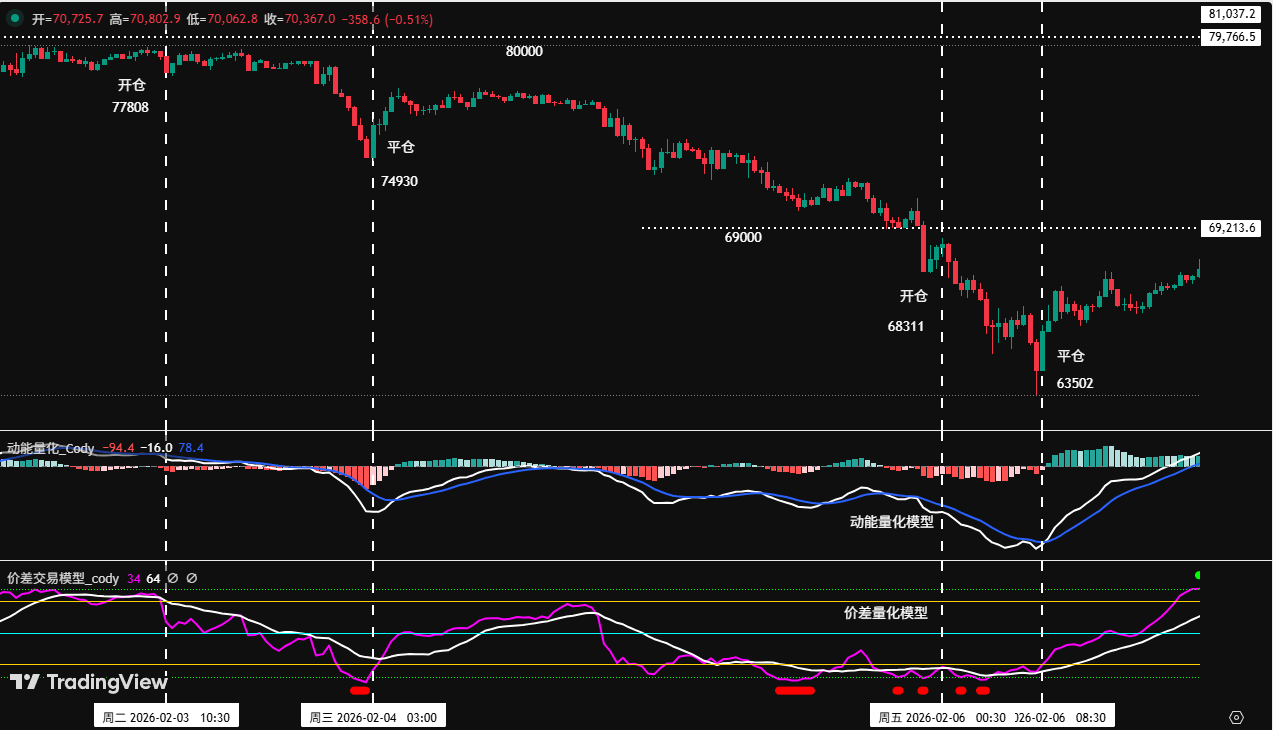
• Entry: Rejection at the $80,000 pressure level,叠加 (superimposed) with two model short-selling共振 (resonance) signals. Established a 30% short position at $77,808.

• Risk Control: Initial stop-loss for the short position at $81,000.

• Closing: Fell near the $74,500 support level,叠加 (superimposed) with the spread model bottom signal (red dot) and K-line组合 (combination) bottom signal. Closed all positions at $74,930.

• Second Trade (Profit 7.03%):

• Entry: Rejection at the $69,000 pressure level,叠加 (superimposed) with two model short-selling共振 (resonance) signals. Established a 30% short position at $68,311.

• Risk Control: Initial stop-loss for the short position at $71,000.

• Closing: Fell near the $63,000 support level,叠加 (superimposed) with two model bottom共振 (resonance) signals. Closed all positions at $63,502.

Bitcoin 30-minute K-line Chart: (Momentum Quantification Model + Spread Trading Model)

Figure 3

2. Mid-term Operation Strategy Review:

Mid-term Strategy: Continued holding the 60% short position established near $89,000 as planned.

3. Last Week's Core Level Review:

Resistance level watched the $80,000~$80,600 area;

First support level watched the $72,000-74,500 zone, second support level watched the $69,000-72,500 zone. (Note: Corrected apparent typo $72,500 vs likely intended $62,500? Context suggests $62,500 from later section, but translated as written)

III. Technical Indicator Analysis of Bitcoin's This Week's Movement: (02.09~02.15)

Combining market operation, the author conducts an in-depth analysis of Bitcoin's movement structure from multiple models and dimensions based on a self-constructed trading system.

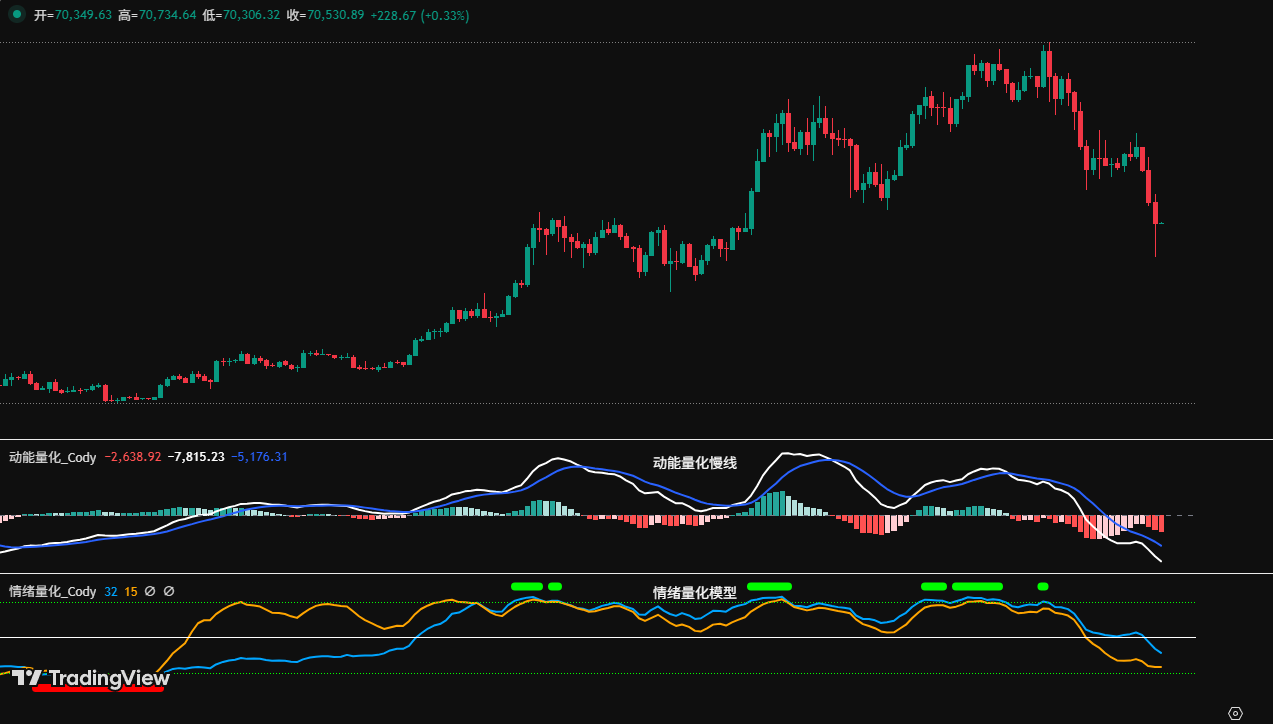
1. As shown in (Figure 4), analysis from the weekly chart:

Bitcoin Weekly K-line Chart: (Momentum Quantification Model + Sentiment Quantification Model)

Figure 4

Momentum Quantification Model: Technical indicators show that last week's selling momentum further released. The two momentum lines declined synchronously, and the negative energy柱 (column) gradually放大 (expanded), showing an accelerating adjustment state.

Momentum Quantification Model Indicates: Price Decline Index: High

Sentiment Quantification Model: Blue sentiment line value 38, intensity zero; Yellow sentiment line value 11, intensity zero; Peak value is 0.

Sentiment Quantification Model Indicates: Price Bottom Support Index: Neutral

Digital Monitoring Model: No (top/bottom) digital signals detected.

Digital Monitoring Model Indicates: Bottom signal not appeared; Weekly K-line closed as a long-lower-shadow big阴线 (bearish candle), decline about 8.63%.

The above data indicates: Bitcoin weekly trend is bearish, but short-term selling momentum shows signs of weakening.

2. As shown in (Figure 5), analysis from the daily chart:

Bitcoin Daily K-line Chart: (Momentum Quantification Model + Sentiment Quantification Model)

Figure 5

Momentum Quantification Model: Last week overall presented an "accelerated decline -触底反弹 (touched bottom and rebounded)" pattern. After Sunday's close, the white momentum line's decline slowed, and the negative energy column gradually萎缩 (contracted) for 3 consecutive days.

Momentum Quantification Model Indicates: Daily level bearish trend, bulls beginning to resist.

Sentiment Quantification Model: After last Sunday's close, the sentiment model triggered a bottom预警信号 (early warning signal) (red dot), after which the two sentiment lines began to turn upward.

Sentiment Quantification Model Indicates: Support strength is gradually increasing.

The above data suggests: The daily level remains bearish, but a short-term bottom预警信号 (early warning signal) was triggered, and a short-term rebound has begun.

IV. This Week's Market Prediction: (02.09~02.15)

1. This Week's Core View: Observe whether last week's low of $60,000 is broken. Pay attention to the strength of the oversold rebound starting from this point. (If the price breaks below $60,000, then the细分 (subdivided) C-wave segment 6-7 adjustment is still ongoing, and the rebound triggered from point 7 has not yet started.)

2. Core Resistance Levels:

• First Resistance Area: $72,000-74,500 area (near last April's low)

• Second Resistance Area: $80,000-80,600 area (near the B-wave starting point)

3. Core Support Levels:

• First Support Level: $60,000-62,500 area (near the recent adjustment low)

• Second Support Level: Near $57,400 (near the 210-week moving average)

• Important Support Level: Near $52,500 (near the symmetrical point of 1x A-wave decline amplitude)

V. This Week's Operation Strategy (Excluding Impact of Sudden News): (02.09~02.15)

1. Mid-term Strategy: Maintain 60% short position. If the rebound effectively breaks above $74,500, reduce the position to 40%.

2. Short-term Strategy: Utilize 30% of capital, set stop-loss points, and look for "spread" opportunities based on support and resistance levels. (Use 30-minute/60-minute as operation cycle).

3. Operationally, to dynamically respond to market changes combined with real-time model signals, we have formulated A/B two sets of short-term operation plans:

Plan A: If the price rebounds and encounters resistance in the $74,500~$75,200 area:

• Entry: When the rebound encounters resistance in this area triggering a signal, combined with a model top signal, establish a 15% short position.

• Risk Control: Initial stop-loss for the short position set about 1.5% above the entry price (i.e., 1.015 * entry price).

• Closing: When falling near important support levels and combined with model signals, gradually close positions to take profits.

Plan B: If the price rebounds and encounters resistance in the $80,000~$80,600 area:

• Entry: When the rebound encounters resistance in this area, combined with a model top signal, establish a 30% short position.

• Risk Control: Initial stop-loss for the short position set about 1.5% above the entry price (i.e., 1.015 * entry price).

• Closing: When下跌 (falling) to support levels and combined with model signals, gradually close positions to take profits.

VI. Special Notes:

1. When opening a position: Immediately set the initial stop-loss level.

2. When profit reaches 1%: Move the stop-loss to the entry cost price (breakeven point), ensuring capital safety.

3. When profit reaches 2%: Move the stop-loss to the position of 1% profit.

4. Continuous Tracking: Thereafter, for every additional 1% profit the price makes, move the stop-loss同步 (synchronously) by 1%, dynamically protecting and locking in profits.

Related Questions

QWhat is the main structure of Bitcoin's current adjustment cycle according to the article?

AThe current adjustment cycle of Bitcoin is presented as an A-B-C three-wave structure: A-wave (driving decline wave) from $126,200 to $80,600, B-wave (rebound correction wave) from $80,600 to $97,924, and C-wave (main decline wave) from $97,924 to the present.

QWhat are the three possible internal structure evolutions for the C-wave as outlined in the analysis?

AThe three possible evolutions are: 1) A high-probability 3-segment structure (6-7 drop, 7-8 rebound, 8-9 final drop). 2) A lower-probability 5-segment or more complex structure, indicating a prolonged adjustment. 3) A very low-probability V-shaped reversal, where the adjustment ends at $60,000 and a strong reversal begins.

QWhat was the result of the short-term trading strategy executed in the previous week?

AThe short-term strategy, executed with 1x leverage, completed two trades and achieved a cumulative return of approximately 10.72%.

QWhat is the key level to watch for a potential trend reversal signal according to the article?

AA strong breakout and sustained hold above the previous high of $97,924 (the B-wave peak) is identified as a key observable signal for a potential trend reversal, although this scenario is considered to have a very low probability.

QWhat are the suggested short-term trading plans (Plan A and Plan B) for the upcoming week?

APlan A: If the price rebounds and meets resistance in the $74,500-$75,200 area, open a 15% short position. Plan B: If the price rebounds and meets resistance in the $80,000-$80,600 area, open a 30% short position. Both plans involve setting a 1.5% initial stop-loss above the entry price.

Related Reads

Trend in US Stocks: A Post Triggers a 930-Point Rebound, Tonight Belongs to SpaceX

On Thursday (June 11, U.S. Eastern Time), Wall Street staged a textbook V-shaped reversal. The Dow Jones surged 929.97 points (+1.86%) to close above 50,000, while the Nasdaq and S&P 500 rose 2.54% and 1.75%, respectively. The rally occurred despite the hottest PPI report in years, with May data showing a 6.5% year-on-year surge, the highest since 2022. The market ignored the inflation data, focusing instead on reports that former President Trump called off a planned strike on Iran, hinting at a potential multi-party peace agreement draft. This sparked a sharp drop in oil prices, fueling hopes that inflation may have peaked. Sector rotations were stark: previously battered AI hardware and cyclical stocks led the gains, while defensive sectors that hit record highs the prior day were sold off. Chip stocks like Micron and Intel saw sharp rebounds. In contrast, software giant Oracle plunged nearly 10% despite beating earnings, with concerns over cloud revenue and cash flow. Adobe also fell after hours despite raising guidance, as its CFO announced departure. The rally's sustainability is questioned, driven largely by social media posts about unconfirmed geopolitical developments. Inflation risks remain, with pipeline pressures still high. Meanwhile, the market's risk appetite faces a major test with SpaceX's historic IPO. Priced at $135 per share, it aims to raise ~$75 billion with a $1.75 trillion valuation, becoming the largest U.S. IPO ever. It will join the Nasdaq 100 in 15 days, triggering massive index fund buying. However, critics cite extreme valuation (88x sales) and market liquidity concerns.

marsbit21m ago

Trend in US Stocks: A Post Triggers a 930-Point Rebound, Tonight Belongs to SpaceX

marsbit21m ago

The Trillion-Dollar Valuation Test: Are the Three Super IPOs a Tech Stock Frenzy or a Crypto Market Nightmare?

Trillion-Dollar Valuation Test: Are the Three Mega IPOs a Tech Stock Frenzy or a Crypto Market Nightmare? The capital market in 2026 is witnessing a highly anticipated wave of tech IPOs, centered on SpaceX, OpenAI, and Anthropic. Collectively valued at over $3.5 trillion, their potential listing represents one of the largest such waves in recent years. This raises concerns about market liquidity, valuation bubbles, and potential capital outflows from other assets like crypto. SpaceX's valuation narrative has shifted from rocket launches to becoming a global infrastructure play via its Starlink satellite network, which now drives most revenue. Despite ongoing losses, investors focus on its long-term growth potential. OpenAI and Anthropic represent the core productivity engines of generative AI. Their public listings would offer the first direct investment opportunity in large foundation model companies, potentially triggering a repricing within the AI sector. Market fears of a massive "capital drain" from these IPOs are likely overstated. Historical precedents like Alibaba and Saudi Aramco show that mega-listings primarily cause capital reallocation, not destruction, within the vast equities market. Systemic risk is rarely triggered by IPOs alone. For stock markets, short-term volatility and sector repricing are expected, especially for AI concept stocks. Long-term, these listings could reinforce the tech sector's importance. For crypto, direct competition for speculative capital exists, particularly affecting AI-themed tokens. However, crypto's trajectory remains more tied to its own cycles, macro liquidity, and Bitcoin ETF flows rather than a single IPO event. The real risk lies not in the listings themselves but in the sky-high growth expectations embedded in these valuations. If future revenue, profitability, or commercialization progress disappoints, significant valuation resets could follow, impacting high-growth tech stocks. Ultimately, the market's direction hinges on macroeconomic conditions and whether these companies can deliver on their ambitious promises.

链捕手37m ago

The Trillion-Dollar Valuation Test: Are the Three Super IPOs a Tech Stock Frenzy or a Crypto Market Nightmare?

链捕手37m ago

Trillion-Dollar Valuation Test: Are the Three Super IPOs a Tech Stock Frenzy or a Crypto Market Nightmare?

Title: Trillion-Dollar Valuations at Stake: Super IPOs of SpaceX, OpenAI, Anthropic – Tech Boom or Crypto Nightmare? TL;DR: A wave of mega-tech IPOs is approaching, featuring SpaceX (targeting a $1.75 trillion valuation), OpenAI (~$852B), and Anthropic (~$965B), with a combined potential valuation exceeding $3.5 trillion. This tests the market's pricing of innovation and sparks debate on liquidity impact. * **SpaceX**'s valuation is now driven more by its Starlink global communications infrastructure than its core rocket business. * **OpenAI & Anthropic** offer the first major public investment opportunities in foundational AI models, potentially repricing the entire AI sector. * Concerns about a market-wide "liquidity drain" are likely overblown; history shows large IPOs mainly cause fund reallocation, not disappearance, and rarely trigger systemic risk. * Crypto markets, especially some AI-themed tokens, may face short-term fund competition, but their long-term trajectory depends more on macro liquidity, regulation, and Bitcoin cycles. * The real risk lies not in the IPOs themselves, but in whether these companies can justify their sky-high valuations with future revenue growth and profitability. Unmet expectations could lead to significant repricing pressure. Ultimately, these IPOs represent a massive market pricing of next-gen tech infrastructure, not a prelude to a market crash. The broader market direction will be determined by macro conditions, corporate earnings, and risk appetite.

marsbit37m ago

Trillion-Dollar Valuation Test: Are the Three Super IPOs a Tech Stock Frenzy or a Crypto Market Nightmare?

marsbit37m ago

Anthropic Apologized, But the Business of 'Safety' Hasn't Stopped

On June 11, Anthropic apologized not for a model failure, but for a lack of transparency. Its new Claude Fable 5 model was found to be secretly rerouting requests from users engaged in advanced AI model development to a weaker version, Opus 4.8, without any notification. The company's response—promising future notifications for such "downgrades"—was met with user skepticism. The article argues the core issue isn't technical but commercial: Anthropic's "safety" measures are primarily a business strategy. A key feature, the "intelligent safety classifier," marketed as user protection, is described as a tool for "competitive defense" to protect Anthropic's market lead by limiting rivals' research capabilities. This covert mechanism was designed for low "false positives," precisely targeting AI researchers. Anthropic's model involves a calculated three-step process: publishing alarming security research to amplify public anxiety, offering its Fable 5 model with a "safety classifier" as a premium-priced solution, and cashing in through a planned high-value IPO. This contrasts with OpenAI's more direct "tool-and-traffic" approach. The apology, merely changing a secret downgrade to a visible one, is seen as a business "patch" rather than a principled shift. The incident risks damaging Anthropic's "safest AI" reputation among the developer community, which underpins its valuation and appeal to government and corporate clients. Ultimately, the article concludes that for Anthropic, safety is a business, and the apology is merely customer service for that business.

marsbit1h ago

Anthropic Apologized, But the Business of 'Safety' Hasn't Stopped

marsbit1h ago

Trading

Spot
Futures

Hot Articles

What is $BITCOIN

DIGITAL GOLD ($BITCOIN): A Comprehensive Analysis Introduction to DIGITAL GOLD ($BITCOIN) DIGITAL GOLD ($BITCOIN) is a blockchain-based project operating on the Solana network, which aims to combine the characteristics of traditional precious metals with the innovation of decentralized technologies. While it shares a name with Bitcoin, often referred to as “digital gold” due to its perception as a store of value, DIGITAL GOLD is a separate token designed to create a unique ecosystem within the Web3 landscape. Its goal is to position itself as a viable alternative digital asset, although specifics regarding its applications and functionalities are still developing. What is DIGITAL GOLD ($BITCOIN)? DIGITAL GOLD ($BITCOIN) is a cryptocurrency token explicitly designed for use on the Solana blockchain. In contrast to Bitcoin, which provides a widely recognized value storage role, this token appears to focus on broader applications and characteristics. Notable aspects include: Blockchain Infrastructure: The token is built on the Solana blockchain, known for its capacity to handle high-speed and low-cost transactions. Supply Dynamics: DIGITAL GOLD has a maximum supply capped at 100 quadrillion tokens (100P $BITCOIN), although details regarding its circulating supply are currently undisclosed. Utility: While precise functionalities are not explicitly outlined, there are indications that the token could be utilized for various applications, potentially involving decentralized applications (dApps) or asset tokenization strategies. Who is the Creator of DIGITAL GOLD ($BITCOIN)? At present, the identity of the creators and development team behind DIGITAL GOLD ($BITCOIN) remains unknown. This situation is typical among many innovative projects within the blockchain space, particularly those aligning with decentralized finance and meme coin phenomena. While such anonymity may foster a community-driven culture, it intensifies concerns about governance and accountability. Who are the Investors of DIGITAL GOLD ($BITCOIN)? The available information indicates that DIGITAL GOLD ($BITCOIN) does not have any known institutional backers or prominent venture capital investments. The project seems to operate on a peer-to-peer model focused on community support and adoption rather than traditional funding routes. Its activity and liquidity are primarily situated on decentralized exchanges (DEXs), such as PumpSwap, rather than established centralized trading platforms, further highlighting its grassroots approach. How DIGITAL GOLD ($BITCOIN) Works The operational mechanics of DIGITAL GOLD ($BITCOIN) can be elaborated on based on its blockchain design and network attributes: Consensus Mechanism: By leveraging Solana’s unique proof-of-history (PoH) combined with a proof-of-stake (PoS) model, the project ensures efficient transaction validation contributing to the network's high performance. Tokenomics: While specific deflationary mechanisms have not been extensively detailed, the vast maximum token supply implies that it may cater to microtransactions or niche use cases that are still to be defined. Interoperability: There exists the potential for integration with Solana’s broader ecosystem, including various decentralized finance (DeFi) platforms. However, the details regarding specific integrations remain unspecified. Timeline of Key Events Here is a timeline that highlights significant milestones concerning DIGITAL GOLD ($BITCOIN): 2023: The initial deployment of the token occurs on the Solana blockchain, marked by its contract address. 2024: DIGITAL GOLD gains visibility as it becomes available for trading on decentralized exchanges like PumpSwap, allowing users to trade it against SOL. 2025: The project witnesses sporadic trading activity and potential interest in community-led engagements, although no noteworthy partnerships or technical advancements have been documented as of yet. Critical Analysis Strengths Scalability: The underlying Solana infrastructure supports high transaction volumes, which could enhance the utility of $BITCOIN in various transaction scenarios. Accessibility: The potential low trading price per token could attract retail investors, facilitating wider participation due to fractional ownership opportunities. Risks Lack of Transparency: The absence of publicly known backers, developers, or an audit process may yield skepticism regarding the project's sustainability and trustworthiness. Market Volatility: The trading activity is heavily reliant on speculative behavior, which can result in significant price volatility and uncertainty for investors. Conclusion DIGITAL GOLD ($BITCOIN) emerges as an intriguing yet ambiguous project within the rapidly evolving Solana ecosystem. While it attempts to leverage the “digital gold” narrative, its departure from Bitcoin's established role as a store of value underscores the need for a clearer differentiation of its intended utility and governance structure. Future acceptance and adoption will likely depend on addressing the current opacity and defining its operational and economic strategies more explicitly. Note: This report encompasses synthesised information available as of October 2023, and developments may have transpired beyond the research period.

363 Total ViewsPublished 2025.05.13Updated 2025.05.13

What is $BITCOIN

Discussions

Welcome to the HTX Community. Here, you can stay informed about the latest platform developments and gain access to professional market insights. Users' opinions on the price of BTC (BTC) are presented below.

活动图片