What's the Connection Between Pinduoduo's Huang Zheng and Blockchain?

链捕手Published on 2026-06-15Last updated on 2026-06-15

Abstract

This text explores the unexpected connection between Pinduoduo founder Colin Huang and blockchain, as suggested in his article *Turning Capitalism Upside Down*. Huang argues Pinduoduo's core business is about managing "uncertainty." He posits that wealth flows to the rich because they absorb life's uncertainties (e.g., illness, job loss) that devastate the poor, who pay a premium for certainty through insurance or stable prices. Pinduoduo's model attempts a "reverse insurance": by aggregating consumer demand via group-buying and flash sales, it creates a large, predictable order for manufacturers. This certainty allows factories to remove risk premiums, passing savings back as lower prices, thus partially reversing the wealth flow. The key obstacle, Huang notes, is that an individual's buying intent is an unreliable promise. He then asks if blockchain is the natural solution for this "reverse insurance." The text elaborates that blockchain, through smart contracts with binding deposits, could transform casual intent into a costly-to-break, enforceable commitment. This replaces interpersonal trust with coded rules, making promises credible, pricable, and resistant to fraud. Finally, the author draws a parallel to Bitcoin, framing two paths to creating certainty: the "Pinduoduo path" of aggregating decentralized will into scale, and the "Bitcoin path" of locking rules into immutable code. Both sacrifice something—personal freedom or system flexibility—to manufacture trust an...

Author: Seven Research

An elder colleague once recommended that I read Huang Zheng's "Turning Capitalism on Its Head." After the recommendation, I sought it out and read it, and jotted down some thoughts afterward.

Why bring it up now? Because many might find it hard to imagine that Huang Zheng—someone in e-commerce, famous for "low prices" and "help me cut the price"—could have anything to do with blockchain. Yet, after reading that article, I discovered there indeed is a connection, and it was pointed out by Huang Zheng himself.

I. The Underlying Logic of Pinduoduo: A Business About "Uncertainty"

First, let's talk about what this article is about.

Most people see Pinduoduo and see cheapness, see targeting lower-tier markets. But Huang Zheng himself said that what he's actually doing is an "insurance" business—a business about "uncertainty."

He first poses a poignant question: Why does money always flow toward the wealthy?

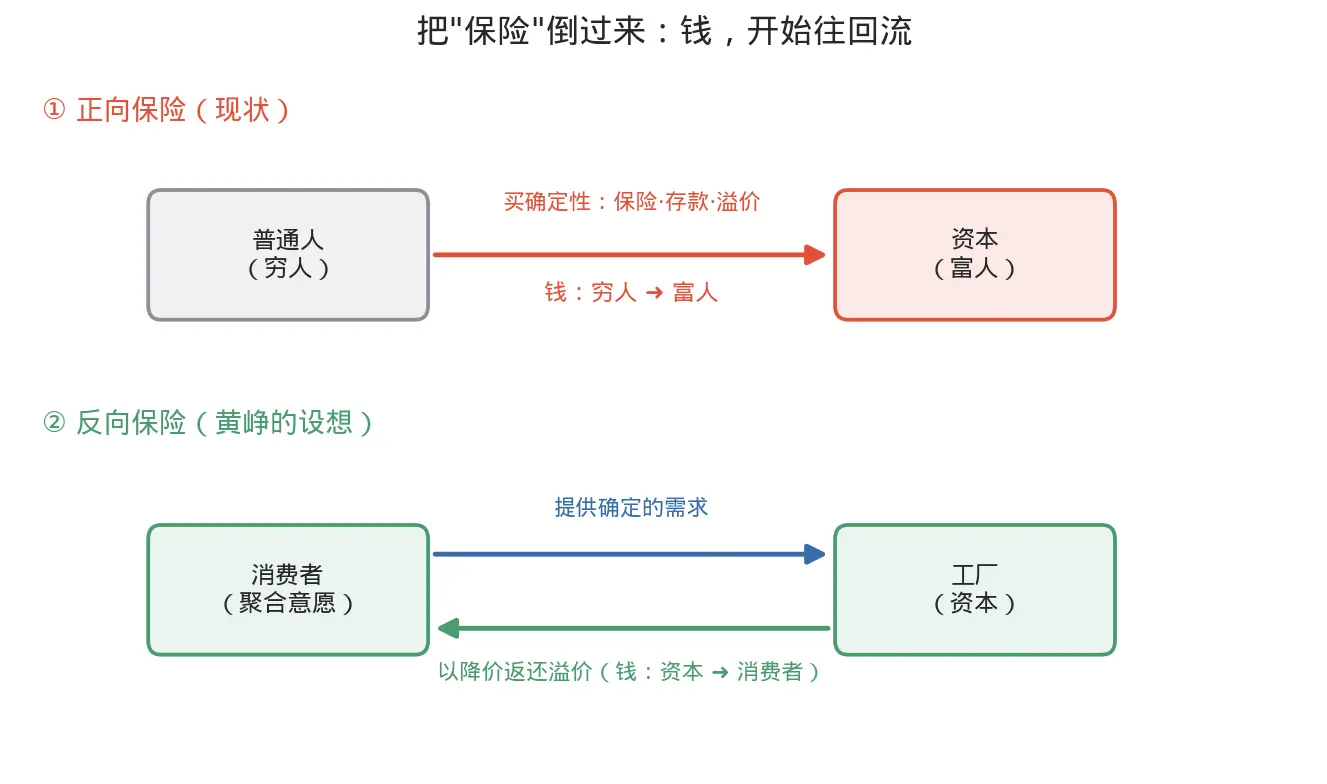
His answer: Because the wealthy bear "uncertainty" for others. The probabilities of life's misfortunes—sickness, unemployment, major illness—striking anyone are roughly the same. But the same blow that might cripple a poor person is just a small, calculable fluctuation on a rich person's ledger. Thus, the poor are willing to spend money for "peace of mind"—buying insurance, depositing money in banks for meager interest, preferring to pay more for goods to get certainty. Money, bit by bit, flows from the bottom to the top. This is the "upright" way.

II. "Reverse Insurance": Turning Capitalism on Its Head

So, can it be turned upside down? Can ordinary people, in turn, sell "certainty" to capital?

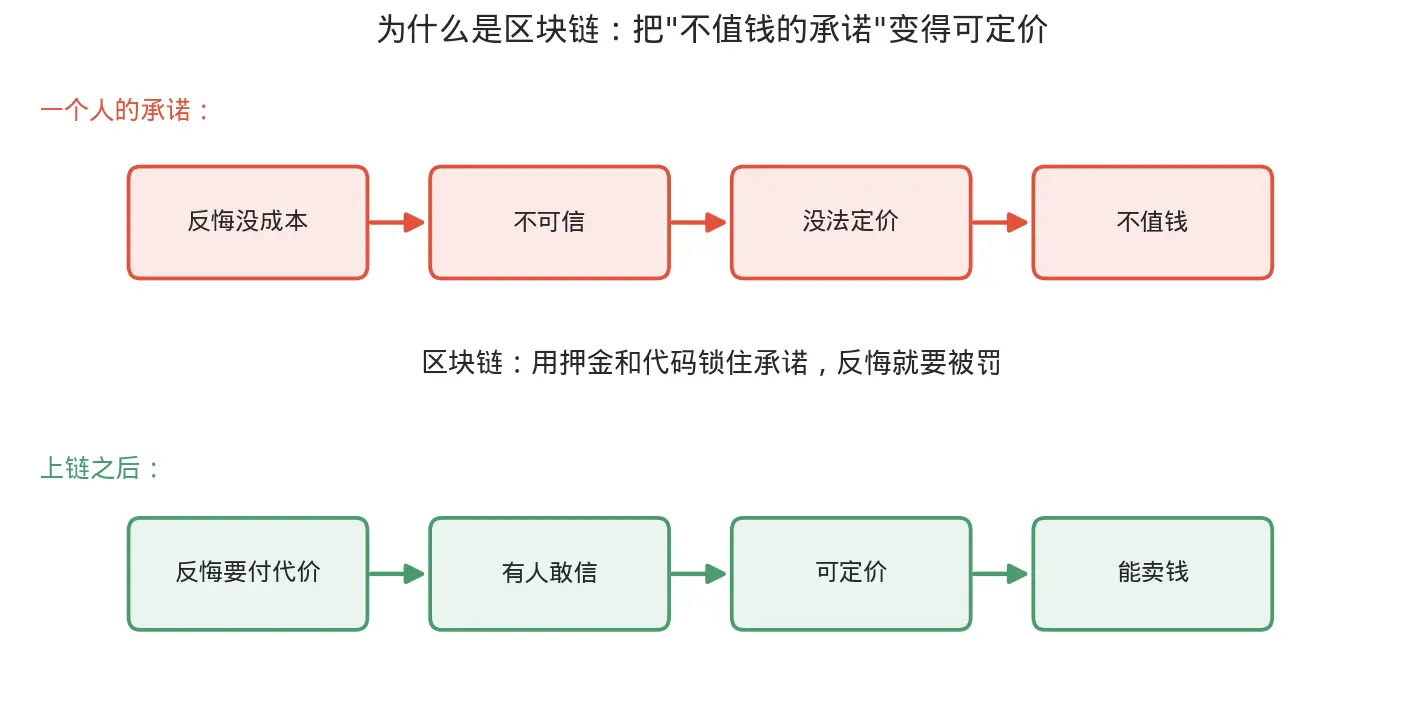
The difficulty lies in this: an individual's promise is worthless. You can cancel an online order anytime with zero cost to yourself; merchants have no recourse. They can only overstock, passing the cost back into the price. Huang Zheng puts it bluntly:

"Your action is treated as a statistical fluctuation, not as a promise that must be fulfilled."

But what if it's not one person, but ten thousand? Pinduoduo's group buying, flash sales—essentially, they catch you before you can hesitate, locking ten thousand people's "intention to buy" at the same moment, forcefully assembling a guaranteed order, eliminating the factory's risk of "producing and not selling." Grateful for this certainty, the factory converts the premium it would have set aside for risk into a "price reduction" returned to consumers. Money flows backward a notch. This is what he calls "reverse insurance."
III. The Final Puzzle Piece: Blockchain

By now, you might still not see the connection to blockchain. Honestly, I didn't either at first.

It's near the end of the article that Huang Zheng himself poses a question. He says that to productize, standardize, and monetize this kind of "certainty," a decentralized approach is needed to prevent fraud and create a virtuous cycle of good money driving out bad; then he asks: Isn't blockchain inherently designed for this kind of "reverse insurance"?

Just this one sentence made me pause. An e-commerce entrepreneur, after a long detour, lands the point squarely on blockchain. He doesn't elaborate further, but upon reflection, it makes perfect sense.

The biggest deadlock for reverse insurance, as mentioned, is that "an ordinary person's promise is worthless"—costless, untrustworthy, unpriced. And blockchain precisely cures this disease:

  • Use smart contracts to irrevocably bind your promise to a deposit. If you renege, the deposit is forfeited, and you face penalties.

  • This way, your "intention to buy" becomes, for the first time, a real promise with a cost to breaking it, a promise that can be enforced. Only then would the factory dare to believe it and arrange production accordingly.

Ultimately, it shifts the basis of "trust" from people to rules. You see, the missing puzzle piece he needed—making promises trustworthy, priceable, and immune to middleman fees—is exactly the inherent capability of blockchain.
IV. Extended Thought: Two Paths to Creating Certainty

Following his question, I couldn't help but think one layer deeper about Bitcoin (an occupational hazard, forgive me for bringing crypto into this).

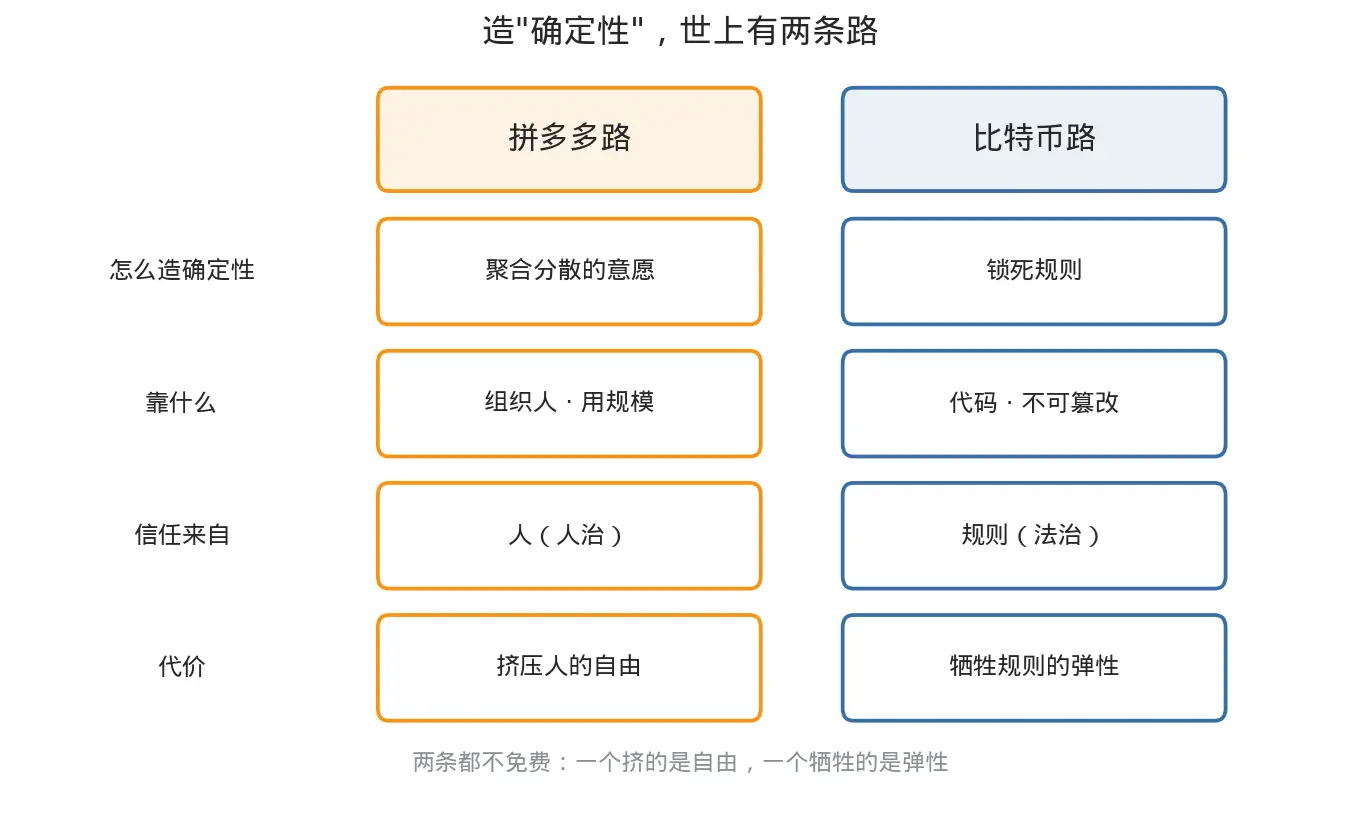
Bitcoin is essentially the purest example of "trusting rules": fixed supply, open-source algorithm, immutable rules.

  • The certainty of fiat currency relies on the restraint of the issuer; it's rule by man.

  • The certainty of Bitcoin relies on cold, impersonal, unfeeling code; it's rule by law.

One relies on people, the other on rules. So, there are actually two paths in the world to creating certainty:

  1. The Pinduoduo path: Aggregate scattered intentions into momentum, using scale to forcibly flatten uncertainty.

  2. The Bitcoin path: Lock the rules completely from the start, leaving no room for human discretion or intervention.

Neither path is free. The former squeezes human freedom; the latter sacrifices rule flexibility.
If you're interested, you can also re-read the article "Turning Capitalism on Its Head."


Related Questions

QWhat is the fundamental business logic of Pinduoduo according to the article?

AAccording to the article, the fundamental business logic of Pinduoduo is a business about 'uncertainty' or an 'insurance' business. Founder Colin Huang argues that Pinduoduo operates on the principle of a 'reverse insurance' model.

QHow does Pinduoduo's 'reverse insurance' model work to redistribute wealth flow?

APinduoduo's 'reverse insurance' model works by aggregating the diffuse intentions of numerous consumers into a single, large, and certain purchase order at a specific moment (e.g., through group buying). This provides manufacturers with production certainty, allowing them to eliminate the 'risk premium' they would normally charge. The cost savings are then passed back to consumers as lower prices, causing money to flow 'backwards' from capital to ordinary people.

QWhat is the core problem that prevents ordinary people's commitments from being valuable, and how does blockchain potentially solve it?

AThe core problem is that an individual's promise or purchase intent lacks credibility and is costless to break (e.g., easy cancellations). Blockchain, through smart contracts, can bind a promise to a deposit. If the promise is broken, the deposit is forfeited, creating a tangible cost for reneging. This transforms a casual 'intent to buy' into a credible, enforceable, and financially accountable commitment that manufacturers can trust.

QAccording to the article's extension, what are the two paths to creating 'certainty' as exemplified by Pinduoduo and Bitcoin?

AThe article outlines two paths: 1) The 'Pinduoduo Path': Creating certainty by aggregating scattered intentions into a large-scale force that flattens out uncertainty through collective action. 2) The 'Bitcoin Path': Creating certainty by locking rules into immutable code from the outset, eliminating the possibility of human discretion or manipulation, thus relying on 'rule of code' rather than 'rule of man'.

QWhat key question did Colin Huang himself raise that connects his 'reverse insurance' concept to blockchain technology?

AColin Huang raised the question: 'Is blockchain inherently born for this kind of 'reverse insurance'?' He suggested that the decentralized, fraud-resistant nature of blockchain, which enables a virtuous cycle of good money driving out bad, is perfectly suited for productizing, standardizing, and monetizing the 'certainty' required for his model.

Related Reads

Four Questions on the Zcash Orchard Vulnerability: Was It Exploited? Can Funds Be Recovered? Is the Supply Verifiable? And Are There Others?

Zcash Orchard Bug: Four Key Questions Answered A critical forgery vulnerability was discovered in Zcash's Orchard privacy pool, raising four major concerns for users. 1. **Was the Orchard bug exploited?** The likelihood is considered low. The bug was found proactively using advanced AI-assisted tools and was promptly patched, limiting any potential attack window. If exploitation had occurred, evidence would likely have surfaced by now. 2. **Can legitimate Orchard funds be recovered?** It is believed so, based on the assessment that the bug was not exploited. If forgery did happen, existing "turnstile" mechanisms could prevent full recovery of legitimate funds if forged coins were moved out first, though this scenario is deemed unlikely. Users can choose to move funds, but this carries risks like loss of privacy or new wallet/software issues. 3. **Can users verify Zcash's total supply?** Currently, no. The vulnerability's prior existence prevented independent verification of the shielded supply. The proposed "Ironwood" network upgrade will restore this ability by sealing the Orchard pool, allowing anyone running a node to verify that the circulating ZEC does not exceed the correct amount. 4. **Are there other forgery bugs?** Ongoing intensive audits by multiple teams, including AI-assisted analysis, have not found additional forgery vulnerabilities, increasing confidence that none remain. Further work and collaborations are planned to provide additional guarantees. In conclusion, while the team assesses that exploitation was unlikely and the supply is safe, the upcoming upgrade is critical to restore users' ability to independently verify Zcash's supply integrity, moving away from reliance on trust.

marsbit20m ago

Four Questions on the Zcash Orchard Vulnerability: Was It Exploited? Can Funds Be Recovered? Is the Supply Verifiable? And Are There Others?

marsbit20m ago

Four Questions on the Zcash Orchard Vulnerability: Was it Exploited? Can Funds Be Recovered? Is the Supply Verifiable? Are There Others?

**Summary: Zcash Orchard Vulnerability Analysis** A critical forgery vulnerability was recently discovered in Zcash's Orchard shielded pool, raising concerns about the coin's supply and user funds. The developers, led by Zcash Open Development Labs, acted swiftly to temporarily freeze the pool and deploy a fix. The article addresses four key questions: 1. **Was the vulnerability exploited?** While unknown, the developers believe it is unlikely for several reasons: the bug was difficult to find, using advanced AI tools; the fix was deployed quickly; and typical crypto exploits are fast, with no evidence of abnormal outflows. 2. **Can legitimate Orchard funds be recovered?** If the bug was not exploited, all funds are safe. If exploited, a mechanism limits total withdrawals from the pool to the amount legitimately entered, potentially blocking some legitimate funds. The developers deem this unlikely but advise cautious users to consider moving funds, noting the privacy and risk trade-offs of moving to transparent or Sapling pools. 3. **Can users verify Zcash's total supply?** Not currently. The vulnerability temporarily broke the ability for users to independently verify that no extra ZEC was created. 4. **Are there other forgery bugs?** Ongoing audits by multiple teams, including using advanced AI analysis, have so far found no others, increasing confidence. The proposed "Ironwood" network upgrade is the core solution. It will **seal** the Orchard pool, preventing new entries or internal circulation. This action, combined with the existing withdrawal mechanism, will restore the ability for any node operator to verify that Zcash's supply limit has not been violated, regardless of whether exploitation occurred in the past. The upgrade aims to restore the system's long-term credibility through user-verifiable supply integrity.

Odaily星球日报21m ago

Four Questions on the Zcash Orchard Vulnerability: Was it Exploited? Can Funds Be Recovered? Is the Supply Verifiable? Are There Others?

Odaily星球日报21m ago

An AI Version of the 'Subprime Crisis'? A Hidden Debt of $1.8 Trillion is Accumulating in the Shadows Amid the Frenzy

Amidst the AI infrastructure construction boom, a massive debt expansion is forming, with the most dangerous portion remaining off-balance sheets. Morgan Stanley research reveals approximately $1.8 trillion in off-balance-sheet exposures, including nearly $1 trillion in purchase commitments and over $800 billion in non-active lease contracts. These future cash outflows are not recorded as liabilities. The leverage of hyperscale cloud companies has surged from 0.9x to 1.8x in just two quarters. Private credit firms like Apollo and Blackstone are shifting leverage into the supply chain through complex, opaque SPV (Special Purpose Vehicle) financing structures. Global AI-related bond issuance has skyrocketed, with annual volume projected to exceed $570 billion. However, capital expenditure growth is outpacing revenue and free cash flow. Major cloud providers may see free cash flow approach zero or turn negative in 2026. A significant 'depreciation cliff' looms as vast amounts of current capital spending, recorded as 'construction in progress,' have yet to begin depreciating, artificially inflating current profit margins. Future depreciation could severely pressure earnings. The core risk is identified as a series of timing mismatches, not an immediate solvency crisis. Investment is racing ahead of monetization, leverage is being obscured, and accounting classifications hinder comparability. The entire financing structure faces a fundamental stress test if AI commercialization lags or enterprise clients shift to cheaper alternatives, potentially triggering chain reactions within the highly interconnected funding ecosystem.

marsbit32m ago

An AI Version of the 'Subprime Crisis'? A Hidden Debt of $1.8 Trillion is Accumulating in the Shadows Amid the Frenzy

marsbit32m ago

Trading

Spot
Futures

Hot Articles

Discussions

Welcome to the HTX Community. Here, you can stay informed about the latest platform developments and gain access to professional market insights. Users' opinions on the price of S (S) are presented below.

活动图片