Four Questions on the Zcash Orchard Vulnerability: Was it Exploited? Can Funds Be Recovered? Is the Supply Verifiable? Are There Others?

Odaily星球日报Published on 2026-06-15Last updated on 2026-06-15

Abstract

**Summary: Zcash Orchard Vulnerability Analysis** A critical forgery vulnerability was recently discovered in Zcash's Orchard shielded pool, raising concerns about the coin's supply and user funds. The developers, led by Zcash Open Development Labs, acted swiftly to temporarily freeze the pool and deploy a fix. The article addresses four key questions: 1. **Was the vulnerability exploited?** While unknown, the developers believe it is unlikely for several reasons: the bug was difficult to find, using advanced AI tools; the fix was deployed quickly; and typical crypto exploits are fast, with no evidence of abnormal outflows. 2. **Can legitimate Orchard funds be recovered?** If the bug was not exploited, all funds are safe. If exploited, a mechanism limits total withdrawals from the pool to the amount legitimately entered, potentially blocking some legitimate funds. The developers deem this unlikely but advise cautious users to consider moving funds, noting the privacy and risk trade-offs of moving to transparent or Sapling pools. 3. **Can users verify Zcash's total supply?** Not currently. The vulnerability temporarily broke the ability for users to independently verify that no extra ZEC was created. 4. **Are there other forgery bugs?** Ongoing audits by multiple teams, including using advanced AI analysis, have so far found no others, increasing confidence. The proposed "Ironwood" network upgrade is the core solution. It will **seal** the Orchard pool, preventing ne...

Original Authors: Jason McGee, CEO of Shielded Labs, and Zooko Wilcox, Founder of Zcash

Compiled by|Odaily Planet Daily Qin Xiaofeng (@QinXiaofeng 888 )
Editor's Note: On June 5th, Beijing time, privacy project Zcash was revealed to have had a critical counterfeiting vulnerability in its new-generation privacy pool, Orchard. The Zcash token, ZEC, briefly plummeted by half, hitting a low near $250. After about ten days of developments, market panic has somewhat subsided, ZEC's price has recovered somewhat, and it returned to $500 today.

This morning, Zcash founder Zooko Wilcox once again published a lengthy post responding to market concerns. He stated that the Orchard vulnerability was likely not previously exploited, and legitimate Orchard funds can be recovered; currently, users cannot independently verify whether the Zcash supply has been inflated, but the Ironwood upgrade will seal the Orchard pool, restoring this verification capability; ongoing audits have not discovered other counterfeiting vulnerabilities, but more work is needed to be completely certain.

The following is the original text by Zooko Wilcox, compiled by Odaily Planet Daily, enjoy~

————————————

The recent Orchard vulnerability has raised important questions about Zcash's supply and the safety of user funds. The discussion has mingled several distinct issues, making it difficult to understand the actual impact of the vulnerability on users. This article attempts to separate these questions and explain what they each mean for users.

The Orchard vulnerability raises four important questions:

  1. Was the Orchard vulnerability ever exploited?
  2. Can legitimate Orchard funds be recovered?
  3. Can users verify that Zcash's supply has not been inflated?
  4. How do we know there are no other counterfeiting vulnerabilities?

Was the Orchard vulnerability ever exploited?

Unknown. We believe it's unlikely to have been exploited before, though we cannot rule it out entirely. We think the vulnerability was likely *not* exploited for three reasons:

Despite years of ongoing review by many of the world's top cryptographers and security researchers, the vulnerability was not previously discovered. Its eventual discovery was not accidental; it was found by Taylor Hornby of Shielded Labs with the explicit purpose of proactively identifying such security vulnerabilities before a malicious attacker could. Taylor used advanced AI-assisted security research techniques and custom-built tools specifically designed to find subtle flaws that others might miss. Doing this would be even more difficult for someone not deeply familiar with the Zcash codebase.

Once the vulnerability was discovered, Zcash developers (led by the Zcash Open Development Labs team) quickly coordinated with mining pools to temporarily freeze the Orchard pool and deployed a fix, thereby limiting the opportunity window for any attack.

Cryptocurrency exploits are common, and attackers typically seek to cash out as quickly as possible, especially after a vulnerability becomes public. For an attacker to profit from this vulnerability, they would need to exchange counterfeit ZEC for valuable assets, which would typically involve ZEC leaving the Orchard pool via the turnstile mechanism. If the vulnerability had been exploited before the fix, we would expect to have seen evidence by now. Historically, cryptocurrency exploits are usually "smash-and-grab" operations, not "4D chess" strategies hidden for months or years.

Can legitimate Orchard funds be recovered?

We believe so, because we believe the vulnerability was never exploited. If this assessment is correct, all legitimate Orchard funds remain fully recoverable.
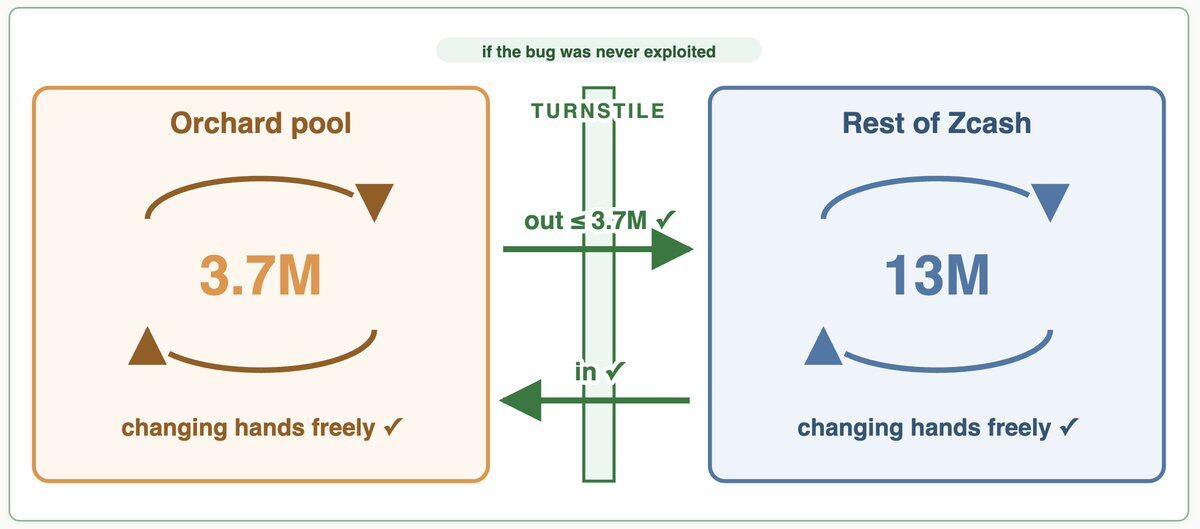
On the other hand, if counterfeiting *did* occur in Orchard, the existing turnstile mechanism would limit the total amount migrated to the amount of ZEC that legitimately entered the pool. Therefore, if counterfeit funds were migrated ahead of legitimate funds, users would be unable to recover some or all of their legitimate Orchard funds.
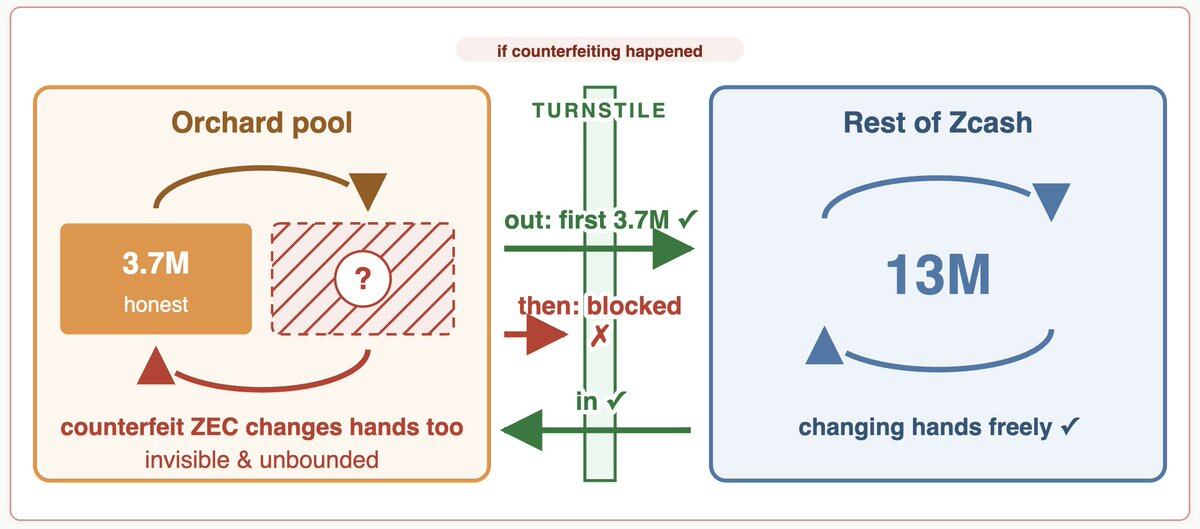
We consider this scenario unlikely. However, for more cautious users, moving their ZEC out of Orchard is still advised. But before doing so, they should understand the following:

  • Moving funds to a transparent pool (i.e., to a t-address) reveals both the amount and the timing of the transfer, and these funds become publicly linked to that t-address.
  • Moving funds from the Orchard pool to the Sapling pool reveals the amount and timing of the transfer, but unlike moving to a t-address, it does not link these funds to a specific address or transaction history.
  • The Sapling pool relies on a trusted setup ceremony performed in 2018. Relying on the security of that trusted setup is an additional risk users should note.
  • To our knowledge, YWallet and Zkool are currently the only widely used, self-custody Zcash wallets that support the Sapling pool.
  • Moving funds to a new wallet or a custodial service introduces additional risks, including user error, software bugs, custodian risk, or other unforeseen problems.

Overall, we consider the above risks moderate. If your funds are currently in a shielded, self-custody wallet, leaving them there is a reasonable choice given our assessment that prior counterfeiting was unlikely. If you have a secure way to move them elsewhere, that could also be reasonable. Users may reasonably reach different conclusions based on their circumstances.

Can users verify that Zcash's supply has not been inflated?

Not yet. The prior existence of this vulnerability meant users could not independently verify that the ZEC circulating in the current shielded pools did not exceed the correct amount.
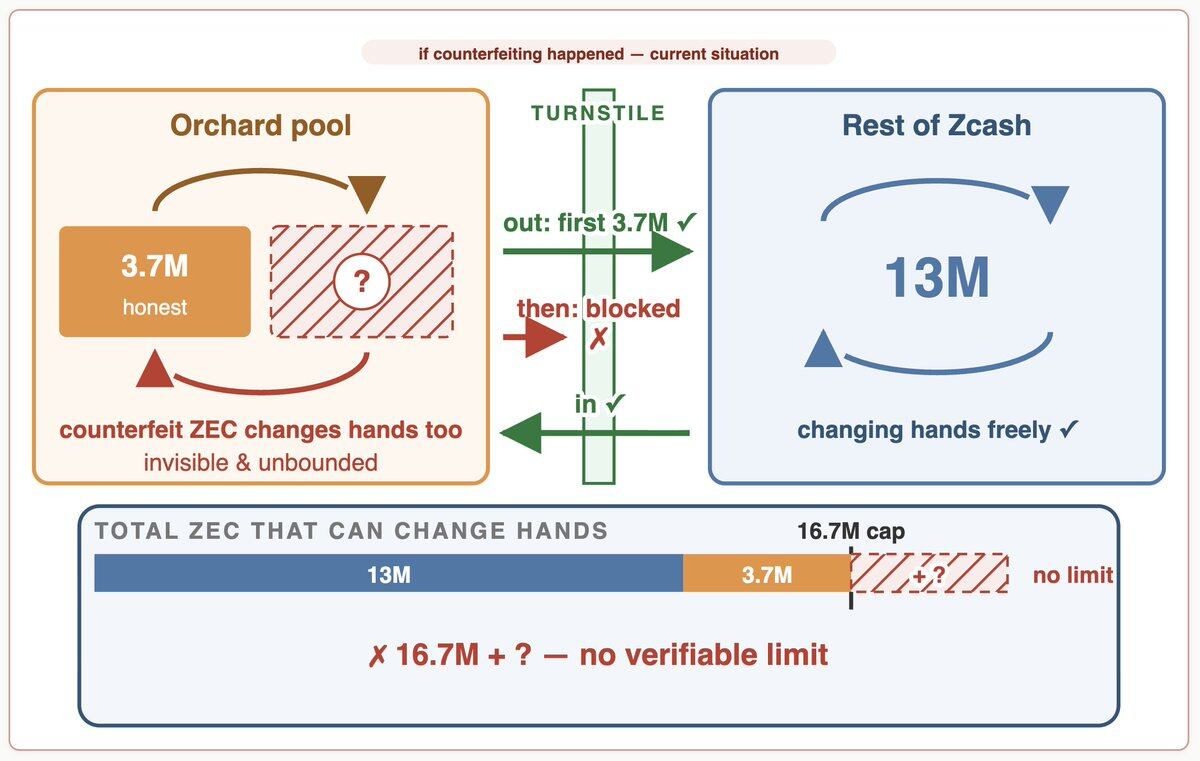
However, as we noted in a previous post, the Ironwood upgrade restores this capability. The diagram below illustrates why.
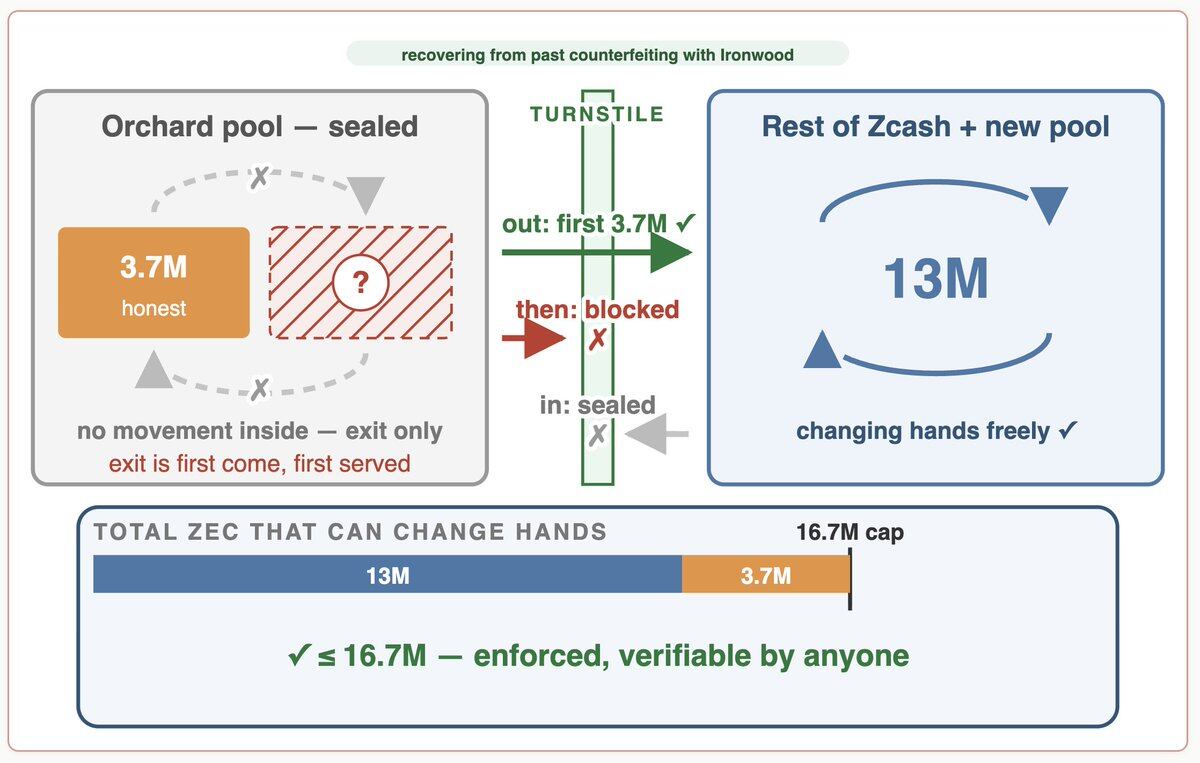
The proposed network upgrade addresses this by adding the guarantee that "no more unknown counterfeiting vulnerabilities exist" and by sealing the Orchard pool. New funds can no longer enter, and funds within the pool can no longer circulate. The only remaining path is to leave via the existing turnstile mechanism, which ensures that no more ZEC can leave the Orchard pool than legitimately entered it.

This change restores the ability to verify the soundness of the Zcash supply.

Currently, if counterfeit funds exist in the Orchard pool, they can continue to circulate within the pool. After the upgrade, this is no longer possible. Regardless of whether counterfeiting ever happened, anyone running a node will be able to verify that no more ZEC is in circulation than the correct amount.

Users won't need to wait for funds to migrate out of Orchard, or infer what attackers or other users might have done. The protocol itself provides a verifiable guarantee that excess ZEC cannot continue circulating within Orchard and inflating the supply.

This is important because Zcash's long-term credibility depends on users being able to independently verify the soundness of its supply. Ironwood restores users' ability to independently verify that the protocol's supply limit is being enforced.

How do we know there are no other counterfeiting vulnerabilities?

We are not yet completely certain, but we have reasons to believe there are none. Shielded Labs and multiple other teams have been carefully reviewing the Zcash protocol for additional counterfeiting vulnerabilities. This includes using a yet-to-be-released Mythos AI model to search for additional vulnerabilities, with help from Anthropic, shortly before Mythos was paused. We plan to share more details about this review and its findings in a follow-up blog post.

So far, no other counterfeiting vulnerabilities have been found. The high level of expertise, effort, and advanced AI-assisted analysis involved in this search gives us greater confidence that no similar vulnerabilities remain undiscovered.

Furthermore, we are working with projects like the Tachyon Project to provide additional assurance that there are no more counterfeiting vulnerabilities in Zcash. We will elaborate on this in future blog posts as well.

Conclusion

The Orchard vulnerability presents four important questions: Was the vulnerability exploited, can legitimate Orchard funds be recovered, can users verify that Zcash's supply has not been inflated, and are there other undiscovered counterfeiting vulnerabilities.

We believe it was likely not exploited previously, and therefore legitimate Orchard funds are recoverable and the current Zcash supply is safe. We are also increasingly confident, based on ongoing reviews by multiple independent researchers and teams, that there are no other undiscovered counterfeiting vulnerabilities. However, users currently cannot verify the safety of the Zcash supply, and they should not have to rely on our assessment—or anyone else's.

The proposed network upgrade solves this. By sealing the Orchard pool, it restores users' ability to independently verify the safety of the Zcash supply. Users no longer need to judge whether counterfeiting occurred in order to verify that the protocol's supply limits are being upheld.



Related Questions

QAccording to the article, why is it unlikely that the Orchard forgery vulnerability was exploited before its discovery?

AThe article cites three main reasons. First, the bug evaded detection by top cryptographers for years and was only found using advanced AI-assisted tools by a dedicated researcher. Second, developers reacted swiftly to freeze the pool and deploy a fix, limiting any potential attack window. Third, crypto exploits are typically 'smash-and-grab' operations for immediate profit, and no evidence of such activity (like ZEC exiting the pool) has been observed.

QWhat action does the proposed Ironwood network upgrade take regarding the Orchard pool?

AThe Ironwood upgrade will seal the Orchard pool. This means no new funds can enter it, and funds already inside cannot circulate. The only remaining action is for funds to exit through the existing turnstile mechanism.

QHow does sealing the Orchard pool restore users' ability to verify Zcash's supply integrity?

ASealing the pool prevents any potential forged ZEC from continuing to circulate and inflate the supply. After the upgrade, anyone running a node can verify that the total ZEC in circulation does not exceed the correct amount, as no extra ZEC can remain active within Orchard.

QWhat are the potential privacy implications for a user moving funds out of the Orchard pool to a transparent (t-address) or Sapling pool?

AMoving to a transparent (t) address exposes both the transaction amount and timing, and publicly links those funds to that address. Moving to the Sapling pool exposes the transaction amount and timing, but does not link the funds to a specific address or transaction history. However, Sapling relies on a 2018 trusted setup ceremony, which is an additional security consideration.

QWhat is the current state of knowledge regarding other undiscovered forgery vulnerabilities in Zcash, as stated in the article?

AThe article states that ongoing, intensive reviews by multiple teams using high-level expertise and advanced AI analysis have not found any other forgery bugs so far. This provides increased confidence, but they cannot be completely certain until more work is done. Collaborations are underway to provide further guarantees.

Related Reads

WeChat AI Card Hands-On Guide: Has the AI Shopping Era Arrived?

**"WeChat AI Card" Practical Test Guide: Has the Era of AI Shopping Arrived?** WeChat has officially launched the "AI Exclusive Card," a feature integrated into its Workbuddy AI assistant. This card is designed to handle payments for AI-initiated purchases. Our hands-on test reveals it's not yet a tool for fully autonomous AI shopping, but rather a controlled payment layer for AI agents. The AI Card functions as an isolated sub-wallet within WeChat Pay. Users must bind the card and transfer funds into it from their main wallet. Crucially, every transaction requires explicit user confirmation via smartphone scan; AI cannot spend autonomously. Currently accessible through the Workbuddy agent, the card targets specific digital consumption scenarios: purchasing paid content (reports, data), calling paid APIs/tools, and subscribing to services. Its design prioritizes security and control by separating funds and mandating approval for each payment. We tested a real-world scenario: ordering bubble tea via Workbuddy using a "Meituan Life Assistant" skill. The process encountered multiple hurdles: high "skill" usage costs (exceeding daily free credits), and most importantly, while a payment was successfully initiated, the AI purchased an incorrect product (a mismatched group-buy coupon instead of the desired drink). This highlights the current limitation: the **AI Card only solves the payment step**. The broader challenge lies in the **AI agent's execution chain**—accurately understanding intent, navigating third-party platforms, selecting the right product, and ensuring proper fulfillment. The payment succeeded, but the purchase failed to meet the user's need. In conclusion, the WeChat AI Exclusive Card is a cautious, early-step experiment in AI commerce. It provides a secure, user-controlled payment method for agent interactions but is not yet capable of reliable, end-to-end complex purchases. For now, it's best used for low-value, low-risk digital services with careful user verification at each step. The vision of AI handling complete shopping tasks remains a work in progress.

marsbit2h ago

WeChat AI Card Hands-On Guide: Has the AI Shopping Era Arrived?

marsbit2h ago

Deconstructing Notion's Growth: From a Note-taking Tool to 100 Million Users—How Notion Built a Triple Growth Flywheel Through Product, Templates, and Community

Notion's growth from a niche note-taking tool to a platform with 100 million users is powered by three interconnected flywheels: Product-Led Growth (PLG), a Template Economy, and Community-Driven Growth. First, Notion's PLG strategy relies on a highly flexible, "plastic" product that users can adapt to countless personal and team workflows. Its freemium model lowers the barrier to entry, while features like page sharing and collaboration drive organic, usage-based viral growth as users naturally invite others. Second, the Template Economy solves the "blank page" problem. Templates, created by both Notion and its community, transform abstract product capabilities into concrete, copyable solutions for specific scenarios (e.g., project management, content calendars). This dramatically lowers activation costs for new users and fuels SEO-driven discovery. Third, a vibrant Community acts as a distributed growth engine. Users and official Ambassadors create tutorials, share use cases, and host local events. This community not only educates users but also fosters a sense of identity around pursuing "better ways of working," strengthening loyalty and enabling global, low-cost expansion. Together, these flywheels create a self-reinforcing ecosystem: a great product attracts users who create templates and community content, which in turn attracts more users and deepens engagement. This system allowed Notion to scale from individuals to teams and enterprises through a bottom-up adoption path. Looking ahead, AI integration promises to accelerate these flywheels further by making templates smarter and the platform a potential AI-native work operating system. Ultimately, Notion's defensible advantage is not just its features, but this deeply entrenched network of user assets, creators, and community trust.

marsbit2h ago

Deconstructing Notion's Growth: From a Note-taking Tool to 100 Million Users—How Notion Built a Triple Growth Flywheel Through Product, Templates, and Community

marsbit2h ago

$10 Billion, Qualcomm to Acquire Chip Legend Jim Keller's Company

Global mobile chip giant Qualcomm is in advanced talks to acquire AI chip startup Tenstorrent in a deal valued between $8-10 billion, according to media reports. This potential acquisition would be one of the largest in the AI chip sector in recent years. Tenstorrent, led by legendary chip architect Jim Keller, has gained prominence for its RISC-V architecture and AI accelerator designs. The move highlights Qualcomm's strategic push to diversify beyond its core smartphone chip business. As the smartphone market matures, Qualcomm is aggressively targeting growth in automotive, data center, and cloud AI. Acquiring Tenstorrent would allow Qualcomm to rapidly enter the high-end AI computing market, bypassing lengthy in-house development cycles. Tenstorrent's cost-effective system architecture, which avoids expensive HBM memory and relies on standard Ethernet for clustering, offers a potential alternative to Nvidia's costly solutions. Furthermore, Tenstorrent's high-performance RISC-V CPU technology and its focus on the automotive and edge computing segments align with Qualcomm's strategic goals, including its "Snapdragon Digital Chassis" platform. Despite the strategic rationale, the high valuation has sparked some investor caution. The successful integration of Tenstorrent's open-source culture and independent team into Qualcomm's organization, along with the commercialization of its technology, remains a key challenge.

marsbit2h ago

$10 Billion, Qualcomm to Acquire Chip Legend Jim Keller's Company

marsbit2h ago

Trading

Spot
Futures
活动图片