What Russia’s Crypto Regulation Overhaul Means for Investors and Market Access

bitcoinistPublished on 2026-01-15Last updated on 2026-01-15

Abstract

Russia is preparing a major overhaul of its cryptocurrency regulations, with a draft bill expected in the State Duma by spring 2026. The legislation, led by Financial Markets Committee chairman Anatoly Aksakov, aims to remove digital assets from "special financial regulation" and allow broader market access. Retail investors would be permitted to buy up to 300,000 rubles (approx. $3,800) in crypto, while qualified investors face no caps. The bill also includes potential risk-awareness tests for retail participants and maintains restrictions on privacy-focused coins. Additionally, it could enable cross-border crypto payments and recognize mining as an export activity, aligning with efforts to modernize Russia’s financial infrastructure amid ongoing sanctions.

Russia is preparing a transition in their crypto market regulations, with a new draft bill expected to reach the State Duma during the spring 2026 parliamentary session.

The proposal, led by Financial Markets Committee chairman Anatoly Aksakov, would remove digital assets from the country’s “special financial regulation” category and allow wider participation in crypto markets. While the move signals broader acceptance of crypto in everyday finance, it also introduces clear risk limits.

If approved, the legislation would represent one of Russia’s most significant policy changes regarding digital assets in recent years, reshaping both domestic trading and cross-border cryptocurrency use.
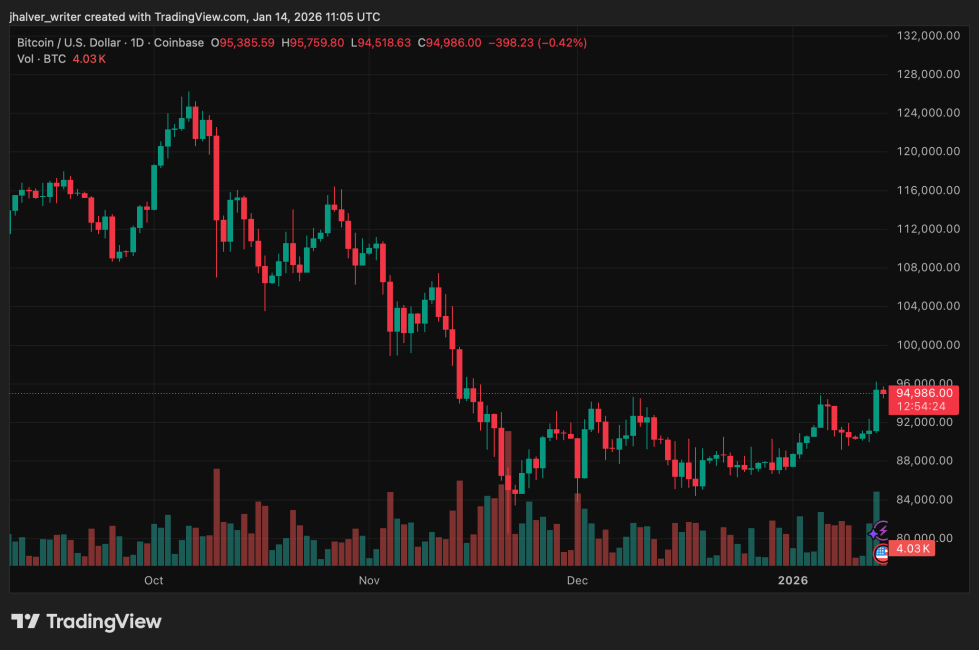
BTC's price trends to the upside on the daily chart. Source: BTCUSD on Tradingview

Retail Access Gets Clear Investment Limits

Under the draft bill, non-qualified investors, those who do not meet professional or institutional standards, would be allowed to buy cryptocurrencies worth up to 300,000 rubles (about $3,800). The cap is designed to mitigate financial risk for everyday users while still providing them with access to the market.

Qualified and professional participants, including financial firms, would not face similar restrictions. This two-tier system reflects the government’s approach to striking a balance between market access and investor protection.

Regulators are also considering a risk-awareness test for retail participants. The Bank of Russia previously proposed that non-qualified investors undergo a basic assessment before trading digital assets, ensuring they understand the potential volatility and associated financial risks.

Similarly, the central bank has reaffirmed its opposition to anonymous and privacy-focused cryptocurrencies. These assets would remain restricted under the new framework to maintain transparency and regulatory oversight.

Cross-Border Payments and Regulatory Implications

Beyond domestic trading, the bill could expand the use of crypto for international settlements. Aksakov has stated that the framework may enable Russian-issued digital tokens to be used in foreign markets, potentially facilitating cross-border payments.

This aligns with Russia’s earlier decision to legalize cryptocurrency for certain international transactions, following Western sanctions that limited access to traditional banking systems. Digital assets are increasingly viewed as an alternative tool for trade and financial transfers where conventional channels are restricted.

Officials have also discussed recognizing crypto mining as an export-related activity, given its impact on foreign currency inflows despite the lack of physical cross-border movement.

What It Means for Investors and the Market

For retail investors, the overhaul means regulated access to crypto within defined limits. The 300,000-ruble cap and potential testing requirements aim to reduce systemic and personal financial risk while still allowing participation in digital asset markets.

For the broader market, the change signals a shift toward integrating cryptocurrency into standard financial systems, rather than treating it as a niche or experimental asset class.

Russia is also advancing its digital ruble project, with a full rollout across state financial systems expected by September 2026. Together, these developments suggest a wider push toward modernizing the country’s digital financial infrastructure.

Cover image from ChatGPT, BTCUSD chart from Tradingview

Trending Cryptos

Related Questions

QWhen is Russia's new draft bill on crypto regulation expected to reach the State Duma?

AThe new draft bill is expected to reach the State Duma during the spring 2026 parliamentary session.

QWhat is the investment limit for non-qualified investors under the proposed Russian crypto regulations?

ANon-qualified investors would be allowed to buy cryptocurrencies worth up to 300,000 rubles (about $3,800).

QHow does the proposed legislation treat anonymous and privacy-focused cryptocurrencies?

AAnonymous and privacy-focused cryptocurrencies would remain restricted under the new framework to maintain transparency and regulatory oversight.

QWhat potential use for cryptocurrency in international transactions does the bill enable?

AThe bill could expand the use of crypto for international settlements, potentially enabling Russian-issued digital tokens to be used in foreign markets to facilitate cross-border payments.

QWhat is the timeline for the full rollout of Russia's digital ruble project?

AA full rollout of the digital ruble across state financial systems is expected by September 2026.

Related Reads

Warsh Deals a Heavy Blow to the 'Dollar Devaluation Trade'! Gold Crashes, Bitcoin Slumps, How Long Can the Chip Frenzy Hold?

The "dollar devaluation trade" that dominated Wall Street this year is rapidly unraveling, driven by a hawkish pivot from Fed Chairman Kevin Warsh and a surging U.S. dollar. This double pressure has triggered a sharp sell-off in non-yielding assets. Gold broke below $4,000 an ounce, silver tumbled below $60, and Bitcoin fell under $60,000, with all retreating significantly from their earlier 2025 peaks. The dollar index hit a 14-month high. Warsh's emphasis on price stability has solidified market expectations for aggressive rate hikes, increasing the opportunity cost of holding assets like precious metals. Concurrently, massive fund flows are rotating out of metals and cryptocurrencies into the semiconductor sector, providing a temporary boost to stocks like Micron and SK Hynix. However, analysts warn this chip rally shows signs of a speculative top. Extreme volatility, with semiconductor stocks seeing trillion-dollar swings, is historically characteristic of major market turning points. Factors like month-end rebalancing, a flood of new equity issuance, and insider selling further signal potential exhaustion. While Micron's strong earnings briefly stemmed selling, it may offer a favorable exit point for remaining chip bulls. The sustainability of the semiconductor frenzy is now in serious doubt as the broader market reprices assets around a stronger dollar and tighter monetary policy.

华尔街日报4m ago

Warsh Deals a Heavy Blow to the 'Dollar Devaluation Trade'! Gold Crashes, Bitcoin Slumps, How Long Can the Chip Frenzy Hold?

华尔街日报4m ago

Micron Shuts Up the Bears, Makes India's 'Buffett' Regret: Sold Too Early, Missed Out on $2 Billion

Indian value investor Mohnish Pabrai, a disciple of Warren Buffett, revealed his costly mistake of selling shares in Micron Technology too early. He initially invested in 2017, holding it for six years and building a position as large as 77% of his portfolio, based on a thesis that the memory chip industry would consolidate into a stable oligopoly of Samsung, SK Hynix, and Micron. However, he sold his entire stake in September 2023, fearing oversupply after Samsung announced production expansion. Shortly after his exit, demand for high-bandwidth memory (HBM) surged with the rise of AI, and Micron's stock price skyrocketed over 15 times in two years. Pabrai estimates this premature sale cost him roughly $20 billion in potential gains. He expressed similar regret over selling his investment in SK Hynix too soon, stating he violated his own principle of holding companies forever. Reflecting on these errors, Pabrai emphasized his core investment checklist principles: avoiding leverage, focusing on the durability of a company's competitive moat, and assessing management's character. Despite these personal trading missteps, his long-term view on the remaining memory chip leaders remains bullish, advising current holders not to sell as "the party is just getting started." He concluded by sharing his philosophical outlook, prioritizing character over wealth, and his goal to donate his entire fortune before his passing.

marsbit1h ago

Micron Shuts Up the Bears, Makes India's 'Buffett' Regret: Sold Too Early, Missed Out on $2 Billion

marsbit1h ago

Mihoyo's Next Protagonist Is Her, Who Plays the Piano

Mihoyo, widely recognized for its hit game Genshin Impact, has long harbored a grander ambition: creating a virtual world where one billion people would want to live. While its character design is unparalleled, the company recognizes a fundamental limitation—these beloved virtual characters are not truly "alive." Their dialogue and actions are pre-scripted. This drive for authentic "living" characters has guided Mihoyo's strategic investments in cutting-edge fields like brain-computer interfaces, AI (including an early investment in MiniMax), and nuclear fusion. Following the release of ChatGPT in late 2022, co-founder Cai Haoyu stepped down from management to lead a new overseas AI venture, Anuttacon, focused on creating AI-driven virtual beings. Mihoyo's path has involved experimentation and iteration. Anuttacon's early project, *Whisper of the Stars*, showcased real-time AI conversation but revealed limitations in underlying language models. The team subsequently focused its resources on developing a sophisticated "emotional" large language model, distinct from purely utilitarian AI. Co-founder Liu Wei (Dawei) announced plans to invest up to 100 billion RMB in this AI pursuit. The first tangible product of this vision is *BSide: Olivia Lin*, a free Steam application featuring a piano-playing virtual companion. Unlike typical AI chatbots demanding constant interaction, Olivia Lin operates on a slower, more deliberate rhythm—responding to letters, playing user-submitted melodies, and serving as a desktop presence. This design emphasizes "lifelikeness" over exhaustive conversation, strategically working around current technological constraints while building a sense of authentic connection. The company's journey traces back to its name, "miHoYo," where "mi" pays homage to the virtual singer Hatsune Miku. For nearly two decades, fans have loved Miku, a character unaware of their devotion. Mihoyo's ultimate goal, now backed by massive investment and AI research, is to bridge that gap—to create virtual beings that can truly know they are loved.

marsbit1h ago

Mihoyo's Next Protagonist Is Her, Who Plays the Piano

marsbit1h ago

Citrini Research: Taking Stock of 5 Major Investment Themes Overshadowed by the AI Trade

Citrini Research identifies five under-the-radar investment themes potentially overshadowed by the dominant AI trade. With capital and analyst attention overwhelmingly focused on AI infrastructure, these overlooked areas present alpha opportunities as market dynamics shift. **Theme 1: Airlines** – Despite strong fundamentals, stocks like Delta and United have been penalized for 18 months due to macro concerns (tariff-inflation, oil prices), not profitability. A rebound is expected as these headwinds fade, aided by trends like premiumization and the 2026 World Cup. **Theme 2: Senior Housing** – A pure demographic play. The U.S. population over 80 is projected to grow 56% in the next decade, drastically outpacing supply. This creates a compelling need for facilities, benefiting REITs like Welltower and operators like Brookdale. **Theme 3: Live Events & Entertainment** – "Being there" is becoming a luxury. This sector has outperformed even tech over the past decade. Companies like TKO Group (WWE/UFC), Cinemark, and IMAX are capitalizing on demand for premium, in-person experiences. **Theme 4: Exchange Competition** – CME Group's ~98% monopoly in U.S. interest rate derivatives faces its first real challenge from FMX Futures Exchange. Backed by major Wall Street banks, FMX offers lower fees and margin savings. While CME's deep liquidity remains an advantage, FMX provides a competitive alternative. **Theme 5: Fintech Recovery** – Heavily sold off in 2026, fintech stocks like SoFi, Robinhood, and Upstart are showing signs of a rebound based on improving fundamentals—SoFi's stablecoin launch, Robinhood's transformation into a "financial super app," and Upstart's renewed AI lending narrative—rather than a change in sector outlook. The report advises maintaining some AI exposure but diversifying into these neglected "small themes" where mispricing exists due to a simple shortage of investor attention.

marsbit2h ago

Citrini Research: Taking Stock of 5 Major Investment Themes Overshadowed by the AI Trade

marsbit2h ago

Trading

Spot
Futures

Hot Articles

Discussions

Welcome to the HTX Community. Here, you can stay informed about the latest platform developments and gain access to professional market insights. Users' opinions on the price of S (S) are presented below.

活动图片