UK FCA makes pound stablecoin payments a 2026 priority

cointelegraphPublished on 2025-12-11Last updated on 2025-12-11

Abstract

The UK Financial Conduct Authority (FCA) has made pound-denominated stablecoin payments a top policy priority for 2026. It is fast-tracking a regulatory sandbox for prospective issuers, allowing them to test their products in a controlled environment before new digital asset regulations take full effect. Applications for the sandbox must be submitted by January 18, 2026. The initiative is part of broader efforts to strengthen the UK’s position as a global financial hub by supporting faster and more convenient payment methods. The move aligns with the FCA’s growth strategy and follows calls for industry feedback on upcoming regulatory frameworks. Meanwhile, jurisdictions like Guernsey are also advancing their own digital finance regulations, including requirements for stablecoins to be fully backed by high-quality liquid assets. UK and Channel Islands policymakers aim to maintain competitiveness amid growing regulatory developments in regions like the EU.

The United Kingdom’s Financial Conduct Authority (FCA) has elevated British pound‐denominated stablecoin payments to a top policy priority for 2026, fast-tracking a dedicated regulatory sandbox for prospective issuers ahead of new digital asset regulations.

The watchdog said the move is part of a package of “ambitious new growth measures” for next year, aimed at supporting UK‐issued stablecoins as a way to make payments faster and more convenient.

In a letter to Prime Minister Sir Kier Starmer this week, the regulator outlined nearly 50 reforms aimed at strengthening the UK’s position as a global financial hub. Among them, the FCA flagged advancing UK-issued pound stablecoins in 2026 as a central milestone in its broader growth strategy.

Testing stablecoin solutions before new rules apply

Firms that plan to issue a pound stablecoin in the UK and want to test their products should apply to the regulatory sandbox by Jan. 18, 2026, which is designed to let firms pilot stablecoin solutions in a controlled environment before the full regime takes effect.

Related: UK finance regulator FCA a ‘deterrent’ to crypto industry, says CryptoUK

The sandbox will sit under the FCA’s existing Digital Sandbox framework, providing participants with regulatory guidance as they test compliance, stability, and consumer-protection measures for sterling-backed digital currencies.
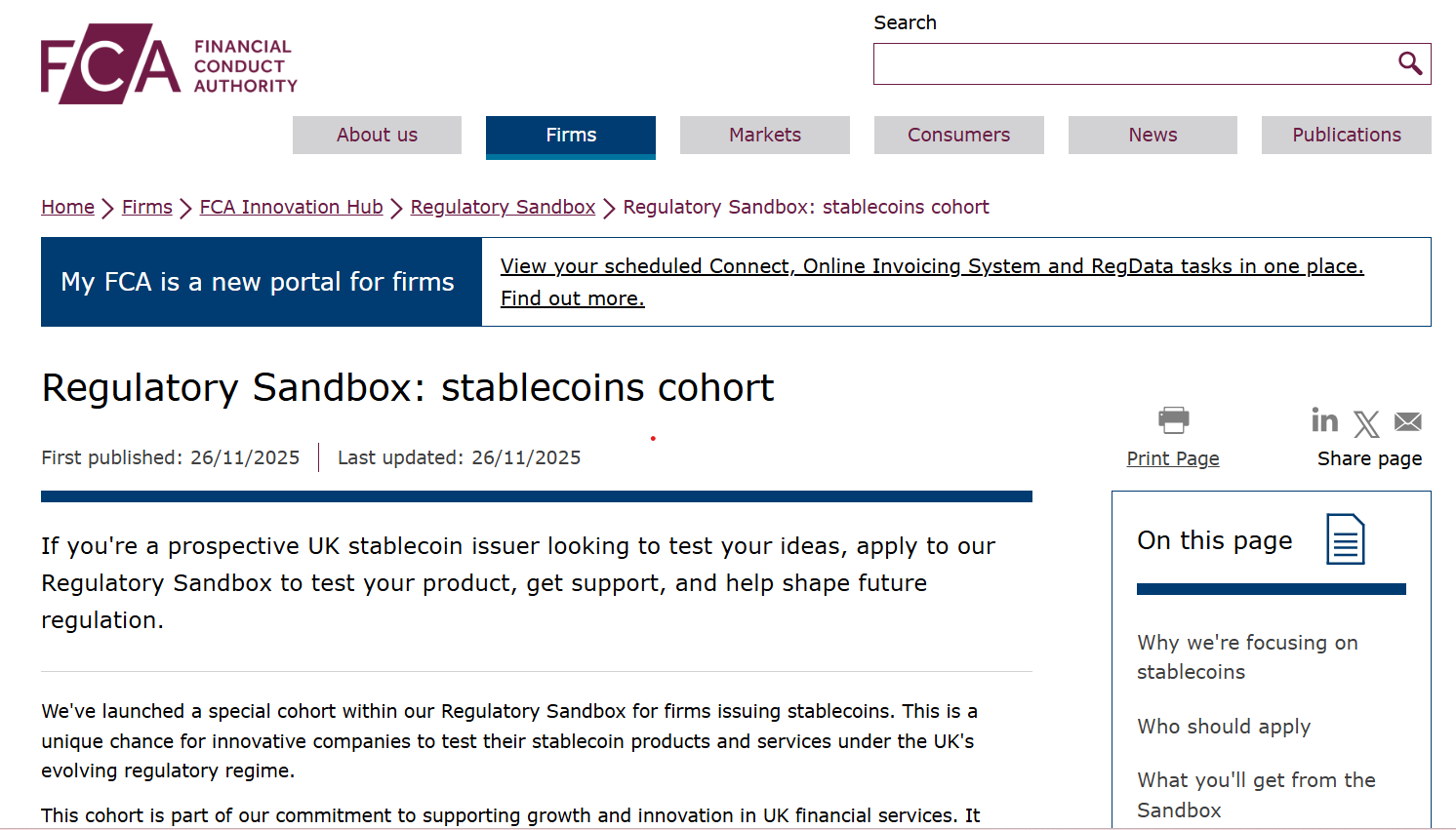
Regulatory Sandbox for Stablecoin Issuers | Source: FCA

The announcement comes as crypto industry stakeholders have been encouraged to submit feedback on UK investment reforms. Earlier this week, the watchdog invited comments from firms involved in digital assets on a series of draft guidance papers expected to feed into the 2026 regulatory framework.

Related: Tether’s stablecoin business set for another record year of profitability

A wider race for competitiveness

Smaller jurisdictions connected to the UK’s financial ecosystem are also making pushes of their own. The Bailiwick of Guernsey’s Financial Services Commission (GFSC) opened a new consultation on its Digital Finance Initiative on Dec. 11, seeking feedback on tokenization, blockchain infrastructure, and stablecoin regulation.

The Digital Finance Initiative is a new regulatory framework for stablecoins, requiring 100% backing by high-quality liquid assets and introducing capital, reporting, and redemption requirements.

Digital Finance Initiative | Source: GFSC

Chris Hutley-Hurst, head at Walkers Channel Island Regulatory & Risk Advisory Group, has actively engaged in discussions with the GFSC. He told Cointelegraph:

“The GFSC’s Consultation marks a pivotal moment for Guernsey’s digital finance landscape. By introducing clear frameworks for stablecoins, tokenization, and custody, the proposals strike the right balance between innovation and robust regulation. This approach not only supports emerging technologies but also reinforces Guernsey’s ambition to be a leading jurisdiction for digital assets and sustainable growth.”

UK and Channel Islands policymakers appear intent on keeping the region attractive for innovative financial firms, particularly as global competitors like the European Union advance their own stablecoin regimes.

“Our reforms help the UK maintain its global competitive edge in our world-leading wholesale markets, attract international investment, and lead on innovation in financial services,” Nikhil Rathi, chief executive of the FCA, said in a statement.


Related Reads

a16z: AI's 'Amnesia', Can Continuous Learning Cure It?

The article "a16z: AI's 'Amnesia' – Can Continual Learning Cure It?" explores the limitations of current large language models (LLMs), which, like the protagonist in the film *Memento*, are trapped in a perpetual present—unable to form new memories after training. While methods like in-context learning (ICL), retrieval-augmented generation (RAG), and external scaffolding (e.g., chat history, prompts) provide temporary solutions, they fail to enable true internalization of new knowledge. The authors argue that compression—the core of learning during training—is halted at deployment, preventing models from generalizing, discovering novel solutions (e.g., mathematical proofs), or handling adversarial scenarios. The piece introduces *continual learning* as a critical research direction to address this, categorizing approaches into three paths: 1. **Context**: Scaling external memory via longer context windows, multi-agent systems, and smarter retrieval. 2. **Modules**: Using pluggable adapters or external memory layers for specialization without full retraining. 3. **Weights**: Enabling parameter updates through sparse training, test-time training, meta-learning, distillation, and reinforcement learning from feedback. Challenges include catastrophic forgetting, safety risks, and auditability, but overcoming these could unlock models that learn iteratively from experience. The conclusion emphasizes that while context-based methods are effective, true breakthroughs require models to compress new information into weights post-deployment, moving from mere retrieval to genuine learning.

marsbit53m ago

a16z: AI's 'Amnesia', Can Continuous Learning Cure It?

marsbit53m ago

Can a Hair Dryer Earn $34,000? Deciphering the Reflexivity Paradox in Prediction Markets

An individual manipulated a weather sensor at Paris Charles de Gaulle Airport with a portable heat source, causing a Polymarket weather market to settle at 22°C and earning $34,000. This incident highlights a fundamental issue in prediction markets: when a market aims to reflect reality, it also incentivizes participants to influence that reality. Prediction markets operate on two layers: platform rules (what outcome counts as a win) and data sources (what actually happened). While most focus on rules, the real vulnerability lies in the data source. If reality is recorded through a specific source, influencing that source directly affects market settlement. The article categorizes markets by their vulnerability: 1. **Single-point physical data sources** (e.g., weather stations): Easily manipulated through physical interference. 2. **Insider information markets** (e.g., MrBeast video details): Insiders like team members use non-public information to trade. Kalshi fined a剪辑师 $20,000 for insider trading. 3. **Actor-manipulated markets** (e.g., Andrew Tate’s tweet counts): The subject of the market can control the outcome. Evidence suggests Tate’sociated accounts coordinated to profit. 4. **Individual-action markets** (e.g., WNBA disruptions): A single person can execute an event to profit from their pre-placed bets. Kalshi and Polymarket handle these issues differently. Kalshi enforces strict KYC, publicly penalizes insider trading, and reports to regulators. Polymarket, with its anonymous wallet-based system, has historically been more permissive, arguing that insider information improves market accuracy. However, it cooperated with authorities in the "Van Dyke case," where a user traded on classified government information. The core paradox is reflexivity: prediction markets are designed to discover truth, but their financial incentives can distort reality. The more valuable a prediction becomes, the more likely participants are to influence the event itself. The market ceases to be a mirror of reality and instead shapes it.

marsbit1h ago

Can a Hair Dryer Earn $34,000? Deciphering the Reflexivity Paradox in Prediction Markets

marsbit1h ago

Trading

Spot
Futures

Hot Articles

HTX Learn: Learn Hot Cryptos to Share 20,000 USDT​

To enhance your understanding of this week's featured cryptos, we are rolling out various rewarding events. Join them now and bring home generous rewards through learning and trading.

20.4k Total ViewsPublished 2026.04.14Updated 2026.04.14

HTX Learn: Learn Hot Cryptos to Share 20,000 USDT​

What is OPG

I. Project IntroductionOpenGradient is building a native intelligence network that aims to bring the world’s compute onchain. OpenGradient is the permissionless platform for open-source model hosting, secure execution, agentic reasoning, and application deployment.II. Token Information1) Basic InformationToken name: OPG(OpenGradient)III. Related LinksWebsite:https://www.opengradient.ai/Explorers:https://basescan.org/token/0xFbC2051AE2265686a469421b2C5A2D5462FbF5eBSocials:https://x.com/opengradient Note: The project introduction comes from the materials published or provided by the official project team, which is for reference only and does not constitute investment advice. HTX does not take responsibility for any resulting direct or indirect losses.

800 Total ViewsPublished 2026.04.20Updated 2026.04.20

What is OPG

Discussions

Welcome to the HTX Community. Here, you can stay informed about the latest platform developments and gain access to professional market insights. Users' opinions on the price of A (A) are presented below.

活动图片