Trial 1314 Days Late: Mastermind Behind $40 Billion Stablecoin Collapse Sentenced to 15 Years

marsbitPublished on 2025-12-12Last updated on 2025-12-12

Abstract

The trial of Do Kwon, the mastermind behind the $40 billion Terra (LUNA) and UST stablecoin collapse, concluded on December 11, 2025, with a 15-year prison sentence. After 1,314 days since the catastrophic crash, Kwon was convicted of orchestrating an "epic, generational-scale fraud" that wiped out life savings for over a million victims and triggered a crypto market crisis, including the fall of FTX. Despite his defense pleading for a five-year term, citing arrogance rather than greed as motive, the judge dismissed it as absurd and deemed the prosecution’s recommended 12 years too lenient. Kwon, who had initially pleaded not guilty, eventually admitted to two counts of conspiracy and wire fraud in August, agreeing to forfeit over $19 million in assets. Victim impact statements revealed devastating losses—homes, retirement funds, and education savings vanished. Many described being misled by Kwon’s false assurances and cult-like influence. In a rare apology, Kwon expressed remorse, acknowledging his "arrogance" and the pain he caused. He may serve half his sentence in the U.S. before potential transfer to South Korea, where he faces additional charges.

Author: Nancy, PANews

On December 11, 2025, 1314 days after the Terra collapse, Do Kwon finally faced justice and was sentenced to 15 years in prison.

Although this epic fraud case has come to a close, the evaporation of over $40 billion, affecting more than a million victims, stands as an expensive and painful lesson in the history of cryptocurrency development.

Luna Dream Shattered, Sentenced to 15 Years in Prison

On December 11, Do Kwon, wearing the yellow prison uniform of the Essex County Jail in New Jersey, sat at the defense table accompanied by four lawyers. The once-flamboyant crypto tycoon faced his final judgment.

During the hearing, Kwon's defense team attempted an emotional appeal, requesting the judge to limit the sentence to five years. They argued that Kwon's crimes stemmed more from arrogance and desperation than extreme personal greed, noting that he had already served time in Montenegro and might face prosecution in South Korea.

However, this argument was strongly refuted by U.S. prosecutors. They pointed out that the stablecoin concept promoted by Terraform Labs, along with its claimed real-world applications like Chai, was built on lies from the very beginning. At its peak, Kwon's token value soared, and he even named his daughter "Luna" to commemorate what he called his "greatest invention."

Prosecutors emphasized that the $40 billion collapse of the Terra ecosystem not only triggered a chain reaction of crises across the entire crypto market but also indirectly led to the bankruptcy of SBF's FTX exchange and sparked a crypto winter. (Related reading: LUNA and UST in the 'Big Short') Faced with such devastating consequences, Kwon and his supporters attempted to construct a "counter-narrative," portraying the collapse as a black swan event or market manipulation, showing no remorse. Furthermore, Kwon's misappropriation of funds, use of fake passports to flee to Singapore and Montenegro, and even his attempt to travel to the UAE demonstrated his extremely high risk of recidivism. Based on this, prosecutors recommended a 12-year sentence.

However, U.S. District Judge Engelmayer rejected the defense's utterly absurd request for a five-year sentence, while also stating that the prosecution's suggested 12 years was too lenient and failed to reflect the devastating impact on the victims.

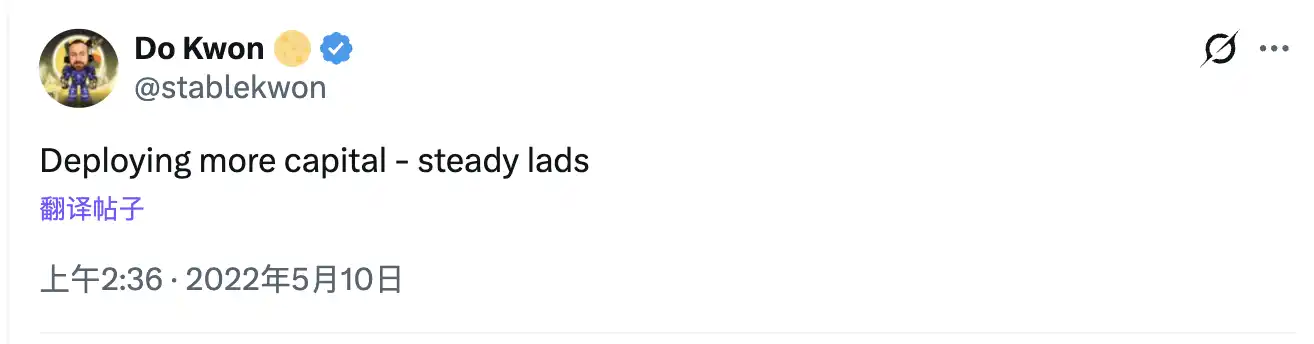
"This was an epic, cross-generational scale fraud. In the history of federal prosecutions, few frauds have caused damage comparable to this," Judge Engelmayer sternly rebuked, noting that Kwon could have chosen to tell the truth but instead chose to deceive investors who entrusted their life savings to him, taking a wrong path. He specifically mentioned the infamous tweet: "Deploying more capital – steady lads."
Ultimately, the judge sentenced Kwon to 15 years in prison.

In addition to the U.S., Kwon still faces fraud charges in South Korea. During the hearing, Kwon stated that he had not seen his family for three years and expressed a desire to serve his sentence in South Korea. U.S. prosecutors indicated that if Kwon complies with the agreement, they would support his application to be transferred to South Korea to serve the remainder of his sentence after completing half of it. In August of this year, Kwon pleaded guilty to two counts of conspiracy to commit fraud and wire fraud, and as part of the plea agreement, he also agreed to forfeit over $19 million in assets and some real estate.

Over a Million Victims, Mysterious Community Influence

From his arrest at Podgorica Airport in Montenegro in March 2023 to his incarceration in the U.S. in December 2024, this 20-month legal battle finally reached its conclusion in a federal courtroom in New York.

Kwon's arrest once sparked an extradition battle between the U.S. and South Korea. During this period, he reached a settlement with the U.S. SEC for a staggering $4.5 billion, including $3.6 billion in disgorgement of ill-gotten gains. After more than a year of detention and diplomatic maneuvering, Montenegrin authorities finally handed him over to U.S. law enforcement late last year. Facing nine U.S. charges, including securities fraud and wire fraud, Kwon initially pleaded not guilty.

It wasn't until August this year that Kwon admitted to two counts of financial fraud, stating, "I concealed the truth about trading companies intervening to restore the peg, made false statements, and my actions were wrong." Given his guilty plea, although the statutory maximum sentence was 25 years, U.S. prosecutors recommended a sentence of no more than 12 years.

This trial was not only about Kwon's personal fate but also touched the nerves of millions of Terra victims worldwide.

However, a hiccup occurred just before the hearing. Judge Engelmayer expressed dissatisfaction with the inefficiency of the U.S. prosecutors, who did notifiy Terra victims until December 1st. The bankruptcy administrator delayed sending emails until December 8th, leaving victims almost no time to submit statements to the court. Judge Engelmayer believed that while the Terra bankruptcy case involved approximately 16,500 creditors, the number of actual victims could be as high as a million, stating, "You need to do better."

Judge Engelmayer stayed up late reading the 315 hastily submitted victim letters and stated bluntly that Kwon held an almost mystical control over Terra investors; many were like cult followers who had drunk the Kool-Aid and would never wake up.

During the hearing, the victims' accusations provided a more直观的 (intuitive - note: this Chinese word was left in the original text, meaning 'intuitive' or 'direct') sense of the devastating impact of the Terra collapse. Some lost their homes, others lost their retirement savings and their children's education funds, and some even became homeless.

One victim wrote, "All of Do Kwon's communication said everything was under control. Then the depeg happened, and I didn't dare close my eyes for four consecutive days... We were told to trust him, and then he disappeared." Another victim angrily accused, "My trust was weaponized. Do Kwon packaged himself as a visionary, and my hard-earned capital just evaporated." Another person lost $200,000 saved over 17 years overnight and pleaded in a letter, "Your Honor, please hold him accountable."

Kwon, who listened to parts of some letters via telephone, expressed a belated apology to the victims in court. "Their stories are heartbreaking and make me realize once again the enormous loss I caused. I want to tell these victims that I am sorry. For the past few years, almost every waking moment I have spent thinking about what I could have done differently then and what I can do now to make amends." In a letter submitted to the court last month, Kwon also wrote, "Looking back, I cannot understand my own arrogance... I bear the pain of everyone alone. I hope accepting any sentence can bring even a little comfort to those I have failed."

This忏悔 (repentance - note: this Chinese word was left in the original text, meaning 'repentance') contrasted sharply with his former arrogant image. Just hours before the Terra collapse in May 2022, Kwon was still mocking critics on Twitter, even leaving behind the arrogant remark, "I don't debate the poor."

Note: Do Kwon's arrogant response to Frances Coppola's质疑 (doubts - note: this Chinese word was left in the original text, meaning 'doubts' or 'questions') about the algorithmic stablecoin design

An ironic scene also unfolded at the trial. As Kwon, wearing a yellow prison uniform and handcuffs, was escorted into the elevator, there were still many supporters applauding him, with some even shouting, "Hang in there, Do! Hold your head high!"


Related Questions

QWhat was the sentence given to Do Kwon for his role in the Terra collapse?

ADo Kwon was sentenced to 15 years in prison.

QHow much financial damage was caused by the collapse of the Terra ecosystem according to the article?

AThe collapse of the Terra ecosystem caused $40 billion in financial damage.

QWhat was the name of the company founded by Do Kwon that was central to this case?

AThe company was called Terraform Labs.

QWhat specific charges did Do Kwon plead guilty to in August?

AIn August, Do Kwon pleaded guilty to two counts of conspiracy to commit fraud and wire fraud.

QWhat did the judge say about Do Kwon's influence over the Terra investors?

AThe judge stated that Do Kwon had an almost mystical hold over Terra investors, with many described as being in a trance-like state, akin to cult followers who would never wake up.

Related Reads

Single-Day Plunge of 30%, Arthur Hayes Suddenly Liquidates: Why Did ZEC Get Exploded by Security Issues?

On June 5th, Zcash founder Zooko Wilcox disclosed a critical soundness vulnerability in the project's latest Orchard privacy pool. This flaw, found in the elliptic curve multiplication constraints, could allow an attacker to create unlimited counterfeit ZEC within the shielded pool, with transactions appearing valid. The vulnerability was discovered in late May by security researcher Taylor Hornby, who utilized Anthropic's new Opus 4.8 AI model for a targeted audit. The Zcash ecosystem had already performed an emergency network upgrade to patch the issue. However, the detailed disclosure triggered severe market panic, causing ZEC's price to plummet over 30% in a single day. Notably, prominent investor Arthur Hayes announced he had sold his entire ZEC position following the news. The incident starkly challenges the "technological trust" narrative central to privacy coins. Despite years of top-tier cryptographic audits, the bug persisted until uncovered with advanced AI-assisted research. This highlights the growing gap between theoretical perfection and practical implementation in privacy technology. The event serves as a industry-wide warning: in an AI-driven security landscape, the assumption that "undiscovered equals safe" is obsolete. It underscores the urgent need for continuous, proactive security practices combining AI audits, formal verification, and rapid response mechanisms.

foresightnews_api58m ago

Single-Day Plunge of 30%, Arthur Hayes Suddenly Liquidates: Why Did ZEC Get Exploded by Security Issues?

foresightnews_api58m ago

Breaking the Curse of DeFi Cascading Liquidations, Vitalik Proposes a New Solution

**Vitalik Buterin Proposes New DeFi Design to Eliminate Forced Liquidations** Ethereum co-founder Vitalik Buterin has published a proposal for a new decentralized finance (DeFi) architecture aimed at removing the automatic liquidation mechanisms prevalent in current lending protocols. The core idea involves creating synthetic assets using options as building blocks, fundamentally avoiding the抵押借贷结构 that triggers forced sell-offs. The proposal responds to a recurring flaw in DeFi: during sharp market downturns, mass自动清算 of under-collateralized positions can exacerbate price declines, creating systemic selling pressure and market instability, as evidenced by recent crypto market volatility. Buterin's model would split an asset like 1 ETH into two option-like derivatives, P and N, pegged to a price index with a set strike price and expiration. At expiry, an oracle determines the settlement price to allocate the underlying ETH between P and N holders. This design eliminates the "cliff" of instant liquidation. Instead, a position's value would gradually drift from its target peg if not actively rebalanced by the user, transferring the rebalancing decision from the protocol to the user or automated tools. A key advantage is the reduced reliance on high-frequency, real-time oracle price feeds, which are vulnerable to manipulation and errors in current systems. The delayed settlement in the options model allows for more robust, fault-tolerant oracle designs. However, significant challenges remain for practical adoption. High transaction costs (slippage) from frequent rebalancing on automated market makers (AMMs) could erode user funds. The model may not be suitable for stablecoins requiring a strict 1:1 dollar peg, as it inherently allows for value drift. Success would depend on developing new liquidity provisioning models and deep markets for these synthetic assets. The proposal represents a fundamental rethinking of DeFi risk management, challenging the industry to explore alternatives to被动集中平仓 rather than merely optimizing existing liquidation processes. It remains a theoretical framework awaiting implementation and testing by development teams.

foresightnews_api1h ago

Breaking the Curse of DeFi Cascading Liquidations, Vitalik Proposes a New Solution

foresightnews_api1h ago

Bitcoin's Decline Marks the Transformation of Crypto

Title: The Decline of Bitcoin Marks the Transformation of Crypto While Bitcoin's price recently fell below $70,000, down approximately 45% from its peak, the broader crypto industry is not following it into decline. Instead, crypto is maturing and evolving beyond its dependence on Bitcoin's price movements. Two of Bitcoin's core functions are being usurped. First, AI has captured its role as the primary speculative asset. AI, with its tangible revenue, explosive demand, and massive capital inflows ($700-830 billion in 2024), is siphoning off the speculative "hot money" that once drove Bitcoin. It also contributes to a sustained high-interest-rate environment, further tightening liquidity for assets like Bitcoin. Second, dollar-pegged stablecoins like USDC and USDT have replaced Bitcoin as the crypto market's foundational currency and primary on/off-ramp. Most trading pairs and on-chain transactions are now settled in stablecoins, severing the historical link where all capital inflows had to pass through Bitcoin first. This decoupling allows projects to thrive based on their own fundamentals rather than Bitcoin's price. Examples include Hyperliquid, an on-chain derivatives exchange with annual revenues of $8-13 billion, and prediction market platform Polymarket, valued at $200 billion with $3.65 billion in annual fees. These projects are evaluated on traditional metrics like revenue and user growth. New opportunities are emerging, particularly around privacy. Privacy coins like Zcash (ZEC) are seeing surging demand, while infrastructure like NEAR enables private, cross-chain asset transfers without requiring users to hold a specific token—privacy becomes a universal service layer. In this new paradigm, stablecoins are the universal cash, various project tokens represent equity, and privacy-enabled cross-chain coordination layers (like NEAR) act as the critical infrastructure connecting a fragmented, multi-chain ecosystem. Bitcoin is now just one asset among many. The era where the entire crypto market moved in lockstep with Bitcoin is over. The industry's health should now be judged by project fundamentals—real revenue, active users, and tokenomics that capture value—and the development of the underlying infrastructure enabling a mature, dollar-denominated crypto economy.

foresightnews_api1h ago

Bitcoin's Decline Marks the Transformation of Crypto

foresightnews_api1h ago

Lightspark CEO: In Ten Years, Bitcoin Will Be as Invisible as TCP/IP, Yet Power Trillions in Daily Transactions

A decade from now, Bitcoin will function like TCP/IP — invisible yet foundational, supporting trillions in daily transactions globally, according to Lightspark CEO David Marcus. In this future, a coffee shop in Lagos receives instant payment, a manufacturer in São Paulo settles an invoice with a supplier in Ho Chi Minh City, and a freelancer in Bangalore gets paid weekly from an Austin startup — all via Bitcoin's settlement layer, with none of the parties consciously interacting with it. This vision parallels the adoption of open protocols: first driven by necessity where existing systems fail, then scaling rapidly as tools mature and economic benefits become clear. The structural shift begins with wallets. Modern non-custodial wallets, like Spark, allow users to hold dollars, local currency, and Bitcoin in a single address, seamlessly switching between them. This eliminates friction and revolutionizes global custody, moving significant deposits to user-controlled keys not by ideology, but by superior utility. As a result, Bitcoin becomes the default savings layer for billions, as its fixed supply and appreciating value make it a rational choice for savers holding it alongside stablecoins in their everyday wallets. Businesses follow a similar path, from small companies in emerging markets to multinational corporations, holding Bitcoin alongside operational stablecoins. The latest trend is direct Bitcoin transactions for commerce. When both parties hold Bitcoin, transacting in it becomes the simplest option — no conversions, no intermediary currency. This starts in niche areas like high-value B2B settlements but grows as infrastructure makes sending Bitcoin as easy as stablecoins. An accelerating force is AI agents. By 2036, AI agents conducting commerce on behalf of individuals and firms will increasingly choose Bitcoin for settlement. Optimizing for speed, finality, and minimal counterparty risk across jurisdictions, they find Bitcoin's global, neutral, and programmable network ideal for netting and settling obligations. Thus, Bitcoin is becoming the native currency for machine commerce, just as it has become a native savings asset for humans. The global monetary system is being rebuilt from the protocol layer: open infrastructure, default self-custody, Bitcoin settling everything underneath, with stablecoins as the interface. Most users won't think about Bitcoin when they transact — and they won't need to.

foresightnews_api1h ago

Lightspark CEO: In Ten Years, Bitcoin Will Be as Invisible as TCP/IP, Yet Power Trillions in Daily Transactions

foresightnews_api1h ago

Trading

Spot
Futures
活动图片