Trading Moment: Silver Plunges After Hitting New High, Institutions Warn of Precious Metals Correction Risk, Bitcoin Shows 'Dead Cat Bounce'?

marsbitPublished on 2025-12-29Last updated on 2025-12-29

Abstract

Silver prices hit a record high above $84/oz before sharply retreating to around $78 amid profit-taking, dragging gold and other precious metals lower. While factors like Fed rate cut expectations and central bank buying persist, new supply concerns emerged as China plans export controls on silver from 2026. Institutions are divided: Goldman Sachs sees gold potentially surpassing $4,900, but UBS and Capital Economics warn of a correction, with silver possibly falling to $42 by end-2026. Bitcoin briefly reclaimed $90k but faces cautious sentiment, with analysts debating if it’s a "dead cat bounce" or a setup for a rally toward $112k. ETF outflows and low trading volume signal fragility, though some expect rotation from metals to crypto. Ethereum hovered near $3k, with key support at $2,775; a break could trigger a drop toward $1,800. Key data: BTC at $89,989, ETH at $3,033, fear index at 24. Over $151M liquidated in 24h. ETF flows: Bitcoin ETFs saw $782M outflows last week, Ethereum ETFs $102M. Notable events: Lighter TGE expected Dec 29, Flow hacked for $3.9M, and several tokens facing unlocks worth hundreds of millions.

Daily key data review and trend analysis, produced by PANews.

1. Market Observation

At the start of the new week, the precious metals market took center stage. Spot silver broke through $84/oz to hit a new historical high, but then faced selling pressure from profit-taking, quickly plunging and turning negative intraday, eventually fluctuating around $78. This rollercoaster ride directly impacted related financial products, with spot gold retreating from near its historical high of $4550, and platinum and palladium both falling close to or over 7%. Beyond the traditional logic of Fed rate cut expectations and continued central bank gold buying, the market began pricing in a new narrative of "commodity control," where the importance of geopolitics and supply chain security is increasingly highlighted, especially after China announced export licensing for silver effective January 1, 2026, further exacerbating expectations of tight global physical supply. However, market divergence also intensified. The Chicago Mercantile Exchange (CME) raised margins on silver futures for the second time in two weeks, sparking concerns about a historical replay of the 2011 silver crash triggered by similar measures. Institutions like Goldman Sachs remain bullish on gold continuing its strength into 2026, with a target price potentially exceeding $4900, but UBS and Capital Economics warned that precious metal prices have detached from fundamentals, accumulating correction risks, with Capital Economics even predicting silver could fall back to $42 by the end of next year. For silver, despite its strong industrial demand in sectors like solar energy, analysis suggests that prices reaching $134/oz could lead to demand destruction; while copper, as a potential substitute, poses little short-term threat as factory retrofits take at least 4 years. Institutions like Guojin Securities believe the 2026 investment theme is already visible across commodities, supply chains, and foreign exchange markets—under a structure where investment outweighs consumption,大宗商品 trading ranges are lengthening, China's manufacturing advantages are prominent, and industrial resources resonating with AI investment and global manufacturing recovery are worth watching.

Compared to the剧烈 volatility in the precious metals market, the cryptocurrency market overall was permeated with cautious and sluggish sentiment, even as Bitcoin broke through $90,000 again today. Most analysts are cautious about the outlook. For example, analyst Killa believes that although there might be short-term bounces, the broader trend is still downward seeking support below $70,000, judging that this cycle has ended. Ali Charts expressed similar views, suggesting that against a backdrop of net capital outflows reaching $4.5 billion and Bitcoin ETFs seeing nearly $1 billion in net outflows over the past two weeks, any rebound is likely a "dead cat bounce" lacking support from spot demand. A report from 10x Research also pointed out that current crypto market trading volume is 30% lower than normal, with undercurrents beneath the surface calm making the market particularly fragile. However, there are also bullish voices in the market. Analyst Astronomer, through liquidity analysis, indicated that the market has built sufficient short liquidity in the $94,000 to $95,000 region, creating conditions for a price surge towards the $112,000 target. Michaël van de Poppe expects that as funds rotate from the overheated precious metals market to the crypto market, Bitcoin could move towards $100,000 in the coming week. Analyst Plan B, by recalling the history of the 2021 bull market which experienced a correction of over 50% mid-cycle before hitting new highs, suggested the current pullback might just be a normal correction within the cycle. Samson Mow made the bold assertion that "2025 is the bear market," predicting Bitcoin might embark on a decade-long bull run. On the technical front, analysts are closely watching key levels. Ardi pointed out that whether Bitcoin can effectively break through the resistance zone between $90,000 and $94,600, and hold the support band between $80,000 and $86,300, is core to judging the future direction.

Ethereum broke through $3000 again, but market sentiment remains cautious. On-chain analyst Murphy provided a deeper analysis, suggesting the main矛盾 (contradiction) for Ethereum currently is not the overhead selling pressure from trapped positions, but the overly dispersed structure of profitable筹码 (chips/holdings) below. He noted that $2700 is one of the few levels that can form a consensus strong承接区 (support area); if lost, the price could enter a "vacuum zone" lacking effective support, with the nearest gap area below between $1800 and $2600. Nonetheless, he also observed that the whale group holding over 100,000 ETH has been adding positions near $2700, showing a posture of "long-term optimism, short-term caution." For short-term movements, technical analyst CyrilXBT described Ethereum as a "coiled spring," believing it needs to break through $3345 to release upward momentum. Michaël van de Poppe gave specific key levels: $2775 is an unbreakable support level, otherwise it could trigger a chain reaction decline; while a break above the $3000 resistance could lead to a rapid冲击 (assault) on $3650.

The market is currently most concerned about the TGE of the decentralized perpetual exchange Lighter, widely expected to occur on December 29. According to its airdrop details, the team confirmed the airdrop will account for 25% of the total supply, requiring no claim and will be sent directly to user wallets. The team also clarified that recent large token transfers were for safeguarding investor and team allocations. Meanwhile, the public chain project Flow experienced a security incident over the weekend, where an attacker exploited a vulnerability in its execution layer to transfer approximately $3.9 million, leading validators to temporarily halt operations to deploy a fix; the project team stated that user balances were unaffected and the protocol faces no solvency risk. Additionally, the ZEROBASE token ZBT saw its price briefly突破 (break through) $0.2, with a 78% gain in 24 hours.

2. Key Data (As of 13:00 HKT, December 29)

(Data sources: CoinAnk, Upbit, SoSoValue, CoinMarketCap)

  • Bitcoin: $89,989 (Year-to-date -3.25%), daily spot trading volume $31.45 billion

  • Ethereum: $3,033 (Year-to-date -9.2%), daily spot trading volume $28.28 billion

  • Fear & Greed Index: 24 (Fear)

  • Average GAS: BTC: 1.75 sat/vB, ETH: 0.02 Gwei

  • Market Dominance: BTC 59.1%, ETH 12%

  • Upbit 24-hour trading volume ranking: BTC, ZBT, XRP, ETH, 0G

  • 24-hour BTC Long/Short Ratio: 50.99% / 49.01%

  • Sector Performance: Crypto sectors generally rose, SocialFi sector up over 3%, only Layer2 sector slightly down

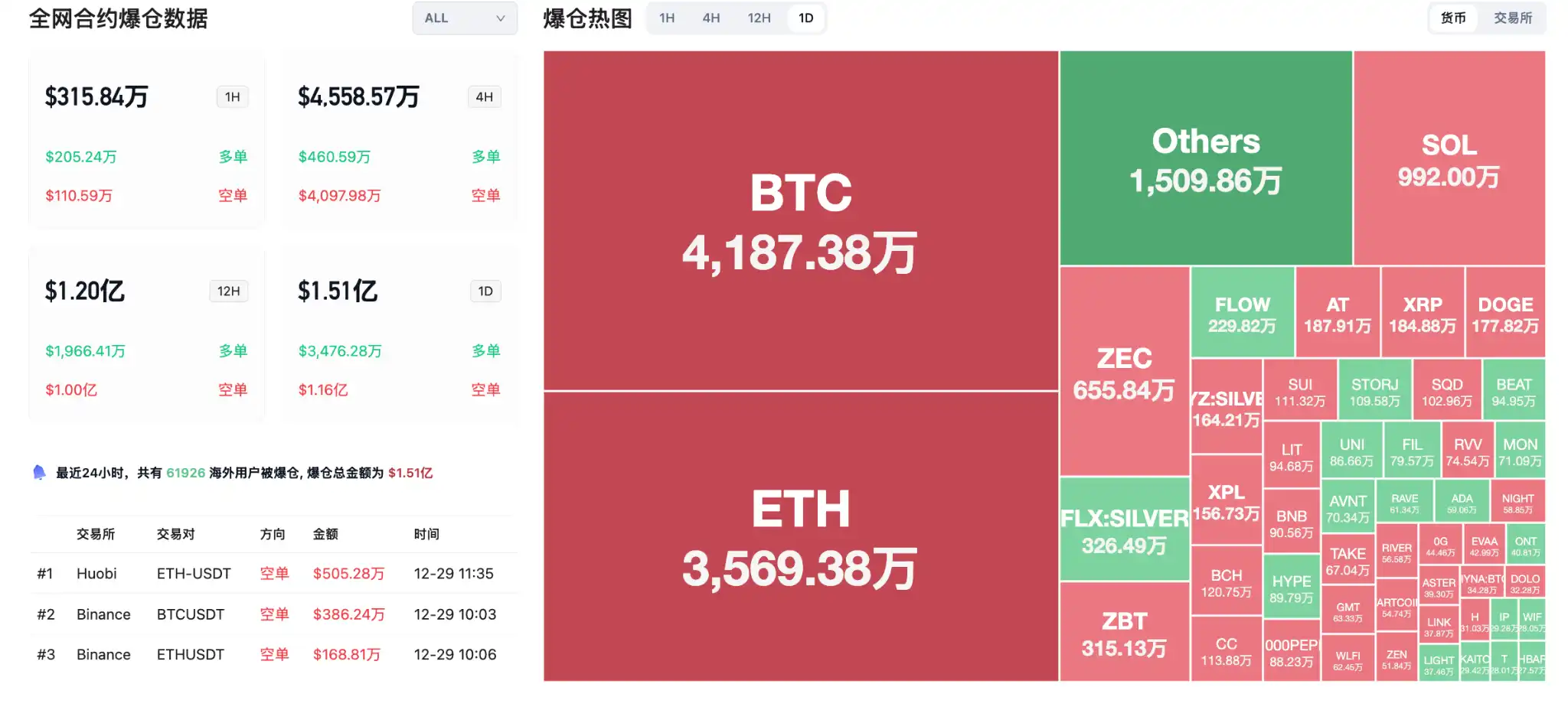
  • 24-hour Liquidation Data: 61,926 people liquidated globally, total liquidation amount $151 million,其中 (including) BTC liquidations $41.87 million, ETH liquidations $35.69 million, ZEC liquidations $6.55 million
3. ETF Flows (As of December 26)

  • Bitcoin ETFs: Net outflow of $782 million last week, BlackRock's IBIT led with net outflow of $435 million

  • Ethereum ETFs: Net outflow of $102 million last week, BlackRock's ETHA led with net outflow of $69.42 million

  • Solana ETF: Net inflow of $13.14 million last week

  • XRP ETF: Net inflow of $64 million last week

4. Today's Preview

  • "Lantian Gerui Case" fund refund registration deadline is December 29, missing it may affect fund return

  • Binance will delist EIGEN/FDUSD, ARB/FDUSD and other FDUSD margin trading pairs on December 30

  • Web3 game studio ChronoForge will shut down on December 30 due to funding shortage

  • Padre: PADRE holders will receive PUMP based on their holdings, need to submit wallet address by December 30

  • SHFE: From close on December 30, price limits for gold and silver futures contracts adjusted to 15%,同时 (simultaneously) adjusting margin ratios

  • SDIC Silver LOF: Class A定投 (fixed investment)上限 (upper limit) reduced back to 100 yuan, Class C shares will begin suspending subscriptions, effective December 29

  • 51VR, Chantecaille (Linshangtang) expected to list on HKEX on December 30

  • Hyperliquid (HYPE) will unlock approximately 9.92 million tokens at 15:30 on December 29, representing about 2.87% of circulating supply, value approx. $256 million;

  • Kamino (KMNO) will unlock approximately 229 million tokens at 20:00 on December 30, representing about 5.35% of circulating supply, value approx. $11.8 million;

  • Slash Vision Labs (SVL) will unlock approximately 234 million tokens at 08:00 on December 30, representing about 2.96% of circulating supply, value approx. $6.8 million;

  • Zora (ZORA) will unlock approximately 166 million tokens at 08:00 on December 30, representing about 4.17% of circulating supply, value approx. $6.7 million.

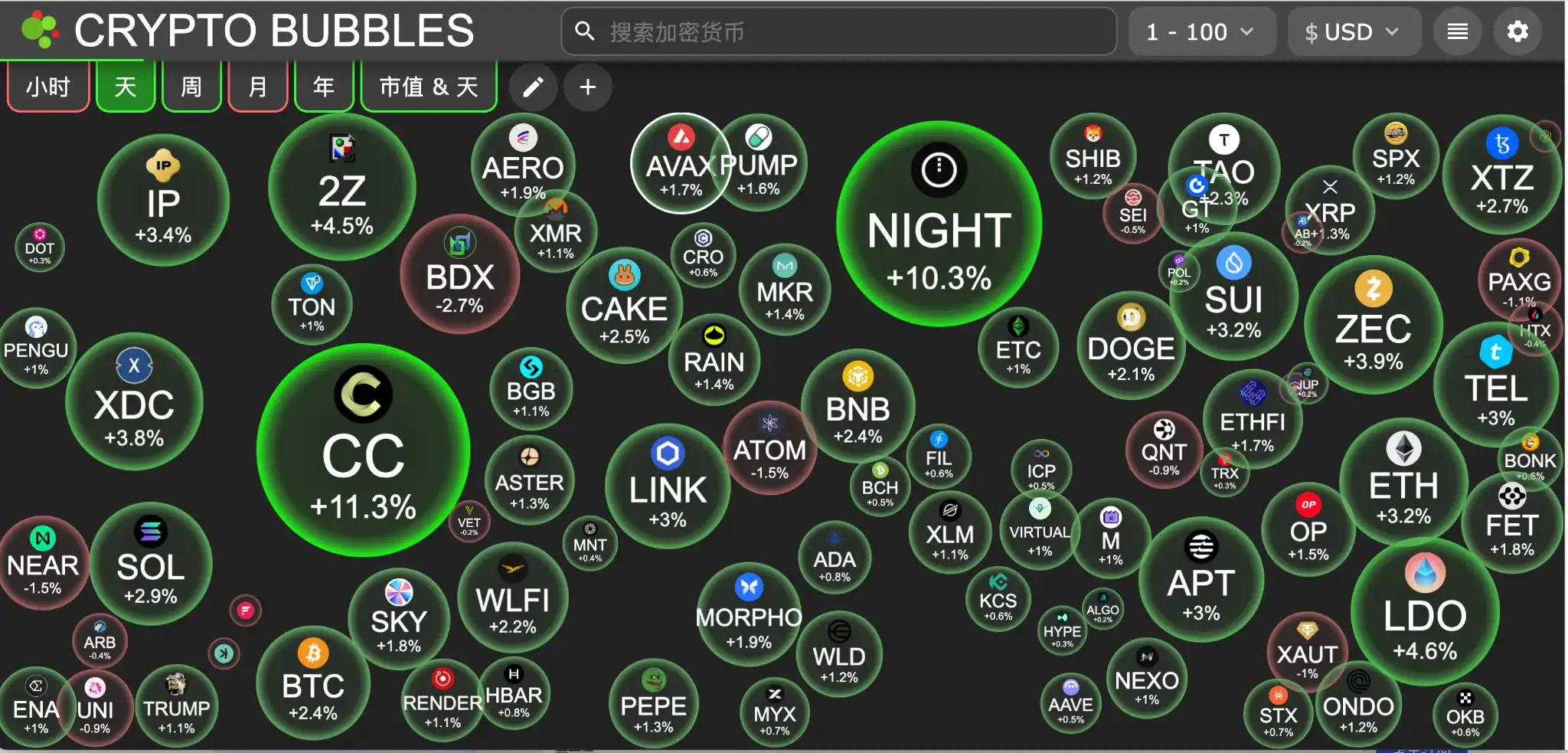
Today's Top 100 Coins by Market Cap - Maximum Gains: Canton Network up 11.3%, Midnight up 10.3%, DoubleZero up 4.7%, Lido DAO up 4.5%, Zcash up 3.9%.
5. Hot News

  • Data: HYPE, SUI, EIGEN and other tokens to see large unlocks next week,其中 (with) HYPE unlock value approx. $256 million

  • Weekly Preview | EU, UK, Hong Kong and other regions implement relevant new regulations for digital assets; Hyperliquid (HYPE) to unlock tokens worth ~$256 million

  • Suspected Trend Research purchased another 11,520 ETH, worth $34.93 million

  • Analysis: Bitcoin spot ETFs累计 (accumulated) net outflows nearly $6 billion over past nine weeks, market funding and sentiment remain under pressure

  • Hyperliquid's weekly revenue仅为 (only) $9.16 million, hitting a new low since early May

  • Solana DEX spot trading volume year-to-date exceeds $1.7 trillion, surpassing Bybit to rank second

  • A whale withdrew 2,218 ETH, 37.1 million SKY, and 4,772 AAVE from Kraken 7 hours ago

  • Spot silver breaks through $80/oz, setting a new record

  • Hyperliquid Co-founder: 1.2 million HYPE tokens will be allocated to team members on January 6 after unlock

  • Bubblemaps: Meme coin project ATLAS疑似 (suspected) insider trading, 68 wallets already hold 47% of token supply

  • Coinbase Bitcoin Premium Index has been in negative premium for two consecutive weeks, currently reported at -0.0784%

  • 100 million UNI burned from Uniswap treasury, worth $596 million

  • Flow hacked for $3.9 million loss, user deposits unaffected

Related Questions

QWhat happened to the price of silver after it hit a new all-time high, and what was a key factor contributing to the subsequent volatility?

AAfter hitting a new all-time high above $84/oz, the price of silver experienced a sharp pullback, falling to around $78/oz. A key factor contributing to this volatility was profit-taking by traders. Additionally, the CME raised margin requirements for silver futures for the second time in two weeks, which historically has triggered sell-offs.

QAccording to analysts cited, what is the prevailing sentiment in the cryptocurrency market despite Bitcoin's price breaking through $90,000?

AThe prevailing sentiment in the cryptocurrency market is one of caution and pessimism. Analysts like Killa and Ali Charts view any price rebounds as potential 'dead cat bounces'—temporary recoveries lacking genuine demand—due to significant capital outflows from Bitcoin ETFs and a general market downturn.

QWhat critical price level for Ethereum did on-chain analyst Murphy identify as a major support zone, and what was the concern if it were broken?

AOn-chain analyst Murphy identified $2,700 as a critical support zone for Ethereum. The concern was that if this level were broken, the price could enter a 'vacuum zone' with little support, potentially falling to a range between $1,800 and $2,600.

QWhat major event is the market anticipating for the decentralized perpetual exchange Lighter, and what is unique about its token airdrop distribution?

AThe market is anticipating the Token Generation Event (TGE) for the decentralized perpetual exchange Lighter, widely expected to occur on December 29th. A unique feature of its airdrop is that it will distribute 25% of the total token supply directly to users' wallets without requiring them to claim it.

QBased on the ETF flow data provided, what was the net flow trend for Bitcoin and Ethereum ETFs for the week ending December 26th?

AFor the week ending December 26th, both Bitcoin and Ethereum ETFs experienced net outflows. Bitcoin ETFs saw a net outflow of $782 million, while Ethereum ETFs had a net outflow of $102 million.

Related Reads

Jensen Huang 'Saves' South Korean Stock Market: Locks In SK Hynix Memory, Chip Shortage to Continue

On June 5th, South Korea's stock market experienced a sharp decline, with major chipmakers like Samsung and SK Hynix dropping nearly 10%. Amidst the turmoil, NVIDIA CEO Jensen Huang's visit to Seoul played a dramatic role in boosting market sentiment. Following a dinner meeting with SK Group Chairman Chey Tae-won and SK Hynix CEO Kwak Noh-Jung, Huang confirmed that NVIDIA's new Vera CPU will utilize SK Hynix DRAM. The companies announced a multi-year technical partnership to co-develop next-generation memory for NVIDIA's AI infrastructure, covering products from data centers to personal AI and robotics. This collaboration extends beyond memory supply. SK Hynix is integrating NVIDIA's AI and Omniverse platform into its own semiconductor design and manufacturing processes, including computational lithography and creating digital twins of its fabrication plants for autonomous operation. While strengthening ties with SK Hynix, NVIDIA is diversifying its supply chain for the upcoming HBM4 memory, with Samsung, SK Hynix, and Micron all certified as suppliers for its Vera Rubin platform. Despite this, Huang warned that the global chip shortage, driven by relentless demand from AI factory construction, is expected to persist for several years across the entire supply chain. His visit underscores NVIDIA's systematic effort to deepen integration with South Korea's broader tech industry.

marsbit27m ago

Jensen Huang 'Saves' South Korean Stock Market: Locks In SK Hynix Memory, Chip Shortage to Continue

marsbit27m ago

Nasdaq Plunges 4.2% in a Single Day: Does "Black Friday" Burst the U.S. Stock Market Bubble?

The Nasdaq plunged 4.18% on June 5, 2026, its worst single-day drop in over a year, as a much stronger-than-expected US jobs report triggered fears of economic overheating and delayed Federal Reserve interest rate cuts. The selloff, centered on high-valuation tech and AI stocks like Nvidia and Broadcom, spread across major indices. The article examines whether this signals a market top. The strong May non-farm payrolls data, nearly double expectations, pushed bond yields higher, directly hurting rate-sensitive tech stocks. This exposed vulnerabilities in the crowded AI trade, where valuations had soared on narratives of infinite growth, despite emerging signs of slowing order momentum and corporate AI monetization challenges. Prior to the drop, market indicators flashed warning signs: historically high valuations (e.g., Shiller CAPE ratio near 39.5), extreme bullish sentiment, and high levels of leverage. Technical charts showed key support levels being breached. Wall Street is divided on the outlook. Bears, citing risks of "stagflation" and AI bubble comparisons to the dot-com era, warn of a potential significant correction. Bulls view the drop as a healthy correction within a bull market, underpinned by a strong economy and expected corporate earnings growth of around 7% in 2026. The immediate future hinges on upcoming key events: the May CPI inflation data and the mid-June FOMC meeting. Their outcomes will critically shape market expectations for the Fed's rate path. The article concludes that conditions for a major market top are aligning, marking a fragile transition from narrative-driven gains to a phase demanding validation from macroeconomic data and corporate fundamentals. Caution is advised.

marsbit31m ago

Nasdaq Plunges 4.2% in a Single Day: Does "Black Friday" Burst the U.S. Stock Market Bubble?

marsbit31m ago

Nasdaq Plunges 4.2% in a Single Day, Did 'Black Friday' Pop the U.S. Stock Bubble?

The Nasdaq Composite plummeted 4.18% on June 5, its biggest single-day drop since April 2025, triggering widespread debate over whether the U.S. stock market has peaked. The sell-off was sparked by a stronger-than-expected U.S. non-farm payrolls report, which fueled fears of economic overheating and pushed back market expectations for Federal Reserve rate cuts, leading to a sharp rise in Treasury yields. The AI sector, the primary driver of the recent bull market, suffered severe losses, with the Philadelphia Semiconductor Index crashing over 10%. Stocks like Nvidia, Broadcom, and Micron led the decline. Concerns are mounting about the sustainability of AI capital expenditures and high valuations, with signs of order cuts for next-generation chips emerging. Analyses point to several warning signs: historically high market valuations (e.g., elevated Shiller CAPE ratio, Buffett Indicator), extreme bullish sentiment indicators, and significant insider selling. The sell-off also caused a key technical breakdown, with the S&P 500 breaking below its short-term moving average and testing its 200-day moving average. Wall Street is divided on the outlook. Bears warn this could be the start of a bubble deflation or a "stagflation" scenario, while bulls view it as a healthy, overdue correction within a bull market driven by solid corporate earnings growth. A more moderate view suggests the easy liquidity-driven rally is over, and markets are entering a phase of fundamental stock-picking with potential for consolidation. The immediate future hinges on key upcoming events: the May CPI report and the mid-June FOMC meeting. Their outcomes will be critical in determining whether this is a temporary pullback or the beginning of a more significant trend reversal. The consensus is that the era of one-directional market gains may be ending, requiring increased investor caution.

Odaily星球日报37m ago

Nasdaq Plunges 4.2% in a Single Day, Did 'Black Friday' Pop the U.S. Stock Bubble?

Odaily星球日报37m ago

The First Case on AI Agents: What Was Adjudicated?

"The First 'Agent' Ruling: What Was Decided?" On April 30, the Guangzhou Internet Court issued a ruling—China's first behavior preservation order in the intelligent agent (AI agent) field. The defendant, an open-source AI agent software, was ordered to stop downloads, cease actions that bypassed a platform's technical protection measures, and delete related tutorials and data. The core issue: the software used the operating system's "accessibility service" permissions to automate user interactions within other apps without those platforms' authorization. This mirrors a recent US case where Amazon sued Perplexity for similar reasons—bypassing Amazon's API to directly scrape and interact with its pages—and won a preliminary injunction. Both rulings establish a crucial legal boundary for the AI agent era: agents cannot operate unchecked. The article argues the fundamental legal principle emerging is one of **dual authorization**. An AI agent requires both **user consent** AND **platform consent** to operate legitimately within that platform's ecosystem. Bypassing platform rules through system-level permissions, even with user permission, undermines platform responsibilities for content moderation, data security, and user privacy, creating liability issues. The piece uses the evolution of "Doubao Phone" (an AI-integrated smartphone) as a case study. Its initial, aggressive version that bypassed platform controls faced roadblocks. Its upcoming 2.0 version is reportedly pivoting to negotiate API access and authorization deals with major platforms (like Alibaba's ecosystem), seen as a strategic adaptation to the new regulatory reality. A global trend is identified: the era of unregulated, "wild west" growth for AI agents is ending, replaced by a **compliance race**. This raises barriers to entry, as securing platform authorizations becomes a new cost. Open-source status is also not a legal shield if the code facilitates bypassing technical protections. In conclusion, these first rulings target not the largest, but the most **aggressive and representative** cases. By setting precedent with them, regulators are efficiently steering the entire industry towards a new, more regulated operating paradigm defined by dual authorization and platform cooperation.

marsbit42m ago

The First Case on AI Agents: What Was Adjudicated?

marsbit42m ago

Fired by Google Over a 14-Page Paper, Over 4,000 Rallied for Her. 6 Years Later: She Almost Predicted the Entire AI Era Back Then.

In late 2020, Google AI researcher Timnit Gebru was effectively dismissed following a conflict over a 14-page, unpublished research paper she co-authored titled "On the Dangers of Stochastic Parrots." The paper, which has since been cited over 14,000 times, raised critical early warnings about the risks of large language models (LLMs). It argued that these models, trained on vast, biased internet data, are essentially "stochastic parrots" that mimic language without true understanding, potentially amplifying societal biases, generating plausible but false information (later termed "AI hallucination"), consuming massive energy, and obscuring their training data contents. Gebru's stance led to a clash with Google management, who requested the paper's withdrawal. Her subsequent internal criticism of the company's diversity efforts and handling of the matter culminated in her termination, which sparked protests from over 4,000 Google employees and researchers. Six years later, the paper's predictions have proven remarkably prescient. Issues like AI hallucination, embedded bias (evident in resume screening and healthcare algorithms), soaring energy consumption from AI data centers, unvetted training data containing harmful content, and the risk of "model collapse" from AI-generated internet content have become central industry challenges. The incident also highlighted concerns about AI development being driven primarily by commercial competition within a handful of powerful tech companies, often at the expense of ethical considerations. After leaving Google, Gebru founded the Distributed AI Research Institute (DAIR) to explore these issues independently. The controversy underscores how her early, critical insights into the fundamental limitations and societal impacts of LLMs anticipated many of the most pressing dilemmas in today's AI era.

marsbit43m ago

Fired by Google Over a 14-Page Paper, Over 4,000 Rallied for Her. 6 Years Later: She Almost Predicted the Entire AI Era Back Then.

marsbit43m ago

Trading

Spot
Futures

Hot Articles

What is $BITCOIN

DIGITAL GOLD ($BITCOIN): A Comprehensive Analysis Introduction to DIGITAL GOLD ($BITCOIN) DIGITAL GOLD ($BITCOIN) is a blockchain-based project operating on the Solana network, which aims to combine the characteristics of traditional precious metals with the innovation of decentralized technologies. While it shares a name with Bitcoin, often referred to as “digital gold” due to its perception as a store of value, DIGITAL GOLD is a separate token designed to create a unique ecosystem within the Web3 landscape. Its goal is to position itself as a viable alternative digital asset, although specifics regarding its applications and functionalities are still developing. What is DIGITAL GOLD ($BITCOIN)? DIGITAL GOLD ($BITCOIN) is a cryptocurrency token explicitly designed for use on the Solana blockchain. In contrast to Bitcoin, which provides a widely recognized value storage role, this token appears to focus on broader applications and characteristics. Notable aspects include: Blockchain Infrastructure: The token is built on the Solana blockchain, known for its capacity to handle high-speed and low-cost transactions. Supply Dynamics: DIGITAL GOLD has a maximum supply capped at 100 quadrillion tokens (100P $BITCOIN), although details regarding its circulating supply are currently undisclosed. Utility: While precise functionalities are not explicitly outlined, there are indications that the token could be utilized for various applications, potentially involving decentralized applications (dApps) or asset tokenization strategies. Who is the Creator of DIGITAL GOLD ($BITCOIN)? At present, the identity of the creators and development team behind DIGITAL GOLD ($BITCOIN) remains unknown. This situation is typical among many innovative projects within the blockchain space, particularly those aligning with decentralized finance and meme coin phenomena. While such anonymity may foster a community-driven culture, it intensifies concerns about governance and accountability. Who are the Investors of DIGITAL GOLD ($BITCOIN)? The available information indicates that DIGITAL GOLD ($BITCOIN) does not have any known institutional backers or prominent venture capital investments. The project seems to operate on a peer-to-peer model focused on community support and adoption rather than traditional funding routes. Its activity and liquidity are primarily situated on decentralized exchanges (DEXs), such as PumpSwap, rather than established centralized trading platforms, further highlighting its grassroots approach. How DIGITAL GOLD ($BITCOIN) Works The operational mechanics of DIGITAL GOLD ($BITCOIN) can be elaborated on based on its blockchain design and network attributes: Consensus Mechanism: By leveraging Solana’s unique proof-of-history (PoH) combined with a proof-of-stake (PoS) model, the project ensures efficient transaction validation contributing to the network's high performance. Tokenomics: While specific deflationary mechanisms have not been extensively detailed, the vast maximum token supply implies that it may cater to microtransactions or niche use cases that are still to be defined. Interoperability: There exists the potential for integration with Solana’s broader ecosystem, including various decentralized finance (DeFi) platforms. However, the details regarding specific integrations remain unspecified. Timeline of Key Events Here is a timeline that highlights significant milestones concerning DIGITAL GOLD ($BITCOIN): 2023: The initial deployment of the token occurs on the Solana blockchain, marked by its contract address. 2024: DIGITAL GOLD gains visibility as it becomes available for trading on decentralized exchanges like PumpSwap, allowing users to trade it against SOL. 2025: The project witnesses sporadic trading activity and potential interest in community-led engagements, although no noteworthy partnerships or technical advancements have been documented as of yet. Critical Analysis Strengths Scalability: The underlying Solana infrastructure supports high transaction volumes, which could enhance the utility of $BITCOIN in various transaction scenarios. Accessibility: The potential low trading price per token could attract retail investors, facilitating wider participation due to fractional ownership opportunities. Risks Lack of Transparency: The absence of publicly known backers, developers, or an audit process may yield skepticism regarding the project's sustainability and trustworthiness. Market Volatility: The trading activity is heavily reliant on speculative behavior, which can result in significant price volatility and uncertainty for investors. Conclusion DIGITAL GOLD ($BITCOIN) emerges as an intriguing yet ambiguous project within the rapidly evolving Solana ecosystem. While it attempts to leverage the “digital gold” narrative, its departure from Bitcoin's established role as a store of value underscores the need for a clearer differentiation of its intended utility and governance structure. Future acceptance and adoption will likely depend on addressing the current opacity and defining its operational and economic strategies more explicitly. Note: This report encompasses synthesised information available as of October 2023, and developments may have transpired beyond the research period.

363 Total ViewsPublished 2025.05.13Updated 2025.05.13

What is $BITCOIN

Discussions

Welcome to the HTX Community. Here, you can stay informed about the latest platform developments and gain access to professional market insights. Users' opinions on the price of BTC (BTC) are presented below.

活动图片