Trading Moment: Bitcoin at $92K in Bull-Bear Battle, Oracle and Moore Thread Drag Down AI Sector

marsbitPublished on 2025-12-12Last updated on 2025-12-12

Abstract

Daily Market Analysis by PANews: Bitcoin hovers around $92K amid intense long-short battles, while AI stocks face pressure from Oracle and Moore Threads. Key drivers include the Fed's 25bps rate cut and plans for $40B monthly Treasury purchases, boosting gold to near $4290 and silver to a record $64. However, rising US jobless claims and China's economic policy shift toward domestic demand and tech innovation signal caution. Oracle's stock plunged 16% due to weak cloud revenue growth and elevated capex guidance, dragging down AI sector momentum. Despite strong earnings, Broadcom fell 1.94%, and Google dropped 2.43% after OpenAI's Disney deal. Domestically, Moore Threads crashed 15% after a 723% rally, warning of unproven product impact. BTC trades between $92K-$94K with reduced selling pressure; analysts target $99K-$112K if bullish momentum holds, but shorts target $87.7K. ETH faces resistance at $3.6K-$3.8K if BTC breaks $94K, with key support at $3.15K. Other highlights: Do Kwon sentenced to 15 years, triggering 30% drops in Terra tokens; fear index at 29; BTC dominance 58.46%. Upcoming events include Bittensor halving and SEC crypto roundtable.

Daily key market data review and trend analysis, produced by PANews.

1. Market Overview

Driven by the Fed's 25 basis point rate cut and the dovish outlook of plans to purchase $40 billion in short-term Treasuries monthly, precious metals performed particularly strongly, with gold breaking above the December high, approaching the $4290 mark, and spot silver surging to $64, setting a new all-time high. However, the US labor market showed signs of weakness, with initial jobless claims surging by 44,000 to 236,000 last week, the largest weekly increase since the pandemic, coupled with a narrowing trade deficit, keeping the market cautious about the economic outlook. Meanwhile, China convened the Central Economic Work Conference, setting the tone for economic work in 2026, clarifying the implementation of more proactive fiscal policy and moderately loose monetary policy, focusing on expanding domestic demand and technological innovation. But on the specific consumer end, Moutai prices continued to face pressure, with the price of 2025 Feitian Moutai falling below the psychological barrier of 1499 yuan, dropping from around 2200 yuan at the beginning of the year, a cumulative decline of over 30%. Industry insiders worry that continued price declines could reduce or even eliminate distributor profits, potentially triggering a vicious cycle of "price drop → sell-off → further drop". Looking ahead, analysts generally believe that global central bank policies will further diverge in 2026. The Fed ending QT and expanding its balance sheet will bring a liquidity turning point, but dollar depreciation pressure may force the ECB into a difficult balance between inflation and exchange rates.

The recent artificial intelligence boom faced a reality check this week, as doubts about AI investment returns triggered a broad tech stock pullback. Oracle's stock plunged 16% intraday due to cloud infrastructure revenue missing growth expectations and raising its capital expenditure guidance to $50 billion, wiping out over $68.9 billion in market value in a single day (some estimates even reached $102 billion). UBS, Morgan Stanley, and other investment banks downgraded its target. Earnings reports showed its profit growth relied mainly on non-recurring gains, with core business profitability under pressure. Although Broadcom exceeded Q4 revenue and profit expectations, with AI revenue growing 65%, its stock still fell 1.94% after hours, indicating cautious market sentiment. Meanwhile, OpenAI released its most advanced model, GPT-5.2, and announced a $1 billion cooperation agreement with Walt Disney, directly causing Google's stock to fall 2.43%. Domestically, Moore Thread, as the "first domestic GPU stock", saw its stock price soar over 723% after listing, with its market cap breaking 440 billion yuan. After hitting a new high of 941.08 yuan and a cumulative gain of 723%, the company issued a risk warning announcement last night, stating that fundamentals remain unchanged, new products are still in the R&D stage, and short-term impact on performance is limited. In early trading today, the stock fell over 15%, briefly falling below 800 yuan.

Bitcoin is currently battling in the range of $92,000 to $94,000. On-chain data shows reduced transfers by large holders to exchanges, easing selling pressure. CryptoQuant pointed out that if the trend continues, BTC could rebound to $99,000 or even $112,000. Man of Bitcoin analysis suggests BTC remains above the upward trend line; a break above the wedge's upper edge could target the $96,962 to $102,432 area. However, bearish forces remain strong. Analyst Astronomer has opened a short position at $92,700, targeting a pullback to $87,700; Killa suggested Bitcoin could surge to $94,000 or higher short-term but might subsequently pull back. He plans to add to positions in the $95,000 to $98,000 range and expects Bitcoin could fall to $70,000 or even $60,000 next year. Ted also noted the current movement is strikingly similar to the last cycle; if the script repeats, it could surge past $100,000 before crashing below $70,000. In prediction markets, traders generally believe the probability of breaking $100,000 before year-end is only around 30%. Meanwhile, Bloomberg analyst Mike McGlone warned that a new "Santa Claus rally" might not appear, and BTC could end the year below $84,000. The market is currently watching whether BTC can hold the $90,000-$91,000 support zone. A break below could test the bottom of the current range, while holding could lead to another challenge of the $94,000 resistance level.

Regarding Ethereum, market sentiment is torn between ETF fund returns and technical pressure. Although spot ETF net inflows rebounded to $21.5 billion, the price remains constrained by key resistance levels. Ali pointed out that ETH has two solid support walls below: one at the $3,150 level, accumulating 2.8 million coins, and another at the $2,800 level, accumulating 3.6 million coins; Glassnode data places key support at $2,770. For future trends, Delphi Digital analyst that1618guy is optimistic, believing ETH has held the daily crossover and completed a retest. If Bitcoin breaks above $94,000, Ethereum could follow towards the $3,600-$3,800 range. However, Man of Bitcoin reminded investors to be cautious, observing that the price is forming a small bearish triangle, and another dip to $3,150 is possible. A break below the trendline would be a clear warning signal.

Additionally, Do Kwon's trial has finally concluded. The US Attorney's Office for the Southern District of New York announced that Terraform Labs founder Do Kwon has been formally sentenced to 15 years in prison for securities fraud and wire fraud, among other charges. The finalization of this news directly caused LUNA, LUNC, and USTC and other related tokens to plummet nearly 30% in 24 hours.

2. Key Data (As of December 12, 13:00 HKT)

(Data source: GMGN, CoinAnk, Upbit, Coingecko, SoSoValue, CoinMarketCap)

  • Bitcoin: $92,551 (Year-to-date -1.12%), daily spot trading volume $46.5 billion

  • Ethereum: $3,253 (Year-to-date -2.5%), daily spot trading volume $240.1 billion

  • Fear & Greed Index: 29 (Fear)

  • Average GAS: BTC: 1.2 sat/vB, ETH: 0.04 Gwei

  • Market Dominance: BTC 58.46%, ETH 12.2%

  • Upbit 24-hour trading volume ranking: XRP, ETH, BTC, SOL, BARD

  • 24-hour BTC Long/Short Ratio: 49.95% / 50.05%

  • Sector Gains/Losses: Layer2 sector up 3.6%, DeFi sector up 3.2%

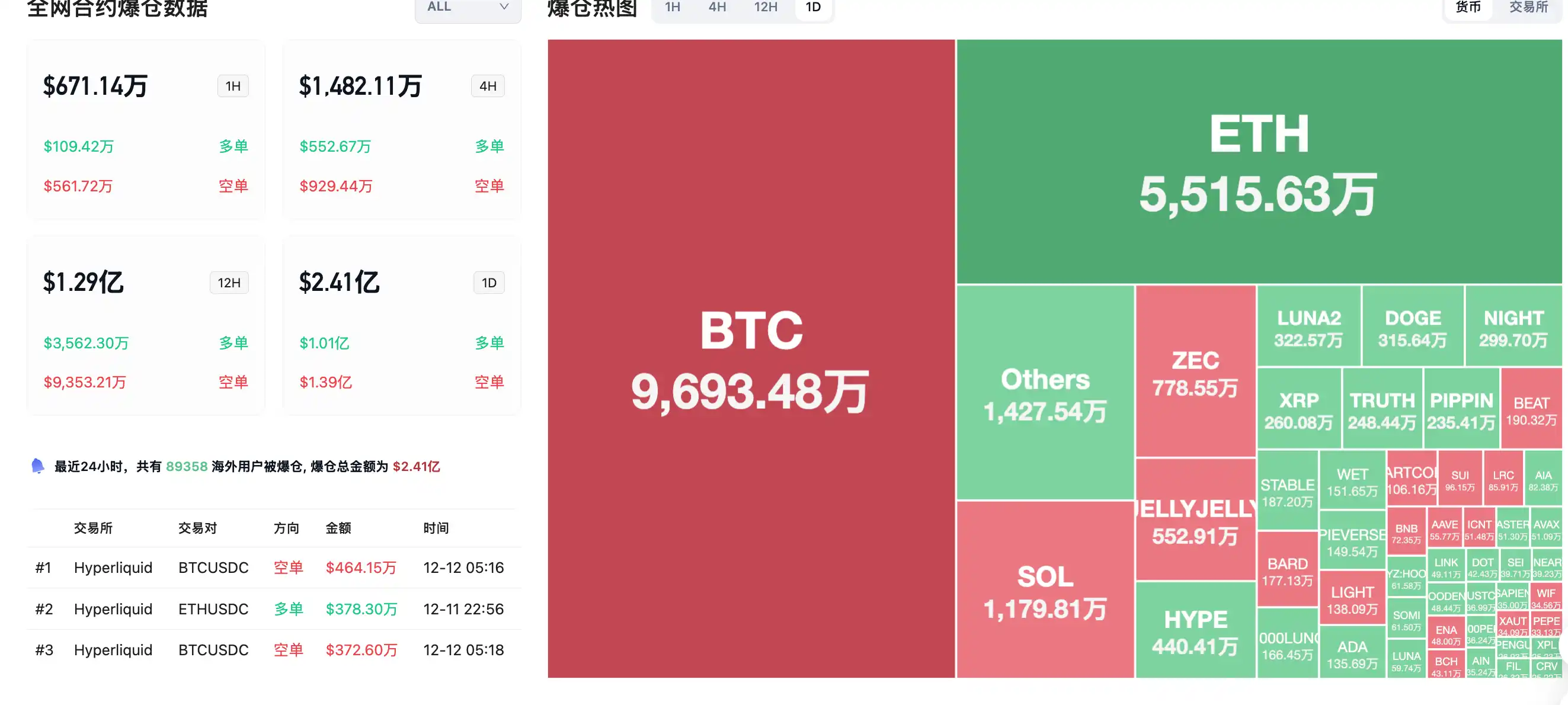
  • 24-hour Liquidation Data: 89,358 people liquidated globally, total liquidation amount $241 million, including BTC liquidations $96.93 million, ETH liquidations $55.15 million, SOL liquidations $11.79 million
3. ETF Flows (As of December 11)

  • Bitcoin ETF: -$77.3419 million

  • Ethereum ETF: -$42.3734 million

  • Solana ETF: +$11.02 million

4. Today's Outlook

  • Binance Alpha will list RaveDAO (RAVE)

  • Talus Foundation: US airdrop claim portal is open, deadline December 14

  • Bittensor will undergo its first halving on December 14, reducing TAO daily issuance to 3600 coins

  • The US SEC Crypto Working Group will hold a roundtable on financial regulation and privacy on December 15

  • Aptos (APT) will unlock approximately 11.31 million tokens at 00:00 on December 12, representing 0.83% of the circulating supply, valued at approximately $19.3 million;

  • Cheelee (CHEEL) will unlock approximately 20.81 million tokens at 08:00 on December 13, representing 2.86% of the circulating supply, valued at approximately $10.8 million;

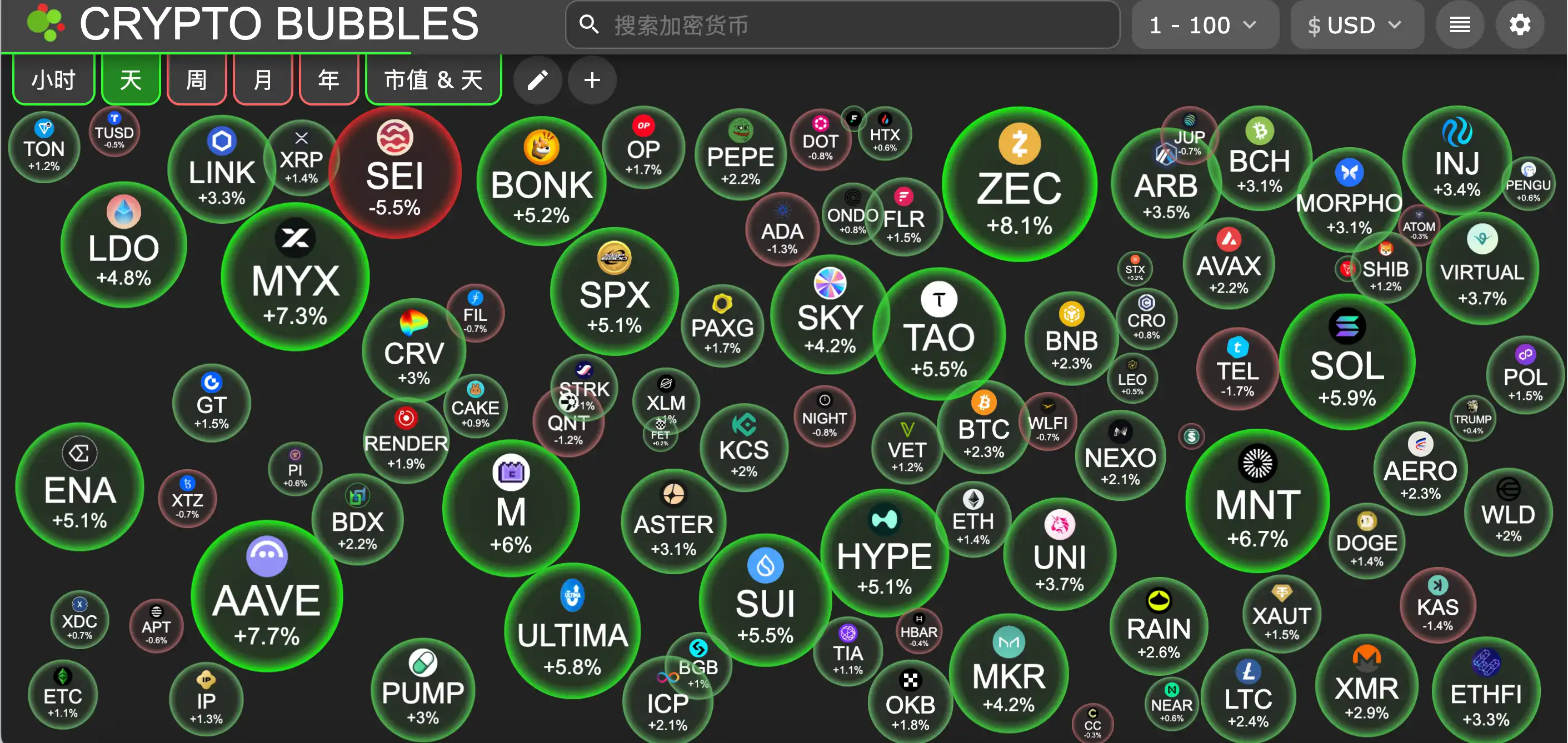
Today's top gainers among top 100 coins by market cap: Zcash up 8.1%, Aave up 7.7%, MYX Finance up 7.3%, Mantle up 6.7%, MemeCore up 6%.
5. Hot News

  • CCB responds to account lock due to Dogecoin transfer备注: Accounts are set to "no receipt, no payment" status if high risk is detected

  • DOYR token creator issued nearly 10,000 MEME coins through 3 associated addresses, profiting over $1.2 million

  • Only one Bitcoin treasury company's stock has outperformed the S&P 500 year-to-date in 2025

  • Jupiter to launch stablecoin JupUSD next week

  • YouTube introduces new option to pay US creators using stablecoins

  • Bloomberg: Coinbase plans to announce prediction markets and tokenized stocks next week

  • "1011 Insider Whale" added 41 BTC to long positions, total BTC long holdings reach 1000 BTC

  • Terraform Labs founder Do Kwon sentenced to 15 years in prison by US judge

  • a16z releases "17 Crypto Trends for 2026", focusing on RWA, AI agents, privacy chains, and other key directions

  • Pump.fun has repurchased 13.8% of PUMP token circulating supply since buyback program launch

  • Fed cuts rates by 25 bps, expects only one rate cut in 2026

  • If SpaceX IPO valuation reaches $1.5 trillion, Musk's net worth will approach $1 trillion

  • Sei to partner with Xiaomi to pre-install Web3 payment app in new global phones

Trending Cryptos

Related Questions

QWhat were the key factors driving the performance of precious metals mentioned in the article?

AThe performance of precious metals was driven by the Federal Reserve's 25 basis point interest rate cut and plans to purchase $40 billion in short-term U.S. Treasury bonds each month, which created a loose monetary policy expectation. Gold broke through the December high, approaching the $4,290 mark, and spot silver surged to $64, setting a new historical record.

QWhy did Oracle's stock price experience a significant drop, and what was the market's reaction?

AOracle's stock price plummeted by up to 16% in a single day due to its cloud infrastructure revenue growth falling short of expectations and an increase in capital expenditure guidance to $50 billion. This resulted in a market capitalization loss of over $68.9 billion (with some estimates as high as $102 billion). Investment banks like UBS and Morgan Stanley subsequently downgraded their target prices for Oracle.

QWhat is the current price range for Bitcoin, and what are the analysts' predictions for its future movement?

ABitcoin is currently trading in the range of $92,000 to $94,000. Analysts have mixed predictions: CryptoQuant suggests that if the trend of reduced selling pressure continues, BTC could rebound to $99,000 or even $112,000. However, some analysts, like Astronomer, are shorting at $92,700 with a target of $87,700, while Killa expects a potential surge to $94,000 or higher followed by a pullback, possibly dropping to $70,000 or even $60,000 next year.

QWhat legal outcome did Do Kwon face, and how did it affect related cryptocurrencies?

ADo Kwon, the founder of Terraform Labs, was formally sentenced to 15 years in prison by the U.S. District Court for the Southern District of New York for securities fraud and wire fraud, among other charges. This news caused related cryptocurrencies such as LUNA, LUNC, and USTC to plummet nearly 30% within 24 hours.

QWhat were the key points from China's Central Economic Work Conference regarding economic policy for 2026?

AChina's Central Economic Work Conference outlined a more proactive fiscal policy and an appropriately loose monetary policy for 2026, with a focus on expanding domestic demand and technological innovation.

Related Reads

Uniswap Founder: When Stocks and Treasuries Are Fully On-Chain, How Will AMMs Restructure the Global Market?

Uniswap founder Hayden Adams argues that as traditional assets like stocks become tokenized, Automated Market Makers (AMMs) could fundamentally restructure global markets. The core insight is that AMMs are most efficient in "correlated pairs"—such as NVDA/SPY—where assets move together. In these pairs, passive liquidity providers (LPs) who are willing to hold the underlying assets face lower inventory risk and minimal hedging costs compared to traditional, delta-neutral market makers. This cost advantage allows AMMs to undercut professional firms. Tokenization enables assets to trade directly against each other on a shared settlement layer, rather than being siloed in dollar-based systems. Adams observes this pattern already emerging in DeFi, where assets naturally pair with correlated benchmarks (e.g., ETH for Ethereum assets). He believes this will extend to tokenized stocks, with liquidity concentrating in low-volatility correlated pairs, while a few high-volume "bridge pairs" (like SPY/USD) handle dollar conversions. The article highlights that early correlated markets for tokenized stocks already exist (e.g., on Robinhood's chain), and Uniswap v4 hooks like DualPool can further boost LP returns. Adams draws a parallel to the rise of passive index funds, suggesting passive AMM liquidity could similarly democratize market-making and capture significant market share from traditional finance. A response from crypto KOL Cody adds practical analysis, noting that while the correlated pair strategy reduces impermanent loss, current on-chain fees may not yet fully compensate for it. He shares his own LP strategy using valuation models, emphasizing that AMMs offer a novel, low-cost market-making avenue for those willing to hold inventory.

marsbit6m ago

Uniswap Founder: When Stocks and Treasuries Are Fully On-Chain, How Will AMMs Restructure the Global Market?

marsbit6m ago

Goldman Sachs Buys Volatility, Turns Bitcoin into a Yield Business

Goldman Sachs acquired NEOS Investments for up to $2.25 billion, gaining a suite of ETFs that generate income by selling options against crypto assets, particularly Bitcoin. This includes the BTCI fund, which sells call options against Bitcoin ETF holdings to capture high premiums from crypto’s volatility, offering investors stable cash flow—around 27% annualized in returns—while capping upside potential and fully exposing them to downside risk. The move highlights Wall Street’s broader push to package crypto-native yield—through staking, lending, and structured products—without taking directional bets on prices. Firms like Fidelity, JPMorgan, and Morgan Stanley now offer staking services or accept crypto as collateral for loans, collecting steady fees regardless of market direction. In contrast, native crypto firms like Bitwise remain vulnerable to market downturns, as their revenue depends entirely on assets under management. This reflects a strategic pivot: large institutions no longer need to “believe” in crypto to profit from it. They monetize volatility and investor activity through fee-based structures, leaving price risk to retail investors. As regulatory shifts like the proposed 401(k) rules unfold, yield-generating crypto products may gain even broader adoption in traditional portfolios, further cementing Wall Street’s role as a neutral intermediary capturing reliable revenue streams from the ecosystem.

marsbit10m ago

Goldman Sachs Buys Volatility, Turns Bitcoin into a Yield Business

marsbit10m ago

AI Launches a Fierce Assault on Cancer, Virtually Tests 4,000 Anti-Cancer Drugs, Google Gemma Downloads Exceed 1 Billion

Google's open-source Gemma AI model family has reached a new milestone, surpassing 10 billion cumulative downloads in two and a half years since its February 2024 launch. This growth has fueled a vast ecosystem, with over 100,000 developer-derived model variants powering diverse applications, from NASA satellites to over 100 million phones. A standout application involves cancer research. In collaboration with Google Research and Yale, a team developed a 27-billion-parameter model called Cell2Sentence-Scale 27B (C2S-Scale). This model innovatively converts complex single-cell sequencing data into a "sentence" of gene names ranked by activity, allowing it to analyze cellular behavior. It was used to conduct a "dual-context virtual screen" of over 4,000 drugs, aiming to find one that specifically boosts antigen presentation—a key process for immune system recognition—only in the presence of low interferon signals (a "cold tumor" context), not in neutral conditions. The model identified silmitasertib (CX-4945), a CK2 kinase inhibitor, as a top candidate. Subsequent live-cell experiments validated this AI-generated hypothesis, showing that the drug combined with low-dose interferon increased antigen presentation by about 50%, whereas neither element alone had a significant effect. This represents a novel, AI-proposed mechanistic pathway for potential cancer therapy. Beyond biomedicine, the Gemma ecosystem is expanding into unique domains. Models have been deployed in space on high-performance GPUs and are being used in projects like DolphinGemma to decipher dolphin communication patterns. The 10-billion-download milestone underscores a key trend: the disruptive potential of AI lies not just in raw model capability but in its widespread, silent integration into diverse hardware and real-world applications, as evidenced by the thriving "Gemmaverse" community.

marsbit11m ago

AI Launches a Fierce Assault on Cancer, Virtually Tests 4,000 Anti-Cancer Drugs, Google Gemma Downloads Exceed 1 Billion

marsbit11m ago

Shocking: OpenAI Fully Open-Sources Codex Harness

OpenAI has open-sourced the core framework of Codex, called "Harness," under an Apache-2.0 license. This move allows developers to deeply integrate AI agents into their own applications and workflows, moving beyond the limitations of generic chat interfaces. The Harness is the underlying execution system that manages an AI agent's complete lifecycle: understanding tasks, maintaining memory, using tools, handling failures, and requesting human approvals. OpenAI demonstrated that optimizations to the Harness alone can dramatically boost a model's performance, tripling scores on a benchmark while using significantly fewer tokens. The release includes three key components: a CLI tool (`codex exec`) for automated tasks, official SDKs (TypeScript/Python) for programmatic control, and the `app-server` for embedding agents directly into products. This enables features like persistent state, real-time event streaming, and human-in-the-loop controls. Early adopters showcase its versatility beyond coding. Examples include a tax preparation system that cut processing time by one-third, Cisco's platform for building apps with natural language, and a demo logistics dashboard where agents analyze data and propose actions within the existing interface. This paradigm shift grants developers full control over the user interface, context, tools, and security boundaries. AI becomes an invisible assistant within specialized software, rather than a separate chatbot. By open-sourcing the engine behind its powerful agents, OpenAI aims to spark a new wave of native, deeply integrated AI applications.

marsbit16m ago

Shocking: OpenAI Fully Open-Sources Codex Harness

marsbit16m ago

Trading

Spot

Hot Articles

What is $BITCOIN

DIGITAL GOLD ($BITCOIN): A Comprehensive Analysis Introduction to DIGITAL GOLD ($BITCOIN) DIGITAL GOLD ($BITCOIN) is a blockchain-based project operating on the Solana network, which aims to combine the characteristics of traditional precious metals with the innovation of decentralized technologies. While it shares a name with Bitcoin, often referred to as “digital gold” due to its perception as a store of value, DIGITAL GOLD is a separate token designed to create a unique ecosystem within the Web3 landscape. Its goal is to position itself as a viable alternative digital asset, although specifics regarding its applications and functionalities are still developing. What is DIGITAL GOLD ($BITCOIN)? DIGITAL GOLD ($BITCOIN) is a cryptocurrency token explicitly designed for use on the Solana blockchain. In contrast to Bitcoin, which provides a widely recognized value storage role, this token appears to focus on broader applications and characteristics. Notable aspects include: Blockchain Infrastructure: The token is built on the Solana blockchain, known for its capacity to handle high-speed and low-cost transactions. Supply Dynamics: DIGITAL GOLD has a maximum supply capped at 100 quadrillion tokens (100P $BITCOIN), although details regarding its circulating supply are currently undisclosed. Utility: While precise functionalities are not explicitly outlined, there are indications that the token could be utilized for various applications, potentially involving decentralized applications (dApps) or asset tokenization strategies. Who is the Creator of DIGITAL GOLD ($BITCOIN)? At present, the identity of the creators and development team behind DIGITAL GOLD ($BITCOIN) remains unknown. This situation is typical among many innovative projects within the blockchain space, particularly those aligning with decentralized finance and meme coin phenomena. While such anonymity may foster a community-driven culture, it intensifies concerns about governance and accountability. Who are the Investors of DIGITAL GOLD ($BITCOIN)? The available information indicates that DIGITAL GOLD ($BITCOIN) does not have any known institutional backers or prominent venture capital investments. The project seems to operate on a peer-to-peer model focused on community support and adoption rather than traditional funding routes. Its activity and liquidity are primarily situated on decentralized exchanges (DEXs), such as PumpSwap, rather than established centralized trading platforms, further highlighting its grassroots approach. How DIGITAL GOLD ($BITCOIN) Works The operational mechanics of DIGITAL GOLD ($BITCOIN) can be elaborated on based on its blockchain design and network attributes: Consensus Mechanism: By leveraging Solana’s unique proof-of-history (PoH) combined with a proof-of-stake (PoS) model, the project ensures efficient transaction validation contributing to the network's high performance. Tokenomics: While specific deflationary mechanisms have not been extensively detailed, the vast maximum token supply implies that it may cater to microtransactions or niche use cases that are still to be defined. Interoperability: There exists the potential for integration with Solana’s broader ecosystem, including various decentralized finance (DeFi) platforms. However, the details regarding specific integrations remain unspecified. Timeline of Key Events Here is a timeline that highlights significant milestones concerning DIGITAL GOLD ($BITCOIN): 2023: The initial deployment of the token occurs on the Solana blockchain, marked by its contract address. 2024: DIGITAL GOLD gains visibility as it becomes available for trading on decentralized exchanges like PumpSwap, allowing users to trade it against SOL. 2025: The project witnesses sporadic trading activity and potential interest in community-led engagements, although no noteworthy partnerships or technical advancements have been documented as of yet. Critical Analysis Strengths Scalability: The underlying Solana infrastructure supports high transaction volumes, which could enhance the utility of $BITCOIN in various transaction scenarios. Accessibility: The potential low trading price per token could attract retail investors, facilitating wider participation due to fractional ownership opportunities. Risks Lack of Transparency: The absence of publicly known backers, developers, or an audit process may yield skepticism regarding the project's sustainability and trustworthiness. Market Volatility: The trading activity is heavily reliant on speculative behavior, which can result in significant price volatility and uncertainty for investors. Conclusion DIGITAL GOLD ($BITCOIN) emerges as an intriguing yet ambiguous project within the rapidly evolving Solana ecosystem. While it attempts to leverage the “digital gold” narrative, its departure from Bitcoin's established role as a store of value underscores the need for a clearer differentiation of its intended utility and governance structure. Future acceptance and adoption will likely depend on addressing the current opacity and defining its operational and economic strategies more explicitly. Note: This report encompasses synthesised information available as of October 2023, and developments may have transpired beyond the research period.

2.0k Total ViewsPublished 2025.05.13Updated 2025.05.13

What is $BITCOIN

Discussions

Welcome to the HTX Community. Here, you can stay informed about the latest platform developments and gain access to professional market insights. Users' opinions on the price of BTC (BTC) are presented below.

活动图片