The 3 Best Cryptos to Get Rich by 2026 According to Claude AI

bitcoinistPublished on 2026-02-03Last updated on 2026-02-03

Abstract

According to Claude AI, three cryptocurrencies are highlighted as potential top performers by 2026: XRP, HYPER, and TAO. The analysis is based on prevailing market narratives, not certainties. XRP's potential hinges on its resolution with the U.S. SEC and its utility for low-cost, fast cross-border payments. Its success depends on real-world adoption by financial institutions, not just speculation. HYPER is a Bitcoin Layer 2 solution promising faster transactions and smart contracts. Currently in presale, it is presented as a high-risk, high-volatility bet aimed at capturing the next wave of Bitcoin-based DeFi. TAO (Bittensor) focuses on decentralized AI, creating a marketplace where AI models compete and are rewarded. A recent halving event increased its scarcity. Its challenge is to break through key resistance levels to regain value. This is not investment advice. Cryptocurrency investments are high-risk and can lead to significant losses. Always conduct your own research and only invest what you can afford to lose.

Predictions from an artificial intelligence are not certainties; they mainly reflect the narratives that already dominate the market. But they provide a good starting point for analyzing projects. In several financial contents that attribute choices or assumptions to Claude, three names keep coming up: XRP, HYPER, and TAO. This article offers an in-depth look at the catalysts and risks.

Ripple with XRP, Betting on Regulatory Normalization

The first argument is the end of a long legal fog. In August 2025, the U.S. Securities and Exchange Commission confirmed the closure of the appeal case, while upholding the final judgment, which included a $125 million civil penalty and an injunction. This clarification made XRP a symbol of stabilizing regulation, a central topic for finance and cryptocurrencies in 2026.

The other angle is utility. Ripple is pushing XRP as a tool for value transfer, particularly for low-cost, fast-settlement cross-border payments. In AI scenarios, the recurring theme remains adoption by financial players, more than pure speculation. A dynamic that could grow actively with RLUSD.

The point of caution remains simple: the thesis only holds if usage actually progresses. If XRP remains primarily a trading asset, the gap between promise and reality can close quickly, especially in a cycle where narratives can reverse abruptly.

Bitcoin Hyper with HYPER, The Promise of a Layer 2 for the Bitcoin Ecosystem

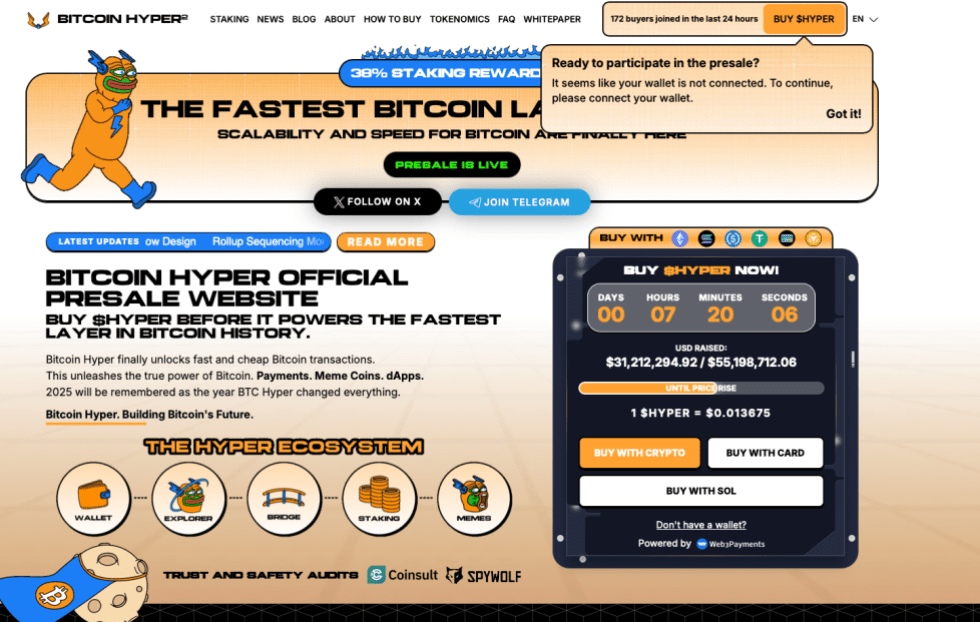
Bitcoin Hyper presents itself as a Layer 2 aiming to make Bitcoin more fluid, via faster transactions and smart contracts, relying on a virtual machine inspired by Solana. According to Claude AI, HYPER is often sold as the best current bet in presale, supposed to capture the next wave of decentralized finance backed by Bitcoin.

But this is also the case where caution must be maximum. Still in presale and not having conducted its TGE, volatility is likely to be extreme at launch, which could appeal to the most seasoned traders.

TAO from Bittensor, Betting on Decentralized AI Long-Term

With TAO, the thesis is more structural. Bittensor aims to create competition among artificial intelligence models, remunerated according to their contribution, a positioning that aligns with 2026 keywords: decentralized AI, infrastructure, and usage monetization. Market analyses highlight the rise of specialized subnets, capable of providing inference or agent services, and thus creating more organic demand.

The clearest catalyst is the emission mechanism. In mid-December 2025, the first halving reduced the daily emission of TAO, mechanically increasing scarcity if demand holds, much like bitcoin.

Oscillating like altcoins towards new support levels, the whole challenge lies in TAO's ability to break through resistances and return above $500. A scenario essential to put sellers on the sidelines and restore on-chain optimism.


This article does not constitute investment advice. The information provided here should not be used as a basis for making financial decisions. Cryptocurrency investments involve risks and can lead to significant losses. You should only invest what you can afford to lose and conduct your own research before making any investment decision.

Related Questions

QAccording to the article, what are the three cryptocurrencies mentioned by Claude AI as potential candidates for wealth in 2026?

AThe three cryptocurrencies mentioned are XRP, HYPER, and TAO.

QWhat is the main regulatory event that is considered a positive catalyst for XRP?

AThe main regulatory event was the closure of the appeal case by the U.S. Securities and Exchange Commission (SEC) in August 2025, which provided regulatory clarity and included a final judgment with a $125 million civil penalty and an injunction.

QWhat is the primary function of the Bitcoin Hyper (HYPER) project, and what is a major risk associated with it?

ABitcoin Hyper (HYPER) is a Layer 2 solution designed to make Bitcoin more fluid with faster transactions and smart contracts. A major risk is its extreme volatility at launch, as it was still in its pre-sale phase and had not yet conducted its Token Generation Event (TGE).

QWhat is the core thesis behind the TAO (Bittensor) project, and what key 2026 trend does it align with?

AThe core thesis of TAO (Bittensor) is to create a decentralized marketplace where different AI models compete and are rewarded based on their contribution. It aligns with the key 2026 trends of decentralized AI, infrastructure, and the monetization of AI applications.

QWhat specific event in TAO's tokenomics occurred in mid-December 2025 that could impact its scarcity?

AIn mid-December 2025, TAO underwent its first halving, which reduced the daily emission of new tokens, thereby mechanically increasing its scarcity if demand remains constant.

Related Reads

From Return to Resignation: Chen Hang's 437 Days at DingTalk

The 437-Day Return and Departure of Chen Hang at DingTalk This article chronicles the 437-day period from March 31, 2025, to June 11, 2026, when Chen Hang (also known as "No Move") returned as CEO of DingTalk, the enterprise communication platform he originally founded, only to later step down. Chen Hang, the creator of DingTalk in 2015, was brought back by Alibaba in 2025 after the company acquired his subsequent startup, HHO. His return was driven by Alibaba's renewed focus on AI and DingTalk's strategic role as its key to-B AI application. However, his aggressive management style, marked by strict work policies like mandatory clock-ins and extended hours, quickly caused internal friction and was criticized as being at odds with Alibaba's culture. Despite the internal turmoil, Chen Hang drove significant product launches. In August 2025, he unveiled "AI DingTalk 1.0," featuring new products like the AI-native entry point "DingTalk ONE." By March 2026, he announced "Wukong," touted as the world's first enterprise-grade AI-native work platform, representing a fundamental rebuild of DingTalk's architecture. The turning point came in early June 2026. A detailed internal post criticizing DingTalk's work culture went viral, followed by a public critique from a former executive. This prompted an unprecedented public rebuke from the Alibaba Partners Committee, which stated such management was not aligned with company values. One day later, on June 11, Alibaba announced Chen Hang's departure. He was succeeded by Chen Yusen, a 32-year-old technical expert known for founding cybersecurity firm Changting Technology. While Chen Hang's tenure laid the technical foundation for DingTalk's AI transformation with "Wukong," his leadership style ultimately led to his replacement as the company seeks a new direction under younger leadership.

marsbit10m ago

From Return to Resignation: Chen Hang's 437 Days at DingTalk

marsbit10m ago

The 2026 Landscape of Decentralized AI: Why Blockchain is the Inevitable 'Antidote' for AI?

Decentralized AI 2026 Landscape: Why Blockchain is AI's Essential "Antidote" Centralized AI faces structural bottlenecks—expensive compute, concentrated control, unverifiable outputs, and difficult data access—that cannot be solved by capital or code alone. Blockchain offers a path to make intelligence open, verifiable, and economically accessible. The decentralized AI stack comprises: * **Infrastructure:** The foundation with compute, verifiable inference, distributed training, data/storage, and privacy/verification layers. Projects like Akash, Render, and Filecoin provide cheaper, decentralized alternatives for raw resources. * **Middleware:** The coordination layer for agent discovery, identity, and commerce. Key players include Bittensor (a network of specialized AI subnets), Virtuals (an agent economy OS), and frameworks providing agent identity and tooling. * **Applications & Services:** Dominated by Agentic Finance (AI agents executing on-chain actions based on natural language) and Agentic Payments (machine-to-machine transactions using blockchain as a settlement layer). Projects like Giza, Infinit Labs, and x402 are enabling these use cases. Key trends for 2026-2027 show AI demand outgrowing infrastructure, compute becoming an asset class, and tokenomics emerging as a structural advantage for coordinating capital, compute, and data. While still early—with adoption uneven and revenue often trailing token incentives—projects like Bittensor, NEAR, and Venice demonstrate decentralized AI is evolving from a narrative into a new model for coordinating intelligence.

Foresight News31m ago

The 2026 Landscape of Decentralized AI: Why Blockchain is the Inevitable 'Antidote' for AI?

Foresight News31m ago

Trading

Spot
Futures

Hot Articles

Discussions

Welcome to the HTX Community. Here, you can stay informed about the latest platform developments and gain access to professional market insights. Users' opinions on the price of AI (AI) are presented below.

活动图片