# Security Related Articles

HTX News Center provides the latest articles and in-depth analysis on "Security", covering market trends, project updates, tech developments, and regulatory policies in the crypto industry.

Developer Warns of Risk of Losing Bitcoins Due to BIP-110

Blockchain expert Kevin Loaec has warned of a security risk where attempting to sell coins from a potential BIP-110 soft fork could lead to the loss of real Bitcoin. Following a blockchain split, a double balance situation arises, with the same assets existing on both chains. In the early stages, transactions are valid on both networks. By signing a transaction to sell the forked tokens, a seller inadvertently provides a ready-made template for an identical transaction on the main Bitcoin network. This could allow malicious buyers to replay the transaction, causing the equivalent amount in real Bitcoin to be spent from the seller's address, with fees deducted twice. Loaec advised that the only safe strategy is to keep assets unmoved, as replaying requires a signed transaction. He noted that while a similar issue occurred with Bitcoin Cash in 2017, BIP-110 lacks the protective mechanism implemented then. The potential split stems from a longstanding debate. It intensified after Bitcoin Core v30 increased the OP_RETURN field limit, prompting the Bitcoin Knots team to propose BIP-110, which temporarily limits non-payment data in blocks. For standard activation, it requires support from 1109 out of 2016 blocks, but currently has only about 2.6%. An alternative activation path could see nodes enforcing BIP-110 begin rejecting non-compliant blocks starting August 8th, potentially creating a separate chain if supported by miners. However, the data limit rule itself would only activate in early September. Until truly separate assets exist on each chain, transactions remain vulnerable to replay attacks between them.

cryptonews.ru08/08 15:22

Developer Warns of Risk of Losing Bitcoins Due to BIP-110

cryptonews.ru08/08 15:22

Number of Bitcoin Wallets Reaches Highest Since 2026 Amid Growing Fallout from Coldcard Hack

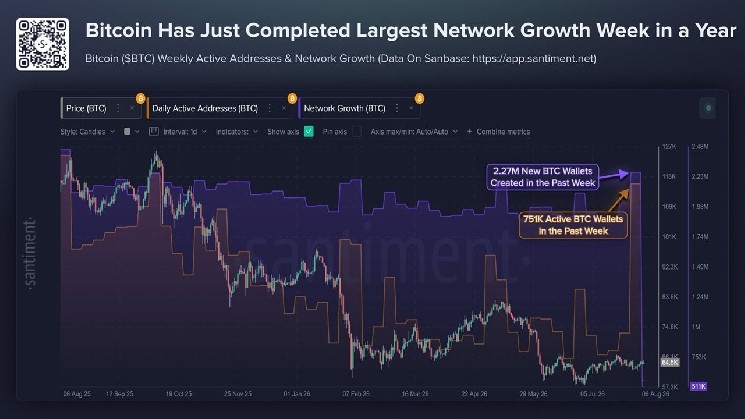
The number of Bitcoin wallets has reached its highest level since 2026, driven by growing concerns over the Coldcard hardware wallet exploit. Data from Santiment shows a surge in network activity, with 751,000 active wallets and 2.27 million new wallets created recently. Daily active addresses peaked at approximately 978,000 on July 31st. Notably, this increase was not accompanied by a corresponding rise in exchange inflows, which remained slightly below July's average. This divergence suggests a defensive market posture, likely due to users migrating funds from potentially compromised wallets. The vulnerability stemmed from a firmware flaw in certain Coldcard models (Mk3, Mk4, Mk5, and Q), where seed phrase generation relied on a software-based random number generator instead of the dedicated hardware entropy chip. This drastically reduced cryptographic security, leaving some devices with as little as 40 bits of real randomness. Reported losses have exceeded $116 million, with thefts continuing in waves. The data indicates that security-conscious owners of affected devices are likely creating new wallets on secure hardware and transferring their coins, explaining the spike in new and active addresses without increased trading activity. Coinkite has since released a firmware patch and a report detailing the issue. Experts emphasize this is not a Bitcoin protocol flaw but a supply-chain issue specific to one manufacturer's implementation. The incident highlights how a narrow, fixable firmware bug can significantly impact key blockchain metrics and market sentiment, amplified by coinciding discussions about unrelated Bitcoin fork proposals.

cryptonews.ru08/08 15:06

Number of Bitcoin Wallets Reaches Highest Since 2026 Amid Growing Fallout from Coldcard Hack

cryptonews.ru08/08 15:06

活动图片