Number of Bitcoin Wallets Reaches Highest Since 2026 Amid Growing Fallout from Coldcard Hack

cryptonews.ruPublished on 2026-08-08Last updated on 2026-08-08

Abstract

The number of Bitcoin wallets has reached its highest level since 2026, driven by growing concerns over the Coldcard hardware wallet exploit. Data from Santiment shows a surge in network activity, with 751,000 active wallets and 2.27 million new wallets created recently. Daily active addresses peaked at approximately 978,000 on July 31st. Notably, this increase was not accompanied by a corresponding rise in exchange inflows, which remained slightly below July's average. This divergence suggests a defensive market posture, likely due to users migrating funds from potentially compromised wallets. The vulnerability stemmed from a firmware flaw in certain Coldcard models (Mk3, Mk4, Mk5, and Q), where seed phrase generation relied on a software-based random number generator instead of the dedicated hardware entropy chip. This drastically reduced cryptographic security, leaving some devices with as little as 40 bits of real randomness. Reported losses have exceeded $116 million, with thefts continuing in waves. The data indicates that security-conscious owners of affected devices are likely creating new wallets on secure hardware and transferring their coins, explaining the spike in new and active addresses without increased trading activity. Coinkite has since released a firmware patch and a report detailing the issue. Experts emphasize this is not a Bitcoin protocol flaw but a supply-chain issue specific to one manufacturer's implementation. The incident highlights how a narro...

This week, Santiment published network data, noting that 751,000 active wallets and 2.27 million newly created wallets indicate the highest Bitcoin network activity in recent months. The number of active addresses peaked at around 978,000 on July 31st, approximately 1.6 times the July daily average, before stabilizing during the first week of August at a still-high level of around 751,000 per day—compared to the July average of close to 610,000.
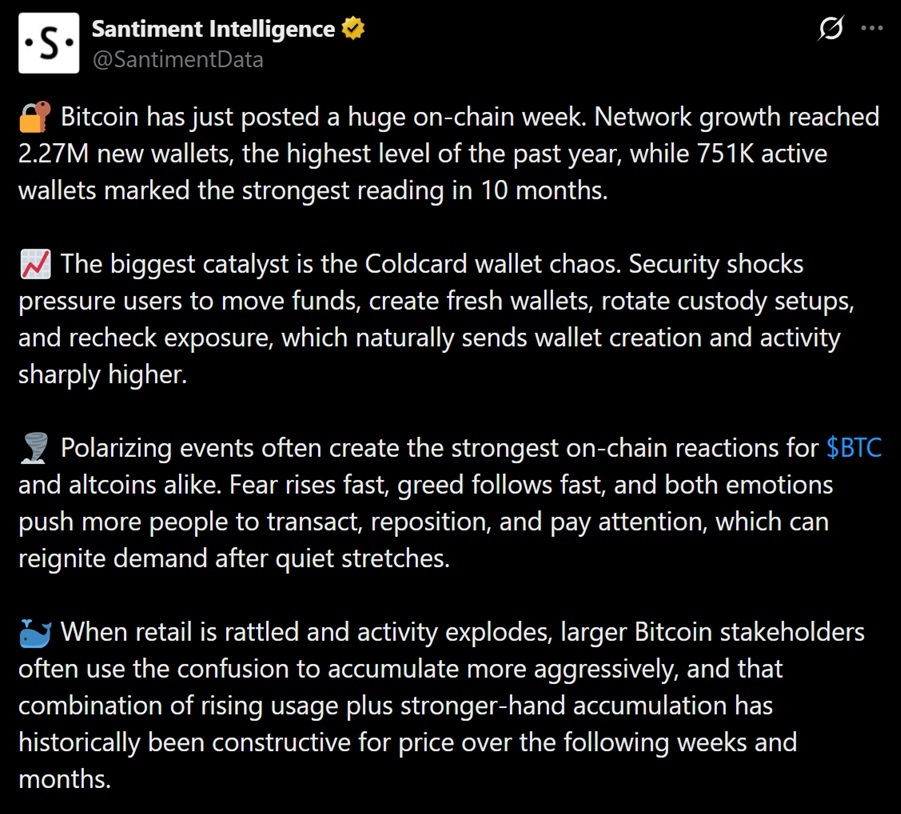
Image source: Santiment

The distinction of this surge from a typical bull-market address boom lies in what's missing: purchases. Exchange inflows during the same period averaged about $1.55 billion per day, essentially slightly below July's average of $1.67 billion. The number of wallets is growing, coins are moving within them, but money is not flowing onto exchanges for trading. This divergence points to a defensive stance among market participants.

Inside the Coldcard Vulnerability

The root cause lies in the Coldcard hardware wallets by Coinkite, where a firmware bug (first appearing in the March 2021 build for versions 4.0.1 through 4.1.9) led to seed phrase generation on affected Mk3 devices being handled by a software random number generator instead of the device's dedicated hardware entropy chip.

What was supposed to be a 128-bit cryptographic key turned out, on the most affected devices, to have about 40 bits of real randomness, and on some later models around 72 bits. Bitcoin.com News is tracking the scale of the damage: losses have exceeded $116 million, and a fourth wave of thefts continues to drain wallets even days after the initial disclosure.

What the Data Really Shows

When news spread that seeds for certain Coldcard Mk3, Mk4, Mk5, and Q devices running vulnerable firmware could be brute-forced, security-conscious owners had every reason to create new wallets on unaffected hardware, move their coins to new addresses, and abandon any configurations that might harbor the same weak-entropy vulnerability.

This behavior alone could explain the spike in new and active wallets combined with the lack of expected exchange inflows.

Since then, Coinkite has released a firmware patch and published a post-mortem on fixing the entropy issue, detailing how much random data the vulnerable devices were actually generating. Independent security researchers have also joined the effort: one emergency audit found nearly 5,000 separate vulnerabilities across hundreds of Bitcoin-related projects in just over a day of testing.

This Is Not a Protocol-Level Issue

Experts are keen to draw a clear distinction between this incident and a vulnerability in Bitcoin itself. The vulnerability was solely in how one manufacturer's firmware generated random data for seed phrases—a self-custody supply chain failure, not a blockchain problem.

Geographic data added another layer of complexity: researchers tracking victim wallets found that Canadian users account for roughly a quarter of the losses linked to this vulnerability, likely reflecting Coinkite's Canadian base and the concentration of early customers in that country.

Coupled with reports that this vulnerability briefly amplified market anxiety over unrelated Bitcoin fork proposals circulating at the same time, this episode serves as a vivid example of how a narrow, fixable firmware bug can still ripple through key blockchain metrics, extending its impact beyond the number of affected devices.

end-content

Trending Cryptos

Related Questions

QWhat recent data from Santiment indicates heightened Bitcoin network activity?

ASantiment data shows 751,000 active wallets and 2.27 million newly created wallets, representing the highest Bitcoin network activity in recent months. The number of active addresses peaked at about 978,000 on July 31, which is roughly 1.6 times the daily average for July.

QWhat is the key difference between this recent spike in wallet activity and typical bull market activity, according to the article?

AThe key difference is the absence of significant buying pressure. While the number of wallets is growing and coins are moving, the average daily exchange inflows during this period were about $1.55 billion, slightly below July's average of $1.67 billion. This suggests market participants are taking a defensive position rather than trading.

QWhat was the core technical flaw in the affected Coldcard hardware wallets?

AThe flaw was in the firmware (versions 4.0.1 to 4.1.9 for Mk3 and other models). It caused seed phrase generation to use a software-based random number generator instead of the device's dedicated hardware entropy chip. This reduced the real randomness of the cryptographic key from 128 bits to approximately 40 bits on the worst-affected devices and about 72 bits on some later models.

QHow does the article explain the connection between the Coldcard vulnerability and the surge in new Bitcoin wallets?

AThe article suggests that security-conscious owners of potentially affected Coldcard devices likely created new wallets on uncompromised hardware and moved their coins to new addresses. This mass migration to secure new wallets directly explains the surge in new and active wallet counts without a corresponding increase in exchange deposits for trading.

QAccording to experts cited in the article, what is the important distinction between the Coldcard incident and a Bitcoin protocol flaw?

AExperts clarify that this was a supply chain failure in a specific manufacturer's self-custody product (a flaw in how Coldcard's firmware generated random data for seed phrases) and not a vulnerability in the Bitcoin blockchain or protocol itself.

Related Reads

Trading

Spot

Hot Articles

How to Buy DATA

Welcome to HTX.com! We've made purchasing DATA Network (DATA) simple and convenient. Follow our step-by-step guide to embark on your crypto journey.Step 1: Create Your HTX AccountUse your email or phone number to sign up for a free account on HTX. Experience a hassle-free registration journey and unlock all features.Get My AccountStep 2: Go to Buy Crypto and Choose Your Payment MethodCredit/Debit Card: Use your Visa or Mastercard to buy DATA Network (DATA) instantly.Balance: Use funds from your HTX account balance to trade seamlessly.Third Parties: We've added popular payment methods such as Google Pay and Apple Pay to enhance convenience.P2P: Trade directly with other users on HTX.Over-the-Counter (OTC): We offer tailor-made services and competitive exchange rates for traders.Step 3: Store Your DATA Network (DATA)After purchasing your DATA Network (DATA), store it in your HTX account. Alternatively, you can send it elsewhere via blockchain transfer or use it to trade other cryptocurrencies.Step 4: Trade DATA Network (DATA)Easily trade DATA Network (DATA) on HTX's spot market. Simply access your account, select your trading pair, execute your trades, and monitor in real-time. We offer a user-friendly experience for both beginners and seasoned traders.

1.6k Total ViewsPublished 2026.07.01Updated 2026.07.01

How to Buy DATA

Discussions

Welcome to the HTX Community. Here, you can stay informed about the latest platform developments and gain access to professional market insights. Users' opinions on the price of DATA (DATA) are presented below.

活动图片