# Security Related Articles

HTX News Center provides the latest articles and in-depth analysis on "Security", covering market trends, project updates, tech developments, and regulatory policies in the crypto industry.

Should Ethereum's Staking Rate Be Capped? EIP-8363 Proposal Ignites Heated Debate

The Ethereum community is currently engaged in intense debate over EIP-8363, a proposal aiming to cap the network's staking ratio. With the ETH staking rate exceeding 33% and rising, concerns have grown about potential centralization if a few large entities control most staked ETH and about perpetual dilution for non-stakers. The "diminishing issuance burn" mechanism of EIP-8363 would progressively burn an increasing portion of validator rewards as the total staked ETH approaches roughly 50% of the supply. At that threshold, new consensus issuance would effectively stop, leaving validators to earn solely from transaction fees and MEV until the staking ratio falls back below 50%. Proponents argue this protects ETH's monetary properties by limiting dilution and establishing a firmer supply cap, while also disincentivizing excessive growth by large stakers first. Critics, however, warn the proposal threatens DeFi vitality by destabilizing the staking yield which serves as a benchmark rate for lending and other protocols. They also argue it could make independent, home staking economically unviable as fixed costs remain while rewards shrink, potentially increasing centralization as MEV becomes a larger portion of validator income. Some suggest the proposal's economic rationale needs refinement. The proposal's procedural status for inclusion in a future upgrade is pending. Regardless of the immediate outcome, the debate centers on whether Ethereum currently overpays for security and if implementing such a cap is worth the potential disruption.

marsbit08/08 12:45

Should Ethereum's Staking Rate Be Capped? EIP-8363 Proposal Ignites Heated Debate

marsbit08/08 12:45

Bitcoin 'Red Team' Uncovers 4,962 Vulnerabilities Following Coldcard Hack

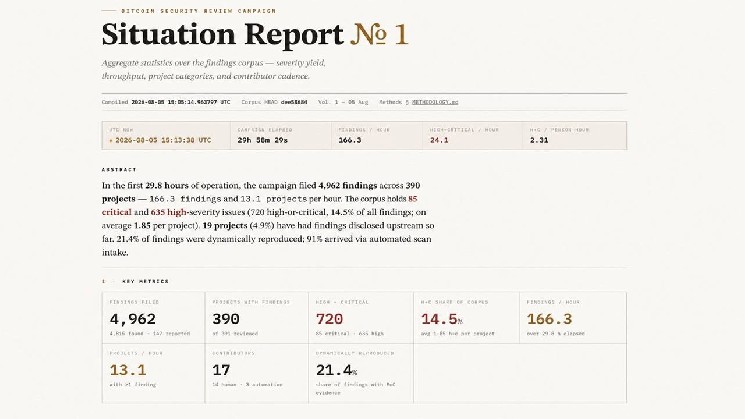
A security vulnerability in the Coldcard hardware wallet led to the theft of over 1,800 BTC (worth more than $116 million at the time) from long-term holders, stemming from a firmware bug first identified in March 2021. This incident prompted the formation of the volunteer 'Bitcoin Red Team,' led by developer Calle and Rob Hamilton, CEO of custody insurance firm Anchorwatch. The team conducted an emergency audit of the broader open-source Bitcoin ecosystem. Sixteen security researchers spent 27.5 hours analyzing 390 Bitcoin-related open-source repositories, combining AI-assisted analysis with manual review. They documented a total of 4,962 vulnerabilities, including 85 classified as critical and 635 as high severity. Funding was provided by the non-profit OpenSats. The team described the ecosystem's security state as "extremely poor," though only about one-fifth of the findings have been independently reproduced so far. The highest concentration of critical issues was found in privacy and coinjoin tools, accounting for 24% of critical finds. Cryptographic libraries had the highest absolute number of issues (1,101) but a lower proportion of high-severity ones. Most analyzed projects had few or no critical problems, with the real danger concentrated in a small group of tools handling private key generation, signing, and privacy-preserving transactions—the same category responsible for the original Coldcard failure. The audit is the first phase of an ongoing effort. The next steps involve verifying which vulnerabilities are actually exploitable and coordinating responsible disclosure with affected projects. For the self-custody community, the audit shows white-hat researchers are now scaling their efforts to match the pace of potential attackers.

cryptonews.ru08/07 13:40

Bitcoin 'Red Team' Uncovers 4,962 Vulnerabilities Following Coldcard Hack

cryptonews.ru08/07 13:40

Bitcoins from 2011 Moved. Their Owner is Up $10 Million

A dormant Bitcoin wallet from 2011 transferred nearly 50 BTC, worth approximately $3.2 million. The wallet's owner originally accumulated 144 BTC in 2011 when the price fluctuated between $13.99 and $2.76, with the total initial investment valued at around $399. Over 15 years, this early holder has realized a total profit estimated at $9.75 million from price appreciation. The owner made their first withdrawal of 11 BTC in 2021 when the price was $39,000. A second transfer of nearly 13 BTC occurred near the market peak in fall 2025 at $122,000. The latest transfer of almost 50 BTC was spotted on August 6. The wallet still holds 70 BTC, valued at about $4.5 million at current prices. The transferred 50 BTC have not been sold yet but were moved to a newer SegWit address (starting with "bc1"), which is more efficient and secure. Funds from this new address are periodically sent to institutional crypto broker FalconX, indicating a potential intent to sell. The movement is part of a broader trend where early holders migrated assets from old wallets to new ones in 2025 due to security concerns, including a phishing scam involving fake claims from "Saloman Brothers." Separately, this week saw a spike in crypto transfers, with $9 billion in Bitcoin moved to exchanges and new addresses following a major hack resulting in over $115 million stolen from Coldcard hardware wallets, marking a first for such devices traditionally considered highly secure.

cryptonews.ru08/07 13:16

Bitcoins from 2011 Moved. Their Owner is Up $10 Million

cryptonews.ru08/07 13:16

活动图片