# Halving Related Articles

HTX News Center provides the latest articles and in-depth analysis on "Halving", covering market trends, project updates, tech developments, and regulatory policies in the crypto industry.

Has Satoshi Returned? Over 600 Bitcoin Over 16 Years Old Suddenly Moved

More than 600 bitcoins worth approximately $48 million, which had been dormant on addresses for over 16 years, were recently moved, sparking speculation about a potential connection to Bitcoin's mysterious creator, Satoshi Nakamoto. According to on-chain platform Whale Alert, 12 addresses containing 600 BTC—all mining rewards from March 2010—became active on September 5th. The platform stated its investigation found no links between these blocks and Nakamoto, reducing panic. The coins were mined when the block reward was 50 BTC, before four subsequent halvings. The movement attracted attention partly because it dates to the period when Nakamoto was still actively involved in Bitcoin's development. Whale Alert noted one transaction occurred several blocks earlier, likely a test. Lookonchain also reported similar activity involving 350 BTC from seven other inactive addresses. From a data analysis perspective, this event fits a broader trend: a significant volume of long-inactive bitcoins, valued at $104 billion, has changed hands in 2024-2025, a phenomenon some call the "great distribution." A technical note: some 2010-era coins are stored in outdated pay-to-public-key (P2PK) formats, making the public key visible and theoretically vulnerable to future quantum computing attacks, raising questions about how many of these ancient coins will be moved before such technology emerges.

cryptonews.ru1h ago

Has Satoshi Returned? Over 600 Bitcoin Over 16 Years Old Suddenly Moved

cryptonews.ru1h ago

Bitcoin Price Surge in August. A Temporary Spike or the Start of a New Cycle

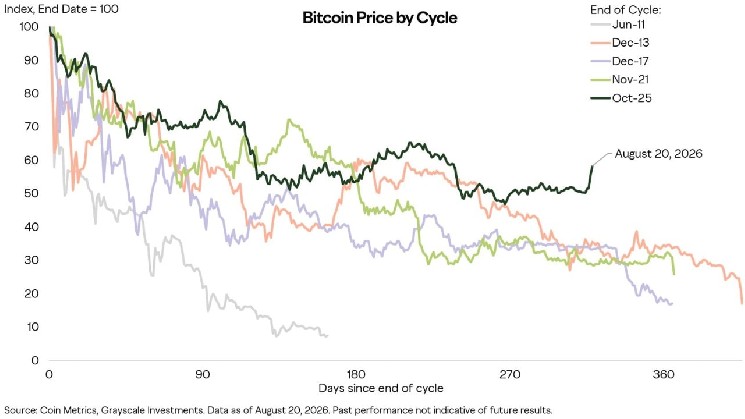
"Bitcoin Price Surge in August: Temporary Spike or Start of a New Cycle?" The cryptocurrency market is ending August with a recovery attempt following a prolonged downtrend that began in October 2025. Bitcoin has seen confident growth recently, aided by macroeconomic and market factors. However, analysts agree it's too early to call a trend reversal, with bearish risks remaining and sideways price movement expected in the coming months within a wide range. Bitcoin's current dynamics fit the classic four-year cycles historically marked by alternating bull and bear trends. These cycles are linked to Bitcoin's halving events. Based on this pattern, the recent lows might indicate a local bottom and an attempt to break the October 2025 downtrend. Many key players statistically predict the cycle's bottom for autumn 2026. Analysts highlight persistent pressure from external macroeconomic factors, including high interest rates and the US Federal Reserve's firm stance, alongside geopolitical uncertainty. However, if recent positive inflation trends continue, the likelihood of Fed policy easing could increase, benefiting BTC and other risky assets. De-escalation in Iran-related tensions could also provide the Fed more room to soften its policy. Another pressure factor is competition from other asset classes, notably semiconductors and AI development. Mining companies are reportedly selling accumulated coin reserves and shifting towards providing computing power for AI, a more profitable and predictable business. This trend is mirrored by institutional investors who have seen higher returns and volatility in traditional assets, contributing to outflows from spot Bitcoin ETFs and reduced trading interest in crypto. Nonetheless, Bitcoin ETFs have attracted over $3.5 billion since early August, signaling a recovery in institutional demand. From a technical perspective, analysts do not expect explosive growth. Strong resistance is seen around $86,000, with a potential correction toward an accumulation zone near $74,000. If this support holds, a path could open toward $96,000 and then $100,000. A broader forecast suggests Bitcoin may enter a wide sideways range between $60,000 and $85,000 until Fed rhetoric softens or interest in semiconductors and AI sectors subsides.

cryptonews.ru08/28 13:16

Bitcoin Price Surge in August. A Temporary Spike or the Start of a New Cycle

cryptonews.ru08/28 13:16

Zcash Hashrate Skyrockets: $870 ZEC Price Awakens ASIC Industry Giants

Zcash's network hash rate has surged significantly, with recent monitoring services reporting 27 to 29 GSol/s, one of the highest levels ever recorded. This increase is driven by ZEC's price rising to around $870, making mining profitable and incentivizing operators to activate idle equipment and deploy new hardware. The Zcash network uses the memory-intensive Equihash algorithm and aims for a 75-second block time, producing roughly 1,152 blocks daily. Miners currently earn 80% of the 1.5625 ZEC block subsidy, plus transaction fees. Network hash rate is estimated differently across tracking services due to varying calculation methods based on network difficulty and actual block times, leading to reported discrepancies. Specialized ASIC miners like Bitmain's Antminer Z15 Pro (840 kSol/s) dominate the landscape. With a network hash rate of ~25 GSol/s, this represents an industrial-scale operation of roughly 30,000 such machines. High ZEC prices justify this deployment, but each new ASIC increases mining difficulty, spreading rewards among more competitors. While Z15 Pro models are officially sold out, pushing buyers to secondary markets, current daily profitability for older Z15 and Z15 Pro models is estimated at $17.06 and $34.69 respectively. The sustainability of this profitability depends on ZEC's price holding as difficulty adjusts, with miners also watching for future protocol changes like NU7 and the 2028 halving.

cryptonews.ru08/25 20:51

Zcash Hashrate Skyrockets: $870 ZEC Price Awakens ASIC Industry Giants

cryptonews.ru08/25 20:51

'The Idea of Catching the Absolute Bottom Is Wrong': Experts on a New Phase of Bitcoin Capitulation

Analysts from CryptoQuant advise investors against trying to pinpoint the exact bottom of Bitcoin's price. Their data shows the percentage of the Bitcoin supply in profit has fallen to 51.4%, a level historically associated with capitulation phases followed by accumulation. This means approximately 48.6% of circulating coins are held at an unrealized loss. The metric, based on UTXO analysis comparing a coin's last moved price to its current market value, last neared this level in early 2023 when Bitcoin traded between $16,000 and $20,000. CryptoQuant states that the idea of catching the "absolute bottom" is flawed. The decline in the average cost basis during a bear market reflects coins transferring from weak hands to stronger, long-term holders. While some investors realize losses, others may use the decline for gradual accumulation. The accumulation window may last longer than many expect, even as fear drives some participants away. Historically, a supply in profit below 55% has been linked to re-accumulation periods. Separately, Swan Bitcoin CEO Cory Klippsten offered a forecast, suggesting Bitcoin could form a bottom in October 2026, followed by a recovery towards approximately $130,000 ahead of the 2028 halving. This aligns with the historical pattern of local lows forming about 12 months after bull market peaks; Bitcoin hit its all-time high above $126,000 in early October 2025. However, Klippsten cautioned against over-relying on past cycles due to limited historical data.

cryptonews.ru08/17 13:14

'The Idea of Catching the Absolute Bottom Is Wrong': Experts on a New Phase of Bitcoin Capitulation

cryptonews.ru08/17 13:14

Peter Todd's Remarks on Emissions Spark Debate Over Bitcoin Inflation

Peter Todd's recent speech on "Tail Emissions and Demurrage" has reignited the intense debate around Bitcoin's 21 million supply cap. He argues that after block subsidies end around 2140, a fee-only model could create security risks by enabling powerful miners to perform chain reorganizations. His proposed solution is a small, fixed "tail emission" of new coins per block or a demurrage fee on dormant coins to provide predictable miner income. The backlash was swift and severe across social media. Critics denounced the proposals as "inflation by another name" and a violation of Bitcoin's foundational social contract of absolute scarcity. They argue that tinkering with the fixed monetary policy undermines Bitcoin's core value proposition versus fiat currencies. Alternatives like relying on Layer-2 solutions and a robust fee market were emphasized as the correct path forward. While a few figures like Starkware's Eli Ben-Sasson have expressed sympathy for limited permanent emission to offset lost coins, Todd acknowledges a hard-fork implementing his idea is highly unlikely in the near future. The consensus remains that any change to the 21 million limit faces insurmountable opposition from the ecosystem of node operators, miners, and holders. The debate underscores that Bitcoin's security budget challenge will ultimately be tested by future halvings and the organic development of its transaction fee economy.

cryptonews.ru08/16 20:46

Peter Todd's Remarks on Emissions Spark Debate Over Bitcoin Inflation

cryptonews.ru08/16 20:46

活动图片