# Fed Policy Related Articles

HTX News Center provides the latest articles and in-depth analysis on "Fed Policy", covering market trends, project updates, tech developments, and regulatory policies in the crypto industry.

On the Eve of the US Stock Inflation Test, Wall Street Faces the Most Severe 'Data Deception' in History

On the eve of the crucial US June CPI release, a significant credibility gap is emerging between official inflation data and consumer sentiment. While May CPI and PCE figures suggested a "concerning but not critical" picture, the University of Michigan Consumer Sentiment Index plummeted to its lowest level in nearly 50 years. This contradiction is prompting economists to question the reliability of key macroeconomic indicators. The core issue, as highlighted by labor economist Kathryn Anne Edwards, lies in a systemic flaw within the current inflation measurement framework. The Consumer Price Index (CPI) averages prices across a "market basket" meant for a "typical consumer," thereby masking vastly different inflation experiences across demographic groups. For instance, Bureau of Labor Statistics (BLS) research indicates that from 2006 to 2023, the lowest income quintile faced a cumulative inflation rate 7.7 percentage points higher than the highest quintile—a disparity largely invisible in the headline CPI number. This averaging effect means investors and policymakers relying on aggregate CPI may be basing decisions on a statistically smoothed figure that fails to capture the true distribution of economic pressure. Edwards argues that expanding this measurement framework is technically feasible, requiring primarily political will rather than new data collection. The BLS already tracks 100,000 items monthly; creating more granular indices for different family types, income levels, and housing statuses would mainly involve re-weighting existing data. The BLS has produced such experimental series before. A more nuanced data picture is crucial for accurate policy and market forecasting. Ultimately, improving measurement cannot solve underlying economic stresses. Edwards notes concurrent pressures like slowing hiring, stagnant wage growth, persistently high prices, rising credit card debt, a subdued housing market due to high rates, and AI's potential disruption to jobs. These factors collectively explain the deep chasm between official statistics and consumer pessimism. The key takeaway for markets is the need to look beyond a single headline CPI number. Understanding the divergence in inflation experiences across the population is critical for accurately assessing the real pressure within the economy, the path of Federal Reserve policy, and risks on the consumer side.

marsbit07/13 14:24

On the Eve of the US Stock Inflation Test, Wall Street Faces the Most Severe 'Data Deception' in History

marsbit07/13 14:24

US Stocks Are at an Extremely Fragile Moment as Earnings Season Kicks Off

U.S. stocks are entering a high-stakes earnings season amidst what analysts describe as an "extremely fragile" market environment. While major indices show subdued volatility, underlying pressures from geopolitics, monetary policy expectations, and mixed credit market signals are building. UBS's proprietary "Turbu-lens" market fragility indicator has reached 0.9, its highest level since September 2025, historically a precursor to a sharp spike in the VIX volatility index. The risk is amplified by elevated earnings expectations. Analysts project robust profit growth for Q2—24% for the S&P 500 and 12% for the Stoxx 600—but recent upward revisions mean disappointment could trigger outsized market moves. Current low VIX levels are seen as misleading and temporary, with the earnings season likely to push volatility higher. Market internals reveal significant stress, with single-stock volatility exceeding index volatility by more than threefold. This divergence suggests a potential convergence that could drive a sharp rise in index-level volatility. Given likely continued sector rotation, UBS suggests single-stock options may offer better tactical hedging opportunities than broad index hedges. Further pressures stem from rising oil prices, which threaten to keep inflation and interest rate expectations elevated, and a cautious credit market where CDS spreads have not confirmed the equity rally's strength. For investors, UBS recommends focusing on pair-wise correlation trades to navigate expected stock-specific volatility, highlighting sectors like Tech, Energy, and Financials in the U.S. and Energy, Tech, and Consumer Discretionary in Europe.

marsbit07/11 02:47

US Stocks Are at an Extremely Fragile Moment as Earnings Season Kicks Off

marsbit07/11 02:47

STRC Hits Historic Low, Saylor's Perpetual Motion Machine Grinds to a Halt

STRC, the perpetual preferred stock issued by MicroStrategy to fund its Bitcoin purchases, hit a historic low of $85.32, a 17% discount to its $100 par value. Designed as a "digital credit engine" to trade stably near par and enable continuous share issuance for buying Bitcoin, its plunge signals a breakdown in this model. Three key factors drove the decline: 1. Bitcoin's price fell over 50% from its peak, trading around $63,000 amid hawkish Fed signals. 2. MicroStrategy's cash reserves were depleted after a $1.5 billion convertible note repayment, slashing the dividend coverage for STRC's 11.5% yield to ~7 months. The company then sold 32 BTC to cover dividends—Michael Saylor's first Bitcoin sale since 2022—damaging the "never sell" narrative. 3. A competing Bitcoin-backed preferred stock, Strive's SATA, offers a higher yield (~13%) and daily dividends, drawing investors away from STRC. The drop triggers a negative cycle: STRC below par halts ATM share issuances, cutting off a key funding source for Bitcoin buys and potentially forcing more BTC sales for dividends, further eroding confidence. While Saylor argues the model is mathematically sound—needing only 2.3% annual Bitcoin growth to sustain itself—the market is testing the resilience of the leveraged Bitcoin treasury strategy in a bear market. The STRC price now reflects rising skepticism about this financial machinery's durability during downturns.

marsbit06/19 05:32

STRC Hits Historic Low, Saylor's Perpetual Motion Machine Grinds to a Halt

marsbit06/19 05:32

Nasdaq Plunges 4.2% in a Single Day, Did 'Black Friday' Pop the U.S. Stock Bubble?

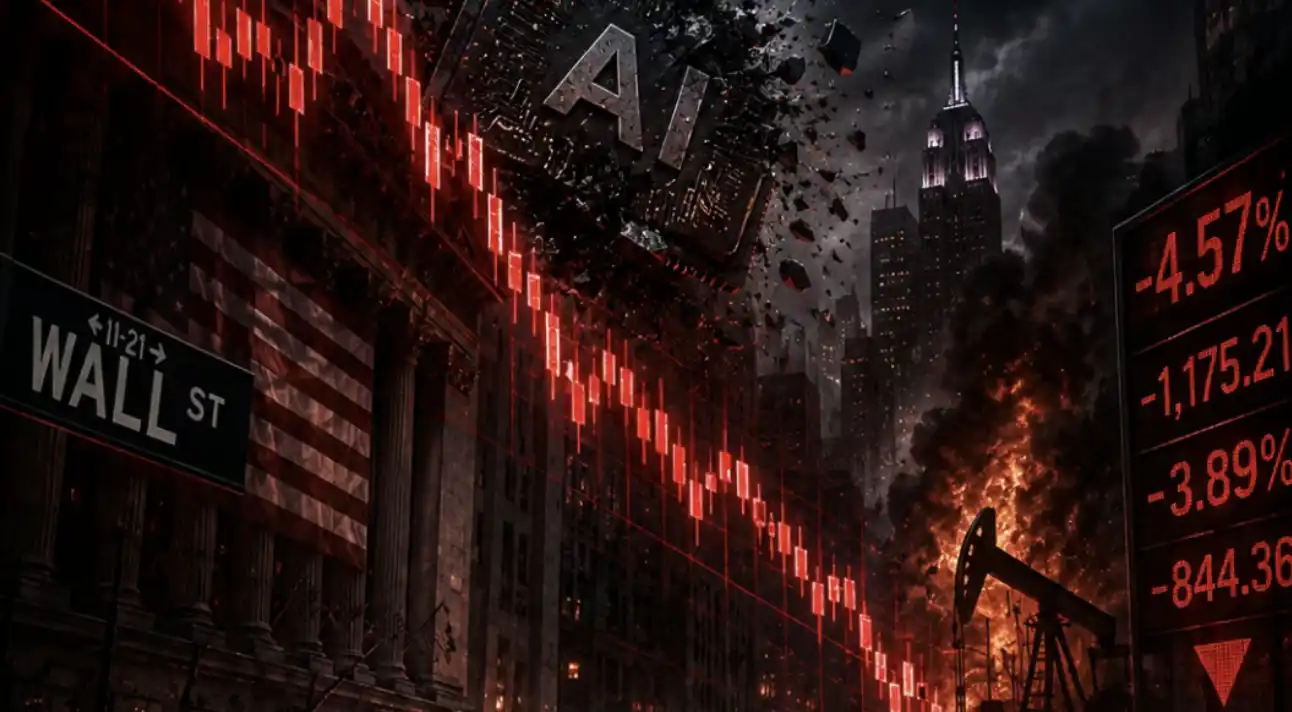
The Nasdaq Composite plummeted 4.18% on June 5, its biggest single-day drop since April 2025, triggering widespread debate over whether the U.S. stock market has peaked. The sell-off was sparked by a stronger-than-expected U.S. non-farm payrolls report, which fueled fears of economic overheating and pushed back market expectations for Federal Reserve rate cuts, leading to a sharp rise in Treasury yields. The AI sector, the primary driver of the recent bull market, suffered severe losses, with the Philadelphia Semiconductor Index crashing over 10%. Stocks like Nvidia, Broadcom, and Micron led the decline. Concerns are mounting about the sustainability of AI capital expenditures and high valuations, with signs of order cuts for next-generation chips emerging. Analyses point to several warning signs: historically high market valuations (e.g., elevated Shiller CAPE ratio, Buffett Indicator), extreme bullish sentiment indicators, and significant insider selling. The sell-off also caused a key technical breakdown, with the S&P 500 breaking below its short-term moving average and testing its 200-day moving average. Wall Street is divided on the outlook. Bears warn this could be the start of a bubble deflation or a "stagflation" scenario, while bulls view it as a healthy, overdue correction within a bull market driven by solid corporate earnings growth. A more moderate view suggests the easy liquidity-driven rally is over, and markets are entering a phase of fundamental stock-picking with potential for consolidation. The immediate future hinges on key upcoming events: the May CPI report and the mid-June FOMC meeting. Their outcomes will be critical in determining whether this is a temporary pullback or the beginning of a more significant trend reversal. The consensus is that the era of one-directional market gains may be ending, requiring increased investor caution.

Odaily星球日报06/08 10:36

Nasdaq Plunges 4.2% in a Single Day, Did 'Black Friday' Pop the U.S. Stock Bubble?

Odaily星球日报06/08 10:36

活动图片