# Сопутствующие статьи по теме Economy

Новостной центр HTX предлагает последние статьи и углубленный анализ по "Economy", охватывающие рыночные тренды, новости проектов, развитие технологий и политику регулирования в криптоиндустрии.
AI Agent Economic Infrastructure Research Report (Part 2)

This report analyzes the AI Agent economy, focusing on OpenClaw—a local AI agent that operates autonomously across 20+ platforms like WhatsApp and Slack. It examines OpenClaw's technical architecture, including its message channels, security gateway, ReAct-based reasoning loop, and memory system, highlighting issues like context loss, security risks, and non-deterministic behavior. The study identifies key structural problems in the Agent economy, such as context immobility (locked to local machines) and the "coordination paradox" where multi-agent collaboration lacks trust and verifiability. It argues that crypto infrastructure (e.g., ERC-8004 for identity, x402 for payments) becomes essential only when agents operate across untrusted, cross-platform environments without pre-established trust—enabling micro-payments, decentralized reputation, and auditable logs. While traditional payment giants (e.g., Stripe, Visa) may dominate early adoption, crypto solutions could prevail in the long term due to their superiority in handling high-frequency, cross-border microtransactions and programmable permissions. The report concludes that infrastructure providers (e.g., those offering computation, routing, security) may capture more value than individual agents, and that "Product-Agent Fit" will replace traditional business models, shifting focus to API reliability, data structuring, and chain-verifiable service quality.

marsbit03/24 08:08

AI Agent Economic Infrastructure Research Report (Part 2)

marsbit03/24 08:08

From OpenClaw to the History of the Web: When AI Gains Sovereignty, What Remains for Humanity?

From Web1 to Web4: A History of Power and Ownership in the Digital Age This article examines the evolution of the web not as a series of technical upgrades, but as a fundamental shift in power—specifically, who owns data, controls wealth, and wields productive force. **Web1 (Read-Only):** Characterized by one-way communication. Platforms like Yahoo owned all content and users were merely passive consumers, or "traffic," with no digital assets. **Web2 (Read-Write):** Users became content creators, but platforms like Facebook and TikTok established a "panoptic dictatorship." They harvested user data to create immense value, but users retained only usage rights, not ownership, of their digital assets and social presence. **Web3 (Read-Write-Own):** A movement to reclaim digital rights through cryptography and decentralization. It enables true digital ownership (e.g., via private keys) and trustless systems (e.g., DAOs, smart contracts). However, it remains a wild frontier with significant legal and security challenges, lacking a capable "workforce" to realize its full potential. **Web4 (Agent Economy):** The convergence of AI Agents and Crypto. AI Agents (autonomous, task-completing AIs) use Crypto as their native currency for machine-to-machine transactions. This shifts power from humans to algorithms, creating independent AI economic actors. This raises critical legal questions, such as liability for AI errors. The future could lead to two extremes: a utopia of liberated human creativity or a dystopia of extreme inequality if AI power is monopolized by a few. **Survival Guide for Web4:** * **Work:** Become a director and risk-manager for AI, not an executor. * **Invest:** Focus on projects with genuine utility, not hype-driven "air tokens." * **Risk Management:** Prioritize robust legal and compliance frameworks for AI operations. The conclusion emphasizes that understanding the transfer of power and assets is key to navigating the future, urging innovation within the boundaries of regulation.

marsbit03/23 13:32

From OpenClaw to the History of the Web: When AI Gains Sovereignty, What Remains for Humanity?

marsbit03/23 13:32

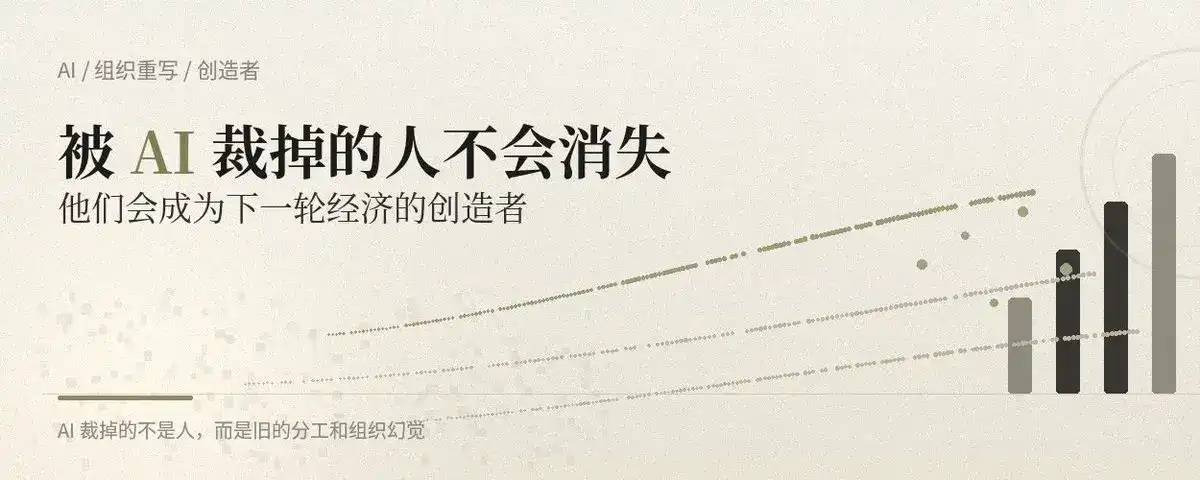
People Laid Off by AI Won't Disappear; They Will Become the Creators of the Next Economy

The article argues that the real question surrounding AI is not whether it will cause unemployment, but what happens to the people displaced. AI is replacing not humans, but the standardized, replicable, and automatable parts of human work. This follows historical patterns where technological revolutions, from stone tools to computers, made old skills obsolete and dissolved old structures—but humanity adapted and reorganized. The author draws a parallel to China’s large-scale layoffs during state-owned enterprise reforms 30 years ago, which initially seemed catastrophic but eventually fueled the growth of a new private economy, new companies, and new types of jobs. Engineers, though among the first impacted, are also positioned to recover fastest. Their systemic understanding and proximity to new productive forces make them ideal candidates to adapt and create in the new economy. More importantly, AI is reshaping companies themselves—reducing organizational bloat, communication costs, and bureaucracy. This enables smaller, more agile teams and empowers strong creators who may have previously struggled with management rather than innovation. The core issue is not job loss, but self-definition: will individuals wait to be reassigned by the old system, or use new tools to reorganize production? AI accelerates differentiation—eliminating some jobs, shattering illusions for some, and offering others a chance to leap forward. The author’s view is that AI is dismantling an entire generation’s belief in stable career paths. Those laid off won’t vanish; instead, many will reinvent themselves—transitioning from employees in old systems to creators of the next economy. Every productivity revolution淘汰 (eliminates) not people, but those who refuse to rewrite themselves. The first to accept this and start building the new world will succeed.

marsbit03/23 10:31

People Laid Off by AI Won't Disappear; They Will Become the Creators of the Next Economy

marsbit03/23 10:31

If Hong Kong's First Batch of Stablecoin Licenses Are Really Only Issued to Banks, We Might Miss the Next Decade

Recent reports indicate that the Hong Kong Monetary Authority (HKMA) is poised to issue its first batch of stablecoin licenses, with speculation suggesting that initial approvals may be limited to traditional note-issuing banks or large financial institutions. This approach, driven by extreme risk aversion and financial stability concerns, has raised alarms within the industry. The author argues that disruptive financial innovations—such as PayPal, Alipay, and cryptocurrencies—historically emerge from agile tech startups and entrepreneurs, not risk-averse traditional banks. Stablecoins, as borderless, programmable, and decentralized monetary instruments, represent a fundamental shift that challenges existing banking models. Entrusting this innovation to institutions with inherent incentives to protect legacy systems may hinder progress. Globally, tech-driven companies like Stripe (which acquired stablecoin platform Bridge) and Circle (issuer of USDC) are leading stablecoin adoption and integration with AI and Web3 ecosystems. The U.S. is leveraging such innovations to advance its fintech competitiveness, while Hong Kong’s conservative licensing strategy could leave local Web3 firms at a disadvantage. Critically, the rise of AI agents will require seamless, high-frequency, micro-transactions across borders—a use case incompatible with traditional banking systems due to high fees, slow settlement, and rigid KYC/AML frameworks. Stablecoins, integrated with smart contracts, are essential for enabling machine-driven economies. The author urges Hong Kong regulators to balance caution with innovation by including technically adept, non-bank entities in the licensing framework. Failure to do so may cause Hong Kong to miss a pivotal decade in the digital economy, undermining its ambition to become a global digital asset hub.

marsbit03/19 14:13

If Hong Kong's First Batch of Stablecoin Licenses Are Really Only Issued to Banks, We Might Miss the Next Decade

marsbit03/19 14:13

活动图片