Algorand Foundation cuts 25% of workforce, citing macro and market pressures

ambcryptoОпубликовано 2026-03-20Обновлено 2026-03-20

Введение

The Algorand Foundation has laid off 25% of its workforce, citing macroeconomic environment and a broader crypto market downturn as reasons. The foundation stated this restructuring allows it to sustainably align resources with its long-term goals. This follows similar cuts at other crypto entities like the Hedera Foundation, Blockworks, and Crypto.com, the latter also pointing to AI disruption. Community reaction was mixed, with some criticizing the foundation's leadership and spending. A transparency report noted the AF spent $12 million after selling millions of ALGO tokens, while a critic pointed to a lack of liquidity, users, and funding. Data confirms a significant decline in the chain's activity; its DeFi Total Value Locked (TVL) has halved since last year to under $40 million, and daily fees remain below $50. Consequently, the price of ALGO dropped roughly 10% amid a wider market pullback.

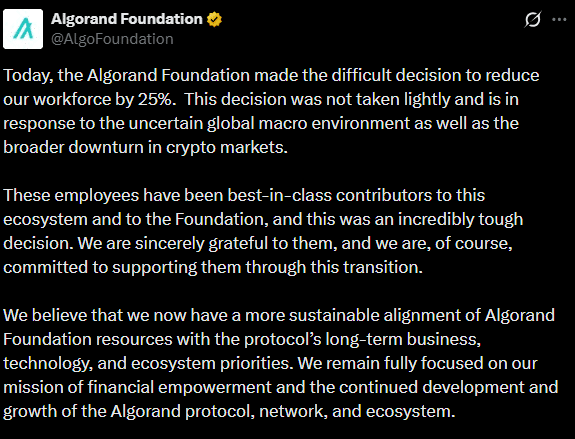
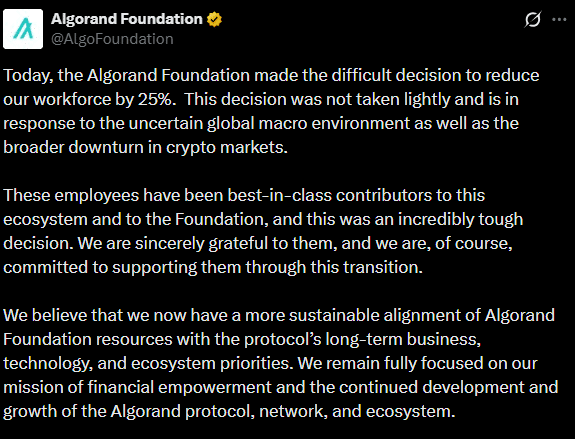
The Algorand Foundation (AF), the steward of the Algorand chain, is in the news after it announced it has axed 25% of its workforce.

According to the AF, the restructuring was informed by the ongoing “global macro environment” and “broader downturn in crypto markets.”

Source: X

Following the layoffs, AF now believes it is lean enough to “sustainably align” the remaining resources with the protocol’s long-term goals.

However, the ongoing crypto rout is not affecting Algorand alone. In January, the Hedera Foundation declared some of its core functions redundant and let go of employees who handled them.

Beyond protocols, crypto media has also been hit, with Blockworks axing its entire newsroom last year.

Besides, pressure is also coming from AI adoption, which, like other global segments, is disrupting the crypto market labour sector. This week, crypto exchange Crypto.com let go 12% of its workforce, citing the need to position itself to rising AI capabilities.

That said, the AF layoffs were met with mixed reactions.

Community and ALGO reaction

As expected, a section of the community sympathized with those affected by the AF layoffs and the disrupted livelihoods.

However, one user pointed out that the AF spent $100 million last year and yet, saw no meaningful impact.

He added,

Using macro uncertainty as cover for doing this feels piss weak. Love the tech. Hate the leadership. Same issues as always. No liquidity. No users. No funding. No mindshare.

According to the AF transparency report, it spent about $12 million as of September 2025 after selling 66.4 million ALGO tokens. Its overall expenditure has been around $18 million per year, covering even staff, which includes 65 employees.

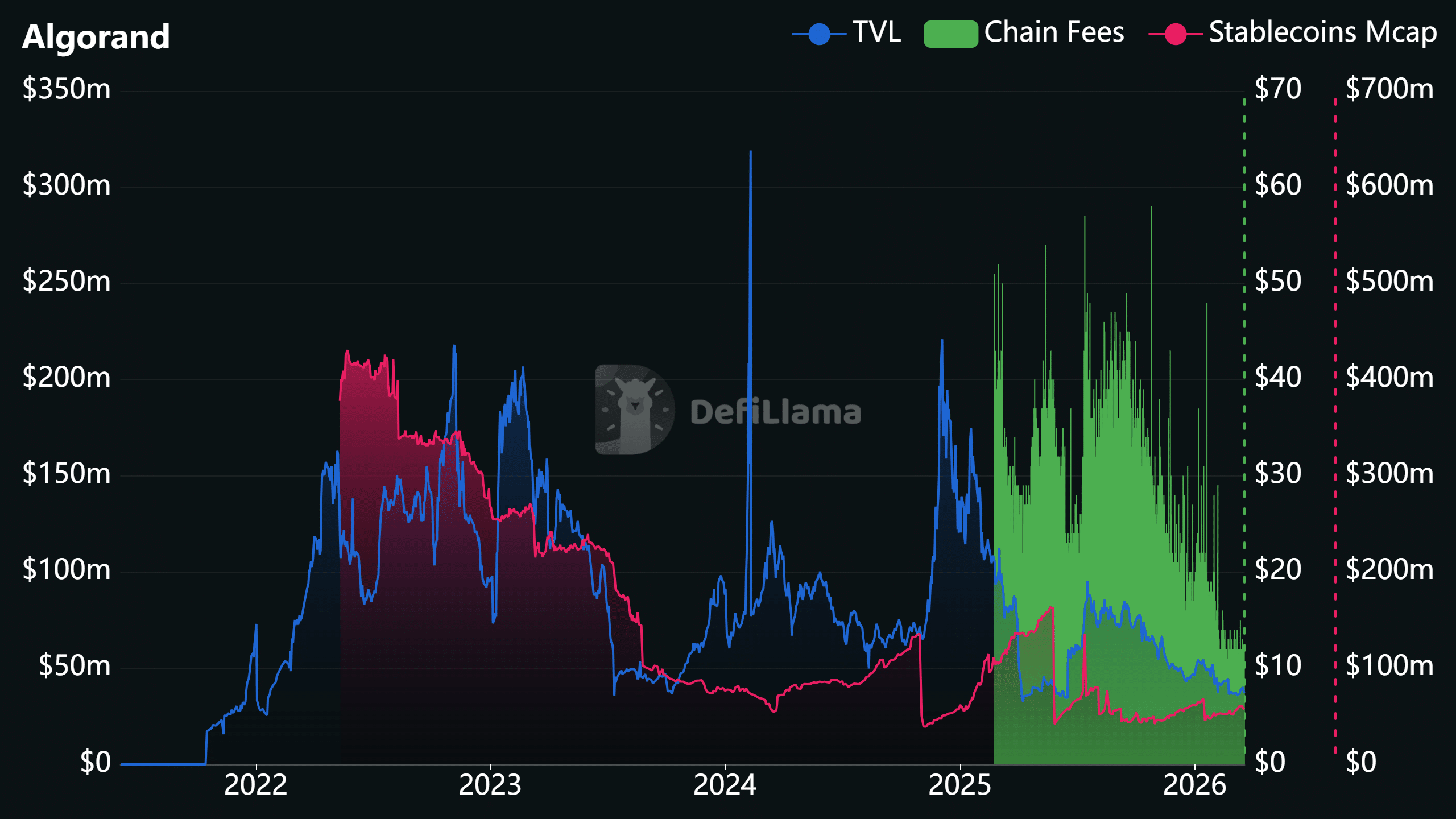
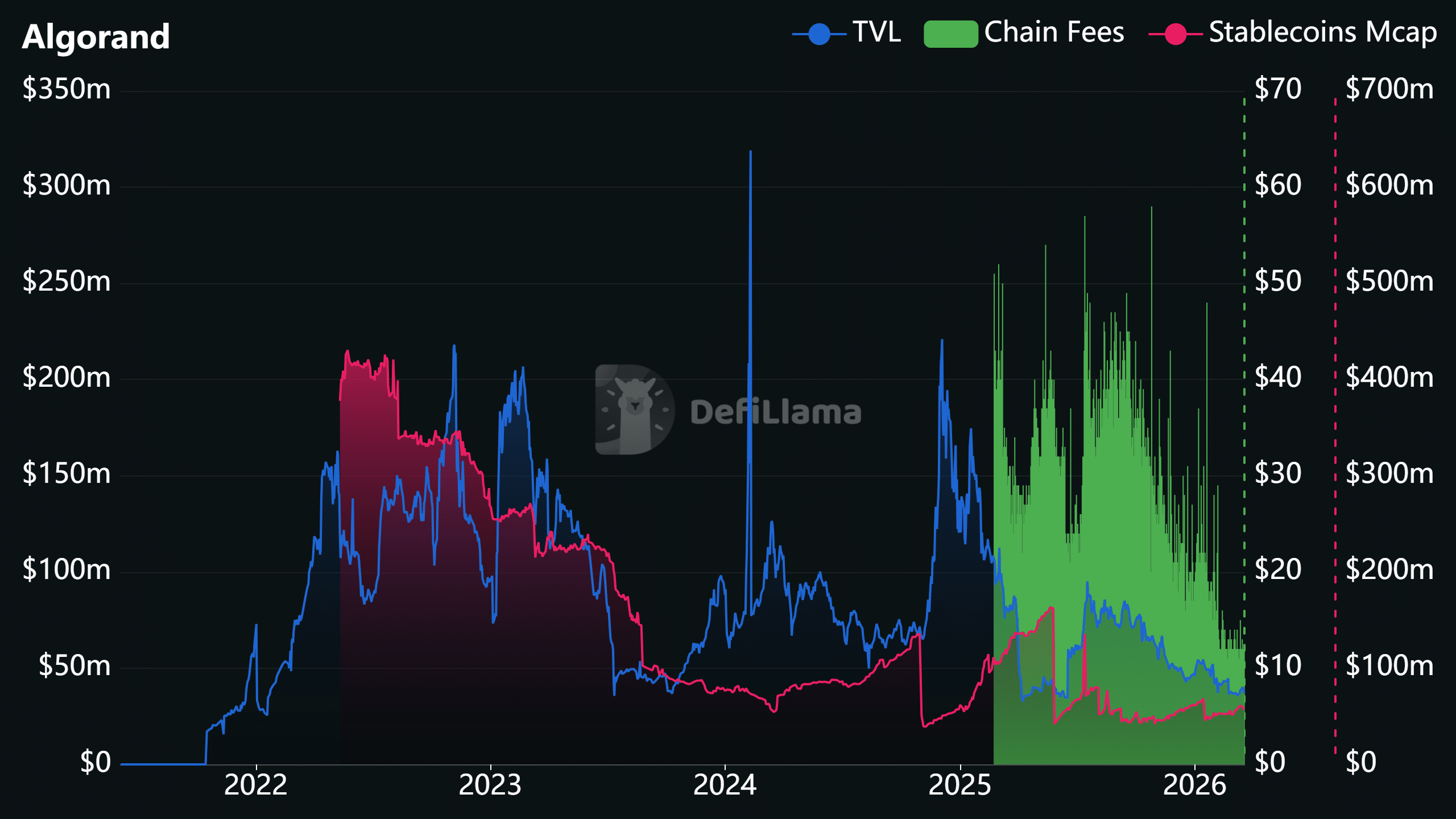
However, the critic was right about lagging chain activity. Its stablecoin liquidity has been declining alongside DeFi activity, as shown by the TVL (total value locked) drop.

Source: DeFiLlama

Since last year, DeFi activity has dropped by half, slipping from $80 million to below $40 million. In fact, the chain’s fees have been hovering below $50 throughout last year.

Meanwhile, ALGO was down about 10% and traded at $0.088 at the time of writing, amid a broader pullback following de-risking linked to traders’ caution after the Fed rate decision.


Final Summary

  • Algorand Foundation axed 25% of its workforce, as bear market, geopolitical tensions, and AI disrupted the labor sector in the space.
  • Algorand chain activity has slowed down with DeFi activity by half, generating less than $50 in daily average fees.

Связанные с этим вопросы

QWhy did the Algorand Foundation lay off 25% of its workforce?

AThe Algorand Foundation cited the ongoing 'global macro environment' and 'broader downturn in crypto markets' as reasons for the layoffs.

QHow has the Algorand chain's DeFi activity changed in the past year?

ADeFi activity on the Algorand chain has dropped by half, falling from $80 million to below $40 million in total value locked (TVL).

QWhat was the community's reaction to the Algorand Foundation's decision?

AThe community had mixed reactions. Some sympathized with the affected employees, while others criticized the leadership for poor performance, citing a lack of liquidity, users, funding, and mindshare despite significant spending.

QHow much did the Algorand Foundation spend according to its transparency report as of September 2025?

AAccording to its transparency report, the Algorand Foundation spent about $12 million as of September 2025 after selling 66.4 million ALGO tokens, with an overall annual expenditure of around $18 million.

QWhat other companies in the crypto space have recently announced layoffs?

AOther companies that have recently announced layoffs include the Hedera Foundation, which declared some core functions redundant, crypto media outlet Blockworks, which axed its entire newsroom last year, and Crypto.com, which let go of 12% of its workforce citing the need to adapt to rising AI capabilities.

Похожее

Agents Take Over Traffic Distribution Power: What Are Tencent, ByteDance, and Alibaba Competing For?

In the race to dominate the AI era's entry point, China's tech giants—Tencent, ByteDance, and Alibaba—are aggressively deploying AI Agents to control the future of traffic distribution. Alibaba is pursuing a dual-track "closed loop + openness" strategy. Its Qianwen app is evolving into a super-Agent integrated across its ecosystem (Taobao, Alipay, etc.) to handle complex tasks like travel planning. Concurrently, it is opening its platform to external brands (Luckin Coffee, KFC) and has launched a B2B Agent platform, "Wukong," targeting enterprise automation. Its other flagship, Quark, aims to be an "AI super search box" for information and tasks. ByteDance is executing an omnipresent "sprawl strategy." Its Doubao app boasts over 300 million monthly active users and is evolving into a default AI entry point for daily life, with plans for paid versions and e-commerce integration. Its core weapon is the Kouzi platform, a visual "AI assembly factory" for developers to build custom Agents. ByteDance is also pushing hardware integration, collaborating on AI phones and developing smart glasses to embed Doubao everywhere. Tencent is playing its long-held "ultimate card" by quietly embedding an AI Agent directly into WeChat. This Agent, accessible via a swipe, can understand user commands and automatically execute tasks by calling upon WeChat's millions of mini-programs (e.g., finding and ordering coffee). This leverages WeChat's unparalleled 1.4-billion-user ecosystem to position the app as an AI-powered "service operating system," a move that could dramatically reshape the competitive landscape. The core battleground is shifting from competing for "user screen time" to competing to be the "default execution layer" for user intent. The business model is evolving from an "attention economy" to an "intent economy," where the Agent that can most efficiently fulfill a user's need gains control over service access and token flow. This represents a fundamental change in how users connect with digital services, making the fight for the Agent入口 (entry point) a pivotal moment for redefining industry leadership in the AI age.

marsbit1 ч. назад

Agents Take Over Traffic Distribution Power: What Are Tencent, ByteDance, and Alibaba Competing For?

marsbit1 ч. назад

From Banning Doubao to Embracing Honor: Why Did WeChat Suddenly 'Change Its Face'?

The article explores the sudden shift in WeChat's strategy towards AI assistants from mobile phone manufacturers, transitioning from strict opposition to active collaboration. For over a year, WeChat fiercely resisted attempts by phone AI assistants (like ByteDance's Doubao in late 2025) to control its features via GUI automation ("simulated clicking"), citing security and data control concerns. This stance created a significant barrier for system-level AI integration. Now, Tencent has initiated A2A (Agent-to-Agent) partnerships with major phone brands like Honor, Xiaomi, OPPO, and vivo. This model allows a phone's system AI (e.g., Honor's YOYO) to parse a user's voice command and send a structured request directly to WeChat's own internal AI agent via secure APIs. WeChat then executes the action (e.g., sending a message) and returns the result. The article attributes Tencent's "change of face" to strategic pressure. While leading in social app usage, Tencent trails rivals like ByteDance and Alibaba in standalone AI app popularity. WeChat, with its vast mini-program ecosystem, is Tencent's key asset for an AI comeback. The upcoming WeChat AI agent aims to handle tasks like booking and payments within the app. However, phone system assistants remain the primary AI entry point for most users. The A2A collaboration allows Tencent to extend WeChat's AI reach to this crucial system layer while maintaining control over its core functions and data. For phone manufacturers, embracing A2A is a pragmatic move. The GUI route proved unviable due to WeChat's blocks. A2A offers a compliant path to integrate a vital service, enhancing their AI assistants' usefulness. It allows them to focus on developing their own AI ecosystems for other services while cooperating on WeChat access. The collaboration is framed as a mutual, strategic necessity: Tencent gains a distribution channel, and manufacturers gain a key functionality. The partnership relies on a "dual authorization" mechanism for security, requiring both user and app consent for each action. While questions about long-term data privacy practices remain, experts note A2A is more secure and compliant than GUI automation. Ultimately, this cooperation is seen as a tentative, calculated truce. Tencent's long-term goal is to make WeChat an AI-powered "service OS." Phone manufacturers aim to make their system AI the central user interface. Their paths may converge or clash in the future, but for now, the A2A deal represents the opening chapter in the battle for the AI-era user入口, driven by necessity and strategic calculus on both sides.

marsbit2 ч. назад

From Banning Doubao to Embracing Honor: Why Did WeChat Suddenly 'Change Its Face'?

marsbit2 ч. назад

Торговля

Спот
Фьючерсы
活动图片