# AI Related Articles

HTX News Center provides the latest articles and in-depth analysis on "AI", covering market trends, project updates, tech developments, and regulatory policies in the crypto industry.

From Cold War Nuclear Wasteland to an 8-Gigawatt AI Superfactory: Huang Renxun Bets $1.5B, OpenAI Secures Exclusive 20-Year Deal

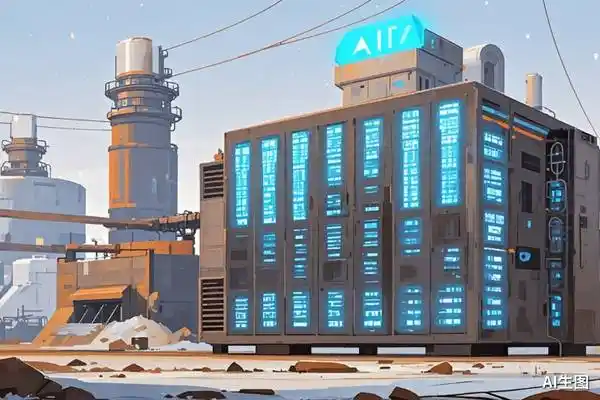
A Cold War-era uranium enrichment site in Ohio, once used for atomic bomb production, is being transformed into the world's largest AI supercomputing facility. NVIDIA, OpenAI, and SoftBank are leading this project, which plans an ultimate power capacity of 8 gigawatts—nearly two-thirds of the total power used by 82 of the world's top AI data centers today. NVIDIA's CEO Jensen Huang has committed $1.5 billion in funding and a 20-year credit guarantee for the infrastructure. OpenAI has signed a 20-year lease to fully utilize the facility's computing power. SoftBank is investing heavily in land acquisition, construction, and grid upgrades, promising to add 1 gigawatt of new power generation. Huang argues that the next major bottleneck for AI advancement is no longer chip supply, but the availability of land, power, and data center space—resources that new AI companies often lack the long-term credibility to secure. By leveraging NVIDIA's market position and credit to lock down these critical physical resources for decades, the company ensures a steady, long-term demand for its GPUs within the facility. The infrastructure, with a 20-year lifespan, will host new generations of NVIDIA hardware every few years, creating recurring revenue streams. Analysts estimate this project alone could represent a $600 billion revenue opportunity for NVIDIA from OpenAI by 2030. This move signifies a strategic shift in the AI race: competition is expanding from semiconductor technology to securing the foundational elements of power and real estate on a massive scale.

marsbit2 days ago 11:21

From Cold War Nuclear Wasteland to an 8-Gigawatt AI Superfactory: Huang Renxun Bets $1.5B, OpenAI Secures Exclusive 20-Year Deal

marsbit2 days ago 11:21

Century-Old Chain Director Regulations Revived, a16z Faces Antitrust Investigation

The US Department of Justice has launched an antitrust investigation into venture capital firm Andreessen Horowitz (a16z), according to people familiar with the matter. The probe centers on whether a16z partners improperly hold board seats at competing artificial intelligence companies, specifically Databricks Inc. and Fivetran Inc., which both provide data collection and analytics services. a16z co-founder Ben Horowitz sits on Databricks' board, while partner Martin Casado is on Fivetran's board. The previously unreported investigation, ongoing for nearly a year, began around the time regulators reviewed and ultimately approved Fivetran's acquisition of a rival, dbt labs, last October. The inquiry revives a Biden-era enforcement focus on "interlocking directorates" under a 1914 law, where individuals or entities serve on the boards of direct competitors. While typical resolutions involve directors resigning from one board, this case is notable because the concern involves multiple partners from the same firm serving on competing boards. The scrutiny is heightened by a16z's significant political connections and influence, including donations to groups supporting both Trump and Harris, and its advocacy for relaxed AI regulations. A16z, managing $90 billion in assets, is a major investor in AI startups. The DOJ has not decided on any action, and the investigation may conclude without charges.

marsbit2 days ago 11:01

Century-Old Chain Director Regulations Revived, a16z Faces Antitrust Investigation

marsbit2 days ago 11:01

What Is the Cost of Bitcoin Mining Companies Going All-In on AI?

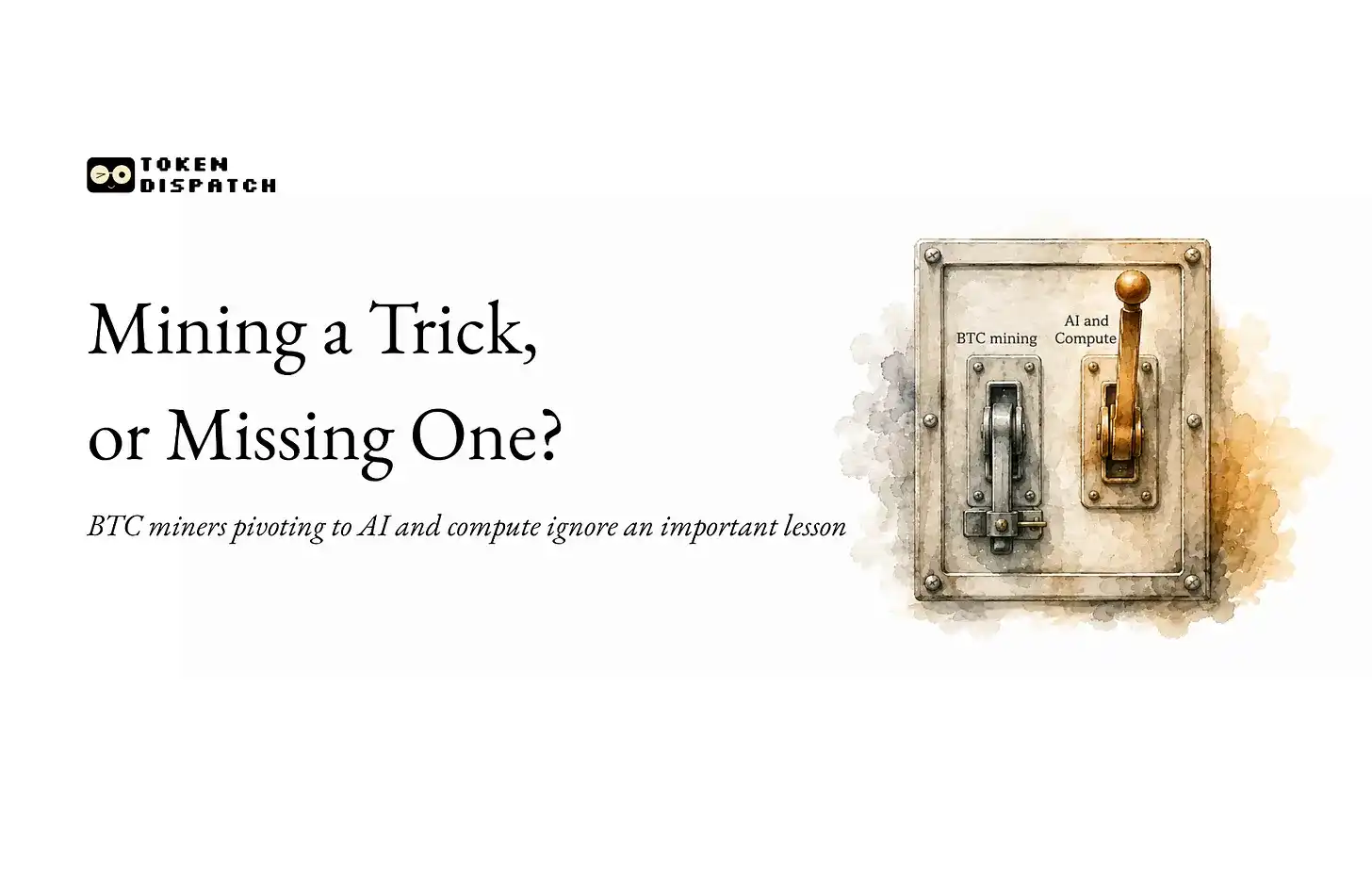
Bitcoin mining companies are undergoing a massive transformation, pivoting from cryptocurrency mining to AI infrastructure and high-performance computing (HPC) services. This shift is driven by the severe profitability crisis in Bitcoin mining following the 2024 halving and the October 2025 market crash, which pushed mining costs as high as $140,000 while Bitcoin's price fell to around $63,000. In response, major public miners like Core Scientific and TeraWulf are rebranding as "energy infrastructure platforms" or "AI cloud service providers." Their revenue structures have flipped, with AI/HPC hosting now constituting over 70-80% of quarterly revenue, dramatically surpassing declining Bitcoin mining income. They are securing massive, long-term contracts worth tens of billions of dollars with tech giants like AMD, CoreWeave, and Anthropic, locking in future cash flow. However, this all-in bet on AI carries significant risks. The AI compute market lacks Bitcoin's self-correcting mechanism, where unprofitable miners exit, reducing network difficulty and boosting profitability for those who remain. An AI compute supply glut could rapidly drive prices down, making today's lucrative long-term contracts burdensome. Furthermore, the transition is largely one-way; retrofitting facilities for AI and signing decade-plus contracts makes it nearly impossible to return to mining when its profitability eventually rebounds. Some companies, like Marathon Digital and Hut 8, are taking a more hedged approach. They are funding AI expansion through debt secured by Bitcoin holdings or by spinning off mining into separate subsidiaries, rather than completely divesting. This strategy maintains the optionality to shift power load back to Bitcoin mining if it becomes profitable again, positioning them as flexible power operators rather than being captive to a single, unproven market cycle. The article concludes that while the pivot to AI is a necessary survival move for many, abandoning Bitcoin mining entirely for long-term AI contracts is a risky gamble that could backfire.

marsbit2 days ago 10:57

What Is the Cost of Bitcoin Mining Companies Going All-In on AI?

marsbit2 days ago 10:57

"We have long ceased to be a crypto company": Tether CEO made a statement after KPMG audit

Stablecoin giant Tether has engaged Big Four auditor KPMG to verify its reserves, including a physical count of roughly 150 tons of gold in a Swiss vault. The audit confirmed the gold is present and that Tether's total reserves exceed its liabilities by $6.8 billion. CEO Paolo Ardoino described the process as "a physically heavy exercise" in an interview with Fortune. The audit aimed to address a long-standing conspiracy theory in the crypto world that USDT is not properly backed and could face a mass default. In a significant statement, Ardoino declared, "We haven't considered ourselves a crypto company for a long time. I think we are a digital dollar and digital gold company." He noted Tether has over 650 million users globally, with a strong focus in Africa and South America, where demand for stable digital assets is high due to recurring currency devaluations. Beyond financial services, Tether has been investing in decentralized communications, agriculture, and solar-powered kiosk networks for low-cost autonomous electricity. The company's next strategic move is to provide basic AI services to its user base in developing countries. Ardoino emphasized that even in the poorest nations, most people have a mobile phone capable of running simple AI models. The goal is to offer affordable, fundamental tools in sectors like healthcare, finance, and sports for a few dollars per month, payable via Tether or other digital payments. Ardoino expressed concern about societal inequality transforming from a wealth gap into a deeper "intellectual gap."

cryptonews.ru2 days ago 09:58

"We have long ceased to be a crypto company": Tether CEO made a statement after KPMG audit

cryptonews.ru2 days ago 09:58

Morgan Stanley Report Analysis: PE Giants Eye Workday, Software Stocks' Valuations Already Cheap Enough to Tempt Buyers

In a report titled "MStanley Software QuickTake: A Signal to Watch" dated August 16, analysts at Morgan Stanley discuss potential shifts in the software sector, highlighted by rumors of Silver Lake's interest in acquiring Workday. A deal of this scale, valuing Workday at approximately $50 billion, could signal a turning point for private equity (PE) interest. The analysts note that even with a 30-40% premium, the acquisition multiple (around 5x 2027 P/S and 16x 2027 FCF) would be below historical averages, suggesting software valuations may have become attractive enough for PE to re-engage. The report explores two key areas. First, the dynamic of open-source large language models is creating price stratification, putting pressure on token prices but not necessarily destroying the return on invested capital for major cloud providers, which could remain between 20-60%. Second, a survey of over 150 investors shows a divided but cautiously optimistic short-term view on software stocks, with expectations for greater price dispersion within the sector. The analysis also touches on specific companies: Netcompany, despite strong revenue growth, faces free cash flow challenges, while the potential acquisition of Cursor by SpaceX is seen as strategically valuable due to its position in the AI-assisted development workflow layer. Overall, the combination of potential PE activity, AI pricing dynamics, and a gradual recovery in investor sentiment points to software sector valuations potentially reaching an inflection point.

marsbit2 days ago 08:41

Morgan Stanley Report Analysis: PE Giants Eye Workday, Software Stocks' Valuations Already Cheap Enough to Tempt Buyers

marsbit2 days ago 08:41

SMIC's Net Profit Soars 2.6 Times: Thriving Under Technological Blockade

SMIC (Semiconductor Manufacturing International Corporation), China's leading foundry, reported a dramatic surge in profits despite longstanding technological restrictions. In Q2 2026, its revenue surpassed $3 billion, a 36.1% year-on-year increase, while net profit attributable to shareholders skyrocketed 261.7% to $479 million. This strong performance was driven by a 14% quarterly rise in wafer shipments, a 5.7% increase in average selling price, and capacity utilization climbing to 93.7%. Contrary to expectations, SMIC is benefiting significantly from the global AI boom, not in cutting-edge logic chips but in mature-node semiconductors. The explosion in AI server demand has drastically increased the need for peripheral chips like power management and interface controllers, which are primarily manufactured using mature processes (e.g., 55nm-90nm) where SMIC has a strong foothold. Furthermore, as global giants like TSMC and Samsung concentrate resources on advanced nodes, capacity for mature technologies has tightened overseas, redirecting a wave of orders—particularly in automotive, industrial, and consumer electronics—to SMIC. While government subsidies provided an initial demand boost, their impact on the smartphone segment is waning. SMIC's revenue structure is diversifying, with smartphones now accounting for only 16.9% of wafer revenue, down from 25.2% a year prior. The improved market dynamics have enabled SMIC to begin negotiating price increases with customers for in-demand products. With robust operating cash flow of $2.52 billion and over $8.2 billion in cash reserves, the company is accelerating capital expenditure to expand capacity. This positions SMIC to potentially enter a virtuous cycle: strong demand drives higher utilization and pricing, generating cash to fund further expansion and capture more orders. The report concludes that while SMIC may not produce the most advanced AI chips, it is profitably building the essential foundation supporting the AI ecosystem.

marsbit2 days ago 08:35

SMIC's Net Profit Soars 2.6 Times: Thriving Under Technological Blockade

marsbit2 days ago 08:35

活动图片