Written by: Prathik Desai
Compiled by: Luffy, Foresight News
Over the past year, every major publicly-traded Bitcoin miner has faced a survival crisis. A look at their financial reports reveals they are shedding their identity as "miners."
Now they are repackaging and repositioning themselves, calling themselves "energy infrastructure platforms," "vertically integrated AI cloud service providers," or "digital infrastructure enterprises built on electricity, land, and computing power."
Behind this rebranding lies a transformation in their revenue structure, with their market capitalization now exceeding valuations from when they were purely Bitcoin mining companies.
On the surface, the story seems wonderful. Struggling miners have seized the opportunity, embraced the explosive demand for AI inference computing power, and found a path to self-rescue. But if we take a broader perspective, they are also giving up some crucial things.
This article will explain why a 180-degree shift away from Bitcoin mining could backfire on miners in the future.
What Sparked This Transformation?
The Bitcoin block reward halving in April 2024 forced miners to make a choice: either mine Bitcoin, hold it, and wait to sell at a higher price, or retrofit their hardware to diversify into high-performance computing (HPC). In October 2024, Bitcoin's price rose from below $70,000, peaking at $124,000 in October 2025. This rally led some miners to continue mining and hoarding their output.
However, the market liquidation event on October 10, which wiped $19 billion from the crypto market's capitalization within 24 hours, triggered a downturn that has yet to be fully recovered from.
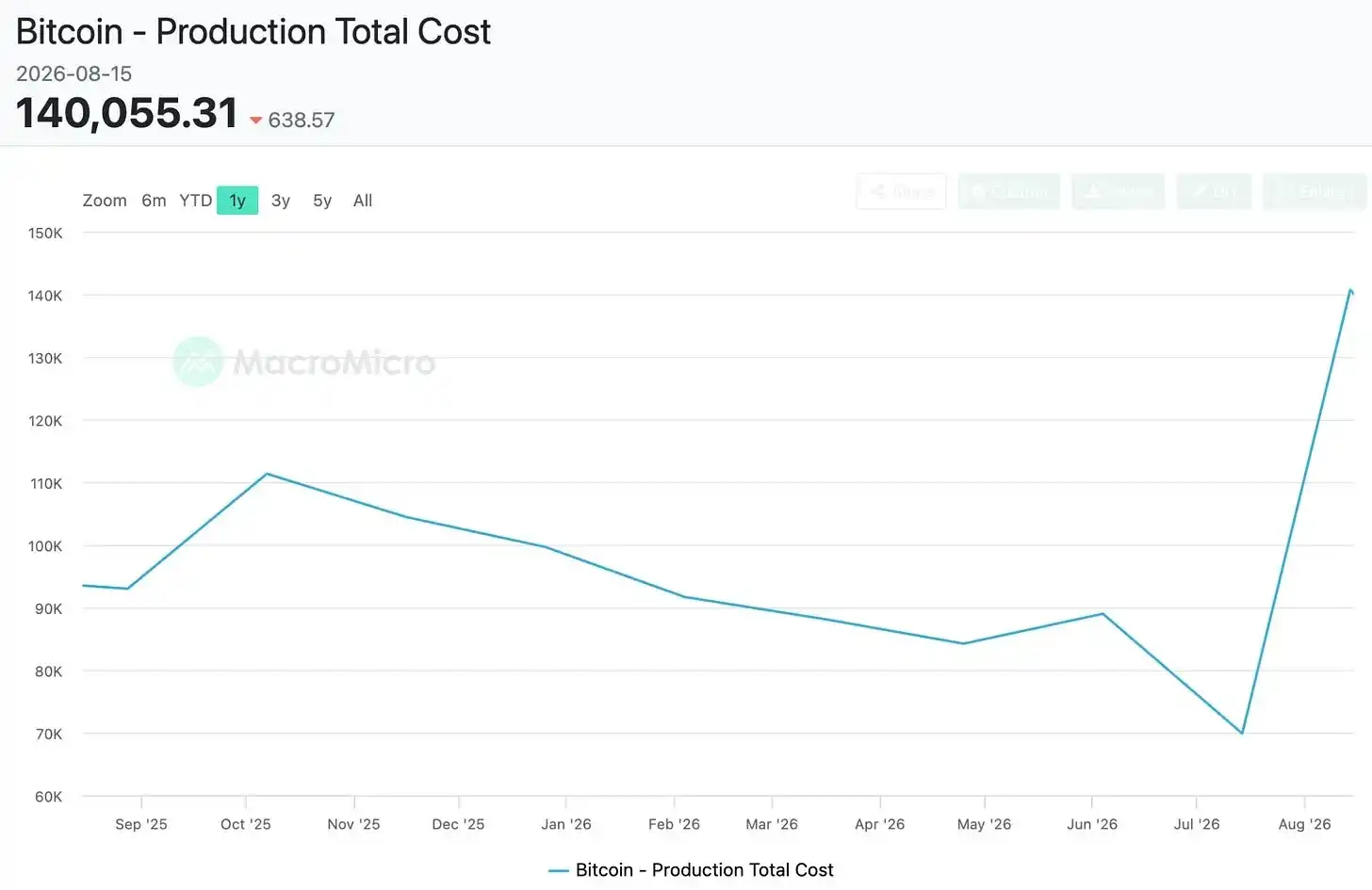
The current Bitcoin price of around $63,000 is nearly halved from last October's high. At this level, selling mined Bitcoin yields almost no profit. Bitcoin mining costs are affected by both electricity prices and network difficulty. The comprehensive mining cost rose from about $40,000 in February 2024 to a range of $90,000-$110,000 between October 2025 and July 2026. By August this year, Bitcoin's comprehensive mining cost hit a new high, soaring to $140,000.
Source: MacroMicro
During the same period of worsening mining conditions, massive capital has flooded into the AI inference sector.
Bitcoin miners use ASIC chips to run complex algorithms and obtain block rewards. This hardware infrastructure is highly similar to the underlying requirements for high-performance computing and AI inference. This makes the transition to AI inference less daunting for miners, significantly lowering the barrier to entry. For miners seeking profitable outlets, pivoting to AI seems like a natural move.
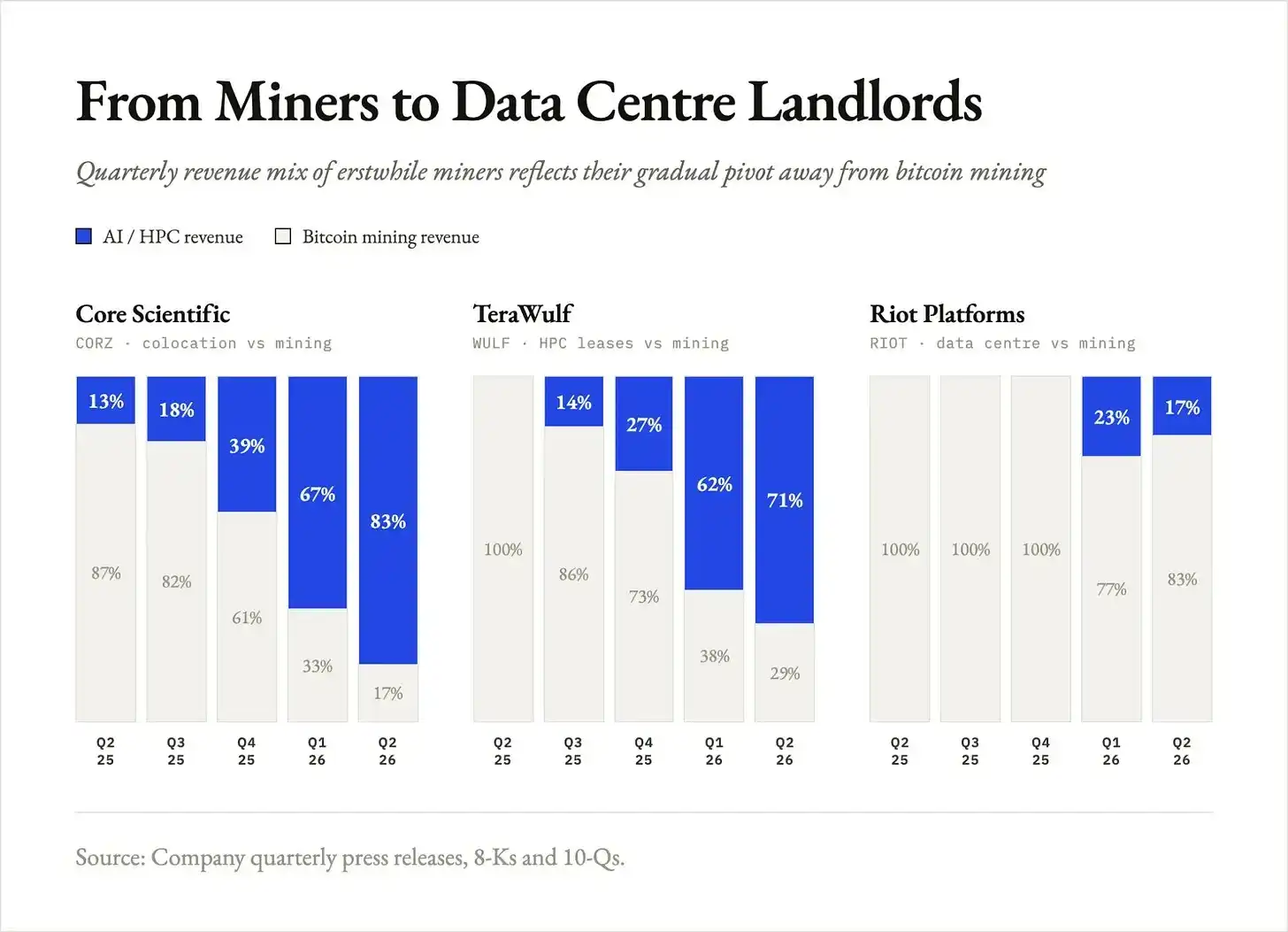
Almost the entire listed mining sector has collectively changed course. The shift in revenue structure over the past few quarters vividly illustrates the scale of this transformation.
Take Core Scientific as an example: In Q2 2025, data center hosting services for AI and HPC generated only $10.6 million in quarterly revenue; during the same period, revenue from mining and selling Bitcoin was $62.4 million. Twelve months later, their positions were almost completely reversed. In Q2 2026, hosting revenue was $136.7 million, while mining revenue shrank by 65% to $21.5 million.
The proportion of hosting revenue to total company revenue skyrocketed from 14% last year to 83%.
TeraWulf's HPC leasing revenue already accounts for 71% of its total revenue. This business line had no revenue in the same period last year but reached $32 million in Q2 2026; during the same period, crypto asset mining revenue shrank by about 75%, remaining at only $13 million.
Many miners are also retrofitting their existing mining facilities and hardware to accommodate AI and HPC businesses.
A Worrisome Land Grab
The shift from Bitcoin mining to AI computing power has turned into a collective stampede. Beyond allocating existing capacity to AI, former Bitcoin miners are frantically securing electricity, land, and signing numerous demand orders. The total value of contracts already in place amounts to tens of billions of dollars.
Core Scientific has committed up to 2.5GW of available computing capacity to AMD and CoreWeave, with potential total revenue exceeding $24 billion over the contract period. Hut 8 holds 949 megawatts of contracted computing power with a base contract value of $26.6 billion and has secured $7.5 billion in new project financing.
TeraWulf signed a 20-year lease agreement worth approximately $19 billion with Anthropic and acquired a gigawatt-scale campus in Kentucky to meet computing demand. Over the past six months, Riot Platforms completed multiple leases totaling 241 megawatts, corresponding to a contract size of about $10 billion. Just last week, IREN delivered its first batch of AI cloud deployment nodes to Microsoft—a five-year contract valued at $9.7 billion; it also secured a 5GW partnership with Nvidia and continues acquiring power sites in Texas and Spain to supply computing needs.
This series of massive contracts has ignited market enthusiasm. Compared to miners' past businesses, signing 20-year leases with leading cloud providers promises more stable cash flow. After a full year of mining losses, locking in contracts for up to fifteen years seems like solid, tangible reality.
However, much market commentary underestimates the hidden risks.
Despite the hardship of mining, Bitcoin mining possesses a characteristic that AI hosting lacks: a self-healing mechanism. When mining becomes unprofitable, miners shut down their machines; when enough miners exit, the Bitcoin network difficulty automatically adjusts downward. The remaining miners, with the same equipment and electricity costs, can achieve higher returns.
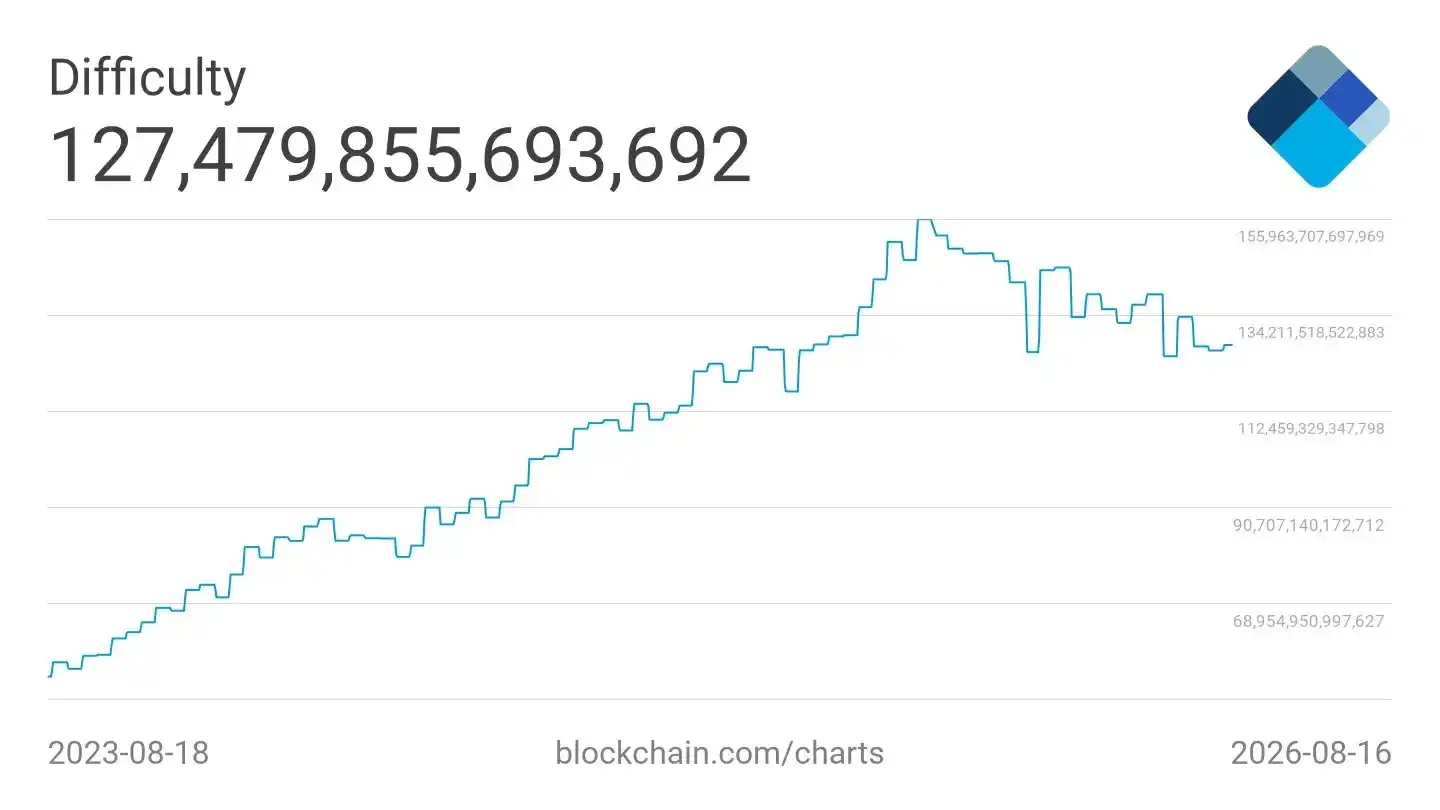
After many miners switched to the AI sector, Bitcoin's network difficulty has dropped from its peak of around 156 trillion in 2025 to 127.5 trillion. Every company exiting mining is making the mining rewards higher for those who remain.
However, the AI computing power industry lacks this automatic adjustment mechanism. If too many players flood in, causing an oversupply of computing power, prices will be driven down.
Although overall demand for AI computing is rising, prices may actually fall—seemingly contrary to basic economic principles. In fact, several AI companies have already lowered their service prices. In the early days of the industry, with hardware and supporting resources scarce, service providers could charge high premiums. Now, cloud giants worldwide are competing for megawatt-level power resources, and this scarcity has attracted a large number of Bitcoin miners and data center operators to massively expand capacity. Once new supply fills the demand gap, computing power prices will decline rapidly.
When prices fall, the 15-20 year long-term leases miners are signing at today's high prices will look prohibitively expensive in hindsight.
There is another tricky aspect to this transition: the path is largely one-way. Converting a mining facility into an AI computing campus is straightforward; the power infrastructure is already in place. But once you replace ASIC miners with H100 GPUs and sign a 20-year lease, you'll be tightly bound by this contract for the next two decades, unable to easily switch back to mining.
When market cycles reverse in the future, with Bitcoin prices breaking away from the $60,000 low and network difficulty decreasing, mining will inevitably become profitable again. By then, former miners who have completely transformed, constrained by multi-year long-term leases, can only watch the opportunity pass by. Worse still, if the actual revenue from AI computing falls short of the optimistic expectations at signing, a double blow will follow.
So, should miners not transform and just wait patiently for the mining cycle to turn? I don't think so. For most companies, transformation is a forced choice for survival. With a comprehensive mining cost of $140,000 and the coin price at only $63,000, continuing to mine is commercially unviable; AI is the only immediate lifeline.
But the will to survive drives companies to make extreme choices. The risk lies precisely with those players who go all-in on AI: forced by survival pressure, they completely abandon Bitcoin mining, destroy/replace all ASIC miners, and lock themselves into decades-long contracts in a nascent industry that will still experience price corrections.
However, not all miners have chosen a complete 180-degree turn; some companies have been more cautious.
Those With Hedging Options Hold the Advantage
Marathon Digital, the listed mining company with the largest Bitcoin treasury, has taken a cautious path. In Q2 2026, it sold 30% of its Bitcoin holdings to reduce debt, but it has not abandoned its Bitcoin mining equipment. Instead, it chose another way to fund its AI expansion.
MARA used its remaining Bitcoin as collateral to secure $150 million in funding through a 2026 credit facility to finance its AI business expansion. As of June 30, its balance sheet still holds over 35,000 Bitcoins while maintaining a flexible, load-adjustable mining operation.
Hut 8 has also not abandoned mining. It spun off its Bitcoin mining business into a new, wholly-owned subsidiary, American Bitcoin Corp, while the parent company focuses on HPC and AI infrastructure.
By keeping mining machines running and maintaining Bitcoin inventories, these companies hold an option abandoned by those who have gone all-in on the transformation. When mining becomes profitable again, they can switch their power load back to mining; companies deeply tied to long-term AI contracts can only watch from the sidelines.
Treating old mining operations as baggage and betting everything on AI computing is gambling on an unproven future. But historical patterns are easy to predict: chips, computers, smartphones—every emerging technology sees product prices fall as the industry matures. Signs of price softening have already appeared in the AI computing power industry.
Companies like Marathon and Hut 8 are not missing out on the AI boom. They haven't liquidated everything to buy GPUs. Instead, they retain some mining capacity and Bitcoin holdings, treating AI as a diversification strategy rather than betting all their capital on an immature sector that will undergo price re-evaluation. As long as the ASIC miners are still there, when mining becomes more profitable and AI computing premiums fade, they can switch the load back to mining Bitcoin.
From a broader perspective, these companies are essentially power operators; the hardware on top is either ASIC miners or H100 graphics cards. Companies that can flexibly allocate power resources between mining and AI computing based on which business yields higher returns will not be entirely at the mercy of market cycles and narratives.