# Adoption Related Articles

HTX News Center provides the latest articles and in-depth analysis on "Adoption", covering market trends, project updates, tech developments, and regulatory policies in the crypto industry.

4 Key Themes Orchestrating the 2025 Crypto Symphony

Four Keywords Outline Crypto's 2025 Journey: Trump Effect, DAT Treasuries, Stock Tokenization, and the October Crash. 2025 was a pivotal year for crypto, marked by mainstream adoption, regulatory shifts, and extreme volatility. The year unfolded in four distinct acts: **Spring: The Trump Effect.** Following his January inauguration, President Trump's pro-crypto stance fueled a market surge. The "official" TRUMP meme coin created a wealth frenzy, and BTC approached $110k. Key developments included appointing a crypto-friendly SEC chairman and initiating a Bitcoin strategic reserve using seized assets, though not without controversy. **Summer: DAT Treasury Companies & Stablecoins.** A Trump-led global tariff war triggered a "Black Monday" crash in April. The market rebounded with the rise of DAT (Digital Asset Treasury) companies, following Circle's landmark IPO. Public companies like Sharplink and Bitmine pivoted to hold massive ETH treasuries, sparking a trend that later saw many face significant paper losses as hype faded. **Autumn: Stock Tokenization & Hype Cycles.** The success of stablecoins and Circle's stock performance ignited the RWA sector. Platforms like xStocks and MyStonks pioneered tokenized stock trading, a trend even Nasdaq sought to join. Meanwhile, hype surrounded new Perp DEXs like Aster and stablecoin projects like Plasma and the Trump-affiliated WLFI, though many saw dramatic price collapses later. **Winter: The October Crash & Prediction Markets.** After a new BTC high, a Trump-announced tariff hike on October 11th triggered a historic market crash, resulting in an estimated $30-40 billion in liquidations. In the aftermath, prediction markets Polymarket and Kalshi emerged as dominant players, both achieving multi-billion dollar valuations as they became central to navigating the volatile political and financial landscape. The year demonstrated that while crypto is increasingly shaped by U.S. policy and TradFi adoption, it remains a high-stakes arena of immense opportunity and risk.

marsbit12/12 03:14

4 Key Themes Orchestrating the 2025 Crypto Symphony

marsbit12/12 03:14

Eight Years of Turbulence in Web3 Phones: From 'Geek Toy' to Xiaomi's 'Factory Standard'

Web3 Smartphones: An 8-Year Evolution from 'Geek Toy' to Xiaomi's 'Standard Feature' On December 10th, high-performance blockchain Sei announced a partnership with Xiaomi, the world's third-largest smartphone manufacturer. The Sei Foundation will develop a next-gen crypto wallet and DApp discovery platform, which will be pre-installed on Xiaomi's new smartphones for global markets (excluding mainland China and the US). Utilizing MPC technology, the collaboration aims to allow users to log in directly via Google or Xiaomi accounts, eliminating intimidating seed phrases. A pilot stablecoin payment system is also slated for 2026, enabling purchases at Xiaomi's retail stores with tokens like USDC. The journey of Web3 phones began around 2018 with devices like Sirin Labs' Finney and HTC's Exodus 1, which focused on "hardware sovereignty" and extreme security, often featuring physical safeguards or trusted execution environments (TEE). These early attempts, including niche projects like Pundi X's communication-focused BOB phone and Electroneum's low-cost "cloud mining" M1, were commercially unsuccessful due to high costs and poor user experience, remaining confined to tech enthusiasts. Mainstream manufacturers like Samsung cautiously entered the space around 2019, integrating features like the Samsung Blockchain Keystore into flagship models. A notable early example was the "KlaytnPhone" edition of the Galaxy Note 10, which included free KLAY, prefiguring the later "airdrop" model. Luxury brand Vertu and HTC also made attempts, but Web3 functions often remained hidden or mere marketing gimmicks. The market was revitalized in 2023 by the Solana Saga. Initially struggling, it sold out instantly after its included BONK token airdrop exceeded the phone's price, earning it the nickname "dividend phone." This success ushered in a new era of "ecosystem binding" and token incentives. Subsequent models like Solana Chapter 2 (Seeker) refined this model with soul-bound tokens (SBT) to prevent scalping. Competition intensified with the TON ecosystem's $99 Universal Basic Smartphone (UBS), Binance Labs' Coral Phone, and the JamboPhone—a $99 device focused on "learn-to-earn" models in emerging markets. An alternative approach emerged from China Telecom and Conflux's BSIM card, which adds Web3 capabilities to any Android phone via a secure SIM card. The evolution highlights five key shifts: 1) Advanced security is moving from simple TEE to architectures like TEEPIN and MPC; 2) Phones are now gateways to specific ecosystems (e.g., Solana, Aptos, Movement Labs); 3) User growth is driven by airdrops and economic incentives, not just security; 4) The focus has shifted from technical concepts (running a full node) to practical applications like payments; 5) The scale is changing dramatically, as Xiaomi's massive annual shipments could onboard hundreds of millions of users, far surpassing niche manufacturers. The conclusion is clear: the greatest barrier to Web3 adoption is not security but complex user experience. The ultimate goal is for Web3 to become an invisible, seamless feature—like 5G—rather than a marketed label. Solana Mobile proved incentive-driven adoption works, but the partnership between Sei and Xiaomi may demonstrate that experience-driven integration is the sustainable path to bringing Web3 to a billion users.

marsbit12/11 09:28
Eight Years of Turbulence in Web3 Phones: From 'Geek Toy' to Xiaomi's 'Factory Standard'

marsbit12/11 09:28

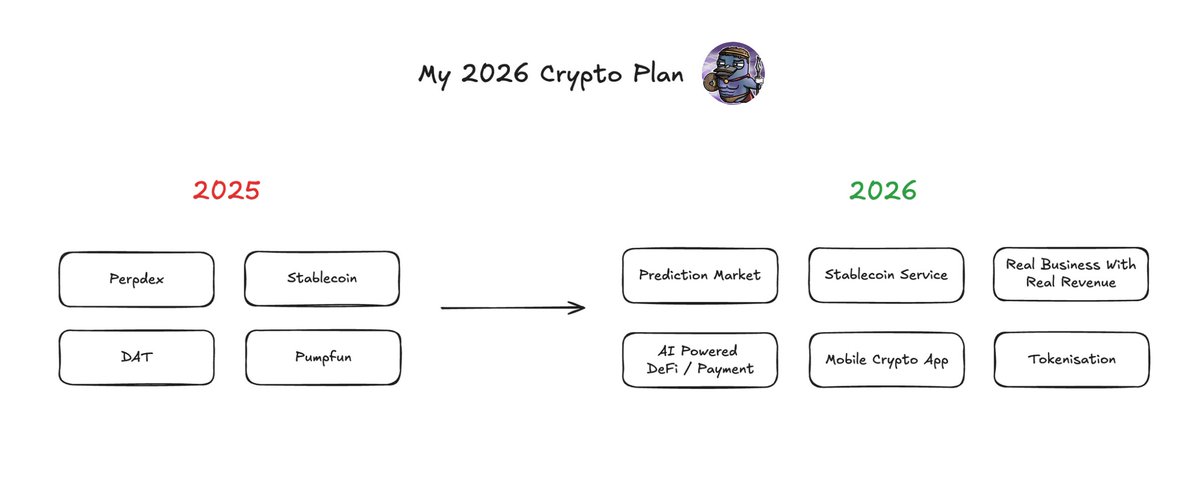
From 'Criminal Cycle' to Value Return: Four Major Opportunities in the 2026 Crypto Market Outlook

The crypto market is undergoing a necessary "purification" phase, shifting from a "crime cycle" of high-FDV, low-utility projects and pump-and-dump schemes towards value-driven growth. Key 2025 trends included maturation of regulated stablecoins (with over $100B in net growth), the rise of PerpDEXs (reaching $230B open interest), and Digital Asset Trusts (DATs) attracting TradFi interest. However, many DATs and airdrops faltered, highlighting the need for real utility and sustainable tokenomics. Looking ahead to 2026, four major opportunities are identified: 1. **Prediction Markets:** Platforms like Polymarket and Kalshi, backed by institutional interest and mainstream distribution, are set to grow significantly. 2. **Stablecoin Payments:** Supported by clear regulations (e.g., the Genius Act) and adoption by giants like Visa and Stripe, stablecoin transaction volumes are surging. 3. **Mobile dApps:** With improved user onboarding and growing mobile transaction trends, apps like Fomo App are driving accessibility and adoption. 4. **Real Revenue and Value Accrual:** Protocols generating actual income (e.g., via buybacks) and sharing profits with token holders will thrive. The focus shifts from speculation to sustainable business models in trading, yield, and payments. The industry is evolving towards practical applications, genuine revenue, and clearer value propositions, making 2026 a pivotal year for crypto's maturation.

深潮12/09 06:01

From 'Criminal Cycle' to Value Return: Four Major Opportunities in the 2026 Crypto Market Outlook

深潮12/09 06:01

Stablecoins at a Crossroads: Clear Regulations Drive Adoption, Systemic Risks Remain

Stablecoins are at a critical juncture, with regulatory clarity driving their rapid evolution from crypto trading tools to mainstream payment and settlement infrastructure. The U.S. GENIUS Act and the EU’s MiCA framework have established federal and regional standards for issuance, reserves, and auditing, accelerating their adoption. Market capitalization has surpassed $300 billion, with USD-pegged stablecoins dominating, though euro and other fiat-backed alternatives are growing. Use cases are expanding significantly, with enterprises adopting stablecoins for cross-border payments, payroll, and treasury management due to their 24/7 availability and low transaction costs. They are increasingly integrated into traditional finance as settlement and custody solutions. However, systemic risks remain. USD-pegged stablecoins face potential de-pegging risks, insufficient reserve transparency, and high centralization, which could trigger liquidity crises. Large holdings of sovereign bonds or fixed-income assets may also impact bond markets and monetary policy. The IMF has warned about financial stability risks and dollarization concerns. For stablecoins to mature into reliable, compliant, and interoperable digital infrastructure—rather than just survive—they require transparent issuance mechanisms, robust regulatory coordination, and effective systemic risk controls.

cointelegraph_中文12/08 11:03

Stablecoins at a Crossroads: Clear Regulations Drive Adoption, Systemic Risks Remain

cointelegraph_中文12/08 11:03

活动图片