Solana Processes 169.9 Million Transactions in a Single Day

cryptonews.ruPublished on 2026-08-06Last updated on 2026-08-06

Abstract

Solana set a new daily transaction record with 169.9 million user/application transactions processed, indicating real network activity. This followed a 66% capacity increase from a July 29th network upgrade (SIMD-0286), which raised the computational unit limit per block. Within six days, this new capacity was reportedly filled. Much of the increased transaction flow comes from market makers and arbitrage bots, which provide liquidity and maintain low spreads with frequent, low-fee trades. The launch of Western Union's 'Stablecard' on Solana highlights growing payments use. However, while transaction counts are at all-time highs, the fees and revenue generated are at multi-year lows, as high-volume speculative trading (e.g., memecoins) has been replaced by higher-frequency, lower-value transactions. Future planned upgrades, like Alpenglow and 200-millisecond slots, aim to further scale the network's throughput.

According to data from Blockworks, Solana processed a record 169.9 million transactions on August 13. This is a record number of transactions for a single day in the network's history. Non-vote transactions filter out messages validators send to each other to agree on blocks, so this number reflects actual user and application activity, not consensus overhead.
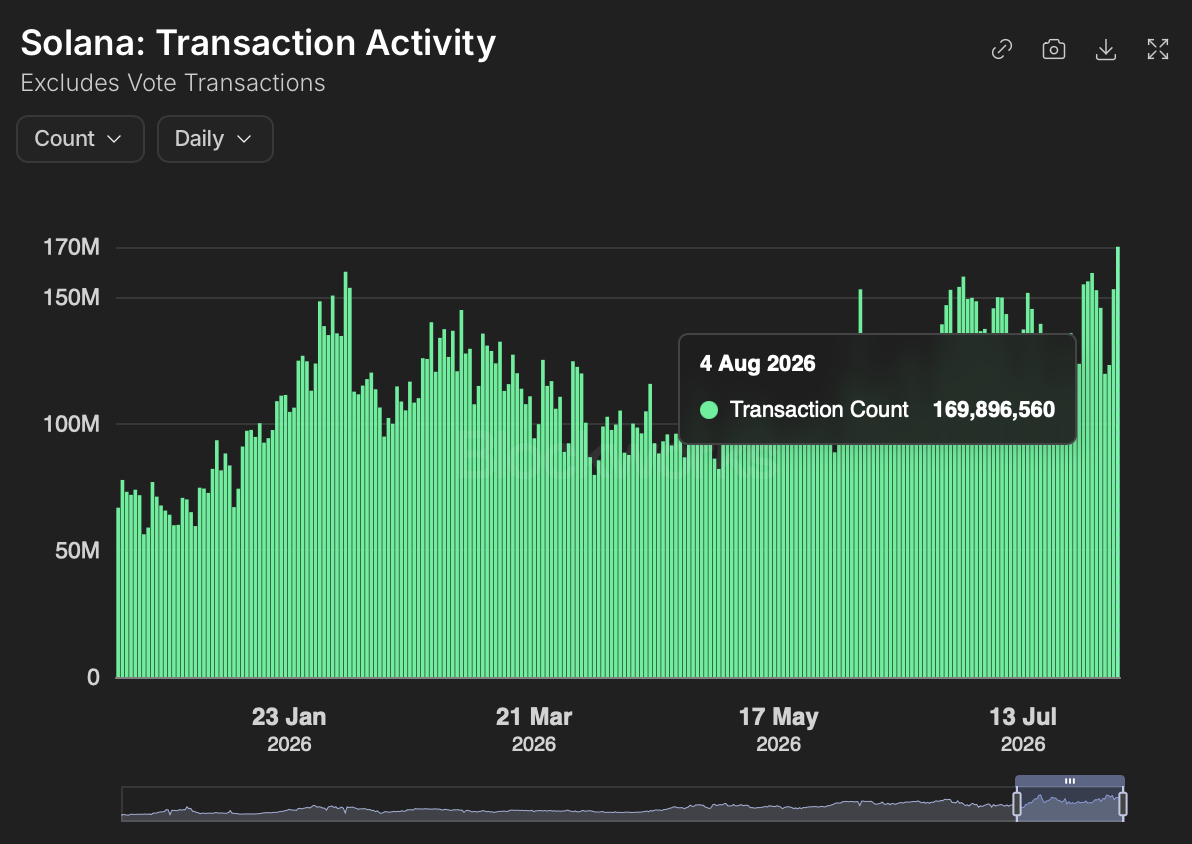
Source: Blockworks

On a weekly basis, the transaction count surpassed the highs set in early February and is up about 55% from this year's lows in April.

Capacity Increased by 66%, Filled in Six Days

On July 29, Solana activated the SIMD-0286 network upgrade at the beginning of a new epoch—the roughly two-day cycle Solana uses to rotate validator duties. The update increased the maximum compute resource limit per block from 60 million to 100 million compute units, representing a 66% increase. Compute units essentially measure the amount of work processed, so a higher limit can accommodate more transactions in a block.

This upgrade, developed by Jito Labs engineer Lukas Bruder, is the most significant throughput increase for Solana since its launch. The block creation time remained at 400 milliseconds, with no impact on speed. This was only possible after XDP kernel-bypass networking technology, which allows validators to transmit data faster by bypassing parts of the operating system, processed 70% of staked SOL.

The 60 Million Limit Was Tested Under Real Traffic

Data from the Solana Foundation shows that 11.2% of blocks reached 56 million compute units or higher, approaching the previous 60 million limit. The limit was stress-tested during periods of volatility, precisely when traders need their orders executed. In this sense, block space wasn't sitting idle waiting for users. Demand was pushing against the limit.

Most New Flow Comes From Trading Mechanisms

Market makers, using their own automated market makers (AMMs), constantly update their quotes on the blockchain, and according to Blockworks Research estimates, this flow could account for roughly 20% of all Solana transactions by the end of 2025. On top of this are arbitrage and order book maintenance. This kind of traffic expands to fill available block space, as this is how providing liquidity works on a platform with 400ms blocks and sub-cent fees. This traffic also keeps spreads low for everyone else.

The payment aspect emerged on the same day. Western Union's Stablecard launched on August 4 on the Solana platform via Rain, covering 37 markets and running on the USDPT stablecoin. The circulation volume is still around 7.4 million tokens, which is not yet impacting transaction counts. But the reason Western Union chose Solana is the same reason the record was set, and there is now potential to scale this flow.

UrgentKIN: Western Union Stablecard is live. Instant payments anywhere Visa works, across 175 million merchant locations in 37 markets at launch. The card runs on USDPT, a native stablecoin on Solana and backed by @WesternUnion, issued on-chain by @raincards . https://t.co/A0ycTQP68X pic.twitter.com/01NajGWGPe


— Solana (@solana) August 4, 2026

Record Throughput, Lowest Fees Since 2023

The issue lies in revenue metrics. Network usage fees in Q2 were $51 million, making it the weakest quarter for Solana since Q3 2023, while decentralized exchange (DEX) trading volumes are at their lowest since September 2024. Transaction counts are breaking records while associated monetary volumes are shrinking.

The mix has changed. Memecoin speculation generated good revenue per transaction. Market maker quote updates and stablecoin payments do not. This is healthier for infrastructure and less costly for business, and it's a real trade-off, not a side effect.

Next up are Alpenglow and 200-millisecond slots. Solana is building towards throughput it has yet to fully realize.


Trending Cryptos

Related Questions

QWhat record did the Solana network achieve according to the article?

AThe Solana network processed 169.9 million transactions in a single day, a record high in the network's history.

QWhat was the purpose and impact of the SIMD-0286 network update activated on July 29?

AThe SIMD-0286 update increased the maximum computational unit limit per block from 60 million to 100 million, a 66% increase. This allowed more transactions to be included in a block without affecting the 400-millisecond block creation time.

QWhat is the main source of the new transaction flow filling the increased block capacity, according to the article?

AA significant portion of the new transaction flow comes from trading mechanisms, specifically market makers using their own Automated Market Makers (AMMs) to constantly update quotes on the blockchain. This is estimated to account for roughly 20% of all Solana transactions by the end of 2025.

QDespite record transaction numbers, what financial challenge for the Solana network is highlighted in the article?

AThe article highlights that while transaction numbers are at record highs, network fee revenue is weak. Q2 fee revenue was $51 million, the lowest quarter since Q3 2023, and DEX volumes are at their lowest since September 2024.

QWhat recent major partnership is mentioned as a potential source for future transaction scaling on Solana?

AThe article mentions the launch of the Western Union Stablecard on the Solana network via Rain on August 4th. It operates on the USDPT stablecoin and is available across 37 markets, representing a significant potential payment flow for the network.

Related Reads

Home Furnishing Listed Companies Are Trying to Turn Around with AI and Semiconductors

Chinese home furnishing listed companies are increasingly turning to AI and semiconductor cross-border ventures to revive their fortunes amid declining core businesses. A prominent example is PVC flooring giant **Elegant Home Furnishing**, whose stock price skyrocketed with 10 consecutive trading limits after announcing a plan to acquire a majority stake in **Ou Kang Nuo**, a semiconductor storage testing equipment and services company. Despite Elegant Home's own financial struggles—including recent losses and tight cash flow—the acquisition, funded through asset sales and loans, has dramatically boosted its market value. The deal involves a cross-shareholding structure with Ou Kang Nuo's controlling shareholder. This trend is widespread. Over the past year, numerous home furnishing firms with stagnant main operations have seen their stock prices surge after announcing moves into hot sectors like AI, semiconductors, or computing power. Key cases include: * **Markor Home Furnishings** ("high-end home furnishing first share"), after years of heavy losses, acquired an AI server high-speed copper cable company and later introduced AI computing power investors. * **Zhenai Meijia** ("blanket king") became the first A-listed manufacturer controlled by an AI large model company following a takeover. * **Fasilon** (integrated ceiling) saw its stock soar after establishing an AI subsidiary. * **Jinlong Decoration** experienced multiple trading limits after being linked to "commercial aerospace" and "AI computing," despite clarifying these segments contribute less than 1% of its business. Statistics show over 20 A-share companies announced semiconductor crossovers in 2025, with home furnishing and building materials firms being the most active. This shift is largely driven by pressures from the real estate downturn, shrinking overseas demand, and trade tariffs, pushing companies to seek growth through trendy concepts rather than core business improvement. However, the article warns that such speculative frenzies often end when the hype fades, leaving stock prices to eventually reflect the companies' weak fundamentals, as seen in Jinlong Decoration's subsequent sharp price correction. The repeated attempts to "ride the trend" highlight a desperate struggle for survival in a challenging traditional industry.

marsbit14m ago

Home Furnishing Listed Companies Are Trying to Turn Around with AI and Semiconductors

marsbit14m ago

"Sell America" Trade Resurfaces: Global Funds Reprice Washington Policy Risks, Dollar and Treasuries Bear the Brunt

"Sale of America" Trade Resurges as Global Funds Reprice Washington Policy Risks, Hitting Dollar and Treasuries First Recent policy signals from Washington are prompting global bond and foreign exchange investors to reignite the "Sale of America" debate. Uncertainty stems from Fed Chair Wash's shift towards less policy communication, Treasury Secretary Bessant's approval of joint intervention with Japan to support the Yen (the first such coordinated move in nearly 30 years), expanding fiscal deficits, and trade war fears. These factors are undermining confidence in U.S. assets. The 30-year Treasury yield recently broke above 5%, hitting a high not seen since 2007, while the Bloomberg Dollar Spot Index has fallen about 2% from its June peak. This dollar weakness is unusual given still-high U.S. interest rates. Investors cite policy uncertainty as a key driver, with one manager calling the Fed Chair and Treasury Secretary a "double whammy" creating a "Trump administration premium." While the S&P 500 continues hitting record highs and foreign holdings of U.S. Treasuries remain high, parts of the bond and FX markets are adjusting. A core concern is whether the Fed under Wash can effectively anchor inflation expectations; analysts warn that if the Fed lags the hiking cycle, long-end yields could face further upward pressure. The 30-year term premium has risen sharply. The U.S.-backed Yen intervention has also sparked debate on the dollar's structural outlook. While framed by Bessant as a "reallocation of reserves," market participants caution that if Japan—America's largest foreign creditor—must sell Treasuries to fund interventions, ripple effects could hit the bond market. Strategists predict moderate dollar depreciation ahead. Most experts are not predicting an end to dollar hegemony or the safe-haven status of Treasuries. However, a key underlying risk is highlighted: the pace of foreign buying of U.S. debt may not keep up with the speed of American borrowing, gradually eroding the structural advantages that have long supported "American exceptionalism."

marsbit15m ago

"Sell America" Trade Resurfaces: Global Funds Reprice Washington Policy Risks, Dollar and Treasuries Bear the Brunt

marsbit15m ago

Trading

Spot

Hot Articles

Discussions

Welcome to the HTX Community. Here, you can stay informed about the latest platform developments and gain access to professional market insights. Users' opinions on the price of SOL (SOL) are presented below.

活动图片