Solana Gets A Big Infra Signal As Alibaba Demos High-Performance RPCs

bitcoinistPublished on 2026-02-11Last updated on 2026-02-11

Abstract

Alibaba Cloud demonstrated high-performance Solana RPC connectivity during a keynote, showcasing a significant infrastructure development for the blockchain. The demo highlighted a migration of a Solana archive node to Alibaba's in-house database, completed in just two days with the aid of AI-assisted coding. Key improvements included a reduction in RPC call latency; a "get slot" call dropped from 25ms to 10ms, while a "get block" call for a 4MB payload saw latency fall to under 200ms. This was achieved by routing traffic through Alibaba's private backbone network instead of the public internet, emphasizing stability and suitability for low-latency, trading-heavy applications. The company also highlighted its global data center footprint as a perfect match for Solana's needs. Although not a formal product announcement, the public benchmarking by a major cloud provider is a notable vote of confidence for the Solana ecosystem.

Solana picked up an infrastructure vote of confidence on Wednesday after Alibaba Cloud used a Hong Kong keynote to demo “high-performance” Solana RPC connectivity, framing the work as part of its broader push to fuse AI tooling with Web3 developer workflows.

In a clip shared by Solana’s official X account, the demo came during an Accelerate APAC 2026 keynote titled “Fueling Web3 Innovation with AI on Cloud,” delivered by Zhao Qingyuan of Alibaba Cloud Intelligence Group. The pitch was straightforward: reduce latency and operational overhead for builders who rely on fast, reliable RPC access, especially in trading-heavy use cases where milliseconds can matter.

Alibaba Flexes Solana RPC Throughput

Zhao framed the talk as a practical example of how large language models can compress development cycles. In the keynote, he said he recently migrated a archive node away from a Google Bigtable setup to an Alibaba Cloud in-house database implementation over a weekend, leaning on AI-assisted coding despite limited prior familiarity with Solana’s usual developer stack.

“Just this weekend, I spent two days — I migrated the Solana archive node from a Google Bigtable implementation to Alibaba Cloud’s in-house database implementation,” Zhao said. “I haven’t even learned Rust before, and I just used web coding to do this in two days. And it will download the data from Hugging Face for the historical slots, and it will synchronize the data with the mainnet, and it can provide the RPC service.”

The remarks landed alongside Alibaba Cloud’s broader messaging around its Qwen family of models, positioned by the company as a general-purpose LLM stack that can be used for coding, assistants, and multimodal workflows.

The more market-relevant part of the demo was the latency claim. Zhao described a setup where users connect to RPC nodes through Alibaba Cloud’s backbone network rather than via general public internet routes.

In a table shown during the talk, he said a “get slot” RPC call latency was reduced from roughly 25 milliseconds to about 10 milliseconds under the backbone-network approach, calling it “a huge reduction.” For “get block,” described as a 4MB block payload, he said latency fell from “more than 200 milliseconds” to “less than 200 milliseconds,” while emphasizing stability and suitability for low-latency workloads.

Alibaba Cloud also leaned into geography. Zhao pointed to the firm’s global footprint, highlighting regions such as Frankfurt, the US, and multiple Asia-Pacific hubs including Tokyo, Singapore, and Hong Kong, as a “perfect match” for Solana’s builder base and latency-sensitive applications.

While the clip stops short of announcing a formal partnership or a productized Solana RPC offering with pricing or SLAs, the optics are notable: a major cloud provider using a Solana ecosystem stage to publicly benchmark RPC latency improvements, and explicitly tying that to trading and “co-location for the high frequency calls.”

At press time, SOL traded at $81.
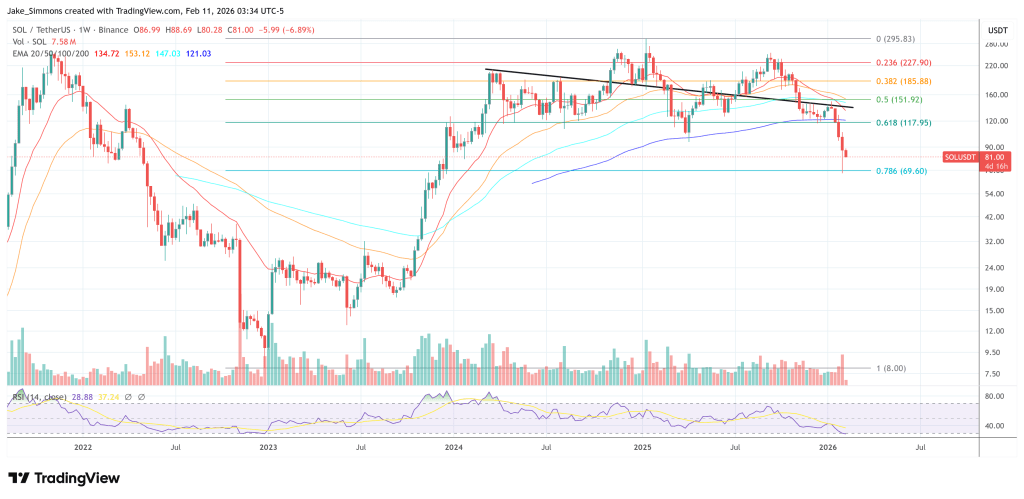
SOL stays above the 0.786 Fib, 1-week chart | Source: SOLUSDT on TradingView.com

Related Questions

QWhat did Alibaba Cloud demonstrate regarding Solana at the Accelerate APAC 2026 keynote?

AAlibaba Cloud demonstrated 'high-performance' Solana RPC connectivity, showcasing reduced latency and operational overhead for developers, particularly in trading-heavy use cases.

QHow did Zhao Qingyuan from Alibaba Cloud migrate the Solana archive node, and what was notable about his approach?

AZhao Qingyuan migrated a Solana archive node from a Google Bigtable implementation to Alibaba Cloud's in-house database over a weekend using AI-assisted coding, despite having limited prior familiarity with Rust or Solana's developer stack.

QWhat latency improvements did Alibaba Cloud claim for Solana RPC calls using their backbone network?

AFor a 'get slot' RPC call, latency was reduced from roughly 25 milliseconds to about 10 milliseconds. For a 'get block' call with a 4MB payload, latency fell from 'more than 200 milliseconds' to 'less than 200 milliseconds'.

QHow did Alibaba Cloud position its Qwen family of models in relation to this demonstration?

AAlibaba Cloud positioned its Qwen family of models as a general-purpose LLM stack that can be used for coding, assistants, and multimodal workflows, using the demo as a practical example of how AI can compress development cycles.

QWhat was the market context for SOL at the time of the article's publication?

AAt press time, SOL was trading at $81.

Related Reads

Day 6 of the rsETH Incident: DeFi United Secures Approximately $100 Million in Intentional Commitments, but a $50 Million Gap Remains

On April 18, Kelp DAO’s rsETH LayerZero bridge was exploited, resulting in the unauthorized minting of 116.5k rsETH (approx. $292M). The attacker borrowed around $190M on Aave V3. The Arbitrum Security Council froze 30,766 ETH linked to the incident. DeFi United, a cross-protocol rescue initiative led by Awe, was formed to cover a total shortfall of 112.2k rsETH ($258M). As of April 24, several protocols have pledged around $100M in support, though most commitments are still under DAO voting or discussion. Key pledges include: - Golem: 1,000 ETH ($2.3M) - Aave founder Stani Kulechov: 5,000 ETH ($11.5M) - EtherFi: up to 5,000 ETH ($11.5M) - Lido: up to 2,500 stETH ($5.75M), contingent on full coverage - Mantle: proposed a $69M loan to Aave DAO under specific terms The remaining shortfall is estimated at $50M. Aave’s treasury and safety module (~$236M combined) can cover the worst-case bad debt scenario ($230M). Three potential loss distribution paths were outlined by DefiLlama’s 0xngmi: 1. Uniform 18.5% haircut for all rsETH holders: Aave bad debt ~$216M 2. Only protect Mainnet, abandon L2: bad debt up to $341M 3. Repay only pre-attack holders: technically difficult, ~$91M net loss KelpDAO has not yet announced a specific plan. The success of DeFi United depends heavily on KelpDAO’s final decision on loss allocation.

marsbit29m ago

Day 6 of the rsETH Incident: DeFi United Secures Approximately $100 Million in Intentional Commitments, but a $50 Million Gap Remains

marsbit29m ago

Kicked Out of PayPal, Musk Aims for a Comeback in the Crypto Market

Elon Musk's X (formerly Twitter) has launched its "Smart Cashtags" feature, generating approximately $1 billion in trading volume within days of its April 2026 pilot launch. The feature allows users to click on stock or crypto tickers (or even full Solana token contract addresses) in posts to view real-time price charts and discussions without leaving the app. Initially available to iPhone users in the US and Canada, with a partnership in Canada enabling direct trading via the Wealthsimple app. This move is part of Musk's broader "Everything App" vision, spearheaded by the upcoming X Money platform. Analysts, such as Mizuho's Dan Dolev, see this as a potential disruptor to the US payments market, even prompting a downgrade of PayPal's stock. X Money's beta offers services like 6% APY on deposits, cashback, and P2P transfers, with speculation it may later incorporate crypto trading and stablecoin settlements for faster transactions. However, the ambitious plan faces significant regulatory scrutiny. Senator Elizabeth Warren has questioned the sustainability of the high 6% yield and raised concerns over X's banking partner, Cross River Bank, which has a history of regulatory violations. Additional risks involve the "GENIUS Act," which may create loopholes for stablecoin issuance without full FDIC insurance coverage, potentially leaving users unprotected. The integration of social trading on a platform with over 500 million users could inject new liquidity and retail interest into the crypto market. Yet, it also amplifies risks like herd mentality and the blurring of lines between entertainment and financial speculation. Musk's return to finance, after his ouster from PayPal, hinges on balancing innovation with regulatory compliance.

marsbit2h ago

Kicked Out of PayPal, Musk Aims for a Comeback in the Crypto Market

marsbit2h ago

Trading

Spot
Futures

Hot Articles

Discussions

Welcome to the HTX Community. Here, you can stay informed about the latest platform developments and gain access to professional market insights. Users' opinions on the price of SOL (SOL) are presented below.

活动图片















