SEC Chair Touts Crypto-Led Shift To On-Chain Finance

bitcoinistPublished on 2025-12-13Last updated on 2025-12-13

Abstract

SEC Chair Paul Atkins announced a significant shift towards integrating crypto-native infrastructure into US financial markets, emphasizing an on-chain future. The SEC issued a no-action letter allowing the Depository Trust Company (DTC) to proceed with a voluntary tokenization pilot program. This initiative permits eligible participants to tokenize securities entitlements using distributed ledger technology, enabling direct transfers between registered wallets while DTC maintains official records. Atkins highlighted benefits like greater transparency, predictability, and efficiency, while also advocating for an "innovation exemption" to reduce regulatory burdens for market participants transitioning on-chain. The pilot is narrowly scoped and time-limited, serving as a supervised sandbox rather than an immediate broad rollout. The announcement reflects a notable tone shift in regulatory approach towards embracing blockchain technology in traditional finance.

SEC Chair Paul Atkins is leaning into a message that would’ve sounded borderline heretical in Washington not that long ago: the rails are changing, and crypto-native infrastructure is going to be part of it.

“As I told @MariaBartiromo last week, US financial markets are poised to move on-chain,” Atkins wrote on X late Thursday, adding that the SEC is “prioritizing innovation and embracing new technologies to enable this on-chain future, while continuing to protect investors.”

Crypto Will Put The Future Of Finance On-Chain

Atkins didn’t leave it at vibes. Earlier in the day, Atkins pointed to a staff no-action letter out of the SEC’s Division of Trading and Markets tied to the Depository Trust Company’s (DTC) voluntary tokenization effort — a pilot that effectively gives the plumbing of US securities settlement a carve-out to experiment without immediately tripping over parts of the Exchange Act rulebook.

“Today, the Division of Trading and Markets issued a no-action letter to the Depository Trust Company (DTC) regarding DTC’s voluntary securities tokenization pilot program. DTC’s initiative marks an important step towards on-chain capital markets,” Atkins shared via X.

The letter dated Dec. 11 describes a “pilot version” of what it calls DTCC Tokenization Services — a preliminary, time-limited program that lets DTC participants elect to have certain security entitlements recorded using distributed ledger tech instead of relying solely on DTC’s centralized ledger.

In plain English: eligible participants can tokenize positions, hold them in registered wallets on approved blockchains, and transfer those tokenized entitlements directly to another participant’s registered wallet — with DTC’s official records still serving as the system of record for what’s real.

Atkins added: “On-chain markets will bring greater predictability, transparency, and efficiency for investors. DTC’s participants will now be allowed to transfer tokenized securities directly to the registered wallets of other participants, which will be tracked by DTC’s official records.I’m excited to see the benefits of this program to our financial markets and will continue to encourage market participants to innovate as we move towards on-chain settlement.”

Notably, the no-action relief itself is narrowly scoped: it’s centered on how the pilot interacts with Reg SCI, Section 19(b)/Rule 19b-4, and certain clearing-agency standards — and it’s structured to sunset three years after launch of the preliminary version, with DTC required to notify staff when that launch happens. So this isn’t “tokenized stocks for everyone next week.” It’s closer to a supervised sandbox with reporting hooks.

Notably, Atkins is already pitching what comes next. “But this is just the beginning,” he wrote, saying he wants the SEC to consider an “innovation exemption” that would let market participants begin transitioning on-chain “without being burdened by cumbersome regulatory requirements.”

That line is doing a lot of work, and it’s also where the fight (or at least the lobbying) is likely to concentrate. What qualifies as “innovation”? Who gets exempted, and from which obligations? And what’s the gating factor — investor protection, market integrity, operational resilience, or just politics?

Crypto watchers noticed the tone shift immediately. CryptoQuant CEO Ki Young Ju summed it up in one sentence: “SEC Chairman: The future of finance is on-chain.”

For now, the tangible takeaway is the DTC pilot: a regulated core market utility experimenting with tokenized representations under staff comfort. The rest — the “on-chain future” language, and the exemption talk — is the part that could either become a framework or just another ambitious headline that runs into the realities of US market structure.

At press time, the total crypto market cap stood at $3.1 trillion.
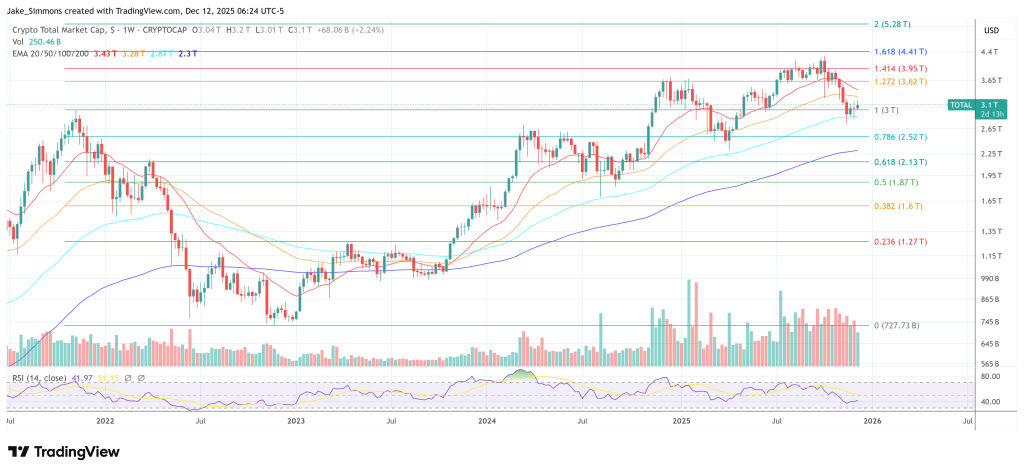
Total crypto market cap remains above the 2021 high, 1-week chart | Source: TOTAL on TradingView.com

Related Reads

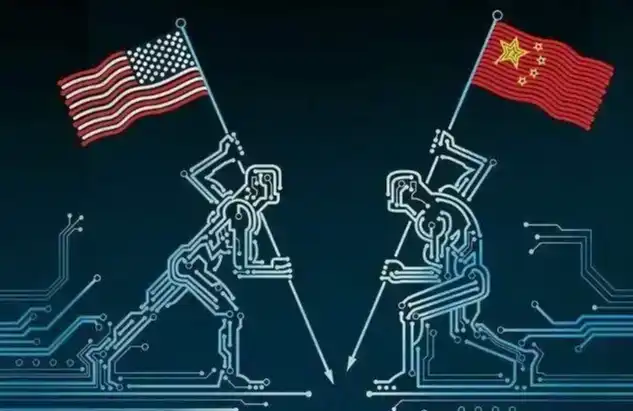
Who Will Define the Rules of the AI Era? Anthropic Discusses the 2028 US-China AI Landscape

This article, based on Anthropic's analysis, outlines the intensifying systemic competition between the U.S./allies and China for AI leadership by 2028. It argues that access to advanced computing power ("compute") is the critical bottleneck, where the U.S. currently holds a significant advantage through chip export controls and allied innovation. However, China's AI labs remain competitive by exploiting policy loopholes—via chip smuggling, overseas data center access, and "model distillation" attacks to copy U.S. model capabilities—keeping them close to the frontier. The piece presents two contrasting scenarios for 2028. In the first, decisive U.S. action to tighten compute controls and curb distillation locks in a 12-24 month AI capability lead, cementing democratic influence over global AI norms, security, and economic infrastructure. In the second, policy inaction allows China to achieve near-parity through continued access to U.S. technology, enabling Beijing to promote its AI stack globally and integrate advanced AI into its military and governance systems, altering the strategic balance. Anthropic contends that maintaining a decisive U.S. lead is essential for shaping safe AI development and governance. The core recommendation is for U.S. policymakers to urgently close compute and model access loopholes while promoting global adoption of the U.S. AI technology stack to secure a lasting strategic advantage.

marsbit1h ago

Who Will Define the Rules of the AI Era? Anthropic Discusses the 2028 US-China AI Landscape

marsbit1h ago

“Why Didn’t You Buy 2x Long SK Hynix?”

The article discusses the immense popularity of the "2x Long SK Hynix ETF" (07709.HK) in Hong Kong, which became the world's largest single-stock leveraged ETF by May 2026. Launched in October 2025, the ETF's net value soared over 1000% in seven months, significantly outperforming the 324% gain of SK Hynix's underlying stock, driven by the AI boom and a critical shift in industry demand from computing power to memory. It highlights the mechanics and risks of daily-rebalanced leveraged ETFs. In a smooth bullish market, they generate amplified returns, but during volatile periods—exemplified by market swings during geopolitical tensions in the Strait of Hormuz in March-April 2026—they suffer severe "volatility decay," where choppy price action can cause losses far exceeding twice the drop of the underlying asset. The piece frames SK Hynix, as NVIDIA's primary HBM supplier, within the classic cycle of the memory chip industry—a commoditized sector prone to boom-and-bust cycles of shortage, price hikes, overcapacity, and crashes. While current AI-driven demand and high margins (Q1 2026毛利率~79%) create a "super cycle," the article questions its sustainability. It warns that extreme profits will inevitably tempt competitors like Samsung and Micron to ramp up HBM production, potentially eroding scarcity. Furthermore, the entire narrative remains tethered to the massive AI capital expenditure of tech giants. In conclusion, the ETF's trajectory symbolizes the accelerated, all-in nature of the current AI revolution, where timeframes are compressed and market moves are extreme. However, it also underscores that while industry trends define ultimate returns, macro-geopolitical risks dictate the volatile and uncertain path to get there.

marsbit1h ago

“Why Didn’t You Buy 2x Long SK Hynix?”

marsbit1h ago

a16z Crypto: A Guide to the CLARITY Act for Crypto Entrepreneurs

The CLARITY Act, a bipartisan crypto market structure bill, has advanced through the Senate Banking Committee, marking a potential historic shift in U.S. digital asset regulation. For years, a lack of clear rules has stifled innovation, pushed development overseas, and exposed consumers to risk. This bill aims to establish a comprehensive framework, providing long-needed regulatory clarity for blockchain networks and digital assets. It builds upon previous legislative efforts like FIT21 and the House version of CLARITY, which gained strong bipartisan support. CLARITY is crucial because it recognizes that blockchain networks are fundamentally different from traditional companies. Networks operate through decentralized, shared rules rather than centralized control. Applying corporate legal frameworks to networks forces them into a centralized model, concentrating power and value. In contrast, decentralized blockchain networks can function as user-owned public infrastructure, distributing value more equitably among participants. The bill seeks to enable the safe launch of networks in the U.S., clarify regulatory jurisdiction between the SEC and CFTC, oversee crypto exchanges, and enhance consumer protections. Its passage would align U.S. law with the nature of decentralized technology, allowing builders to operate transparently and fund projects domestically without structural compromises due to regulatory uncertainty. Similar to the positive impact seen after the stablecoin-focused GENIUS Act, CLARITY could unlock a new wave of innovation, helping the U.S. reclaim leadership in the crypto space while combating fraud and abuse.

链捕手2h ago

a16z Crypto: A Guide to the CLARITY Act for Crypto Entrepreneurs

链捕手2h ago

Trading

Spot
Futures

Hot Articles

What is GENIUS

I. Project Introduction1. What Is Genius?Genius (GENIUS) is positioned as the “ultimate on-chain terminal,” a decentralized trading platform focused on privacy and speed. By integrating top-tier privacy technology, it aims to build a next-generation privacy trading infrastructure across networks such as BNB Chain, enabling users to interact on-chain with a seamless experience comparable to centralized exchanges.2. How Does Genius Work?Genius's core technical architecture is structured as follows:(1) Chain-invisible: Users do not need to manually handle multi-step approvals for cross-chain operations, asset wrapping, or complex gas management.(2) Signatureless Trading: Through integrations such as Turnkey, Genius enables instant trading without pop-up confirmations or per-transaction authorization.(3) Aggregator of Aggregators: Genius is powered by a best-in-class aggregation stack integrated with more than 150 DEXs, claiming superior quote efficiency compared with competing products.(4) Account Management: The platform adopts a non-custodial architecture and leverages Turnkey and Lit Protocol for key management, allowing users to securely access their accounts through passkeys.3. Who Created Genius?According to its official Terms of Service, Genius was developed by Shuttle Labs, Inc. Based on the project’s official X account, Ryan Myher is one of the key contributors driving product iteration, including developments such as the rollout of the Ghost protocol, as well as broader community engagement.Binance founder CZ has officially joined the project as an advisor, with the goal of helping the team build a faster and more privacy-preserving on-chain trading experience.In addition, the project has received strong backing from YZi Labs, which has invested in Genius and works alongside the Genius Foundation, responsible for maintaining the core Genius Bridge Protocol (GBP).4. Genius TokenomicsGENIUS is the native token of the Genius ecosystem. As of now, the project has not released a full tokenomics document.Based on the latest official disclosures, Genius incorporates a deflationary mechanism, and 4.6% of the total token supply had already been burned during the early launch phase.Genius Points (GP) System:(1) Trade-to-Earn: The platform has established a reward pool of 200 million Genius Points, and users earn GP for every trade executed through the terminal.(2) Tiering and Badges: Genius features a progression-based badge system ranging from Smart to God, with higher levels unlocking additional perks and benefits.(3) Native Yield: Users holding designated assets such as usdGG in the dashboard can earn native yield directly without going through complex staking.(4) Referral Incentives: Referrers can earn fee rebates of over 45% paid in USDC, along with additional GP.5. Timeline & Key MilestonesMarch 2020: The project’s official X account was created, marking the beginning of its early preparation phase.January 13, 2026: Genius announced a multi-million-dollar investment from YZi Labs and simultaneously confirmed CZ as an advisor to accelerate the buildout of its privacy trading infrastructure.April 18, 2026: The project announced that the Ghost privacy protocol would be launching soon.April 29, 2026: The Ghost protocol officially opened to its first 50 testers, marking the beginning of a new era for privacy trading on BNB Chain. At the same time, the team confirmed 4.6% of tokens have been burnt.​II. Token Information1) Basic InformationToken name: GENIUS (Genius)III. Related LinksWebsite:https://www.tradegenius.com/homeExplorers:https://bscscan.com/address/0x1f12b85aac097e43aa1555b2881e98a51090e9a6Socials:https://x.com/GeniusTerminalNote: The project introduction comes from the materials published or provided by the official project team, which is for reference only and does not constitute investment advice. HTX does not take responsibility for any resulting direct or indirect losses.

1.1k Total ViewsPublished 2026.04.29Updated 2026.05.11

What is GENIUS

How to Buy GENIUS

Welcome to HTX.com! We've made purchasing Genius (GENIUS) simple and convenient. Follow our step-by-step guide to embark on your crypto journey.Step 1: Create Your HTX AccountUse your email or phone number to sign up for a free account on HTX. Experience a hassle-free registration journey and unlock all features.Get My AccountStep 2: Go to Buy Crypto and Choose Your Payment MethodCredit/Debit Card: Use your Visa or Mastercard to buy Genius (GENIUS) instantly.Balance: Use funds from your HTX account balance to trade seamlessly.Third Parties: We've added popular payment methods such as Google Pay and Apple Pay to enhance convenience.P2P: Trade directly with other users on HTX.Over-the-Counter (OTC): We offer tailor-made services and competitive exchange rates for traders.Step 3: Store Your Genius (GENIUS)After purchasing your Genius (GENIUS), store it in your HTX account. Alternatively, you can send it elsewhere via blockchain transfer or use it to trade other cryptocurrencies.Step 4: Trade Genius (GENIUS)Easily trade Genius (GENIUS) on HTX's spot market. Simply access your account, select your trading pair, execute your trades, and monitor in real-time. We offer a user-friendly experience for both beginners and seasoned traders.

2.4k Total ViewsPublished 2026.04.29Updated 2026.05.11

How to Buy GENIUS

Discussions

Welcome to the HTX Community. Here, you can stay informed about the latest platform developments and gain access to professional market insights. Users' opinions on the price of A (A) are presented below.

活动图片