SEC Chair Touts Crypto-Led Shift To On-Chain Finance

bitcoinistPublished on 2025-12-13Last updated on 2025-12-13

Abstract

SEC Chair Paul Atkins announced a significant shift towards integrating crypto-native infrastructure into US financial markets, emphasizing an on-chain future. The SEC issued a no-action letter allowing the Depository Trust Company (DTC) to proceed with a voluntary tokenization pilot program. This initiative permits eligible participants to tokenize securities entitlements using distributed ledger technology, enabling direct transfers between registered wallets while DTC maintains official records. Atkins highlighted benefits like greater transparency, predictability, and efficiency, while also advocating for an "innovation exemption" to reduce regulatory burdens for market participants transitioning on-chain. The pilot is narrowly scoped and time-limited, serving as a supervised sandbox rather than an immediate broad rollout. The announcement reflects a notable tone shift in regulatory approach towards embracing blockchain technology in traditional finance.

SEC Chair Paul Atkins is leaning into a message that would’ve sounded borderline heretical in Washington not that long ago: the rails are changing, and crypto-native infrastructure is going to be part of it.

“As I told @MariaBartiromo last week, US financial markets are poised to move on-chain,” Atkins wrote on X late Thursday, adding that the SEC is “prioritizing innovation and embracing new technologies to enable this on-chain future, while continuing to protect investors.”

Crypto Will Put The Future Of Finance On-Chain

Atkins didn’t leave it at vibes. Earlier in the day, Atkins pointed to a staff no-action letter out of the SEC’s Division of Trading and Markets tied to the Depository Trust Company’s (DTC) voluntary tokenization effort — a pilot that effectively gives the plumbing of US securities settlement a carve-out to experiment without immediately tripping over parts of the Exchange Act rulebook.

“Today, the Division of Trading and Markets issued a no-action letter to the Depository Trust Company (DTC) regarding DTC’s voluntary securities tokenization pilot program. DTC’s initiative marks an important step towards on-chain capital markets,” Atkins shared via X.

The letter dated Dec. 11 describes a “pilot version” of what it calls DTCC Tokenization Services — a preliminary, time-limited program that lets DTC participants elect to have certain security entitlements recorded using distributed ledger tech instead of relying solely on DTC’s centralized ledger.

In plain English: eligible participants can tokenize positions, hold them in registered wallets on approved blockchains, and transfer those tokenized entitlements directly to another participant’s registered wallet — with DTC’s official records still serving as the system of record for what’s real.

Atkins added: “On-chain markets will bring greater predictability, transparency, and efficiency for investors. DTC’s participants will now be allowed to transfer tokenized securities directly to the registered wallets of other participants, which will be tracked by DTC’s official records.I’m excited to see the benefits of this program to our financial markets and will continue to encourage market participants to innovate as we move towards on-chain settlement.”

Notably, the no-action relief itself is narrowly scoped: it’s centered on how the pilot interacts with Reg SCI, Section 19(b)/Rule 19b-4, and certain clearing-agency standards — and it’s structured to sunset three years after launch of the preliminary version, with DTC required to notify staff when that launch happens. So this isn’t “tokenized stocks for everyone next week.” It’s closer to a supervised sandbox with reporting hooks.

Notably, Atkins is already pitching what comes next. “But this is just the beginning,” he wrote, saying he wants the SEC to consider an “innovation exemption” that would let market participants begin transitioning on-chain “without being burdened by cumbersome regulatory requirements.”

That line is doing a lot of work, and it’s also where the fight (or at least the lobbying) is likely to concentrate. What qualifies as “innovation”? Who gets exempted, and from which obligations? And what’s the gating factor — investor protection, market integrity, operational resilience, or just politics?

Crypto watchers noticed the tone shift immediately. CryptoQuant CEO Ki Young Ju summed it up in one sentence: “SEC Chairman: The future of finance is on-chain.”

For now, the tangible takeaway is the DTC pilot: a regulated core market utility experimenting with tokenized representations under staff comfort. The rest — the “on-chain future” language, and the exemption talk — is the part that could either become a framework or just another ambitious headline that runs into the realities of US market structure.

At press time, the total crypto market cap stood at $3.1 trillion.
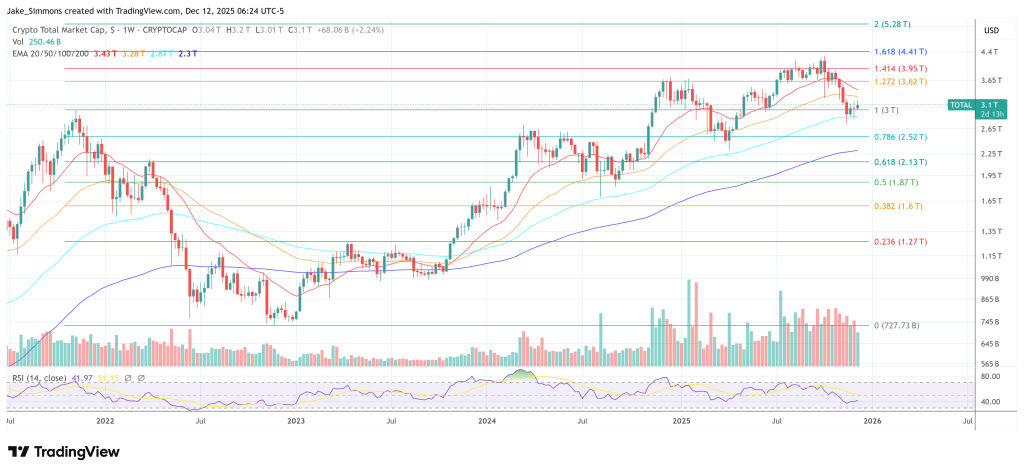
Total crypto market cap remains above the 2021 high, 1-week chart | Source: TOTAL on TradingView.com

Trending Cryptos

Related Reads

How Far Are We from the End of the Crypto Bear Market?

How Much Longer Until the Crypto Bear Market Ends? A persistent negative Coinbase Bitcoin Premium Index, reaching a record 46 consecutive days of negative values, underscores the ongoing crypto bear market. The downturn accelerated in late May/early June when MicroStrategy (referred to as "Strategy" in the text), a major BTC holder, sold a small amount of Bitcoin (32 BTC), shattering market confidence and triggering sharp declines in BTC, ETH, and SOL. This was compounded by sustained net outflows from US spot Bitcoin ETFs. June saw Bitcoin briefly fall below $60,000, its worst weekly performance since 2022, breaking below the critical 200-week moving average—a signal some analysts consider confirmation of a bear market. While some institutional analyses in mid-June suggested the bottom might be near (e.g., around $53,600 based on realized price, or a potential end during the 2026 World Cup summer), further price drops quickly disproved these optimistic forecasts. Key bear market indicators include: the severe de-pegging of MicroStrategy's preferred shares (STRC) from their $100 NAV, which later recovered partly due to company stabilization plans; a record number of BTC (over 10.83 million) and a significant portion of long-term ETH holders now in unrealized loss; and Bitcoin's price trading below its 200-week moving average. Predictions for the bear market's end vary. Some, like investor Yilihua, suggest July-August 2026 could present a final buying opportunity. Others, like miner Jiang Zhu'o'er, predict a bottom between $42,000-$44,000 in October-December 2026, based on the historical lag between MicroStrategy's mNAV ratio bottom and Bitcoin's price bottom. Technical indicators like the BTC 4-year average price index dipped briefly below 1, and the Coinbase Premium Index remains negative, suggesting a need for a price rebound to around $77,000 for a return to positive territory. In the absence of major external catalysts, the consensus leans toward the bear market persisting for another 2-3 months, with late September to early October 2026 being a potential turning point window.

Odaily星球日报1h ago

How Far Are We from the End of the Crypto Bear Market?

Odaily星球日报1h ago

Solana Ecosystem Shows Signs of Recovery: On-Chain Governance Upgrade, Tokenized Stocks and Meme Coins Heat Up

Solana Ecosystem Shows Signs of Revival: Governance Upgrades, Tokenized Stocks, and Memecoins Heat Up While the broader crypto market faces a downturn, Solana has shown relative strength with its price rising nearly 15% recently. This resilience is attributed to warming ecosystem activity, particularly in tokenized stocks and memecoins, coupled with a major upgrade to its on-chain governance. In the Real World Assets (RWA) sector, Solana now leads all public chains in both the number of unique holder wallets and the quantity of RWA assets. Its tokenized stock weekly trading volume has surged to a record $1.42 billion, capturing about 96% of the market share, largely driven by the Backpack exchange. Simultaneously, the Solana memecoin sector has reignited, fueled by the rapid ascent of the ANSEM token following endorsements from a prominent crypto influencer. This has boosted activity across platforms like Pump.fun and increased fee revenue for several Solana-based exchanges. A key development is the launch of Solana Governance Proposals (SGP), a new on-chain mechanism. It allows validators with at least 100,000 SOL delegated to submit proposals for community vote, enhancing decentralized decision-making. SGP will operate alongside the existing technical proposal process (SIMD), focusing on broader ecosystem governance. Despite these positive signals in specific areas, overall on-chain activity and transaction volumes still lag behind previous bull market peaks, indicating the recovery remains partial rather than ecosystem-wide.

marsbit1h ago

Solana Ecosystem Shows Signs of Recovery: On-Chain Governance Upgrade, Tokenized Stocks and Meme Coins Heat Up

marsbit1h ago

While Semiconductor Stocks Plunge, Anthropic Plans to Develop a 2nm Chip

Anthropic, the AI company behind Claude, is exploring the development of its own custom AI chip, according to a report from The Information. The company is in early discussions with Samsung Electronics to manufacture the chip using Samsung's most advanced 2-nanometer process and packaging technology. While the project is still in preliminary stages, including defining chip specifications, and could be abandoned, it marks a strategic step for Anthropic. The move comes as the company seeks greater control over its computing costs and hardware optimization, particularly for inference tasks to run its models more efficiently and cheaply. Samsung's potential involvement follows its participation as a strategic investor in Anthropic's recent $65 billion funding round. For Samsung, partnering with a major AI lab represents a significant opportunity for its foundry business to compete with market leader TSMC in advanced semiconductor manufacturing. Anthropic's CEO, Dario Amodei, has previously highlighted the immense financial challenge of securing enough computing power for anticipated growth, making cost-effective inference a critical focus. The company would join other tech giants like Google, Amazon, Microsoft, Meta, and OpenAI in pursuing custom AI silicon. However, analysts note this trend creates deeper interdependencies rather than independence, as US AI labs become more tightly woven into Asian semiconductor supply chains. Despite this move, Anthropic remains heavily reliant on a multi-cloud, multi-vendor strategy for its immediate computing needs. It has secured massive, long-term commitments for capacity from Amazon Web Services (Trainium chips), Google (TPUs), and even leased a large GPU cluster from xAI. For now, Nvidia continues to dominate the AI chip market, with its share reportedly growing to 74%.

链捕手1h ago

While Semiconductor Stocks Plunge, Anthropic Plans to Develop a 2nm Chip

链捕手1h ago

Trading

Spot

Hot Articles

What is NES

I. Project IntroductionNesa is the largest decentralized AI platform and ecosystem backed by a privacy-first AI Layer 1. Its proprietary encrypted inference technology supports a broad range of workloads and serves Fortune 500 enterprise customers in industries like retail, healthcare, and IT.II. Token InformationToken name: NES(Nesa)III. Related LinksWebsite:https://nesa.ai/Explorers:https://bscscan.com/address/0x3131f6B80C26936aB03F7d9D29Eb4Ddf36AC3FB5Twitter:https://x.com/nesaorgNote: The project introduction comes from the materials published or provided by the official project team, which is for reference only and does not constitute investment advice. HTX does not take responsibility for any resulting direct or indirect losses.

335 Total ViewsPublished 2026.06.24Updated 2026.06.24

What is NES

How to Buy NES

Welcome to HTX.com! We've made purchasing Nesa (NES) simple and convenient. Follow our step-by-step guide to embark on your crypto journey.Step 1: Create Your HTX AccountUse your email or phone number to sign up for a free account on HTX. Experience a hassle-free registration journey and unlock all features.Get My AccountStep 2: Go to Buy Crypto and Choose Your Payment MethodCredit/Debit Card: Use your Visa or Mastercard to buy Nesa (NES) instantly.Balance: Use funds from your HTX account balance to trade seamlessly.Third Parties: We've added popular payment methods such as Google Pay and Apple Pay to enhance convenience.P2P: Trade directly with other users on HTX.Over-the-Counter (OTC): We offer tailor-made services and competitive exchange rates for traders.Step 3: Store Your Nesa (NES)After purchasing your Nesa (NES), store it in your HTX account. Alternatively, you can send it elsewhere via blockchain transfer or use it to trade other cryptocurrencies.Step 4: Trade Nesa (NES)Easily trade Nesa (NES) on HTX's spot market. Simply access your account, select your trading pair, execute your trades, and monitor in real-time. We offer a user-friendly experience for both beginners and seasoned traders.

210 Total ViewsPublished 2026.06.24Updated 2026.06.24

How to Buy NES

Discussions

Welcome to the HTX Community. Here, you can stay informed about the latest platform developments and gain access to professional market insights. Users' opinions on the price of A (A) are presented below.

活动图片