Saylor Says Strategy’s Bitcoin Credit Model Is Not A Ponzi Scheme

bitcoinistPublished on 2026-05-11Last updated on 2026-05-11

Abstract

Michael Saylor defended MicroStrategy's Bitcoin-backed credit model against criticisms that it resembles a Ponzi scheme, emphasizing the company monetizes Bitcoin's capital gains rather than relying on perpetual equity issuance. He clarified his famous "never sell your Bitcoin" stance, stating the more precise strategy is to never be a *net seller*. The company's recent announcement that it might sell Bitcoin to fund dividends on its STRC preferred instrument sparked debate. Saylor explained the core model: issuing credit to buy Bitcoin, expecting its long-term appreciation to exceed dividend costs, analogous to a real estate firm. He argued that even if Bitcoin is sold for dividends, ongoing credit issuance ensures the company remains a net buyer, especially if Bitcoin appreciates more than the dividend yield. Saylor dismissed critics like Peter Schiff, stating their objections stem from rejecting Bitcoin's legitimacy itself. He described STRC as overcollateralized "digital credit" designed to offer yield while mitigating volatility.

Michael Saylor defended Strategy’s Bitcoin-backed credit model after critics argued that the company’s STRC dividend structure resembled a Ponzi scheme, saying the business is built around monetizing Bitcoin capital gains rather than relying on perpetual equity issuance.

Speaking in an interview shared via X on May 9, Saylor addressed the market reaction to Strategy’s recent earnings call, where the company said it was prepared to sell Bitcoin, if needed, to fund dividends on its STRC preferred instrument. The remark drew attention because Saylor has long been associated with the phrase “never sell your Bitcoin.”

According to Saylor, the more precise formulation is that Strategy does not intend to be a “net seller” of Bitcoin.

“I’m very famous for saying, never sell your Bitcoin. And that’s why the internet went crazy when we said we might sell it,” Saylor said. “But if I was being more precise, I’d say never be a net seller of Bitcoin. It just wouldn’t have been so viral or so catchy to say never be a net seller of Bitcoin.”

Why Strategy Is Not A Bitcoin Ponzi Scheme

The issue became a point of contention after Peter Schiff and other critics suggested that Strategy’s willingness to sell Bitcoin to support STRC dividends exposed weakness in the model. Saylor rejected that framing, saying the company’s balance sheet should not be treated as if its Bitcoin holdings were unusable or worth zero.

“If you had $65 billion worth of something and people wanted to value it at zero, it’s not very good,” he said. “We don’t want the credit rating agencies to think the company has $0 of assets. We want the credit rating agencies to think we have $65 billion of assets.”

Saylor said the core model is straightforward: Strategy issues credit, uses the proceeds to buy Bitcoin, and expects the asset’s long-term appreciation to exceed the cost of the dividend. He compared the structure to a real estate development company raising capital through credit, acquiring land, improving it, and later monetizing the appreciation through sales, rent, or refinancing.

“What we wanna do is we wanna reinforce the business model is we sell credit to make a capital investment in an asset, Bitcoin, digital capital,” Saylor said. “The capital investment accretes over time faster than the dividend. We then monetize the capital gain and we pay the dividend.”

That distinction is central to Saylor’s response to Ponzi allegations. In his view, critics conflate selling common equity to fund dividends with the broader economic structure of the business. He said Strategy historically used MSTR equity, which he described as a derivative of Bitcoin that typically trades at a premium to Bitcoin, to fund dividends. But the company now wants the market to understand it could also use appreciated Bitcoin directly.

Saylor said that does not mean Strategy expects to shrink its Bitcoin position. He argued that even if the company sold Bitcoin for dividend payments, its credit issuance would allow it to buy substantially more Bitcoin than it sells.

“If we sell Stretch, if we issue Stretch credit equal to 2.3% of our Bitcoin holdings, then that means we will be a net buyer of Bitcoin forever, even if we sell Bitcoin to pay the dividend,” he said. “Another point is that if Bitcoin appreciates 2.3% a year, we can pay the dividends forever, right? And continue to grow value, right? And we can do it without selling any common equity.”

He added that Strategy sold $3.2 billion of STRC in April, while the monthly dividend requirement was roughly $80 million to $90 million. In that scenario, he said, the company would effectively be “buying 30 Bitcoin and selling one Bitcoin,” leaving it a net accumulator.

The interview also directly addressed Schiff’s criticism. Saylor said Schiff’s objection begins with a rejection of BTC itself, making it unlikely that he would accept a credit instrument built on top of it.

“Peter thinks Bitcoin’s a Ponzi scheme. Peter is not really a lover of anything in this space,” Saylor said. “Bitcoin is digital capital and we’ve created a digital treasury company by selling equity and credit instruments to buy capital. I think that Bitcoin is going to continue because it represents economic wealth in tokenized form with full property rights for the world.”

Saylor described STRC as a form of “digital credit” designed to strip out some Bitcoin volatility while producing a defined yield. He said Strategy overcollateralizes the instrument, with “for every $5 of Bitcoin” the company selling “$1 of credit.”

“If you don’t acknowledge Bitcoin as legitimate, you’ll never acknowledge any derivative on top of it as legitimate,” he said. “But for those people that believe that Bitcoin is digital capital, as a store of economic wealth in tokenized form, then what we’re doing is very straightforward.”

At press time, BTC traded at $80,929.
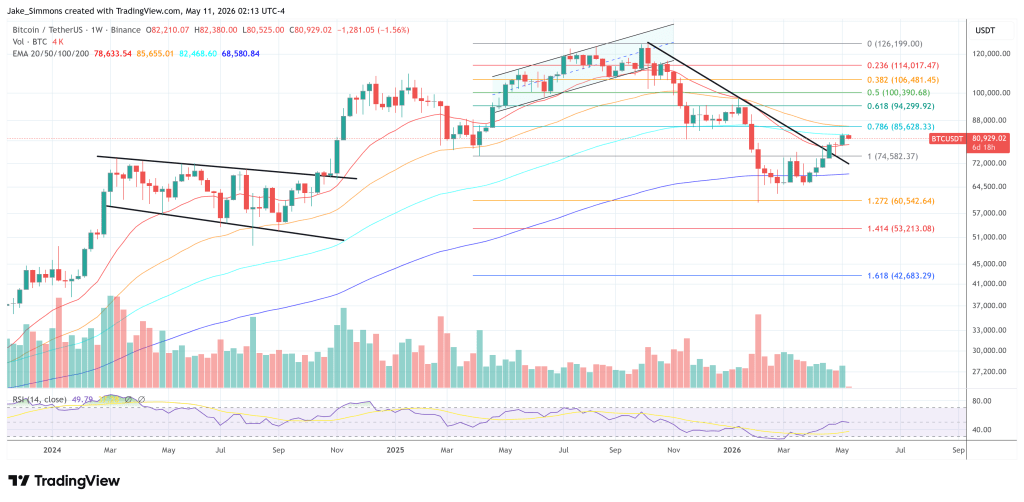
BTC bulls eye the 0.786 Fib, 1-week chart | Source: BTCUSDT on TradingView.com

Related Questions

QWhat is the main accusation that Michael Saylor was addressing regarding MicroStrategy's business model?

AMichael Saylor was addressing accusations from critics like Peter Schiff that MicroStrategy's Bitcoin-backed credit model and its STRC dividend structure resemble a Ponzi scheme.

QHow did Michael Saylor clarify his famous phrase 'never sell your Bitcoin' in the context of MicroStrategy's strategy?

ASaylor clarified that a more precise formulation is that MicroStrategy does not intend to be a 'net seller' of Bitcoin, meaning they plan to buy more Bitcoin than they sell over time.

QWhat analogy did Michael Saylor use to explain MicroStrategy's core business model involving Bitcoin and credit?

ASaylor compared the model to a real estate development company that raises capital through credit, acquires land (Bitcoin), improves it, and later monetizes the appreciation through sales, rent, or refinancing.

QAccording to Saylor, what is the key financial mechanism that allows MicroStrategy to pay STRC dividends without becoming a net seller of Bitcoin?

ASaylor stated that if Bitcoin appreciates at least 2.3% per year (the STRC dividend rate), the company can pay dividends from the capital gains and continue growing its Bitcoin holdings, especially as new credit issuance funds further Bitcoin purchases.

QHow did Michael Saylor characterize Peter Schiff's fundamental objection to MicroStrategy's STRC instrument?

ASaylor characterized Schiff's objection as stemming from a fundamental rejection of Bitcoin itself as a legitimate asset, making it impossible for Schiff to accept any derivative financial instrument built on top of it.

Related Reads

"119 to 176 Dollars": Behind SpaceX's Listing, MSX Once Again Successfully Executes the Pre-IPO Closed Loop

Following May's 300% gain on Cerebras, MSX delivered another outstanding performance during SpaceX's listing night. On June 12, SpaceX (SPCX) launched on Nasdaq, reaching a high of $176. This marked the successful culmination of MSX's Pre-IPO project launched in March, where users subscribed at $119, achieving gains of approximately 40-48%. This event validated MSX's complete Pre-IPO mechanism, a crucial advantage in a market where access to top-tier private company equity is typically limited to institutions. MSX's model provides a full cycle for users: subscription (at $119 for SpaceX), real-time on-chain portfolio tracking, optional early redemption, seamless conversion to tradable spot assets (SPCX.M) upon IPO, and final settlement in stablecoins. This end-to-end process distinguishes MSX from platforms that faced settlement issues during the SpaceX IPO, highlighting that the core challenge of Pre-IPO is not just access, but a clear exit and conversion path post-listing. This success with SpaceX is MSX's second major Pre-IPO verification, following the Cerebras listing in May, which yielded ~300% returns for early participants. These back-to-back achievements demonstrate MSX's capability to source, structure, and deliver real assets through a replicable on-chain model. The true barrier for Pre-IPO products lies not in providing an entry point, but in ensuring reliable fulfillment from subscription through to post-IPO liquidity. MSX's proven闭环 (closed-loop) process addresses this, offering Web3 users a structured way to access high-growth, pre-public companies in sectors like AI and frontier tech. MSX plans to continue expanding its Pre-IPO portfolio with this focus on authenticity, transparency, and post-listing execution.

Odaily星球日报46m ago

"119 to 176 Dollars": Behind SpaceX's Listing, MSX Once Again Successfully Executes the Pre-IPO Closed Loop

Odaily星球日报46m ago

Trading

Spot
Futures

Hot Articles

Discussions

Welcome to the HTX Community. Here, you can stay informed about the latest platform developments and gain access to professional market insights. Users' opinions on the price of S (S) are presented below.

活动图片