Rejecting Nvidia's Offer at $6 Per Share, He Says He Can Earn More Trading Stocks

marsbitPublished on 2026-05-22Last updated on 2026-05-22

Abstract

A mysterious X user known as Serenity (@aleabitoreddit) has become a significant influence in financial markets, with over 150,000 followers across three continents tracking his stock picks. His recent endorsement of UK hardware company Raspberry Pi ($RPI) triggered an approximate 90% surge in its stock price over two days, later validated by strong earnings that matched his forecasts. Previously banned from Reddit's r/wallstreetbets for a controversial post, Serenity moved to X. He claims to be a former AI research scientist who declined a job offer from Nvidia when its stock was around $6. His identity and reported investment returns (e.g., 630% in one year) remain unverified. Serenity's strategy focuses on identifying "chokepoints"—critical, often overlooked components in complex supply chains, like the indium phosphide substrates for AI datacenter optics. His calls on small-cap stocks such as AXTI and Sivers Semiconductors (SIVE) have preceded major price rallies driven by events like export controls or strategic partnerships. While his free, public research differs from typical financial influencers who sell courses, the anonymous, self-reported nature of his success warrants caution. He represents a new phenomenon where detailed, niche analysis can move markets, but his track record lacks independent audit.

Across three continents, 150,000 people, from retail investors to hedge fund managers, are copying the homework of a 'Twitter Stock God.'

His recent public endorsement of a stock directly led to a nearly 90% surge in just two days.

On February 17, 2026, at the London Stock Exchange, a small stock named Raspberry Pi in the FTSE 250 index saw its price soar 27% in the first hour of trading. It accumulated gains of nearly 90% over two days and still maintained over a 50% gain within a week.

This UK hardware company, with a market capitalization of just over £500 million, had seen its stock price languish below its IPO price for the past six months.

No analyst expected it to become one of the hottest UK stocks at the start of 2026.

Reuters, Bloomberg, the Financial Times, and The Register all sent reporters to investigate, with their clues all pointing to the same source.

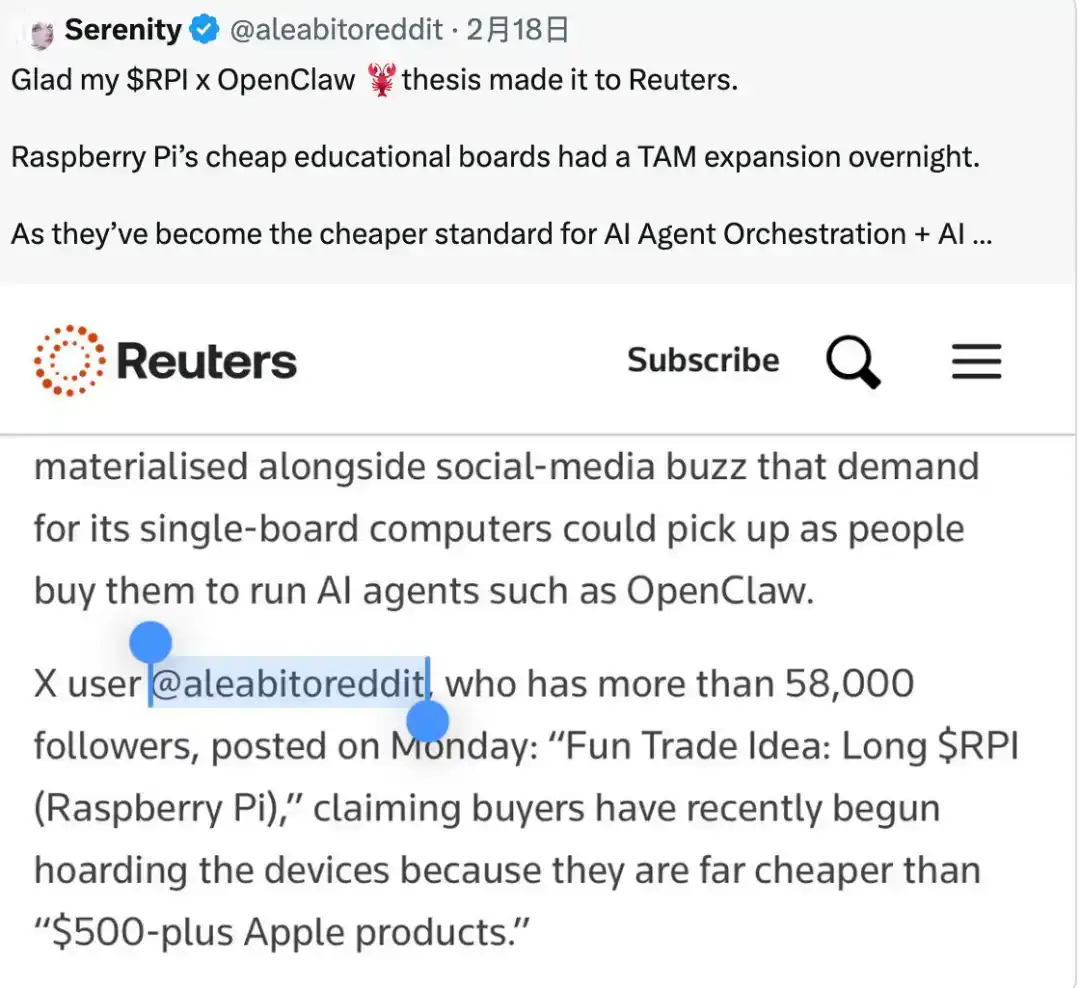
The day before, Eastern Time, an account with 58,000 followers on platform X posted a tweet titled, 'Fun Trade Idea, Long $RPI.'

The account name is Serenity, with the handle @aleabitoreddit, using a female profile picture.
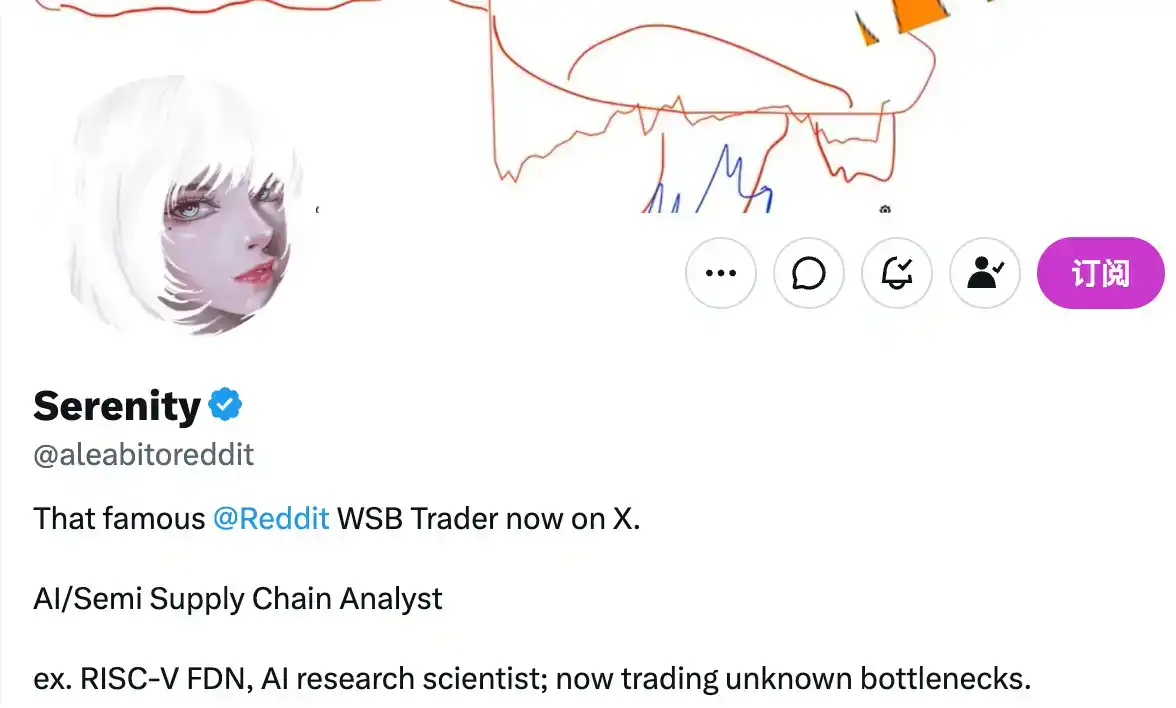
The opening line of Bloomberg's report read, 'It all started Monday with a post titled 'Fun Trade Idea' from a user called aleabitoreddit on X.'

Reuters' article directly quoted Serenity's arguments about Raspberry Pi. When asked about the unusual stock activity, a Raspberry Pi company spokesperson stated, 'The company has no information beyond what is already in the public domain.'

The story doesn't end there.

At the end of March, Raspberry Pi released its full-year financial results. Revenue grew by 58%. Serenity's prediction two months prior was 55%.

The consensus among sell-side analysts aggregated by Bloomberg was only 14% at the time. On the day the earnings were released, RPI's stock price rose another 44.76% in a single day, followed by another 27.43% the next day.

This is why, over the past year, an increasing number of Silicon Valley investors have added this Twitter account to their daily must-read list.

A single tweet moved a FTSE 250 constituent's market cap by 50% in a week, and two months later, an earnings report validated his forecast.

Yet, the person repeatedly creating such market ripples—no one knows his real name.

The Person Who Was Banned

The Serenity account's bio describes him as an 'AI Semiconductor Industry Chain Research Institute,' 'Nature paper,' 'RISC-V Foundation member.'

He once joked that in 2018, Nvidia tried to recruit him to lead an AI team when Nvidia's stock price was only around $6.

But he declined.

To understand the Serenity account, the story must start with a ban four years ago.

In early 2022, the moderators of r/wallstreetbets, the self-proclaimed world's largest casino for retail traders, banned an account named AleaBito.

The incident started when this account posted about a stock with a name that sounded like a pyramid scheme.

AXTI, with a market cap just over $200 million, specialized in indium phosphide substrates; its stock price was around $12 at the time. The moderators accused him of drumming up hype and with a single strike, banned the account.

AXTI later rallied to $70. In Serenity's own recent review, he called this his most legendary trade to date, with a single-stock profit of 1000%.

After the ban, he switched platforms directly. He moved from Reddit to X, giving himself the new name Serenity, meaning 'peace' in Chinese.

A person chased off a forum giving himself such a name left a line in his bio, 'That famous WSB trader, now on X.'

He claims to have been an AI research scientist, a RISC-V Foundation member, published a Nature paper, and turned down Nvidia's offer to lead an AI team.
Serenity's followers have grown rapidly this year, with people in the US, Taiwan, and European stock communities translating his posts. In Chinese communities, moomoo, Xueqiu, and PTT each have copy-trading groups.

Some have built dashboards to track his portfolio changes; some manage hedge funds based on his ideas. His paid product is just an Excel sheet, which he jokingly calls 'A Dollar's Worth of Ideas.' All core research is freely disclosed on X.

The Consistent Winner

Calling RPI is just one among his past calls. Serenity has a string of similar cases, each following the same trajectory: post a tweet, get criticized, then get validated.

First, AXTI. The very stock that got him banned from WSB.

Indium phosphide substrate, the foundational material at the very bottom of AI datacenter optical modules. In February 2025, the East implemented export controls on indium phosphide. By January 2026, license approvals tightened further, forcing AXT to lower its quarterly revenue guidance.

Overnight, this small plant in Fremont, California, transformed from a small-cap stock into a national security-level strategic asset. He called this company two years ago.

Second, SIVE. Sweden's Sivers Semiconductors, listed in Stockholm, making CPO external light source continuous-wave lasers, a core component for next-generation 1.6T co-packaged optics.

After he publicly announced his position, the first wave saw a single-day surge of 73.78%, its market cap instantly jumping from $130 million to $230 million. On April 15, 2026, Jabil announced a collaboration with SIVE to develop 1.6T LRO optical modules, boasting a 2.5x efficiency advantage. A month later, on May 19, CHIPS Act Year 2 funding of $6.6 million arrived.

Third, Soitec. A French semiconductor company, the near-monopoly player in CPO SOI substrates, with even Japan's Shin-Etsu needing to license from them.

He explicitly tweeted a change in view this March, building a position around €43, calling it 'a hidden monopoly to hold long-term.' That day, Soitec's stock price surged 16%.

And a string of Taiwanese stocks. FOCI (3363, microlens and fiber arrays), Win Semiconductors (3105, GaAs foundry), TSEM (Tower Semiconductor).

These stocks were already discussed among local retail circles in Taiwan, but in the English-speaking world, he might be the first to systematically link them to the CPO narrative.

Regarding performance, he self-reported a 630% return in the year before joining X, and his YTD at one point this year exceeded 500%, recently experiencing some pullback.

Of course, these numbers are unaudited and can only be taken as reference.

But one thing has been verified. Reuters and Bloomberg directly cited his online alias in their reports.

150,000 followers across three continents translate his posts, hedge funds copy his homework.

The Bottleneck Point

To understand Serenity's investment logic and what he got right, one must first understand Wall Street's dominant narrative over the past three years.

From 2023 to 2026, retail investors worldwide have been chasing the same batch of tickers: AI

Nvidia, AMD, Microsoft, Google, Meta.

Every sell-side report, every YouTube creator, every financial headline was calculating whether these companies would beat expectations next quarter.

Serenity went the opposite way. He dug downwards, layer by layer, searching for the 'nuts and bolts' on Nvidia.

He gave this kind of thing a name: chokepoint, the bottleneck point.

This concept can be explained with an analogy.

Indium phosphide substrate is to AI optical modules what the Strait of Hormuz is to global oil. 20% of the world's oil passes through that strait; whoever controls it controls everyone.

Another more everyday version. In high-end kaiseki restaurants in Tokyo's Ginza, the most expensive item on the bill might be otoro tuna, but what the entire shop can't do without is the shiso leaf underneath the sashimi.

90% of Japan's premium shiso leaves come from a few family farms in Izu. When a typhoon hits and the farms close, all the kaiseki restaurants in Ginza have to shut down that day.

A bottleneck point is something like that. Usually unmentioned, but if a problem arises, everyone is finished.

Serenity's working method is the exact opposite of mainstream Wall Street analysts.

Sell-side analysts look down from big companies; he works backward from bottleneck points. He draws his own supply chain maps, starting from Nvidia H100 clusters and working backward layer by layer to the deepest narrow passages. He uses AI to challenge himself, often saying, 'I make Gemini challenge my thesis,' feeding his research to AI to play the devil's advocate.

Using stocks from the US, Taiwan, Europe, and Japan, he mapped out a complete global bottleneck point map for the AI era.

Each node is a potential Strait of Hormuz. Every geopolitical event, every earnings report, every export control measure, he can find the corresponding coordinate on his map and then vote with his portfolio.

Recently, he has extended his radar to rare earths and humanoid robots. The investment logic remains a continuation of before: find narrow passages, find monopolies, find the links that, if broken, spell disaster for everyone.

This is something most Wall Street sell-side analysts can't do. They are siloed by department: TMT analysts don't cover materials, materials analysts don't cover optics, optics analysts don't cover geopolitics.

His most frequent saying is, 'My earliest views are usually the ones that get criticized the most.'

Is He the God of Retail Investors, or Just Another Glorified Gambler?

Writing up to this point, the tone must shift.

Strip away all the unverifiable aspects of Serenity: completely anonymous identity, no photos, real name, or institutional background to check.

'Rejected Nvidia's AI team offer at $6 per share,' 'Nature paper,' 'RISC-V Foundation member'—all self-reported.

Self-reported performance, no audit, no third-party reconciliation. Highly concentrated portfolio, mostly small to mid-cap non-consensus stocks with poor liquidity. Retail followers can easily enter at the wrong time.

Among financial KOLs over the past decade, those with unverified identities, self-reported performance, and rampant copy-trading culture mostly ended badly.

But there are a few things about Serenity that are different.

So far, he hasn't sold courses, run copy-trading groups, offered training, or charged for high-priced subscriptions. Core research is freely public on X. He doesn't take ads, drive traffic, or work with MCNs.

Currently, he doesn't qualify as a scammer. But he shouldn't be treated as a god either.

Of course, an anonymous person banned from a forum, getting over 150,000 people, including Wall Street hedge funds, to work for him for free, validating his arguments, disseminating his research, translating his posts.

That is also legendary in its own right.

Related Questions

QWho is Serenity, and what is his main claim regarding his background?

ASerenity is an anonymous financial influencer on X (formerly Twitter) with 5.8 thousand followers, known for his stock market predictions. He claims to have a background as an AI research scientist, a Nature paper author, a RISC-V Foundation member, and to have turned down an offer from Nvidia to lead an AI team when its stock was around $6.

QWhat was the key stock recommendation that first brought Serenity widespread attention, and what was the result?

AHis key stock recommendation was for Raspberry Pi (RPI) on the London Stock Exchange. After his post, the stock surged nearly 90% in two days and maintained a gain of over 50% within a week. Later, when the company's earnings matched his prediction, the stock price rose again significantly.

QWhat is Serenity's core investment philosophy or strategy as described in the article?

ASerenity's core investment strategy is to identify 'chokepoints' or bottlenecks in global supply chains. He focuses on small, often overlooked companies that produce critical components for major industries like AI, where a disruption could have widespread effects. He researches from the bottom up, mapping supply chains to find these narrow, monopolistic points.

QWhat is one major concern or criticism mentioned in the article about following Serenity's advice?

AA major concern is that Serenity's identity and claimed credentials are entirely anonymous and unverifiable. His reported investment returns are unaudited, and his recommended stocks are often small-cap, illiquid, and non-consensus picks. This makes it risky for followers who might enter positions at the wrong time, and history suggests such anonymous financial influencers often end poorly.

QHow does Serenity's approach to sharing his research differ from that of many other financial influencers, according to the article?

AUnlike many financial influencers, Serenity does not sell courses, run paid groups, offer high-priced subscriptions, or engage in MCN/advertising deals. He makes his core research freely available on his X account, with his only paid product being a simple Excel spreadsheet he jokingly calls 'a dollar idea'.

Related Reads

Female Crypto Mogul Survived Mining Crackdown and Market Plunge, but Paid a $60 Million Tuition to a U.S.-Style 'Pig-Butchering' Scam

An 80s-born Chinese entrepreneur, Fiona Lyu (also known as Lv Yongshuang), CEO of the mining firm Chengdu Valarhash Technology, was defrauded of over $9.4 million (approx. RMB 60 million) in the US, according to a Caixin report. Lyu's company once operated the 1THash and Bytepool mining pools, which collectively controlled about 9% of the global Bitcoin hash rate at their peak in early 2020. The scam began in 2021 after China's crackdown on crypto mining forced Lyu to seek overseas relocation for her operations. She was introduced to Zubair Al Zubair, who posed as an "UAE royal family member" with connections to Middle Eastern capital and US local government resources. He and his brother, who impersonated a hedge fund manager, orchestrated a fake contract signing for a mining facility in Ohio, witnessed by local officials. Lyu transferred millions in contract payments. The brothers, both US citizens with fabricated backgrounds, later fraudulently sold 1,067 of her miners for $6.17 million. The scheme involved bribing a mayor's chief of staff for legitimacy. In May 2026, US courts sentenced Zubair to 24 years in prison, his brother to 23 years, and the official to 8 years. Simultaneously, Lyu faced a separate legal battle in China. A subsidiary of listed company ST Zhongchang sued her firm, seeking refunds for a 2021 contract involving Bitcoin mining equipment. Chinese courts ruled the mining contract invalid and ordered a refund of nearly RMB 19.3 million. This dual blow marked a stark downturn for the once-prominent figure in the crypto mining industry.

Foresight News12m ago

Female Crypto Mogul Survived Mining Crackdown and Market Plunge, but Paid a $60 Million Tuition to a U.S.-Style 'Pig-Butchering' Scam

Foresight News12m ago

Trade.xyz Pricing Controversy Exposes Fatal Weakness of Pre-IPO Perpetual Contracts

The Trade.xyz pricing controversy surrounding its SPCX (SpaceX) pre-IPO perpetual contract on Hyperliquid has exposed a critical vulnerability in decentralized finance (DeFi) platforms offering such instruments. The dispute erupted after SpaceX's updated filing revealed its total shares outstanding were approximately 10% higher than market estimates. While centralized exchanges (CEXs) paused trading and repriced contracts based on the new data, Trade.xyz maintained its position that its "IPOP" contract tracks market expectations for the per-share price, not the company's fundamental valuation or share count. This discrepancy triggered cross-platform arbitrage and led to significant losses for leveraged long positions on Trade.xyz, as the contract price gaped down without a value-neutral adjustment mechanism. The incident highlights the absence of a "Rebase" function—a mechanism that proportionally adjusts contract prices and user positions to reflect corporate actions like share count changes—within many decentralized perpetual exchanges (Perp DEXs). Unlike CEXs, which can centrally execute such adjustments, implementing Rebase on-chain involves significant technical complexity, gas costs, and potential security risks. Trade.xyz's architecture, which allows independent market deployment, further complicates platform-wide Rebase implementation. The controversy underscores broader challenges for Perp DEXs venturing into real-world assets (RWA) like pre-IPO shares. It raises questions about pricing reliability, transparent rule disclosure, and the ability to handle corporate events, testing user trust and the long-term viability of these synthetic markets for price discovery before official listings.

链捕手28m ago

Trade.xyz Pricing Controversy Exposes Fatal Weakness of Pre-IPO Perpetual Contracts

链捕手28m ago

When AI Traffic Surpasses Humans, How Do You Prove You're Human?

As AI-generated web traffic now surpasses human activity, the internet's foundational business models—built on human attention, browsing, and advertising—face severe disruption. AI agents crawl websites at immense scale without generating ad revenue, while AI summaries divert traffic from original content sites. In response, over 2.5 million sites are blocking AI crawlers, and protections like Cloudflare's "honeypot" traps have emerged, though advanced AI can bypass these. The collapse of traditional CAPTCHAs, which assumed machines were weaker than humans, has led to a shift toward behavioral biometrics for human verification. Companies like IBM and BioCatch now analyze unique human patterns—cursor movements, typing rhythms, keystroke dynamics, and even cognitive delays like the Stroop effect—to distinguish real users from bots. These biometric signatures are difficult to fake or alter, offering a new layer of security but raising significant privacy concerns. Two competing visions for a reliable human verification system are emerging. One, exemplified by Sam Altman’s World (formerly Worldcoin), uses centralized iris scanning to generate unique credentials, though it faces bans and criticism over unauthorized data collection. The other employs cryptographic zero-knowledge proofs, allowing users to prove they are human without revealing identity or biometric data, as advocated by Vitalik Buterin. However, decentralized approaches risk exploitation through identity renting in economically unequal regions. The central dilemma is between a scalable but privacy-invasive centralized system that permanently controls users' biometric data, and a privacy-preserving cryptographic system vulnerable to real-world economic manipulation. The author expresses a preference for the cryptographic path, arguing that despite its flaws, it avoids the irreversible biometric surveillance inherent in centralized alternatives.

Foresight News36m ago

When AI Traffic Surpasses Humans, How Do You Prove You're Human?

Foresight News36m ago

Crypto Primary Market Investment and Financing Forward-Looking Weekly Report | Stablecoin Regulation Nears Implementation, ETF Funds Continue to Withdraw, Capital Begins Betting on Payment and Cash Flow

Crypto Market Weekly Report (Jun 1-7, 2026): Capital Shifts Focus to Payments & Cash Flow Market data indicates a significant divergence: while traditional institutional funds continue exiting via BTC and ETH ETFs (recording net outflows of $1.72B and $168M this week, respectively), stablecoin supply continues growing. This suggests capital is shifting from speculative asset allocation toward defensive positioning within on-chain liquidity, awaiting new, concrete opportunities. This trend is reflected in venture capital focus. Weekly fundraising fell 27% to $302M, with investments concentrating on infrastructure with tangible revenue potential: 1. **Stablecoin Infrastructure (28% of funding):** Projects like M0 Protocol ($35M raise) are gaining attention as regulatory clarity (e.g., the GENIUS Act) nears, shifting the focus from legitimacy to building payment and settlement networks. 2. **AI Agent Infrastructure (26%):** Investments are moving from conceptual AI Agents towards the execution and economic layers required for a functional "Agent economy." Key raises include OpenRouter ($40M) and Halliday ($20M). 3. **Real World Assets (RWA) (18%):** The search for on-chain yield and cash flow drives continued interest in RWA platforms like Ondo Finance. Security threats are evolving from smart contract exploits toward key management failures, permission control issues, and regulatory execution risks (e.g., court-ordered asset freezes). **Key Takeaways:** The investment thesis is shifting from narrative-driven bets to revenue and cash-flow-generating protocols. Future attention should be on the progression of stablecoin regulations, the commercial validation of AI Agent economies, and the performance of high-revenue protocols like derivatives platforms.

marsbit43m ago

Crypto Primary Market Investment and Financing Forward-Looking Weekly Report | Stablecoin Regulation Nears Implementation, ETF Funds Continue to Withdraw, Capital Begins Betting on Payment and Cash Flow

marsbit43m ago

Trading

Spot
Futures

Hot Articles

Discussions

Welcome to the HTX Community. Here, you can stay informed about the latest platform developments and gain access to professional market insights. Users' opinions on the price of S (S) are presented below.

活动图片