Trade.xyz Pricing Controversy Exposes Fatal Weakness of Pre-IPO Perpetual Contracts

链捕手Published on 2026-06-11Last updated on 2026-06-11

Abstract

The Trade.xyz pricing controversy surrounding its SPCX (SpaceX) pre-IPO perpetual contract on Hyperliquid has exposed a critical vulnerability in decentralized finance (DeFi) platforms offering such instruments. The dispute erupted after SpaceX's updated filing revealed its total shares outstanding were approximately 10% higher than market estimates. While centralized exchanges (CEXs) paused trading and repriced contracts based on the new data, Trade.xyz maintained its position that its "IPOP" contract tracks market expectations for the per-share price, not the company's fundamental valuation or share count. This discrepancy triggered cross-platform arbitrage and led to significant losses for leveraged long positions on Trade.xyz, as the contract price gaped down without a value-neutral adjustment mechanism. The incident highlights the absence of a "Rebase" function—a mechanism that proportionally adjusts contract prices and user positions to reflect corporate actions like share count changes—within many decentralized perpetual exchanges (Perp DEXs). Unlike CEXs, which can centrally execute such adjustments, implementing Rebase on-chain involves significant technical complexity, gas costs, and potential security risks. Trade.xyz's architecture, which allows independent market deployment, further complicates platform-wide Rebase implementation. The controversy underscores broader challenges for Perp DEXs venturing into real-world assets (RWA) like pre-IPO shares. It raises q...

Author: Nancy, PANews

As crypto players on social media were eagerly posting screenshots of their SpaceX subscriptions and sharing the joy of participating in this super IPO feast, Trade.xyz on Hyperliquid became a focal point of market controversy due to the pricing rules of its SpaceX (SPCX) pre-IPO perpetual contract, plunging into a public opinion vortex.

Following the SPCX Pricing Storm, Trade.xyz Faces a Trust Test

On June 10th, Trade.xyz issued a statement formally responding to the recent pricing controversy surrounding the SPCX pre-IPO perpetual contract.
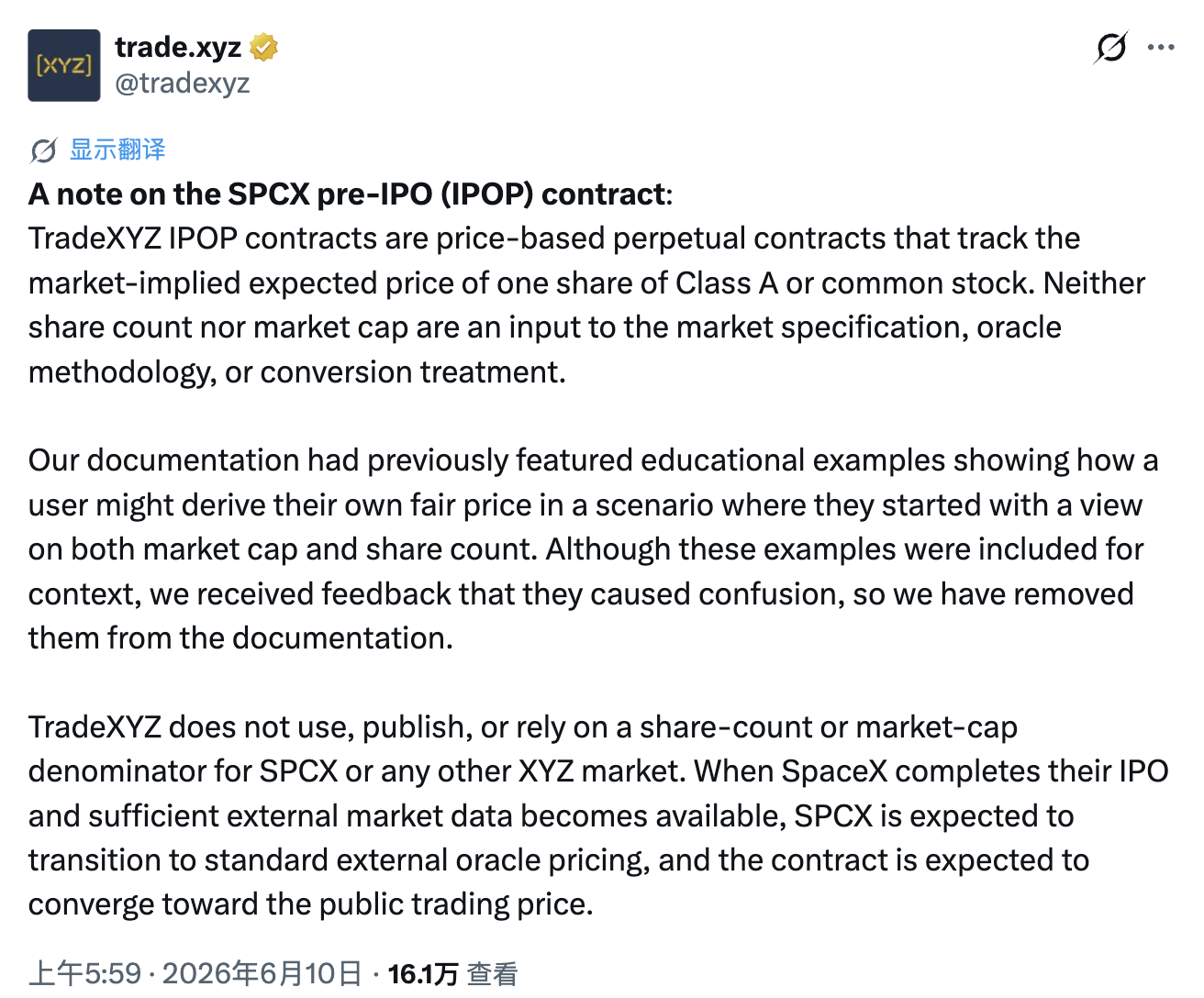
According to the statement, Trade.xyz's IPOP contract is a type of price-based perpetual contract. Its core objective is to track market expectations for the price per share of Class A Common Stock, rather than reflecting the company's overall valuation. Therefore, information such as the company's total shares outstanding or market capitalization is not part of the contract rules, oracle pricing logic, or future contract conversion mechanisms. In other words, the SPCX price on Trade.xyz is more akin to an indicator reflecting market sentiment and trading expectations, not a theoretical stock price calculated based on company fundamentals.

Trade.xyz also mentioned that early product documentation had included some tutorial examples demonstrating how users could derive a reasonable per-share price based on their own judgments about company valuation and total shares outstanding. Although these contents were intended only to help understand the product mechanism, some users mistakenly believed the platform itself would price based on market cap or share data. Consequently, these examples have now been removed from the official documentation.

The statement emphasizes that Trade.xyz will not use, disclose, or rely on share count or market capitalization as a pricing benchmark for SPCX or any other XYZ market.

The trigger for this controversy came from the recently disclosed updated SpaceX S-1 filing. The document shows SpaceX's actual total shares outstanding is 13.08 billion, approximately 10% higher than the previously widely used market estimate of 11.87 billion shares. This implies that, assuming the company's overall valuation remains unchanged, the corresponding theoretical per-share price for SpaceX would need to be adjusted downward by about 10%.

Following this announcement, several centralized exchanges (CEXs) chose to suspend related contract trading, repricing based on the new share data before resuming trading. In contrast, Trade.xyz insisted its product logic does not depend on share count data and therefore did not adjust its pricing framework accordingly. The divergence between the two pricing systems sparked a wave of cross-platform arbitrage, quickly thrusting Trade.xyz into the spotlight of public scrutiny.

Regarding how to resolve this discrepancy in the future, Trade.xyz stated that once SpaceX officially completes its IPO and sufficient external trading data is formed in the public market, SPCX will switch to a standard external oracle pricing mechanism. At that point, the contract price is expected to gradually converge to the actual trading price of SpaceX stock in the public market.
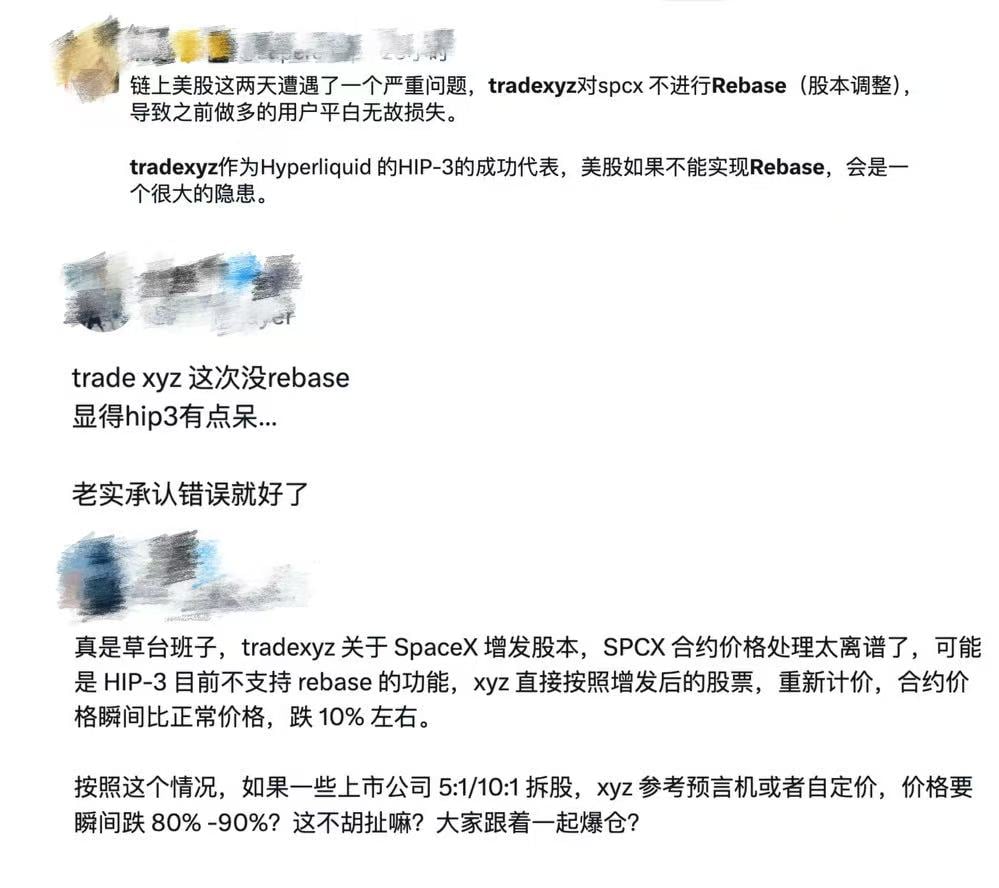
Feedback from some community members

However, this clarification further fueled market controversy. Many users believe that during the initial product launch, Hyperliquid did not sufficiently and clearly disclose the contract rules, and the UI interface and official documentation long contained descriptions that were prone to misinterpretation. It was only when the IPO approached and the controversy erupted that the platform hastily issued a clarification announcement and revised the documentation. This retroactive corrective approach was difficult to convince users.

Greater discontent stemmed from users' real financial losses. As the HIP-3 mechanism itself lacks the Rebase capability of traditional exchanges, when the market repriced based on SpaceX's latest share count, the SPCX contract price could only be passively adjusted downward in a gap. As a result, the value of long positions shrank by approximately 10% in a short period, forcing many highly leveraged users to liquidate or even be directly liquidated. These losses directly translated into gains for short positions and arbitrageurs.

In the view of these affected users, the platform not only failed to express sufficient concern for the losses suffered but also did not propose any compensation or mitigation measures. Instead, it responded with "the product mechanism is as such," appearing very indifferent and lacking a sense of responsibility.

In a sense, the discussion surrounding SPCX pricing authority also provides a reference case for the design and rule disclosure of future on-chain Pre-IPO assets.

Rebase Dilemma Remains, On-Chain Pre-IPO Faces a Major Test

For Perp DEXs, lacking Rebase capability means that any future Pre-IPO asset, if it encounters common corporate actions in traditional stock markets like stock splits, additional issuances, or dividends, could lead to instantaneous revaluation of contract prices. This may trigger large-scale cascading liquidations and unfair losses, eroding user trust in the platform.

To understand the importance of Rebase, it is first necessary to understand what Rebase is and why it becomes a critical component in the design of Pre-IPO perpetual contracts.

Simply put, Rebase is a value-neutral adjustment mechanism. The platform synchronously adjusts the contract price and user position quantity in the same proportion, keeping the trader's overall position value largely unchanged before and after the adjustment. The need for this mechanism arises because during the Pre-IPO stage, the company's actual total shares outstanding are usually not publicly disclosed. Exchanges can only design the contract's initial price and multiplier based on market-estimated share counts. When the company formally submits an S-1/S-1A filing and discloses the actual share count, if the real number differs from the estimate, Rebase is needed to calibrate contract parameters. Otherwise, the contract price will gradually deviate from the true per-share value, creating opportunities for cross-platform arbitrage and causing passive losses for one-sided position holders.

However, compared to CEXs, implementing Rebase on Perp DEXs is more challenging.

Specifically, CEXs rely on centralized databases and professional risk control teams. They can quickly suspend trading after a corporate action (like a share increase or stock split), uniformly adjust all user positions via the exchange backend, and then resume market trading. This process is completed by the exchange, keeping users' nominal position value smooth and continuous. However, even for large CEXs with mature trading systems and professional technical teams, such Rebase operations involving synchronized adjustments across all market positions remain a complex engineering task.

Furthermore, on Perp DEXs, matching, liquidation, and position states all run on smart contracts, preventing direct data modification like CEXs. Achieving a similar Rebase effect often requires designing additional monitoring logic, special hooks, or upgrading contract mechanisms. This not only increases Gas costs and system complexity but also expands the potential attack surface, introducing new security risks.

Additionally, Rebase may further amplify the existing problem of liquidity fragmentation in decentralized markets. The same Pre-IPO asset might exist simultaneously on multiple DEXs, each with limited market depth. Facing the extra uncertainty brought by Rebase, LPs (Liquidity Providers) may reduce their willingness to commit capital, ultimately leading to decreased liquidity, wider slippage, and a further deterioration of the trading experience.

Of course, Rebase is not entirely impossible within a decentralized architecture. Some community users pointed out that, for example, Aster has already completed a Rebase adjustment for a similar asset. This suggests the real challenge is not that DEXs are inherently incapable of support, but rather whether platforms are willing to design additional mechanisms and bear the associated development and operational costs.

In contrast, beyond adhering to a more market-oriented pricing philosophy, Trade.xyz's underlying HIP-3 architecture allows developers to independently deploy their own Perp markets. While this model inherits Hyperliquid's high-performance order book system, each market has completely independent contract specifications, oracle definitions, and parameter settings. It lacks platform-level native support for unified Rebase, making it unable to easily implement batch adjustments for all positions. However, community insiders also revealed that Trade.xyz is researching solutions for possible future special events like stock splits.
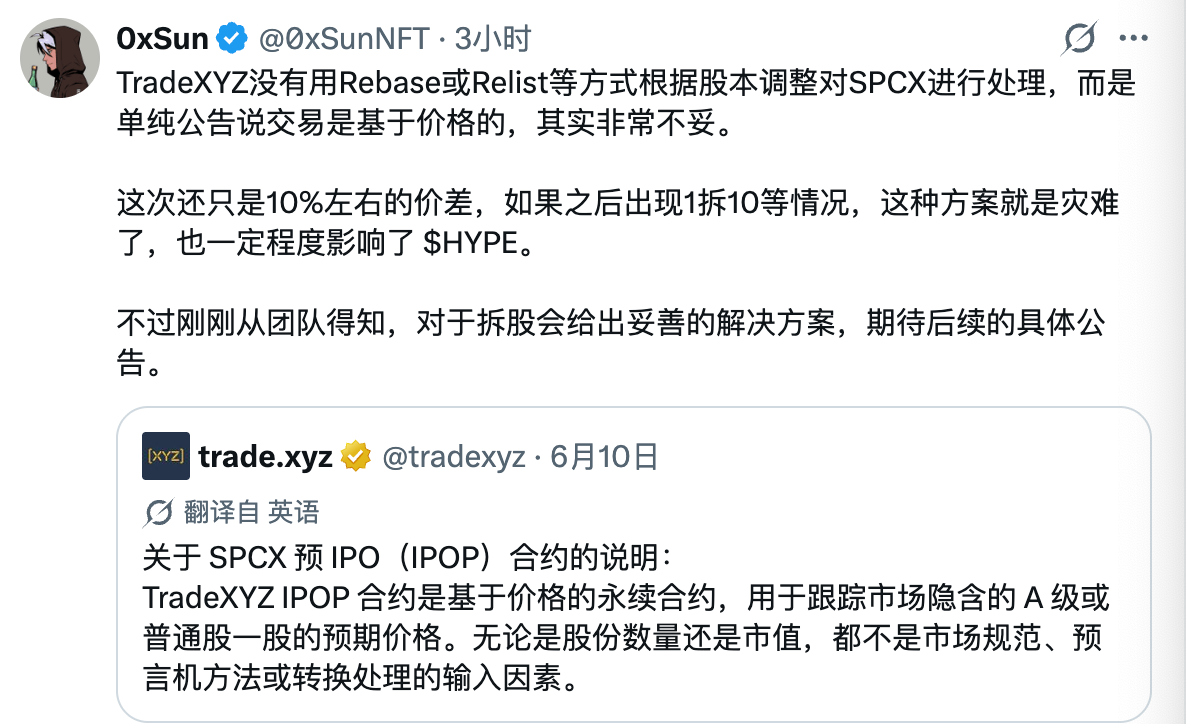
From a longer-term perspective, the SPCX pricing controversy exposes not merely a single product design flaw but also a practical challenge that current Perp DEXs must confront in their exploration of RWA assets. In the future, as more Pre-IPO assets are mapped onto the blockchain, serving as a prelude to public market price formation, the question remains: Can on-chain Pre-IPO perpetual contracts establish a reliable enough price discovery mechanism? Can they withstand the tests of real corporate actions and information disclosure? Or will they devolve into capital games detached from fundamentals? Time and the market will provide the answers.


Trending Cryptos

Related Questions

QWhat was the core reason behind the controversy surrounding Trade.xyz's SPCX pre-IPO perpetual contract?

AThe controversy stemmed from a misunderstanding about the contract's pricing rules. Trade.xyz's SPCX contract was designed to track market expectations for the per-share price of SpaceX's A-class common stock, not the company's total valuation based on fundamentals like share count. When SpaceX's official filing revealed ~10% more shares than the market's previous estimate, other exchanges paused and repriced, but Trade.xyz did not, as its mechanism was not based on share count. This created a price discrepancy, caused significant losses for leveraged long positions, and led to accusations of insufficient disclosure.

QHow did Trade.xyz's response to the SpaceX share count revision differ from centralized exchanges (CEX)?

ACentralized exchanges (CEXs) paused trading for their related SpaceX contracts, repriced them based on the new, higher share count (which lowered the implied per-share price), and then resumed trading. Trade.xyz, however, did not adjust its pricing framework. It maintained that its HIP-3 based contract mechanism was designed to track market expectations for the per-share price and was not dependent on share count or valuation data for pricing, leading to a persistent price gap with CEXs.

QWhat is the 'Rebase' mechanism, and why is it a critical challenge for decentralized perpetual exchanges (Perp DEX) offering Pre-IPO contracts?

AA 'Rebase' is a value-neutral adjustment mechanism. When a company's fundamental data (like total shares) changes, the exchange simultaneously adjusts the contract price and users' position sizes by the same ratio, keeping the total dollar value of holdings constant. For Perp DEXs, implementing Rebase is difficult because all operations (matching, clearing, positions) are on-chain in smart contracts. Unlike CEXs which can centrally modify databases, DEXs require complex, potentially risky contract upgrades or new mechanisms to achieve this, increasing gas costs, complexity, and security vulnerabilities.

QWhat were the main user complaints against Trade.xyz following the SPCX pricing incident?

AUsers complained about: 1) Insufficient and unclear initial disclosure of contract rules, with misleading descriptions in UI and documentation that were only corrected after the controversy erupted. 2) Significant financial losses, as the lack of a Rebase mechanism forced a sharp downward price gap, causing leveraged long positions to be liquidated or suffer ~10% losses, which benefited shorts and arbitrageurs. 3) A perceived lack of responsibility and empathy from the platform, which responded by simply stating 'this is how the product works' without offering compensation or mitigation plans.

QWhat broader issue for the DeFi sector does the SPCX pricing controversy highlight, according to the article?

AThe controversy highlights a fundamental challenge for Perp DEXs venturing into Real-World Asset (RWA) tokenization, specifically Pre-IPO assets. It exposes the difficulty of designing robust on-chain derivatives that can withstand real-world corporate actions (like share count changes, stock splits, dividends) and information disclosures. The incident questions whether on-chain Pre-IPO perpetual contracts can establish reliable price discovery mechanisms before a public listing or if they risk devolving into speculative markets detached from underlying fundamentals.

Related Reads

Must-Watch Events Next Week|CLARITY Act Could Face Senate Vote; SpaceX, Circle to Report Earnings (8.3-8.9)

**Summary: Key Events and Developments to Watch (August 3-9)** The upcoming week is marked by significant financial disclosures, key legislative deadlines, and notable product updates. **Major Financial Events:** Several companies are scheduled to release their Q2 2026 earnings. American Bitcoin (ABTC) will report on August 3, followed by SpaceX and Hut 8 Mining Corp. on August 4, and Circle on August 5. Notably, a significant portion of SpaceX shares (up to 12% of total shares) will be unlocked on August 6 following their earnings release. **Key Legislative Deadline:** The U.S. Senate faces an August 7 deadline to secure 60 votes for the CLARITY Act, a bipartisan bill aiming to establish a federal regulatory framework for cryptocurrencies. The Senate may hold a full vote on the bill during the week. **Economic Data:** The U.S. July Non-Farm Payrolls report will be released on August 7, providing crucial labor market data. **Technology & Product Updates:** * **Shutdowns:** DeFi portfolio tracker Zapper and wallet app Ctrl Wallet will cease operations on August 3. * **Upgrades:** LayerZero will deprecate its v1 relayers on August 3. XRP Ledger's new version 3.3.0, featuring five new functions, is expected next week. * **AI:** Elon Musk announced that the advanced Grok 4.6 AI model is set for release around August 7. * **Bitcoin:** The BIP-110 forced signaling for a potential Bitcoin network change is scheduled to begin around August 8. **Other Notable Events:** Chinese robotics firm Unitree Tech has set its preliminary price inquiry for its IPO for August 5. South Korean exchange Upbit will delist AQT and AERGO tokens on August 3.

marsbit2h ago

Must-Watch Events Next Week|CLARITY Act Could Face Senate Vote; SpaceX, Circle to Report Earnings (8.3-8.9)

marsbit2h ago

Stocks Are Plummeting More Sharply Than Cryptocurrencies. Where Has the Money Gone?

Stock Markets Plunge Deeper Than Cryptocurrencies: Where Did the Money Go? In late July, Seoul's Kospi index triggered circuit breakers for two consecutive days, plummeting over 40% from its June high. The collapse was led by heavyweight stocks like SK Hynix, whose record profits still disappointed investors, and devastating leveraged ETFs, with one major product losing over 83% of its value. This signaled a global, forced deleveraging targeting the most crowded trades. Interestingly, while stocks exhibited extreme volatility akin to crypto markets, Bitcoin rose nearly 15% in July after a prior steep drop. Analysis shows the money fleeing equities did not flow into Bitcoin. Instead, Bitcoin had already absorbed its sell-off in May-June, when U.S. spot Bitcoin ETFs saw historic outflows. The true safe-haven beneficiary was gold, whose price rose over 20% year-on-year, highlighting a decoupling between Bitcoin and gold as "digital gold." The sell-off was a targeted unwinding of leveraged positions in tech and semiconductors, accelerated by broker-dealer risk management and shifts in the AI narrative, including new competition from Chinese memory chipmakers. The retreat path was clear: from high-valuation tech stocks to cash and U.S. Treasuries, then to gold. For Bitcoin to attract sustained institutional inflows, conditions like eased global liquidity pressure, a "soft-landing" Fed rate cut, and U.S. regulatory clarity via legislation like the stalled CLARITY Act are needed. Currently, Bitcoin is not a safe haven but an already-cleared asset. Its low correlation with tech stocks, however, makes it a potential diversification play for institutional portfolios once the storm passes. The money isn't here yet, but the positioning is underway.

marsbit2h ago

Stocks Are Plummeting More Sharply Than Cryptocurrencies. Where Has the Money Gone?

marsbit2h ago

In Conversation with Ray Dalio: We Are Currently in an AI Bubble, with 1% of My Portfolio in Bitcoin

Ray Dalio, founder of Bridgewater Associates, warns in an interview that the current AI boom shows classic bubble characteristics, which could lead to significant economic downturns as seen in past cycles like 1929 or 2000. He explains that speculative enthusiasm, fueled by debt and overvaluation, often precedes a crash when rising rates or taxation force asset sales, causing widespread losses and recession. Dalio also outlines his "Big Cycle" theory, describing an approximate 80-year pattern where widening wealth gaps, massive government deficits, and shifting geopolitical power (like China's rise) create internal conflict and global instability. He emphasizes that we are in a late-cycle, transitional phase where traditional powers like the US and UK face decline. For personal wealth protection, Dalio advises diversification beyond cash into assets like stocks, bonds, real estate, and particularly gold, which he prefers over Bitcoin. While he holds about 1% of his portfolio in Bitcoin as a non-printable hard asset, he views gold as more secure from technological or governmental threats. Regarding AI's impact, Dalio believes it will disproportionately benefit capital owners, worsening inequality by replacing both physical and cognitive labor. He suggests that human intuition and emotional intelligence, combined with AI, will be key for future workers. On taxation, Dalio argues that wealth taxes are impractical and risk triggering asset sell-offs, reducing productive investment. He points to the UK as a cautionary example of debt, low productivity, and political strife. Geopolitically, Dalio foresees a more regionalized world, with the US showing weakness in prolonged conflicts like with Iran, akin to past imperial declines. The ideal outcome, he suggests, is coexisting powerful blocs (e.g., Americas, China-Asia Pacific) without major war.

marsbit5h ago

In Conversation with Ray Dalio: We Are Currently in an AI Bubble, with 1% of My Portfolio in Bitcoin

marsbit5h ago

Trading

Spot

Hot Articles

Discussions

Welcome to the HTX Community. Here, you can stay informed about the latest platform developments and gain access to professional market insights. Users' opinions on the price of S (S) are presented below.

活动图片














