Recursive Self-Improvement AI Gains Traction, Google Pours Cold Water, While DeepSeek and Others Approach the Fringes

marsbitPublished on 2026-06-06Last updated on 2026-06-06

Abstract

The term "recursive self-improvement" (RSI), where AI improves itself autonomously, is gaining momentum in the AI industry. Startups like Recursive Superintelligence and projects such as Andrej Karpathy's Auto-Research aim to create systems where AI designs, implements, and validates its own research, moving toward superintelligence. While Google CEO Sundar Pichai cautions that such exponential acceleration is not yet a reality, progress is evident. For instance, Anthropic reported its Claude Code writes nearly 100% of the team's code, though it still lacks true self-direction. Analysts frame RSI development in stages: "adequacy" (systems functioning without humans), "parity" (matching human research quality), and "supremacy" (exceeding human-AI collaboration). Reaching parity could trigger rapid, unpredictable advancement due to AI's continuous operation. In China, companies like DeepSeek and Baidu incorporate self-optimization techniques without explicitly branding them as RSI, focusing on algorithmic efficiency and reinforcement learning. However, challenges remain, including "model collapse" from training on AI-generated data and the immense computational and open-collaboration requirements. Ultimately, RSI represents a trend of increasing automation in AI development, potentially reducing human oversight in the creation process itself.

"Recursion" has recently become a hot topic in the AI community.

Two startups have directly used this term as their company names, and many labs have started inserting the three-letter acronym RSI—which stands for Recursive Self-Improvement—into their roadmaps. Much like AGI, RSI is becoming an exciting yet unsettling industry buzzword, even though a unified definition hasn't been fully established.
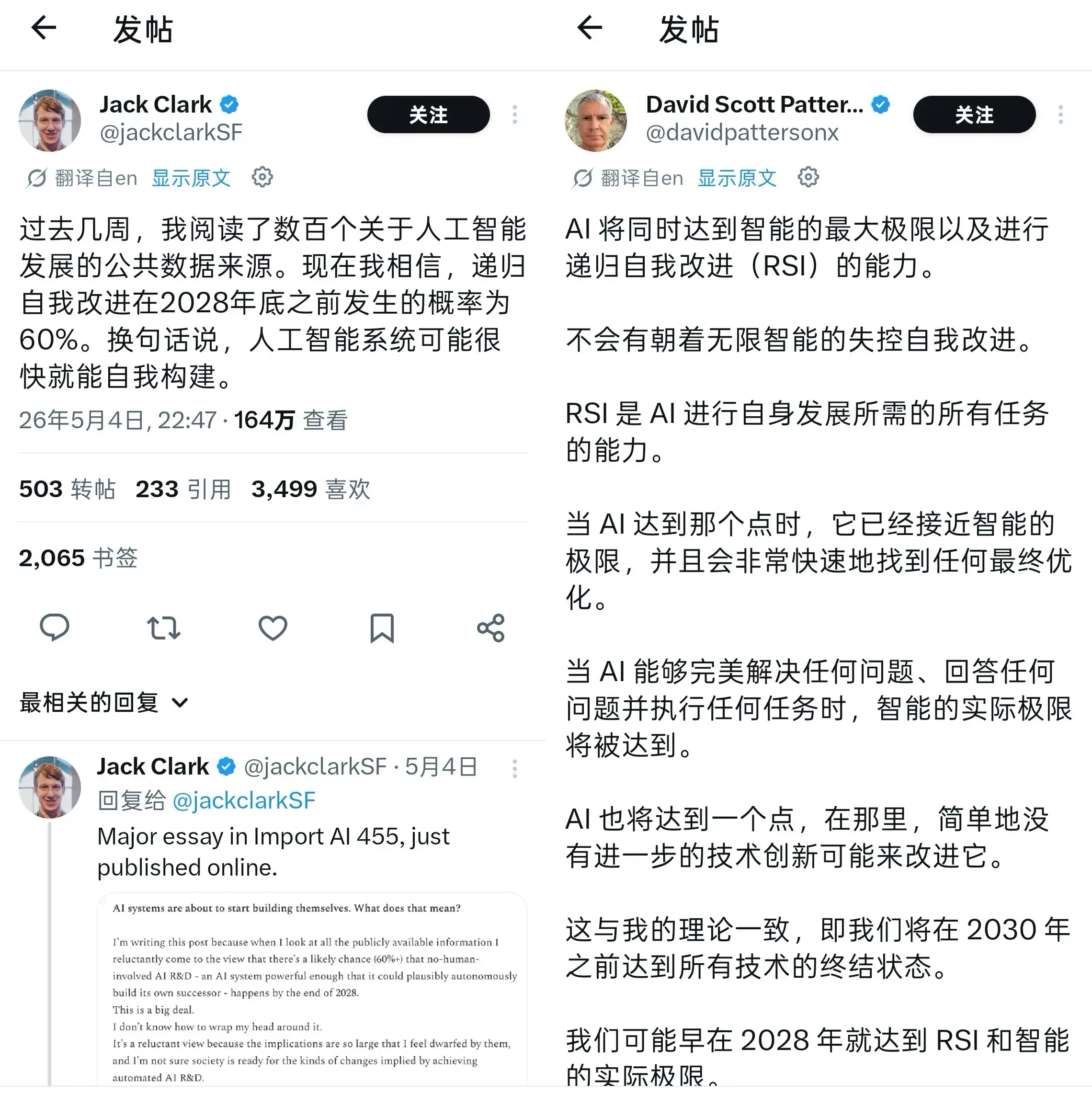
(Image source: X)

What is RSI? Simply put, it's about enabling AI to train itself. In the tech world, RSI has long been regarded as a major indicator of artificial intelligence progress, alongside memory, reasoning, and multimodality. The only limitation is computing power; humans are no longer a necessary condition, not even as assistants.

Sounds like science fiction, or perhaps, sounds dangerous? But upon calm reflection, this isn't the first wave of fervor in the AI industry. From AlphaGo in 2016 to ChatGPT in 2023, and now the parameter arms race among major models, the industry's nature is to chase the next "game-changer." In the view of Leike Technology AGI, RSI might be the next carnival.

RSI Gains Traction: When AI Can "Recursively" Construct Itself

In May of this year, renowned AI researcher Richard Socher high-profile founded a new company called Recursive Superintelligence, its name directly referencing RSI.

He stated: "Our core goal is to build a truly recursive self-improving superintelligence. The entire process of research conception, implementation, and validation will be automated."

Another case that has garnered more buzz within the circle is a project called Auto-Research advanced by Andrej Karpathy: using agent clusters to train language models, enabling models to perform simple research tasks and improve themselves autonomously.
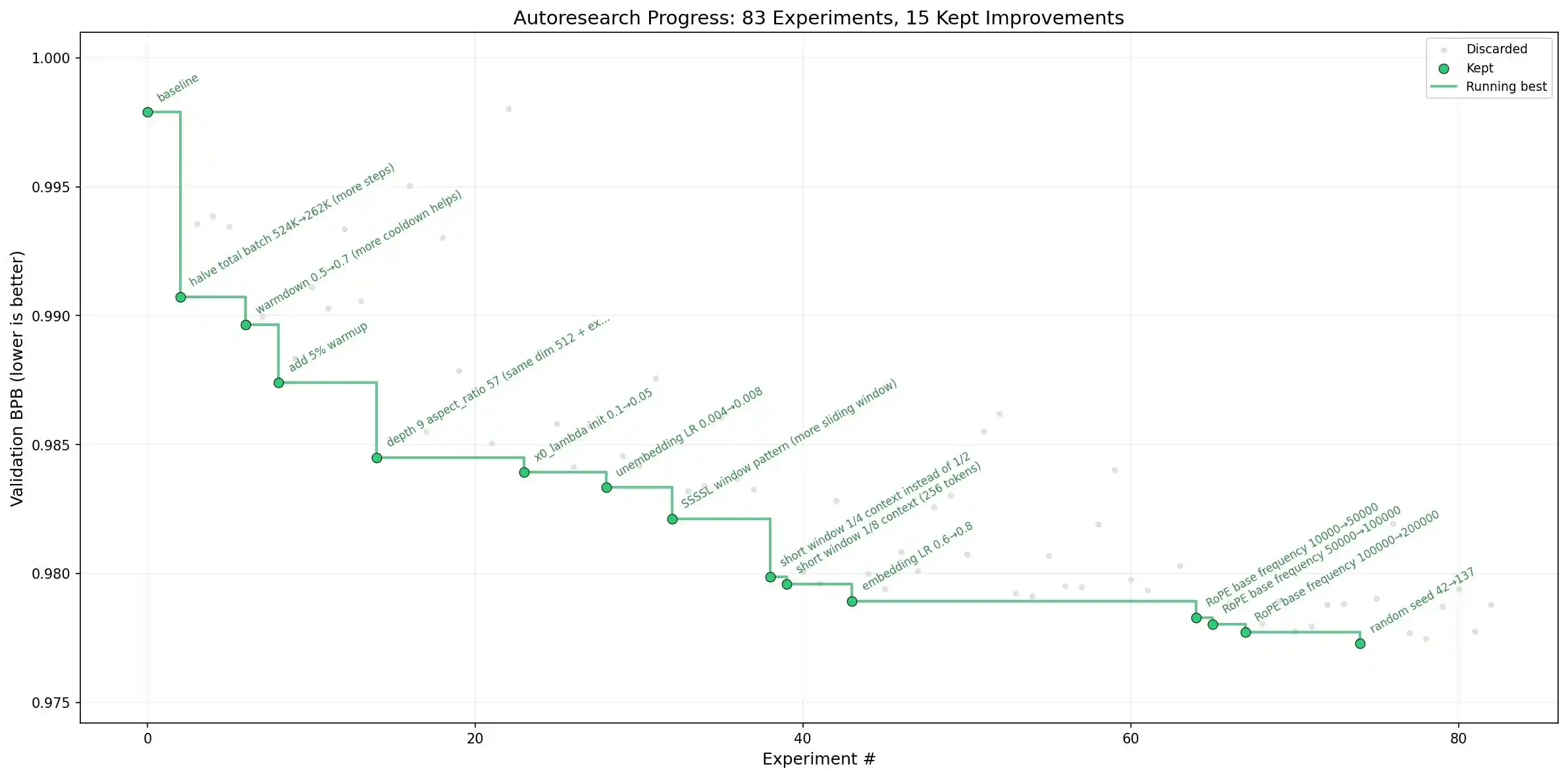
Image source: github

Andrej Karpathy is also a legendary figure, having left significant contributions at Tesla in autonomous driving and at OpenAI on GPT. Now he's all-in on RSI as his next stop, and he's advancing it with remarkable transparency, indicating he genuinely believes it's achievable.

Interestingly, he has been unusually candid about this project, regularly updating progress on Twitter and maintaining a public GitHub repository for the code. Of course, Andrej Karpathy himself has noted that current work is still iterating on small models at the GPT-2 level, "not yet breakthrough research (for now)," but this is enough to drive a large number of researchers to follow suit.

More importantly, Andrej Karpathy recently joined Anthropic's pretraining team. Anthropic has Claude, Karpathy has the auto-research methodology; combining the two, large model + self-training loop, if proven successful, would move beyond the small-scale experiments of GPT-2.

Image source: haimagazine

Another company called Adaption launched a tool called AutoScientist, aiming to automate the training process of frontier models. The logic aligns with Andrej Karpathy's auto-researchers: training agents for incremental improvement. However, Adaption's ambition is greater, seeking to directly establish a complete training loop for a full-scale frontier model.

These two represent two different approaches: Andrej Karpathy is verifying from the ground up piece by piece, building momentum within the community while open-sourcing; Adaption is directly targeting commercial large-model training scenarios with a stronger drive for practical application. Whichever path succeeds first will have distinctly different impacts on the entire industry.

Google CEO Pours Cold Water: We're Not There Yet

Regarding RSI, opinions among AI industry leaders vary widely.

Last month, in a podcast, Google CEO Sundar Pichai acknowledged reality with quite cautious wording: "(RSI) is a continuum. We are indeed all making progress. But if we talk about RSI in the way people describe it, that represents the next level of acceleration, with many implications, but we're not at that stage yet."

Even so, the term "continuum" here contains much food for thought.

In January this year, a programmer leading Claude Code development at Anthropic admitted that nearly 100% of the team's code was written by Claude Code, which is AI literally writing itself. It's not AI assisting engineers in writing code; it's an AI tool, to some extent, already replacing engineers in writing its own code.
Image source: Anthropic

Anthropic conducted an internal survey about the Mythos preview version: among 18 engineers, five believed that if the supporting systems were improved, this version of Mythos could replace an L4 engineer—a mid-level programmer capable of independently handling complex projects without real-time supervision.

However, the weaknesses were also clearly stated: "The main weaknesses reported by Claude include: fuzzy tasks beyond one management cycle, understanding organizational priorities, taste, verification, instruction following, and epistemology." In other words, its weaknesses lie precisely in the aspects of self-motivation, which is the foundation of RSI.

Interestingly, the Georgetown Center for Security and Emerging Technology (CSET) last year assembled a group of experts specifically to study RSI. These experts exhibited a clear split in their assessments. Some anticipated an imminent "superintelligence explosion," while others expected slower progress that would eventually reach a plateau.

But they shared one consensus: recursion makes the future exceptionally difficult to predict.

To this end, an article by METR researcher Ajeya Cotra breaks down the RSI process into several milestones. I find this to be the most useful analytical framework currently available.

The first level is called "Adequacy": After completely removing humans, the system can still conduct research—even if inferior to humans, it can function.

The second level is called "Parity": Research conducted independently by AI matches the quality of research conducted independently by humans.

The third is called "Supremacy": The performance of an independent AI system surpasses that of a human-AI collaborative system.

It's somewhat akin to L2, 3, 4, 5 in autonomous driving. Ajeya Cotra's assessment is: we are already very close to the first level. But when the second level will arrive, she didn't provide a timeline. However, she offered a clear deduction: once the second level arrives, subsequent acceleration will far exceed past rates, "potentially reaching the third level within a year."

Why so fast? Because at the moment the second level is achieved, AI becomes a research team that doesn't need sleep, meetings, or KPI alignment. It can experiment, modify, and re-experiment 24/7. Humans conducting research, no matter how efficient, only have a few hours of effective deep work per day, interspersed with countless interruptions and communication overhead. Once this bottleneck disappears, the acceleration is cliff-like.

No One in China is Shouting RSI, But DeepSeek and Others Have Already Touched the Edges

After discussing overseas progress, you might wonder: what about China?

Frankly, domestic companies rarely publicly shout about RSI. Overseas AI companies can write "recursive superintelligence" into their mission statements; such a thing is almost unimaginable in China. But when it comes to having AI improve itself, domestic players have already quietly approached the edges on different paths.

The most typical example is DeepSeek. They spend an order of magnitude less money than OpenAI, yet can compete head-on in many reasoning tasks. This is achieved through extreme optimization of algorithmic efficiency—MoE architecture, extreme compression of activation parameters, and engineering refinement of training strategies.

Although this isn't directly related to RSI, it represents a path of using smarter methods to replace brute-force computational power. And this path is precisely one of the core logics of RSI: enabling models to find smarter paths through iteration.

On the Baidu Wenxin side, reinforcement learning-driven model self-optimization has become routine. Although they don't use the RSI label, they are doing the same thing: allowing models to continuously improve through self-feedback loops on specific tasks. From this perspective, domestic companies are not ignoring RSI; they have already incorporated certain aspects of RSI into daily engineering practice, just without the label.
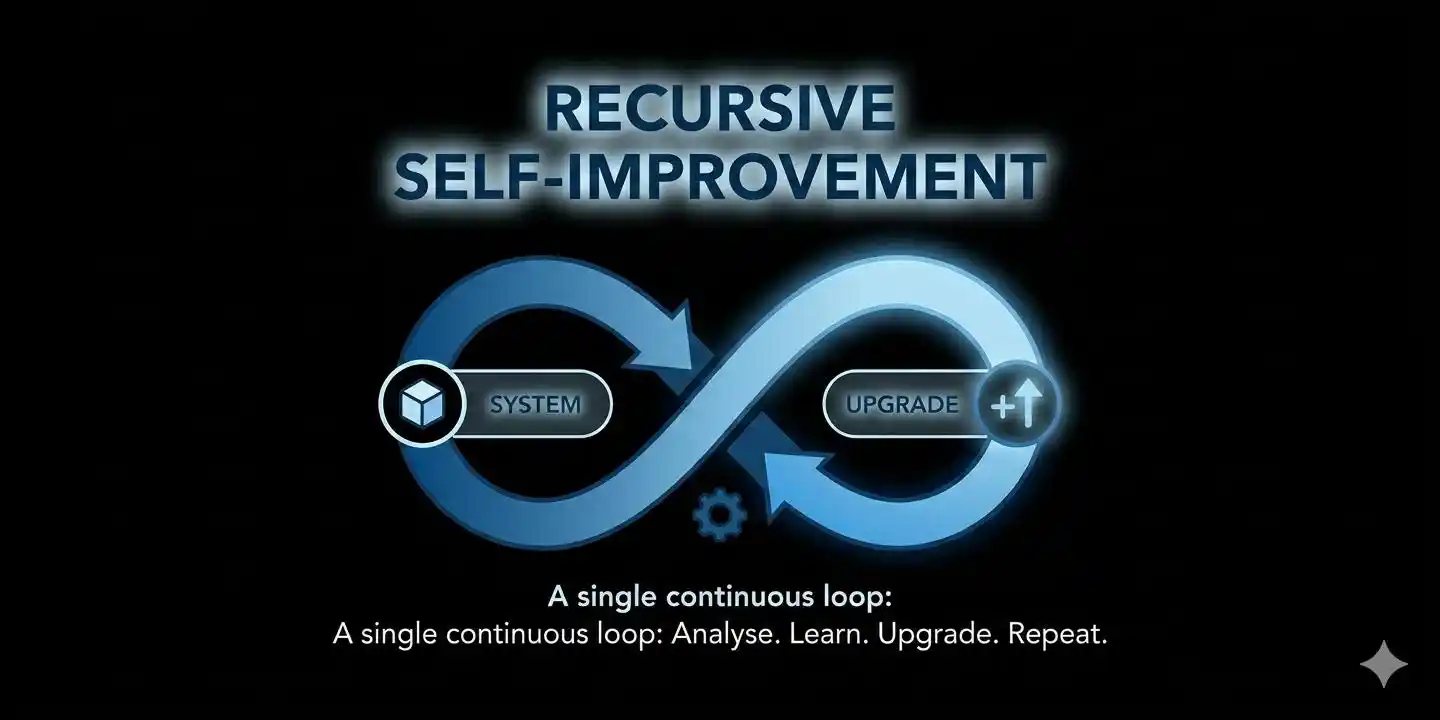
(Image source: gemini generation)

Of course, objective gaps exist. The talent density at OpenAI and Anthropic is still unmatched by any domestic company, meaning that in the exploration of RSI, the current status is still one of following.

But historical experience shows that domestic companies often exhibit astonishing speed in catching up once "the path is clearly defined." The RSI framework is being increasingly dissected by overseas experts, and Karpathy's code is publicly available on GitHub. Once a reproducible path is established, the cost control capabilities and application scenario density of domestic players will become a variable severely underestimated by the market.

Simultaneously, we must also pour some appropriate cold water. In reality, data generated by AI used to train the next version of AI tends to degrade in quality. The logic of RSI is that AI generates good data, which is then used to train the next generation of AI, making it stronger.

But the actual situation might be reversed. AI-generated data often mixes in its own hallucinations, biases, and quality degradation. These second-hand data are fed to the next version, which then produces even worse third-hand output. After a few cycles, the entire system collapses, akin to a photocopier repeatedly copying copies; by the tenth copy, the image is blurred beyond recognition.

Academia refers to this as model collapse, and papers have already verified this phenomenon's existence.

Furthermore, the ideal environment required for RSI doesn't exist in the real world. For this system to function, two prerequisites are indispensable: infinite computing power and a globally open, collaborative research ecosystem.

The reality is that the cost of training a frontier model has reached the billion-dollar scale. Chip capacity is limited, energy is limited, high-quality data is diminishing, and export controls and technological decoupling are fragmenting AI research into several non-interconnected circles. When people and goods can't flow freely, and these basic conditions can't be met, talking about RSI is premature.

RSI is no longer just a technical problem; it requires a sufficiently open world. Whether this prerequisite can be established is beyond the control of the tech community.

In Conclusion

Finally, here's an interesting observation I've made: Over the past five years, the industry first lured people into "parameter worship" through large-scale pretraining, then convinced them that "values can be fine-tuned" with RLHF, and now RSI tells a story of "machines completing the entire R&D chain autonomously." Each step pushes humans one step back—not out of the industry, but out of the decision-making chain.

Although this retreat isn't necessarily a bad thing, it is irreversible. Once a certain link is automated, human intuition, experience, and judgment in that link gradually deteriorate, much like how navigation ability declines when you stop using GPS.

By then, we might not even truly understand how the tools we use are made.

Trending Cryptos

Related Questions

QWhat is Recursive Self-Improvement (RSI) in the context of AI, as described in the article?

ARecursive Self-Improvement (RSI) refers to the concept where an AI system is capable of training and improving itself, essentially constructing its own next generation. In the AI industry, it is seen as a major sign of progress. The core idea is that the AI handles the entire process of research conception, implementation, and validation automatically, with humans being potentially unnecessary, limited mainly by computing power.

QAccording to the article, what is Google CEO Sundar Pichai's view on the current state of RSI?

AGoogle CEO Sundar Pichai expressed a cautious view, stating that while progress is being made, the industry has not yet reached the level of acceleration and impact that many associate with a fully realized RSI. He described RSI as a 'continuum' of progress but emphasized that the next-level acceleration often described is not yet a reality.

QWhat are the three milestones in the RSI progression framework proposed by METR researcher Ajeya Cotra, as mentioned in the article?

AThe three milestones are: 1. **Adequacy**: The system can perform research without humans, even if it's less effective than human researchers. 2. **Parity**: The quality of research done independently by AI is equal to that done independently by humans. 3. **Supremacy**: The performance of the independent AI system surpasses that of human-AI collaborative systems.

QHow does the article characterize the approach of Chinese AI companies like DeepSeek towards RSI concepts?

AThe article notes that Chinese AI companies like DeepSeek rarely publicly champion the term 'RSI'. However, they are quietly exploring similar concepts through different paths. DeepSeek focuses on extreme algorithmic efficiency (e.g., MoE architecture, parameter compression) to achieve strong performance with fewer resources. Baidu's ERNIE uses reinforcement learning for self-optimization. Essentially, they are implementing elements of RSI as practical engineering without using the specific label, often in a 'fast-follower' mode once paths are established.

QWhat are two major challenges or risks associated with achieving true RSI, according to the article?

ATwo major challenges are: 1. **Model Collapse**: Using AI-generated data to train the next-generation AI can lead to a degradation in quality over cycles, as errors, biases, and hallucinations accumulate, similar to repeatedly copying a copy until it becomes illegible. 2. **Prerequisites in the Real World**: RSI ideally requires unlimited computing power and a globally open, collaborative research ecosystem. In reality, there are constraints like the enormous cost of training, limited chip/energy resources, diminishing high-quality data, and geopolitical fragmentation (export controls, tech decoupling) that hinder these necessary conditions.

Related Reads

Why Is AI Agent Shopping Hard to Popularize?

The article argues that the popular narrative of "AI agent shopping" – equipping AI with a wallet to autonomously handle purchases – is fundamentally flawed and oversimplifies the complexity of shopping. It deconstructs shopping into two core actions: **information retrieval** (standardized, easily automated) and **value judgment** (deeply subjective and human-centric). The narrative mistakenly assumes AI can fully handle both. Value judgment itself has two layers: **evaluation** (assessing options against criteria) and **demand definition** (setting the criteria, weights, and values). The latter is inherently human and dynamic, as preferences are not fixed but constructed during the decision-making process ("constructive preferences"). The real dividing line for automation is not product standardization, but whether the **act of choosing** itself holds experiential value. For mundane purchases (e.g., printer paper), full AI delegation works. For experiential goods (e.g., wine, furniture), the joy of selection is core to consumption, so AI should act as an assistant that narrows options, leaving the final choice to humans. The "AI wallet" concept confuses three separate elements: decision-making, execution, and fund custody. Current payment industry solutions (e.g., from Stripe, Mastercard, Google, Visa) show that limited, scoped payment authorization tokens are sufficient for most consumer scenarios, not full fund custody. The true use case for autonomous AI wallets is in **B2B procurement** and **machine-to-machine (M2M) settlements** for standardized, high-frequency, low-value transactions. The real bottlenecks for AI shopping are not payment technology, but **1) the lack of trusted data sources** (e.g., fake reviews, counterfeit goods) and **2) the impossibility of automating human demand definition**. The conclusion is that the focus should be on safely automating the assessment and filtering process while reserving for humans the rights to define their criteria and enjoy the final act of choice. For experiential goods, the platform's competitive advantage shifts to providing a superior selection experience.

Foresight News21m ago

Why Is AI Agent Shopping Hard to Popularize?

Foresight News21m ago

After Nine Months of Shorting, a Full Turn to Long: Renowned Trader Opens Bitcoin Positions Around 64K, Crypto Market Long-Short Divergence Intensifies

After nine months of being short, prominent crypto trader Doctor Profit has closed all his bearish positions and started buying Bitcoin near $64,000, signaling a complete bullish reversal. He argues that structural market changes—such as impending U.S. regulation (CLARITY Act) and institutional adoption via securities tokenization—are rewriting the traditional four-year cycle script, potentially bringing the market bottom forward from the widely expected September/October timeframe. This view finds some technical support from on-chain analyst gumsays, who notes a bullish divergence on Bitcoin's weekly chart has persisted for 147 days, nearing the 161-day duration seen before the 2022 cycle low. However, cycle researcher Jake Pahor presents a counter-argument based on historical data. Analyzing patterns since 2014, he identifies three common features of past bear market bottoms: a ~12-month duration from peak to trough, a sustained period of extreme fear (with a proprietary risk score below 20), and the price falling below Bitcoin's realized price (~$53,000 currently). The current cycle, only nine months from its October 2025 peak, meets none of these conditions. The debate highlights a market torn between "front-running" a potential early bottom driven by new fundamentals and waiting for confirmation through traditional on-chain and sentiment metrics. While Doctor Profit opts for aggressive buying, Pahor maintains a disciplined, tiered accumulation strategy, continuing weekly buys at current risk levels but reserving larger orders for if more extreme fear emerges.

marsbit40m ago

After Nine Months of Shorting, a Full Turn to Long: Renowned Trader Opens Bitcoin Positions Around 64K, Crypto Market Long-Short Divergence Intensifies

marsbit40m ago

Senior Trader's Confession: How to Trade Market's False Expectations?

Veteran trader's case study: trading the market's "wrong expectations". This trade centered on a textbook "expectation error" after a weak CPI report. While the market initially priced in broad monetary easing (sending Nasdaq to 30,060), the crucial 30-year real yield hit a 20-year high. This signaled a fractured transmission mechanism: short-term rates eased, but long-term funding costs (vital for tech valuations) refused to fall. The trader executed five short positions on the Nasdaq (NQ) as it fell from 30,060 to 28,768. The core methodology: don't just trade the data, but analyze the market's implied causal chain and identify where it breaks. In this case, the chain was: Weak CPI → Policy Easing → Lower Long-Term Funding Costs → NQ Valuation Expansion. The break occurred between policy easing and long-term rates. The "veto variable" – long-term real yields – refused to confirm the bullish narrative. Trades were structured around "fast variables" (price) temporarily repairing while "slow variables" (funding conditions) remained broken. The article outlines a repeatable framework: 1) Map the market's implied causal chain. 2) Identify the veto variable. 3) Observe if it rejects the narrative. 4) Enter when price still follows the old script. 5) Choose the cleanest asset expression (e.g., short NQ, not broad S&P). 6) Define both invalidation and fulfillment exit conditions. The key insight: Alpha often comes not from an information edge, but from a "reaction function edge" – recognizing when the market is applying an outdated causal logic to new data. The critical question: What causal chain is the market's first reaction relying on, and is that chain still valid today?

marsbit1h ago

Senior Trader's Confession: How to Trade Market's False Expectations?

marsbit1h ago

Opinion: The Hedging Relationship Between U.S. Treasuries and Stocks Has Broken Down, and BTC, as a Risk Asset, Is Under Dual Pressure

For the past 20 years, U.S. investors relied on a free insurance policy: when stocks fell, bonds rose, cushioning portfolio losses. This reliable inverse correlation underpinned entire financial strategies. However, this mechanism broke down around 2020 and has not recovered. Currently, the two-month rolling correlation between the S&P 500 and 10-year Treasury yields is at -0.69, its lowest level since 1996, indicating stocks and bonds are moving in sync to an unprecedented degree, eliminating the traditional portfolio shock absorber. The失效 of this hedge is not simply due to lost confidence in U.S. debt. The key driver is the shift from growth-dominated to inflation-dominated market narratives. When growth fears prevail, stocks and bonds move inversely. Since 2022, persistent inflation volatility has been the dominant factor, causing both asset classes to suffer simultaneously from higher inflation expectations. Investors now seek safety without duration risk, favoring cash, dollars, and short-term Treasuries while selling long-duration bonds. Record U.S. deficits, rising net interest payments, and waning foreign demand (e.g., from Japan) are pressuring long-term yields, with the 30-year yield surpassing 5%. This environment places Bitcoin, as a risk asset on the far end of the risk curve, under dual pressure. Higher risk-free rates increase the opportunity cost of holding non-yielding assets like Bitcoin, while falling equities reduce overall risk appetite. Bitcoin's performance has become highly sensitive to macro conditions such as real yields, dollar strength, and financial conditions. While its long-term thesis as a fixed-supply asset outside the sovereign credit system is strengthened by these fiscal trends, the same conditions hurt it in the short term. The return of bonds as a effective hedge requires inflation volatility to subside, growth risks to retake dominance, and the Fed to have room to ease policy. Until then, Bitcoin trades in a market where the deepest asset class no longer absorbs shocks, removing the safety floor for all risk assets, especially those that pay nothing to wait.

marsbit1h ago

Opinion: The Hedging Relationship Between U.S. Treasuries and Stocks Has Broken Down, and BTC, as a Risk Asset, Is Under Dual Pressure

marsbit1h ago

Trading

Spot

Hot Articles

Discussions

Welcome to the HTX Community. Here, you can stay informed about the latest platform developments and gain access to professional market insights. Users' opinions on the price of AI (AI) are presented below.

活动图片