Rare monthly buy signal flashes for Ethereum—but the bullish case isn’t clear-cut

ambcryptoPublished on 2026-07-02Last updated on 2026-07-02

Abstract

Ethereum (ETH) has seen recent price gains of 8.05% in the past week and 4.9% in the past day. However, the overall sentiment remains bearish, evidenced by significant outflows of $358.3 million from its spot ETFs since mid-June 2026 and the loss of key support levels at $3.2k and $2.0k. Despite the downtrend, market data shows a potential short-term squeeze. The taker buy-sell ratio and Open Interest have risen, indicating aggressive buyer orders and renewed speculative interest in perpetual swap markets. This activity could fuel a short squeeze, though a slowdown in Open Interest would suggest the bounce is merely due to short covering, not sustained demand. A critical long-term support level is the -1.0σ MVRV band at $1,549. Meanwhile, a rare monthly TD Sequential buy signal has flashed for July—similar signals in the past preceded major rallies of 235% and 182%. However, the persistent negative ETF flows and weak market sentiment cast doubt on whether a major bottom is forming. The bullish case is not clear-cut, and time will tell if further decline is ahead.

The Ethereum [ETH] price action was in a longer-term downtrend, but has rallied 8.05% in the past week and 4.9% in the past 24 hours alone. Yet, according to data from Farside Investors, the Ethereum spot ETF flows since June 17, 2026, measured a negative $358.3 million.

These persistent outflows underlined the bearish market sentiment behind the leading crypto altcoin. It has lost two major support levels in 2026: the $3.2k and $2.0k levels.

AMBCrypto reported that Ethereum, trading at $1.5k, witnessed strong bearish positioning, but also warned of a possible short squeeze.
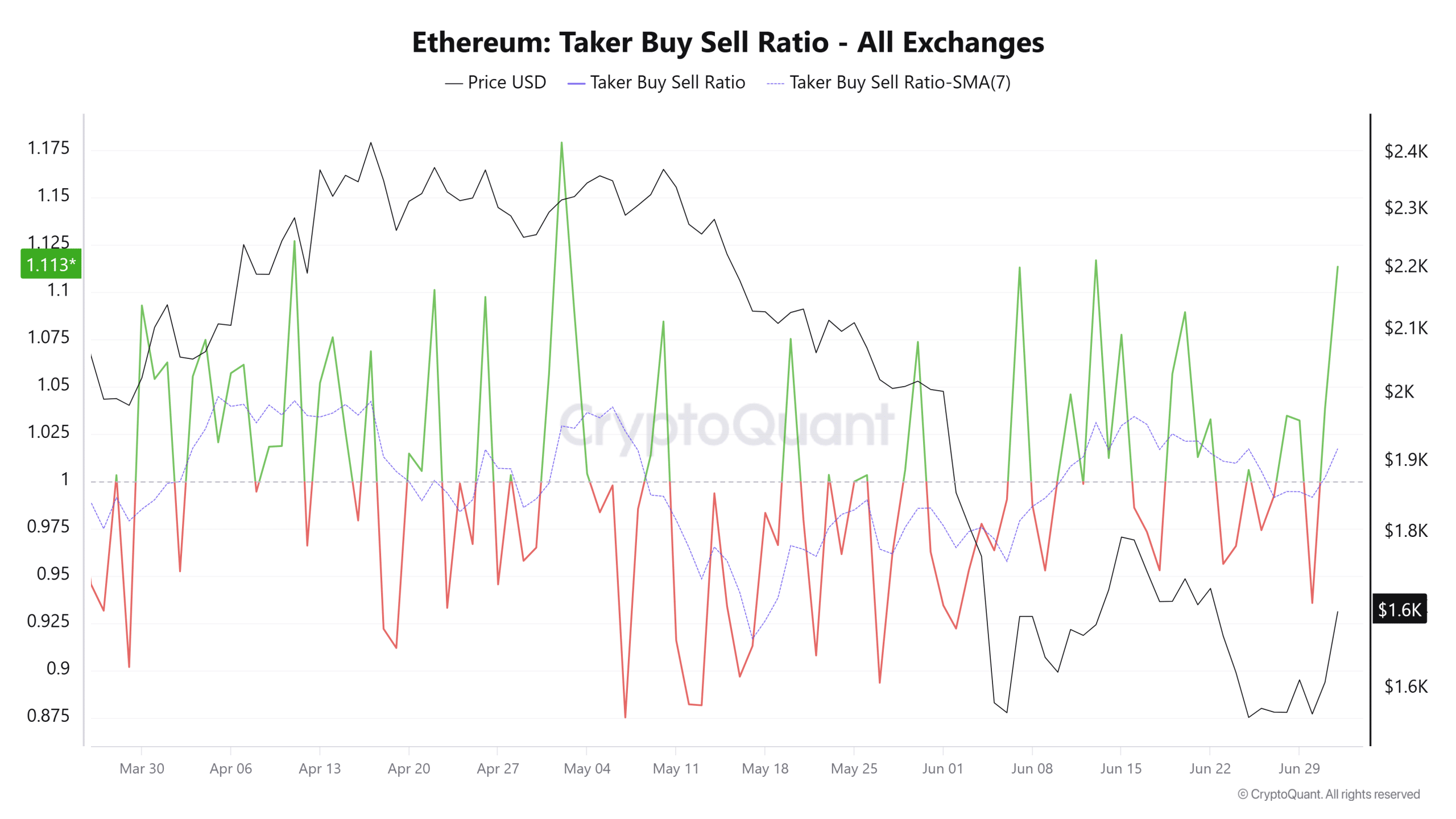
Source: CryptoQuant

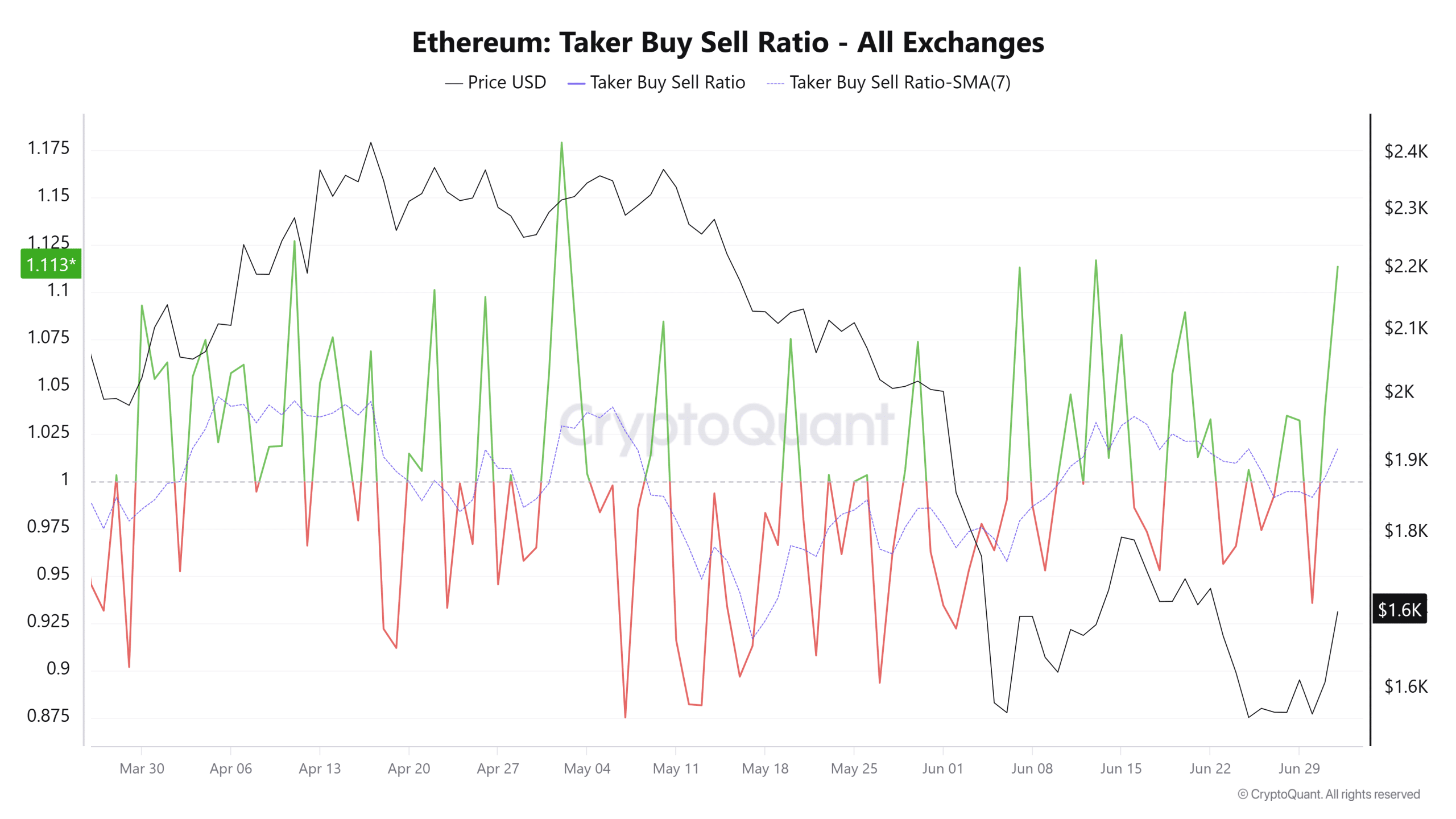
The taker buy-sell ratio jumped back above 1 in the past couple of days of trading. The metric’s 7-day moving average also rose back above 1. This showed that the recent gains were partially driven by aggressive buyer orders in the perpetual swap markets.
Source: CryptoQuant

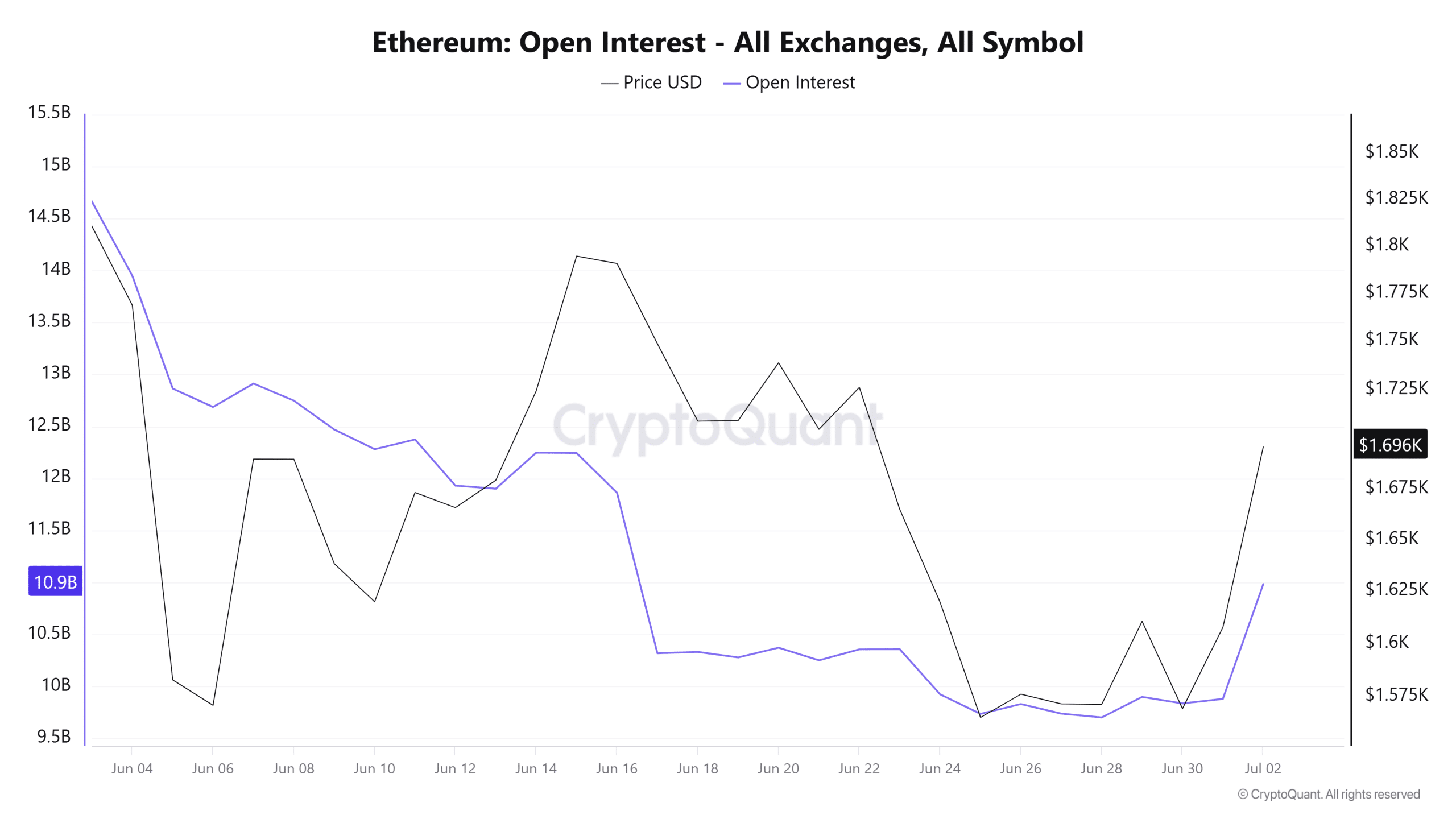
The Open Interest also picked up slightly. Increased speculative interest and buyer aggression could help drive a short squeeze in the coming days. However, if the Open Interest begins to slow down again, it would indicate the bounce was driven by short positions unwinding rather than sustained demand.

The dilemma for long-term Ethereum investors
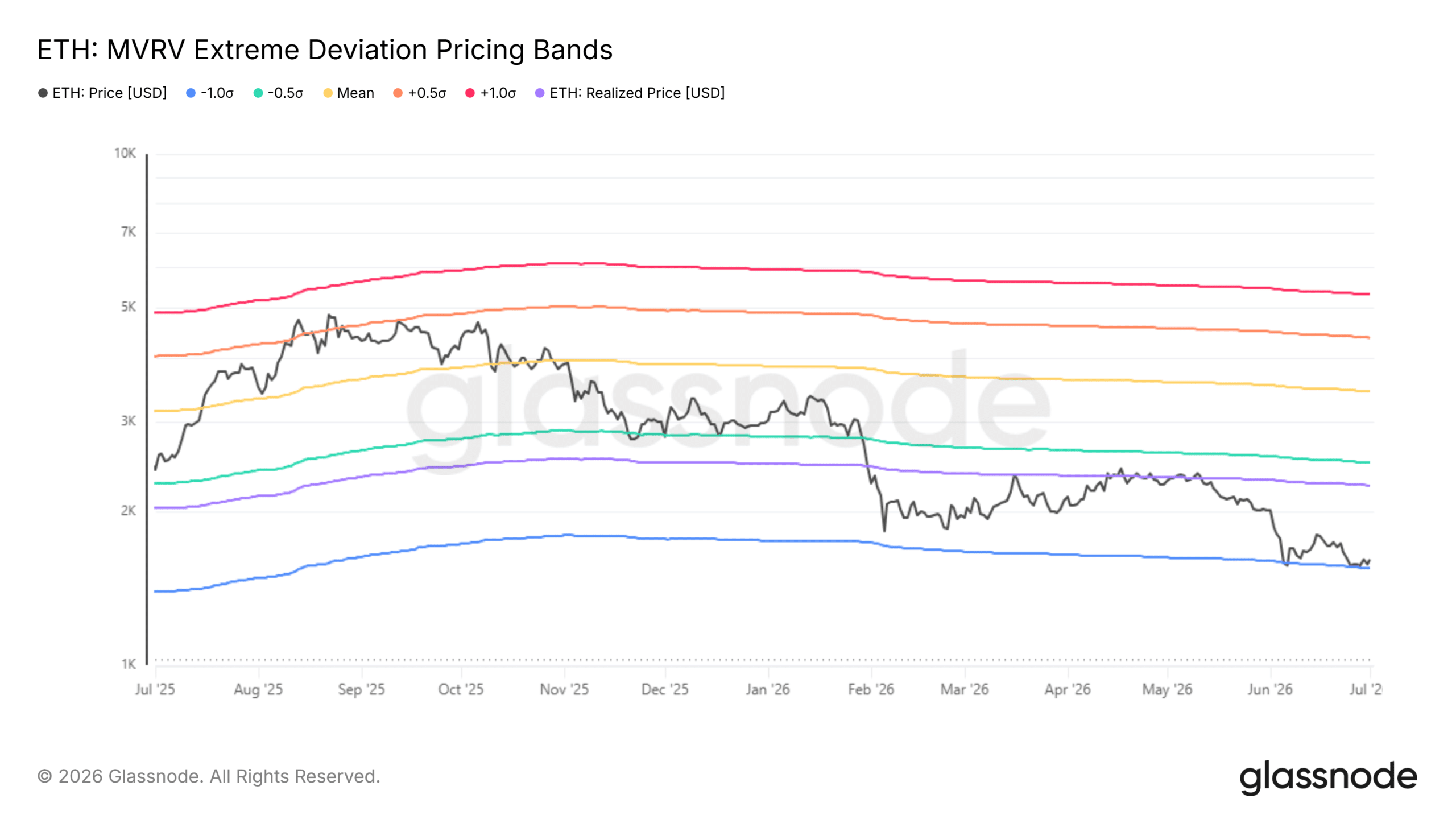
Source: Glassnode

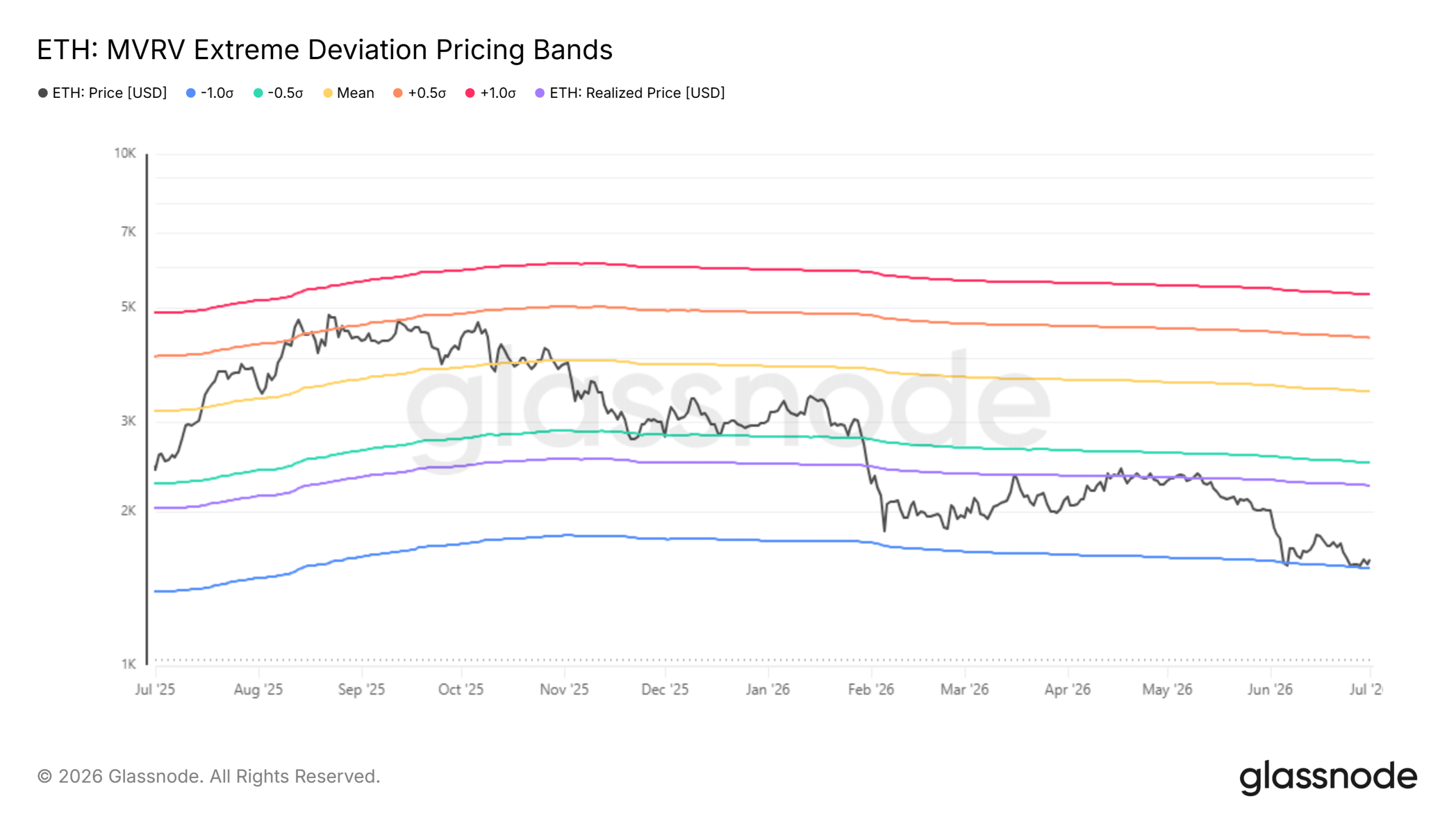
The Ethereum MVRV extreme deviation pricing bands use the all-time MVRV mean and degrees of deviation from it to form bands. These bands act as dynamic support/resistance levels.

Right now, the extreme low of the band, the -1.0σ, or one standard deviation below the mean, at $1,549, was acting as support.

Crypto analyst Ali Martinez pointed out in a post on X that July has kicked off with a buy signal on the monthly timeframe from the TD Sequential indicator.

In September 2022 and March 2025, when the same monthly buy signal flashed, Ethereum rallied 235% and 182%, respectively.

The ETF flows and wider market sentiment did not make it seem like a major market bottom was forming. Only time will confirm whether a deeper drawdown is lying in wait.


Final Summary

  • The increased Ethereum taker buy ratio in perpetual markets and Open Interest signaled increased short-term speculative interest.
  • ETH’s spot ETF flows were negative over the past two weeks, underlining weak investor conviction.


Trending Cryptos

Related Questions

QWhat recent price movements has Ethereum experienced, according to the article?

AEthereum has rallied 8.05% in the past week and 4.9% in the past 24 hours, although it has been in a longer-term downtrend.

QWhat does the negative $358.3 million in Ethereum spot ETF flows since June 17, 2026, indicate about market sentiment?

AThe persistent negative ETF outflows underline the bearish market sentiment and weak investor conviction towards Ethereum.

QWhat two major support levels did Ethereum lose in 2026, as mentioned in the article?

AEthereum lost the $3.2k and $2.0k support levels in 2026.

QWhat recent signal from the TD Sequential indicator does analyst Ali Martinez point out, and what were the historical results of similar signals?

AAli Martinez points out a monthly buy signal from the TD Sequential indicator in July. Historically, similar signals in September 2022 and March 2025 preceded rallies of 235% and 182%, respectively.

QWhat does the article suggest the recent rise in Open Interest and the Taker Buy-Sell Ratio could potentially lead to?

AThe article suggests that increased speculative interest and buyer aggression, signaled by rising Open Interest and a Taker Buy-Sell Ratio above 1, could help drive a short squeeze in the coming days.

Related Reads

Musk Awaits $50 Trillion: Is There a Limit to the U.S. National Debt and What Comes Next?

Elon Musk reacted to a projection of US national debt reaching $50 trillion by 2030, labeling it a "precise timeline" with a laughing emoji. The debt has recently passed the $40 trillion mark. Skeptics note that specific debt thresholds have been breached before without immediate collapse. However, analysts warn the focus should shift from the nominal debt amount to its affordability. A key metric is when the average interest rate on the debt exceeds the economy's growth rate, a point the US Congressional Budget Office projects for 2031. Once this "debt spiral" begins, interest costs grow self-reinforcing. Currently, interest payments have already surpassed defense spending, exceeding $1 trillion annually. Ray Dalio warns a debt crisis could occur within "three years, plus or minus two," advising portfolio diversification into gold and some Bitcoin. Potential outcomes if debt becomes unmanageable include: 1) Financial repression and monetization (the "Japanese path" of controlled yields and inflation), seen as the most likely; 2) Severe austerity (the "Greek path" of spending cuts/tax hikes), considered politically unlikely; or 3) Technical default/restructuring, which would cause global financial shock. The most probable path is a hybrid of moderate financial repression and gradual inflation, leading not to a sudden crash but to long-term economic stagnation and a declining standard of living. By 2056, debt could reach 175% of GDP. Ultimately, the limit for US debt is not a fixed number but a function of market confidence in the dollar.

cryptonews.ru1h ago

Musk Awaits $50 Trillion: Is There a Limit to the U.S. National Debt and What Comes Next?

cryptonews.ru1h ago

Solana Developer Mert Mumtaz Highly Praises Altcoin!

In the world of cryptocurrencies and finance, where privacy is a major focus, significant developments are underway. Valor Group founder Dev and notable crypto ecosystem figure Mert Mumtaz participated in a program on The Rollup crypto broadcasting platform, discussing the latest developments for the Zcash (ZEC) network and its important future roadmap. The conversation covered network scalability, security updates, and measures taken against quantum threats. The recent Ironwood update implemented in the Zcash network is considered a crucial milestone for the project. During the event, Mert highlighted that internal security audits using 'red team' methods and AI identified a potential vulnerability in the Orchard pool that could have allowed the creation of counterfeit notes. Extensive work and formal verification proved the code mathematically perfect according to specifications. The seamless migration of funds from the Orchard pool to the new Ironwood pool has completely eliminated the risk of counterfeit coin creation in the network. Dev shared important technical details about Zcash's future vision, emphasizing that Valor Group's main goal is for Zcash to achieve transaction volumes comparable to credit cards. He stated they aim to process over 50,000 transactions per second with sub-second latency while maintaining the full proof-of-work mechanism. The main scaling bottleneck was identified not as the nodes themselves, but wallet scanning processes. A new wallet architecture and synchronization delay optimization are expected to resolve this issue. The upcoming Tachion update promises to provide complete protection for Zcash against quantum computing threats. This update will integrate recursive zero-knowledge proofs into the network. It is reported to reduce transaction sizes by more than five times, eliminate node data processing overhead, and address state growth issues. With Tachion, the network is claimed to achieve not just 'quantum-resilient' but a truly 'quantum-secure' privacy structure.

cryptonews.ru1h ago

Solana Developer Mert Mumtaz Highly Praises Altcoin!

cryptonews.ru1h ago

Trading

Spot

Hot Articles

Discussions

Welcome to the HTX Community. Here, you can stay informed about the latest platform developments and gain access to professional market insights. Users' opinions on the price of ETH (ETH) are presented below.

活动图片