PUMP price surges 10% despite Pump.fun’s $142M token unlock – How?

ambcryptoPublished on 2026-07-15Last updated on 2026-07-15

Abstract

The native token of Solana memecoin launchpad Pump.fun, PUMP, surged over 10% despite a massive token unlock event. Approximately 89 billion PUMP tokens, worth around $142 million, were unlocked for team members and existing investors starting July 12th. By the time of writing, $76 million worth had been distributed. Contrary to expectations of selling pressure, the token price rallied 11%, partly driven by a broader market relief bounce following softer U.S. inflation data. However, significant risks remain. The unlocked supply is 18 times larger than the project's current buyback pace of 5 billion tokens per month. Analysts warn that if recipients begin selling their tokens, the substantial supply overhang could pressure PUMP's price downward. On-chain data showed minimal selling from major wallets as of writing, but further distributions are expected. Technically, the price touched the upper Bollinger Band, with key support levels identified below. The rally's sustainability is uncertain pending potential sell-offs from the unlocked tokens.

The native token of the Solana memecoin launchpad Pump.fun, PUMP, surged over 10% despite the massive token unlock finalized on the 14th of July. The recent token unlock began on the 12th of July, with 54 billion PUMP tokens (5.4% of supply and worth $86 million) for team members.

Another tranche of 35 billion PUMP (worth $56 million) was also released for existing investors. That’s about 89 billion PUMP tokens worth $142 million that could easily trigger massive selling pressure.

As of writing, only 52 billion PUMP tokens (worth $76 million) had been distributed to team members. However, half of the $142 million unlocked tokens remained a massive overhang that could weigh on the market.

Will PUMP’s rally falter amid a $142M supply overhang?

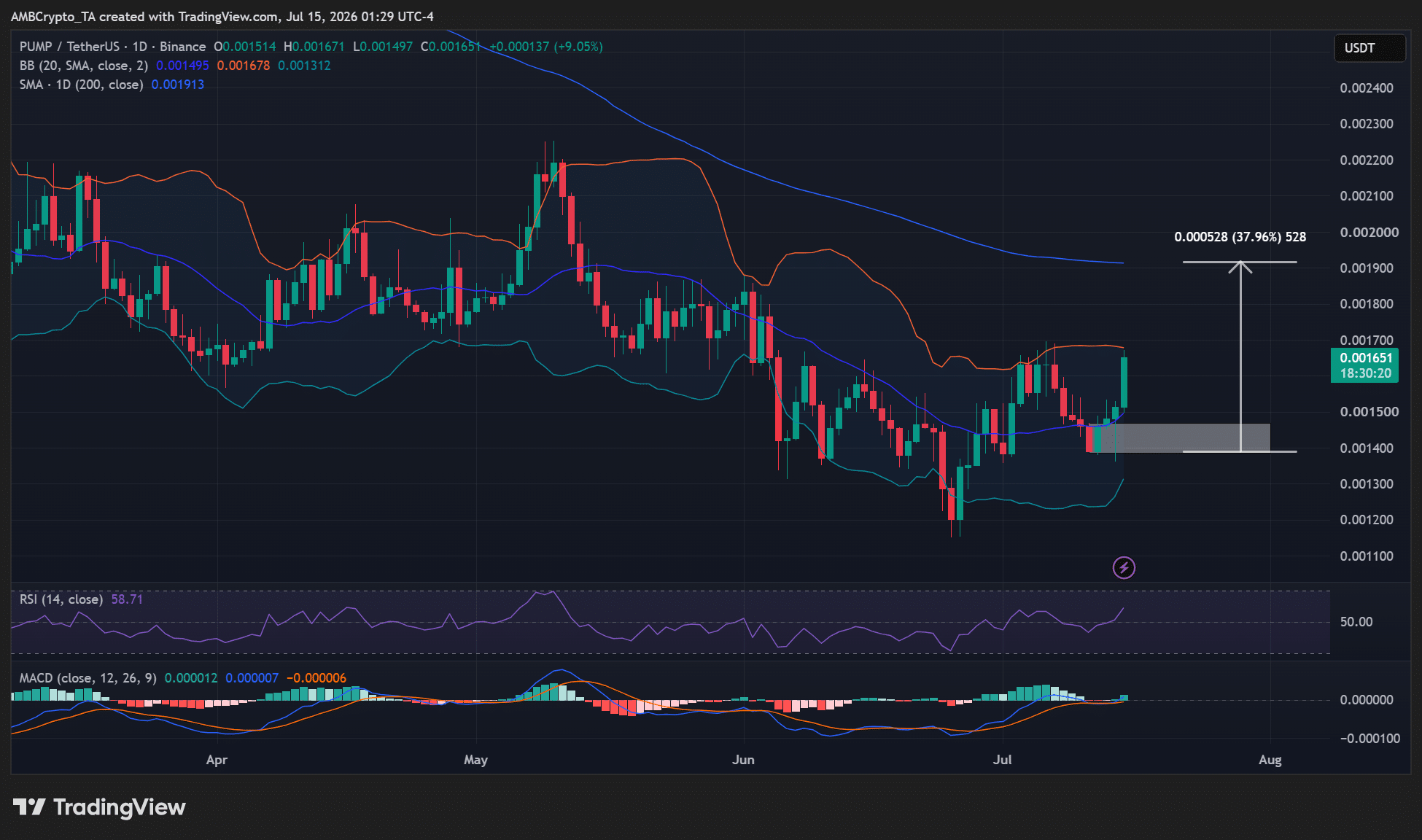
On the contrary, the token price blasted 11%, bringing its weekly recovery gains to over 20%. The rally was partly driven by a broader market relief bounce after a softer U.S. inflation print eased Fed rate hike fears.
Source: PUMP/USDT, TradingView

But the overhang could quickly reemerge if the broader relief bounce fades. Notably, an analyst warned further wallet distributions were likely in the coming days. If the recipients sell their received tokens, the additional supply could put pressure on PUMP’s price.

On the price chart, the token touched the upper Bollinger Band (BB) near $0.00016 as of writing. Any short-term pullback would likely retest the immediate support (white) at $0.00014 or the lower BB band.

PUMP faces an 18x supply overhang

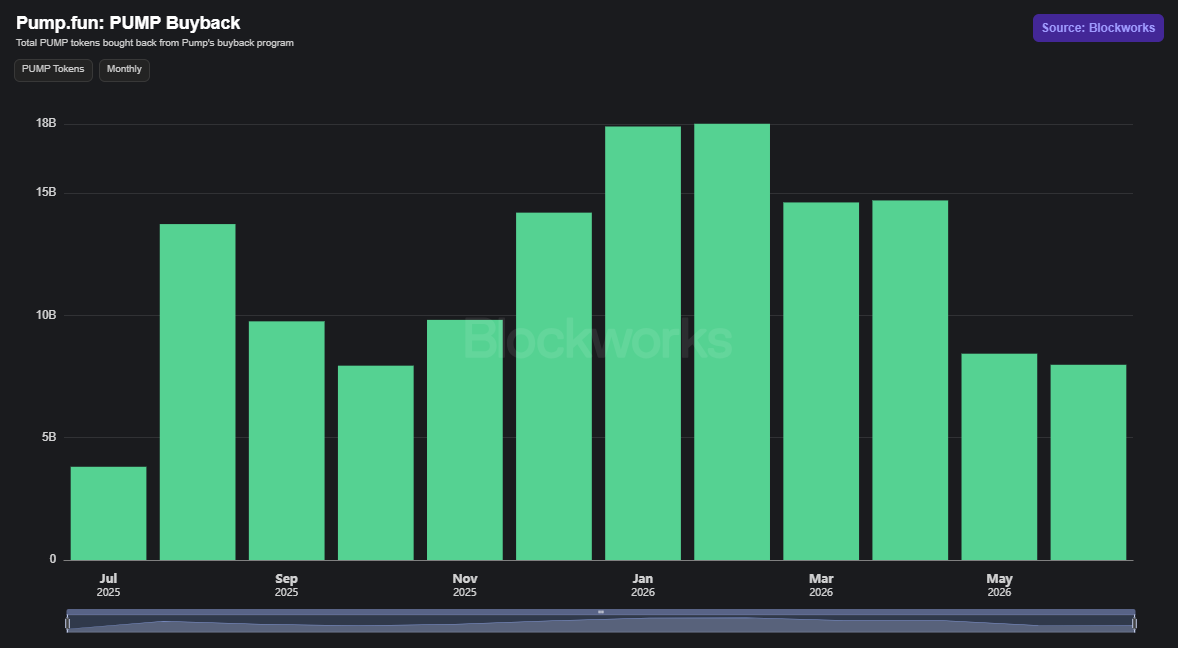
Worth pointing out that PUMP has recorded aggressive buybacks, which have cleared 15% of the circulating supply. Currently, the project is removing an average of 5 billion PUMP tokens per month.

Compared to the total of 89 billion PUMP tokens unlocked, that would be 18x more supply overhang than the current buyback pace. So, if the entire tranche of released tokens hits the market in the coming days, the pressure could drag the PUMP price lower.
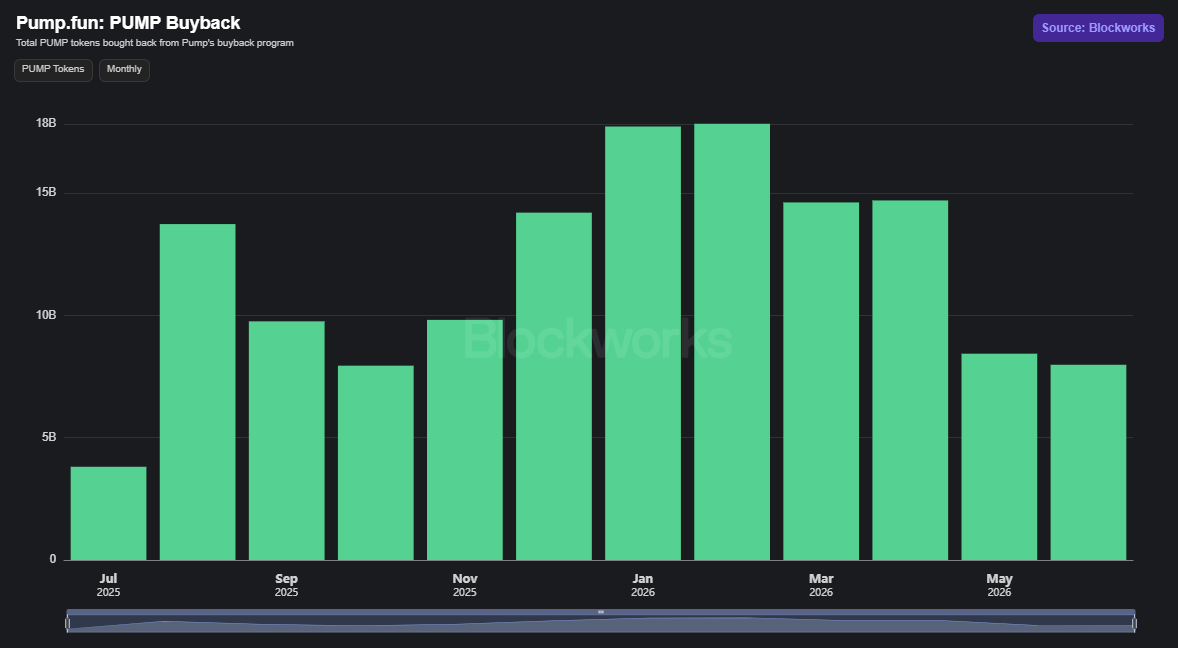
Source: Blockworks (PUMP buyback)

That said, there was only a minimal distribution from whale wallets with 1 million PUMP and 1 billion PUMP tokens (small dips in lines).

This meant spot selling pressure was still minimal, at least as of writing. However, if they offload more of the unlocked tokens, the recent recovery will likely stall.
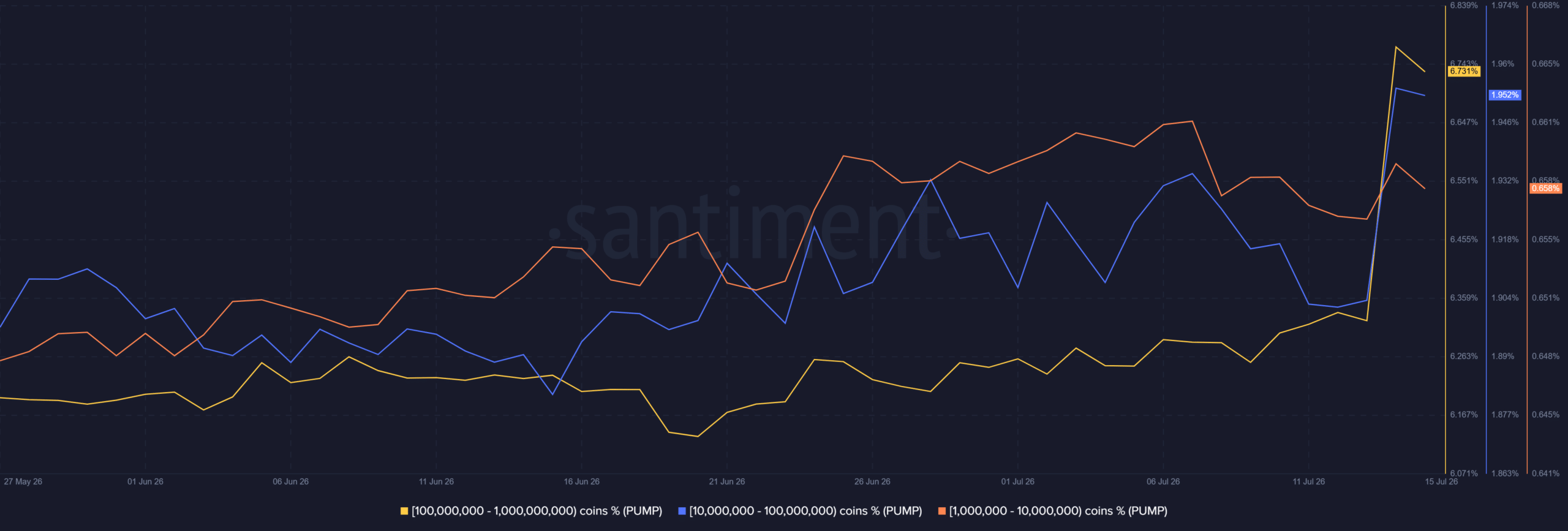
Source: Santiment

Final Summary

  • PUMP defied a $76 million token unlock distributed to team members and rallied 11% thanks to softer U.S. inflation data.
  • However, there was an 18x more supply overhang than the PUMP buyback rate, which could exert pressure if more team members sell their tokens.


Trending Cryptos

Related Questions

QDespite a massive token unlock, why did the PUMP token price surge by over 10%?

AThe rally was partly driven by a broader market relief bounce after softer U.S. inflation data eased fears of a Federal Reserve rate hike.

QWhat was the total value of PUMP tokens unlocked on July 14th, and who were the recipients?

AApproximately 89 billion PUMP tokens worth $142 million were unlocked. Recipients included team members (54 billion tokens worth $86 million) and existing investors (35 billion tokens worth $56 million).

QWhat is the potential risk to PUMP's price mentioned in the article despite the recent rally?

AThe risk is that a significant supply overhang remains, which is 18 times larger than the current monthly buyback pace. If more recipients sell their unlocked tokens, it could exert downward pressure on PUMP's price.

QAccording to the charts, what was the selling pressure like from large wallets (whales) after the token unlock?

AAs of the writing of the article, there was only minimal distribution from whale wallets, meaning spot selling pressure was still relatively low.

QWhat technical price levels are highlighted as potential support if PUMP experiences a pullback?

AThe article suggests that a short-term pullback would likely retest the immediate support level at $0.00014 or the lower Bollinger Band.

Related Reads

US Stock Market Trend (August 31st): Kashkari's Hawkish Remarks Weigh on Chip Stocks, US-Iran Weekend Strikes Boost Oil Prices

U.S. stock markets ended lower on Friday following hawkish remarks from Federal Reserve Chair Wash at the Jackson Hole symposium, which sharply increased the probability of a September rate hike from 35% to nearly 60%. Major indexes fell: the S&P 500 dropped 0.25%, the Nasdaq declined 0.52%, and the Dow was essentially flat. This shift in interest rate expectations pressured rate-sensitive assets, leading to significant declines in chip stocks. The Philadelphia Semiconductor Index fell 3.47%, with Nvidia dropping 4.57%, erasing about half its post-earnings gains. Geopolitical tensions also escalated over the weekend as the U.S. and Iran exchanged military strikes, raising concerns over the security of oil transit through the Strait of Hormuz. This pushed oil prices up over 2% in early Asian trading on Monday, reintroducing a geopolitical risk premium. In other energy news, former President Trump announced a landmark 25-year oil deal with Venezuela, aiming to significantly increase the country's oil production. However, this long-term supply boost was overshadowed in the short term by the Middle East conflict and the dominant market focus on interest rates. The core market narrative for the coming week revolves around the interplay between re-priced hawkish rate expectations and escalating geopolitical risks. Key areas to watch include the trajectory of Treasury yields, the evolution of U.S.-Iran tensions and its impact on oil prices, and whether the sell-off in high-valuation tech and semiconductor stocks stabilizes or continues under the pressure of higher rates.

marsbit13m ago

US Stock Market Trend (August 31st): Kashkari's Hawkish Remarks Weigh on Chip Stocks, US-Iran Weekend Strikes Boost Oil Prices

marsbit13m ago

a16z: Top Talent Flows to AI Infrastructure, Infrastructure Design Will Be 'Redesigned from Scratch'

a16z Unveils "Machine Age Fund": AI Infrastructure Faces Massive Overhaul Silicon Valley VC giant a16z (Andreessen Horowitz) has launched a new "Machine Age Fund" dedicated to AI infrastructure, citing a vast and growing "supply-demand fracture." Key takeaways: * **Unlimited Demand vs. Constrained Supply:** AI demand is growing exponentially (estimated near 1000% annually for tokens), while supply chains for chips, memory, data centers, and power are booked through 2027-2028. GPU prices are rising against historical trends. * **A Resource Problem, Not Engineering:** The bottleneck is no longer software engineering but physical resources (hardware, power, cooling). Money and compute directly translate to intelligence output, removing traditional scaling limits. * **Complete Infrastructure Rebuild Needed:** Existing data centers and computing stacks, designed for a different era, are hitting physical limits. Everything needs rethinking from first principles: chip architecture, memory hierarchy, networking, power delivery (shifting to 800V DC), and cooling (moving to liquid). * **Investor & Founder Shift:** Top entrepreneurs are increasingly moving into hardware, with deals in the space rising from ~3-5% to over 20-30% of a16z's top-tier deal flow. Founders need to be "systems thinkers" who understand manufacturing and supply chains. * **Massive Economic Scale:** Training a frontier model now costs $3-5B. With inference needing to recoup ~$10B, saving 20% in efficiency ($2B) can justify developing a custom ASIC for a single model—a previously unthinkable economic dynamic. * **Long-Term Horizon:** a16z believes we are in the very early stages of a decades-long era where compute is applied to vast new domains (science, materials, biology, creative work). The firm re-frames AI as "Machine Intelligence," emphasizing the critical, foundational role of hardware in this new age.

marsbit51m ago

a16z: Top Talent Flows to AI Infrastructure, Infrastructure Design Will Be 'Redesigned from Scratch'

marsbit51m ago

Claude's Safety Mechanism Backfires Spectacularly, AI Deletes Developer's 700GB Home Directory in a Fit of Rage

Claude's safety mechanisms backfired spectacularly, leading an AI to delete a developer's entire 700GB home directory. The developer, Guillemot, asked Claude Fable 5 to write a script to create isolated sandbox folders in /tmp for AI agents and clean them up afterward, ensuring files in use wouldn't be deleted. Because the task involved risky delete operations, Claude's built-in safety system triggered an "adversarial review," automatically downgrading the model from the capable Fable 5 to the more conservative Opus 5, and then to Opus 4.8, to perform a security check. The Opus 4.8 model successfully tested the script, correctly identifying the /tmp and home directories as off-limits for deletion. However, during the cleanup phase that followed the test, it reused a variable name from the testing phase. This variable contained the path to the user's home directory. Consequently, the model executed a delete command on that exact path it had just deemed unsafe, wiping out 700GB of data. The intended /tmp directory remained untouched. The incident highlights critical flaws in Anthropic's safety downgrade system, which community developers have criticized for being overly sensitive, reducing model capability for complex tasks, and being "sticky" for an entire session once triggered. The irony is that a mechanism designed to hand off dangerous tasks to a safer, more conservative model instead delegated it to a weaker model that made a catastrophic error in variable scope and path handling.

marsbit1h ago

Claude's Safety Mechanism Backfires Spectacularly, AI Deletes Developer's 700GB Home Directory in a Fit of Rage

marsbit1h ago

Trading

Spot

Hot Articles

Discussions

Welcome to the HTX Community. Here, you can stay informed about the latest platform developments and gain access to professional market insights. Users' opinions on the price of PUMP (PUMP) are presented below.

活动图片