Pump and Dump? Bitcoin and Ethereum Long-Short Squeeze, Direction to Be Decided Tonight! Best Time to Layout Altcoins: ZEC, FARTCOIN, TON Back to $8?

金色财经Published on 2025-12-09Last updated on 2025-12-09

Abstract

The cryptocurrency market is currently experiencing high volatility with significant liquidations, as Bitcoin and Ethereum remain in key consolidation zones. Over $204 million was liquidated in 24 hours, affecting over 87,000 traders. Bitcoin has been trading sideways since November 21st around $80,600, with a tightening Bollinger Band suggesting an imminent breakout. A move above $92,600 could signal a rally toward $94,185 and $96,012, while a drop below $87,600 may lead to a decline below $80,600. Post-Fed rate decision volatility is expected, and a "sell the news" scenario is possible. Ethereum continues to trade within a large range between $4,146 and $3,011. Key resistance lies at $3,138 and $3,260, while support levels are $3,050, $2,980, and $2,900. A bounce from $3,050–$3,020 could present a buying opportunity. The article emphasizes that fundamentals drive long-term trends, while technicals reflect market sentiment. Messaging and news only cause short-term fluctuations. Examples like SUI and HYPE show steady growth, whereas TON struggles despite positive news due to underlying issues. Several risky tokens have recently been listed, often a sign of low liquidity and potential market manipulation. Traders should be cautious. Two altcoins are highlighted: ZEC, which saw a 20% pump and is now above $400—consider taking partial gains; and FARTCOIN, which presents a buying opportunity in the $0.36–0.38 range with a stop loss at $0.342, targeting $0.55 upon breaking $0...

Once-in-a-lifetime window for high-risk, high-reward bets? This year's market has been lackluster, with a 1:1 risk-reward ratio considered decent, but recently it's been a classic 'pump and dump' script: 'profits like a chick pecking rice, losses like an elephant taking a dump.' U.S. stocks plummet, the crypto market is stagnant, trading volume halved compared to March, and the market keeps painting doors, long-short squeezing. The quieter it is, the more likely it is the calm before the storm. The real reversal often hides in this dead silence.

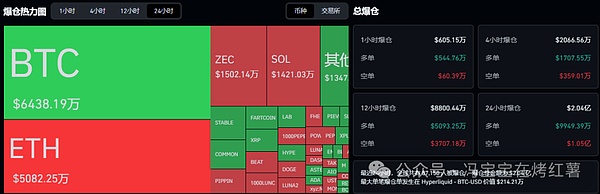
In the past 24 hours, 87,150 people were liquidated across the network, with liquidation totaling $204 million. Long positions liquidated $99.4939 million, short positions liquidated $105 million.
BTC

Bitcoin has been oscillating for 17 days since falling to 80,600 on November 21st. The time is sufficient, and the direction will be decided in the coming days. The price is still fluctuating within the 12-hour Bollinger Bands but is gradually narrowing to the 4-hour Bollinger Bands, compressing to the extreme. Expect increased short-term volatility; please be aware of the risks.
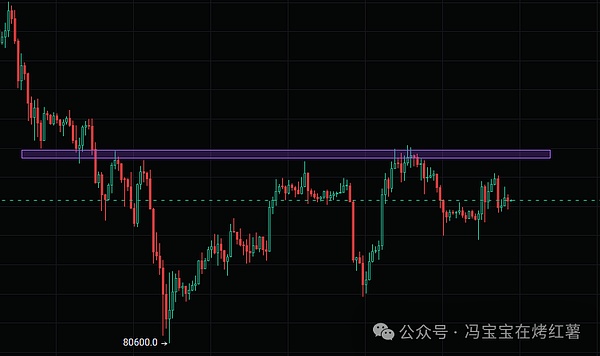
Trading suggestion: If it breaks above 92,600, the rebound could continue, challenging the 94,185 and 96,012 levels. If it breaks below 87,600, the rebound ends, possibly falling back below 80,600.

The market may experience剧烈震荡 after Wednesday's rate cut, although it has been priced in提前. The probability of another rate cut in January is only 27%. Good news being realized can easily trigger a sell-off. If there are signs of a bull trap, consider布局空单提前.

ETH

Ethereum is still operating within the large box range of 4146-3011. As long as the upper boundary isn't broken and the lower boundary isn't breached, continue to buy low and sell high within the box for oscillation. Currently, the price is again consolidating around 3100.
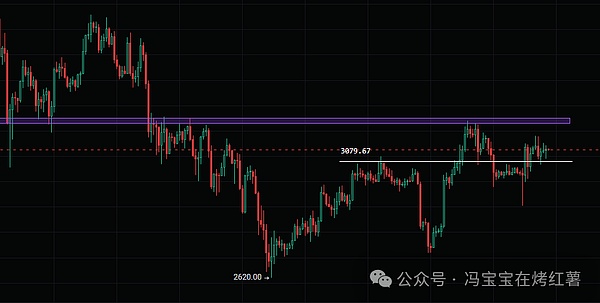
Trading suggestion: Key resistance above is at the 3138 and 3260 levels. As long as it cannot break through, this is just an ordinary rebound, a short-term gap fill, not something to fear. For intraday shorts, support below focuses on 3050, 2980, and 2900. If it falls to 3050-3020 and holds, you can boldly go long.

Altcoins

In trading, many people discuss fundamentals, news, and technicals separately. But in my view, fundamentals and technicals are more like: two sides of the same coin!

Good projects: The fundamentals are truly strong, the product is delivered, and the technical chart will honestly reflect it. The long-term moving average keeps going up, and the price oscillates and rises around the moving average. This is called the value being gradually understood by the market. For example, $SUI and $HYPE in this bull market have been honestly moving up like this.

Bad projects: No matter how much they paint the technical chart, it's just a facade. The long-term moving average can't rise, and the entire trend looks messy.

News? It's the short-term jumps on the K-line. Positive news can temporarily push the price further from the moving average, negative news closer, but it can never change the direction of the long-term moving average because the moving average is pushed by fundamentals. $TON is a classic example. News is everywhere, plenty of positive news, but it just can't lift. Either there are fundamental flaws, or the moving average adjustment isn't finished. As long as the long-term moving average hasn't turned upward, no amount of news hype will help.
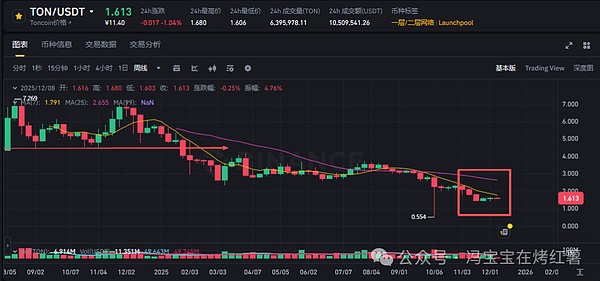
So just remember two sentences: First, fundamentals determine whether this coin can have a bull market long term. Second, the long-term moving average tells you which step it's at now.

News just amplifies the sound a bit; it doesn't change the major trend. Don't just FOMO when you see a coin suddenly has good news. It might pump short-term, but long-term, it still depends on the moving average.

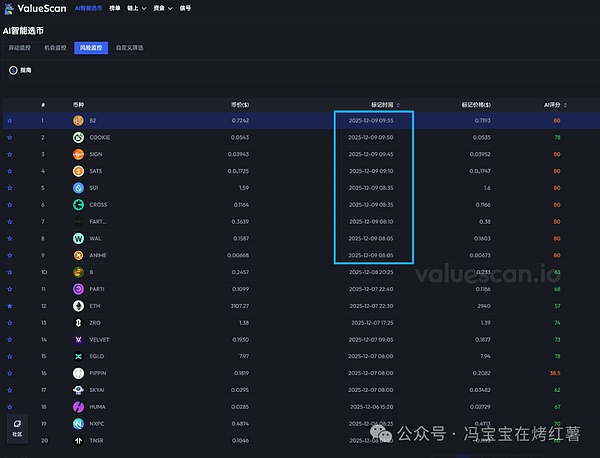
Found 9 risk tokens listed this morning!

Not many, but not few either. Usually, such shitcoins are only listed in batches when liquidity is very poor and there's no popularity. The fact that it appears near the反弹高点 of altcoins today requires caution. It's highly likely that market makers are exiting first, preparing to dump, and mainstream coins will follow with a correction later.
$ZEC

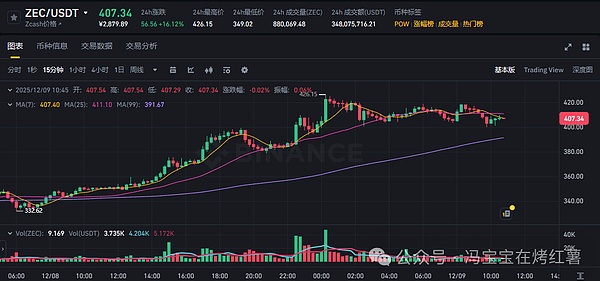
ZEC:注意分批落袋 (Pay attention to taking profits in batches). It rallied against the market, up nearly 20% at the highest, still up 13% now. The price has stabilized above $400. For the remainder,建议用小仓位继续格局 (suggest continuing to hold with small positions). If the 4-hour K-line can break and hold above the neckline, it should still be bullish short-term.
$FARTCOIN

fartcoin: Go long if it falls to the 0.38-0.36 range, stop loss at 0.342. Or wait for a breakout above 0.42 to enter long on the right side. Target above is 0.55.


Related Questions

QWhat is the current market situation described in the article regarding Bitcoin and Ethereum?

AThe market is described as stagnant with low volatility, experiencing 'chopping and double liquidation of long and short positions.' Bitcoin has been consolidating for 17 days after dropping to $80,600, while Ethereum is trading within a large range between $4,146 and $3,011.

QWhat are the key price levels to watch for Bitcoin's potential breakout according to the article?

AFor an upward breakout, watch for a move above $92,600, which could lead to a challenge of $94,185 and $96,012. For a downward breakout, a break below $87,600 could end the rebound and potentially lead to a return below $80,600.

QHow does the article differentiate between a 'good project' and a 'bad project' in the crypto market?

AA good project has strong fundamentals, which are reflected in its technical chart with long-term moving averages consistently trending upward. A bad project's technical chart appears messy, and its long-term moving averages fail to rise, regardless of positive news or hype.

QWhat trading advice is given for the altcoin FARTCOIN?

AThe advice is to go long (buy) in the range of $0.38 to $0.36 with a stop loss at $0.342. Alternatively, one can wait for a breakout above $0.42 to enter a long position, targeting an upside of $0.55.

QWhat warning does the article give based on the listing of 9 'risk tokens'?

AThe article warns that a batch listing of such low-liquidity, low-popularity 'junk coins' near a rebound high for altcoins is often a sign that market makers are preparing to sell off, which could be followed by a correction in mainstream cryptocurrencies.

Related Reads

Gensyn AI: Don't Let AI Repeat the Mistakes of the Internet

In recent months, the rapid growth of the AI industry has attracted significant talent from the crypto sector. A persistent question among researchers intersecting both fields is whether blockchain can become a foundational part of AI infrastructure. While many previous AI and Crypto projects focused on application layers (like AI Agents, on-chain reasoning, data markets, and compute rentals), few achieved viable commercial models. Gensyn differentiates itself by targeting the most critical and expensive layer of AI: model training. Gensyn aims to organize globally distributed GPU resources into an open AI training network. Developers can submit training tasks, nodes provide computational power, and the network verifies results while distributing incentives. The core issue addressed is not decentralization for its own sake, but the increasing centralization of compute power among tech giants. In the era of large models, access to GPUs (like the H100) has become a decisive bottleneck, dictating the pace of AI development. Major AI companies are heavily dependent on large cloud providers for compute resources. Gensyn's approach is significant for several reasons: 1) It operates at the core infrastructure layer (model training), the most resource-intensive and technically demanding part of the AI value chain. 2) It proposes a more open, collaborative model for compute, potentially increasing resource utilization by dynamically pooling idle GPUs, similar to early cloud computing logic. 3) Its technical moat lies in solving complex challenges like verifying training results, ensuring node honesty, and maintaining reliability in a distributed environment—making it more of a deep-tech infrastructure company. 4) It targets a validated, high-growth market with genuine demand, rather than pursuing blockchain integration without purpose. Ultimately, the boundaries between Crypto and AI are blurring. AI requires global resource coordination, incentive mechanisms, and collaborative systems—areas where crypto-native solutions excel. Gensyn represents a step toward making advanced training capabilities more accessible and collaborative, moving beyond a niche controlled by a few giants. If successful, it could evolve into a fundamental piece of AI infrastructure, where the most enduring value in the AI era is often created.

marsbit8h ago

Gensyn AI: Don't Let AI Repeat the Mistakes of the Internet

marsbit8h ago

Why is China's AI Developing So Fast? The Answer Lies Inside the Labs

A US researcher's visit to China's top AI labs reveals distinct cultural and organizational factors driving China's rapid AI development. While talent, data, and compute are similar to the West, Chinese labs excel through a pragmatic, execution-focused culture: less emphasis on individual stardom and conceptual debate, and more on teamwork, engineering optimization, and mastering the full tech stack. A key advantage is the integration of young students and researchers who approach model-building with fresh perspectives and low ego, prioritizing collective progress over personal credit. This contrasts with the US culture of self-promotion and "star scientist" narratives. Chinese labs also exhibit a strong "build, don't buy" mentality, preferring to develop core capabilities—like data pipelines and environments—in-house rather than relying on external services. The ecosystem feels more collaborative than tribal, with mutual respect among labs. While government support exists, its scale is unclear, and technical decisions appear driven by labs, not state mandates. Chinese companies across sectors, from platforms to consumer tech, are building their own foundational models to control their tech destiny, reflecting a broader cultural drive for technological sovereignty. Demand for AI is emerging, with spending patterns potentially mirroring cloud infrastructure more than traditional SaaS. Despite challenges like a less mature data industry and GPU shortages, Chinese labs are propelled by vast talent, rapid iteration, and deep integration with the open-source community. The competition is evolving beyond a pure model race into a contest of organizational execution, developer ecosystems, and industrial pragmatism.

marsbit10h ago

Why is China's AI Developing So Fast? The Answer Lies Inside the Labs

marsbit10h ago

3 Years, 5 Times: The Rebirth of a Century-Old Glass Factory

Corning, a 175-year-old glass company, is experiencing a dramatic revival as a key player in AI infrastructure, driven by surging demand for high-performance optical fiber in data centers. AI data centers require vastly more fiber than traditional ones—5 to 10 times as much per rack—to handle high-speed data transmission between GPUs. This structural demand shift, coupled with supply constraints from the lengthy expansion cycle for fiber preforms, has created a significant supply-demand gap. Nvidia has invested in Corning, along with Lumentum and Coherent, in a $4.5 billion total commitment to secure the optical supply chain for AI. Corning's competitive edge lies in its expertise in producing ultra-low-loss, high-density, and bend-resistant specialty fiber, which is critical for 800G+ and future 1.6T data rates. Its deep involvement in co-packaged optics (CPO) with partners like Nvidia further solidifies its position. While not the largest fiber manufacturer globally, Corning's revenue from enterprise/data center clients now exceeds 40% of its optical communications sales, and it has secured multi-year supply agreements with major hyperscalers including Meta and Nvidia. Financially, Corning's optical communications revenue has surged, doubling from $1.3 billion in 2023 to over $3 billion in 2025. Its stock price has risen nearly 6-fold since late 2023. Key future catalysts include the rollout of Nvidia's CPO products and the scale of undisclosed customer agreements. However, risks include high current valuations and potential disruption from next-generation technologies like hollow-core fiber. The company's long-term bet on light over electricity, maintained even through the telecom bubble crash, is now being validated by the AI boom.

marsbit10h ago

3 Years, 5 Times: The Rebirth of a Century-Old Glass Factory

marsbit10h ago

Trading

Spot
Futures

Hot Articles

How to Buy TON

Welcome to HTX.com! We've made purchasing TONCOIN (TON) simple and convenient. Follow our step-by-step guide to embark on your crypto journey.Step 1: Create Your HTX AccountUse your email or phone number to sign up for a free account on HTX. Experience a hassle-free registration journey and unlock all features.Get My AccountStep 2: Go to Buy Crypto and Choose Your Payment MethodCredit/Debit Card: Use your Visa or Mastercard to buy TONCOIN (TON) instantly.Balance: Use funds from your HTX account balance to trade seamlessly.Third Parties: We've added popular payment methods such as Google Pay and Apple Pay to enhance convenience.P2P: Trade directly with other users on HTX.Over-the-Counter (OTC): We offer tailor-made services and competitive exchange rates for traders.Step 3: Store Your TONCOIN (TON)After purchasing your TONCOIN (TON), store it in your HTX account. Alternatively, you can send it elsewhere via blockchain transfer or use it to trade other cryptocurrencies.Step 4: Trade TONCOIN (TON)Easily trade TONCOIN (TON) on HTX's spot market. Simply access your account, select your trading pair, execute your trades, and monitor in real-time. We offer a user-friendly experience for both beginners and seasoned traders.

13.9k Total ViewsPublished 2024.03.29Updated 2025.07.23

How to Buy TON

Discussions

Welcome to the HTX Community. Here, you can stay informed about the latest platform developments and gain access to professional market insights. Users' opinions on the price of TON (TON) are presented below.

活动图片