3 Years, 5 Times: The Rebirth of a Century-Old Glass Factory

marsbitPublished on 2026-05-10Last updated on 2026-05-10

Abstract

Corning, a 175-year-old glass company, is experiencing a dramatic revival as a key player in AI infrastructure, driven by surging demand for high-performance optical fiber in data centers. AI data centers require vastly more fiber than traditional ones—5 to 10 times as much per rack—to handle high-speed data transmission between GPUs. This structural demand shift, coupled with supply constraints from the lengthy expansion cycle for fiber preforms, has created a significant supply-demand gap. Nvidia has invested in Corning, along with Lumentum and Coherent, in a $4.5 billion total commitment to secure the optical supply chain for AI. Corning's competitive edge lies in its expertise in producing ultra-low-loss, high-density, and bend-resistant specialty fiber, which is critical for 800G+ and future 1.6T data rates. Its deep involvement in co-packaged optics (CPO) with partners like Nvidia further solidifies its position. While not the largest fiber manufacturer globally, Corning's revenue from enterprise/data center clients now exceeds 40% of its optical communications sales, and it has secured multi-year supply agreements with major hyperscalers including Meta and Nvidia. Financially, Corning's optical communications revenue has surged, doubling from $1.3 billion in 2023 to over $3 billion in 2025. Its stock price has risen nearly 6-fold since late 2023. Key future catalysts include the rollout of Nvidia's CPO products and the scale of undisclosed customer agreements. Howeve...

According to CRU, fiber optic demand from AI data centers grew 75.9% year-over-year, widening the supply-demand gap from 6% to 15%. Fiber optic prices have more than tripled within months.

Capacity can no longer keep up.

This is why NVIDIA invested in Corning and accelerated fiber optic capacity expansion. Two months ago, it had already invested $2 billion in Lumentum and $2 billion in Coherent. These three investments total $4.5 billion, covering everything from lasers to optical chips to optical fiber.

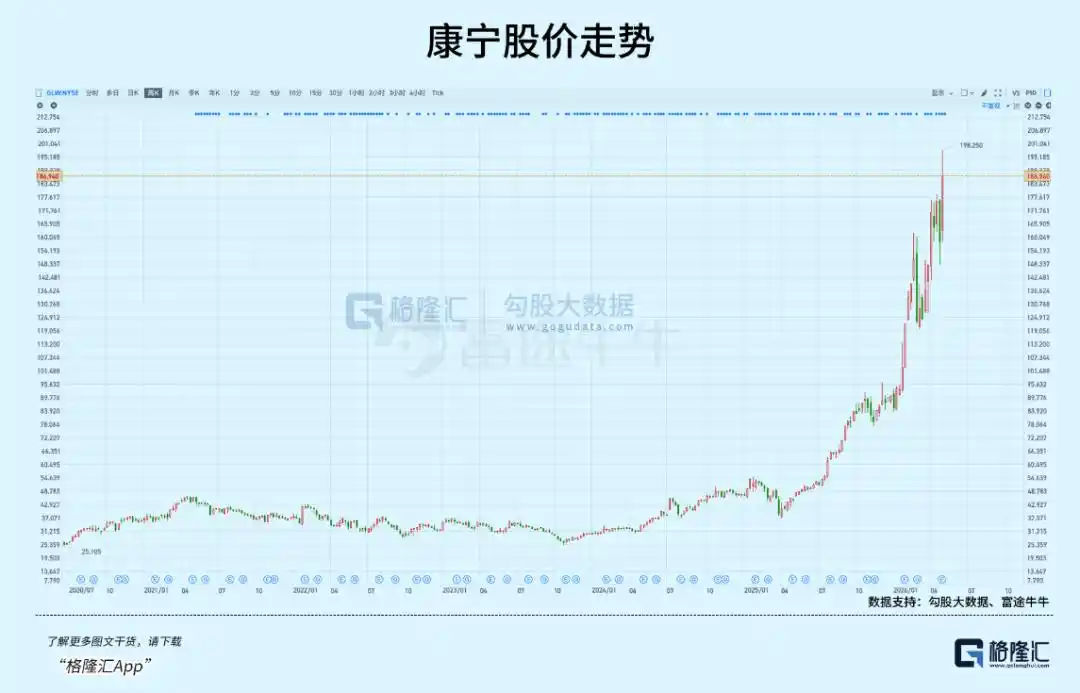
The chosen company, Corning, is a New York-based glass company founded in 1851. On May 6, its stock price touched $195.81 intraday, marking a 316.81% gain over the past year, with its market capitalization standing at over $160 billion.
How did a 175-year-old glass factory position itself on the AI infrastructure map?

01

The Nerve Fibers of AI Infrastructure

Three investments correspond to three segments.

According to Forbes and CNBC reports, Lumentum handles lasers, backed by multi-year purchase commitments and priority access to advanced capacity, and will build new factories in the US. Coherent focuses on next-generation silicon photonics, securing the supply of optical interconnect products. Corning is responsible for the fiber itself, committing to a 10x capacity expansion and three new factories.

In the NVIDIA official announcement, Jensen Huang stated: "AI is driving the largest infrastructure buildout in history." The underlying logic for NVIDIA's heavy bets in the optical upstream stems from two aspects.

First, supply-side rigidity.

The preform is to the fiber optic industry what the wafer is to the chip industry—it determines the entire industry's capacity ceiling. A fiber optic preform is a 1 to 2-meter-long cylindrical glass "mother blank." Its quality directly determines the attenuation rate, strength, and bandwidth of the finished fiber.

One preform can be drawn into hundreds of kilometers of fiber, but the process of making preforms—from raw material purification to precise chemical vapor deposition, then to drawing and strength testing—each step requires extremely high-precision process control.

Moreover, building a new production line requires meeting multiple preconditions simultaneously: cleanroom construction, deposition equipment debugging, process parameter calibration, and training of skilled operators. Any shortfall in any of these areas can affect the yield of the entire production line.

The entire expansion cycle takes 18 to 24 months. When a structural surge occurs on the demand side, this rigid constraint becomes a bottleneck for the entire supply chain.

Second, technological iteration forces a shift from "electrical to optical."

The dual constraints of transmission efficiency and power consumption are forcing large data centers to turn to optical interconnects. According to SemiAnalysis data, the Hopper architecture supports 900 GB/s, the Blackwell architecture 1,800 GB/s, and the next-generation Rubin is expected to reach 3,600 GB/s. Copper cables' transmission distance at speeds above 800G is compressed to less than 1 meter, with power consumption and signal integrity already hitting physical limits.
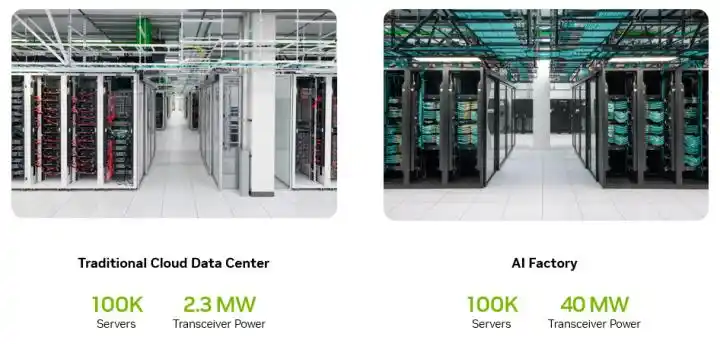
NVIDIA's developer blog disclosed that AI training clusters consume 50 to 150 megawatts, with optical transceivers potentially consuming up to 24 megawatts, accounting for over 10% of the entire data center's power. Co-packaged optics (CPO) solutions can save tens of megawatts of power. This energy advantage makes the CPO adoption curve increasingly steep, with TrendForce predicting CPO penetration could reach 35% by 2030.

The convergence of these two forces results in a structural explosion in fiber optic usage.

According to Corning's Investor Day data, the fiber usage in an AI cabinet is already 5 to 10 times that of a traditional cabinet.

Within the entire fiber optic market, the share of AI-driven fiber demand is climbing from less than 5% in 2024, with the Securities Daily reporting it's expected to reach 35% by 2027. In contrast, the overall fiber optic market growth is only 4.1% (CRU data).

Fiber in AI data centers is like nerve fibers in the human body. GPUs are the brain, the network is the synapse, and fiber is the axon conducting signals.

Fiber usage increases with cluster scale. For a 72-GPU AI node, fiber usage is already 16 times that of a traditional data center. ScaleFibre's actual measurements show that a 576-GPU cluster requires about 16 fibers per GPU. Each order-of-magnitude increase in GPU cluster size leads to a more-than-proportional growth in fiber consumption.
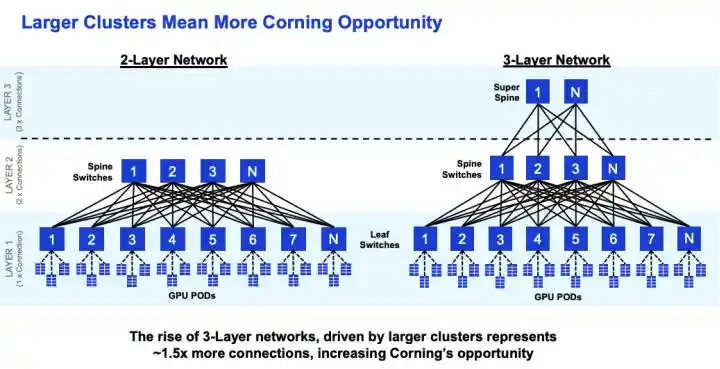
(Increased complexity in GPU clusters brings more communication demands)

In terms of market size, Grand View Research estimates the data center cabling market at about $20.2 billion, with fiber optics accounting for 56%. LightCounting predicts the datacom optical module market will grow from $22.8 billion to $41.4 billion.

On this optical chain targeted by NVIDIA, Corning's stock price started from $29 at the end of 2023, rising to $195 over two years. Gains were 60% in 2024, 88% in 2025, and over 100% year-to-date in 2026. The total gain is close to 6x.

Among global fiber optic stocks, this performance is leading. How did it transform from a company selling glass into the fiber optic king of the AI era?

02

Revenue Acceleration

Corning's financial reports show that its Optical Communications - Enterprise revenue grew from $1.3 billion in 2023 to over $3 billion in 2025, doubling in two years. In Q1 2026, Optical Communications net sales increased 93% year-over-year. The CFO stated on the earnings call that the actual growth has far exceeded the target of a 30% CAGR.

Acceleration is also evident at the customer level. According to a CNBC report, Meta signed a multi-year fiber supply agreement valued at up to $6 billion. Corning's investor relations disclosure reveals that two other hyper-scale customers of similar scale have signed similar agreements, and NVIDIA's multi-year lock-in agreement is also in place. These four long-term agreements form the certain foundation for revenue.

Revenue and orders form a verifiable closed loop, further solidified by the expansion plans. AI fiber demand is not just a curve on a PowerPoint; it's real money already reflected on Corning's income statement.

However, Corning is not the world's largest fiber optic manufacturer.

According to CommMesh and TTI Fiber statistics, the leader in market share is Prysmian (Italy) at about 15%. Second is Yangtze Optical Fibre and Cable (YOFC, China) at about 10-12%. Corning is around 10%, ranking third. In terms of preform capacity, YOFC is the world's largest. In terms of comprehensive cable business, Prysmian is the strongest.

The reasons why Meta and NVIDIA chose Corning require understanding the special requirements AI data centers have for fiber optics.

The fiber needed for AI data centers is fundamentally different from standard fiber deployed in operator FTTH networks. It requires ultra-low loss, high-density, bend-insensitive, high-end specialty fiber. At transmission rates from 800G to 1.6T, every 0.01 dB/km difference in attenuation directly impacts signal quality and power consumption. Density determines how much fiber can fit within limited conduit space. Bend performance determines signal stability in high-density cabling within racks.

These three dimensions precisely point to the areas of Corning's deepest technological expertise. According to publicly available industry parameters, Corning's SMF-28 Ultra fiber has an attenuation of 0.15 dB/km, the lowest in the industry. Contamination control is at the parts-per-billion (ppb) level. In comparison, YOFC's fiber is around 0.16 dB/km, close but with a gap. Hengtong's is 0.18 dB/km, a more noticeable difference.

In terms of density, Corning's Investor Day data shows its Gen AI fiber optic system can pack 2 to 4 times more fiber into existing conduits. With AI data center rack space extremely tight, this capability directly translates into deployment efficiency advantages.

Positioning in the CPO field is also crucial. Corning collaborates directly with NVIDIA and Broadcom on CPO connectivity solutions, an area not yet entered by A-share fiber optic companies. Co-packaged optics requires deep physical-level integration of fiber with chips, where Corning's materials science background provides a unique advantage.

Customer structure is another structural difference. Within Corning's Optical Communications revenue, Enterprise (i.e., data center customers) already accounts for over 40%. A-share fiber optic companies primarily serve China's three major telecom operators, with AI data center demand accounting for less than 5% of their revenue. This creates a fundamental difference in revenue growth rates and predictability.

R&D investment is also on a different scale. Corning invests over $1 billion annually in R&D. YOFC invests around $140 million, and Hengtong around $200 million. These differences allow Corning to stand out in the high-end specialty fiber segment.

But these advantages did not appear out of thin air. According to ETHW records in the history of engineering, in 1970, Corning physicist Donald Keck measured the world's first low-loss optical fiber, with an attenuation of 16 to 17 dB/km. The OVD (Outside Vapor Deposition) process invented that year became the technological cornerstone for fiber optic manufacturing for the next 50 years.

When the telecom bubble burst in 2001, Corning's stock fell from over $100 to $1.5, and 12,000 employees were laid off. Wall Street repeatedly pressured the company to exit the fiber business. Corning refused, viewing fiber as a "physics-supported inevitability"—copper cannot scale indefinitely; light will eventually replace electricity. This judgment was validated 20 years later.

The price increase signals driven by the widening supply-demand gap are not only benefiting Corning but also other global fiber optic manufacturers. Data shows that Hengtong Optic-Electric's Q1 net profit increased 98.5% year-over-year, ZTT's increased 46.4%, and YOFC's optical interconnect components revenue increased 48.6%. The fiber optic price increase dividend is being released across the entire industry.

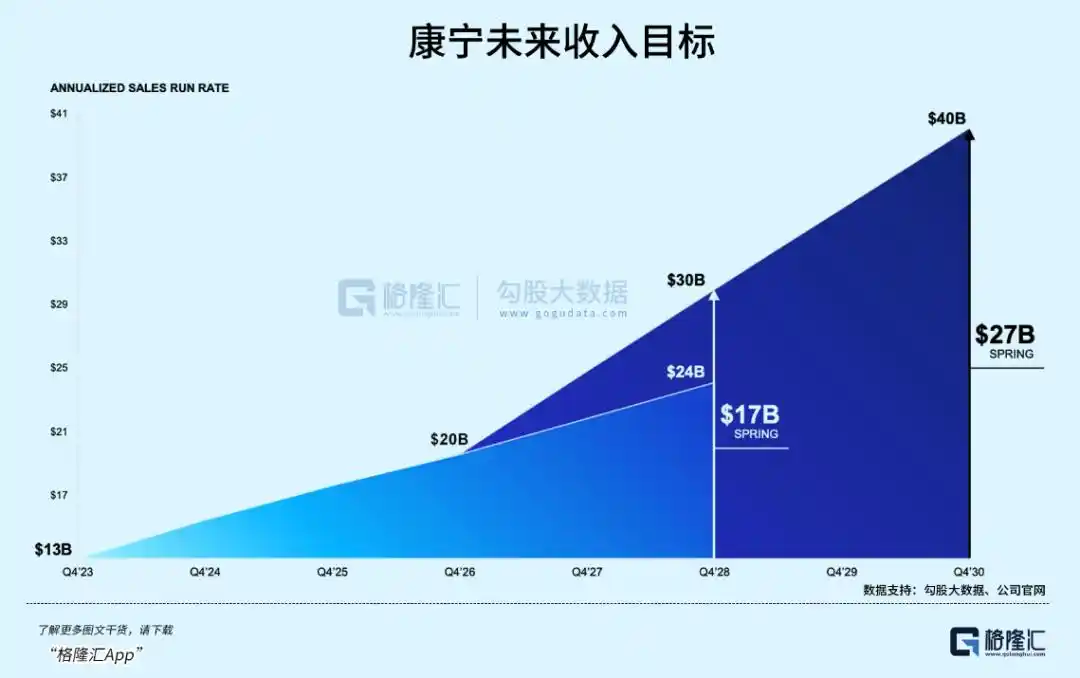
According to Corning's investor relations disclosure, the upgraded Springboard goal targets annualized sales reaching $40 billion by 2030. Management is betting on the long-term path, but the question is: how much of this expectation is already priced into the $195 stock price?
03

Conclusion

Before the AI narrative took off in early 2024, Corning's P/E ratio was 25-30x. Its valuation has now expanded more than 3 times. Comparing the current market capitalization to the 2026 target revenue of $20 billion results in a P/S ratio of about 8x. Corning's financial report shows Q2 guidance is $4.6 billion, slightly below the consensus estimate of $4.694 billion.

There are two core variables worth watching here.

One is the CPO adoption pace. NVIDIA's CPO products are scheduled for initial volume production in the second half of 2026. Each step forward for CPO amplifies the demand for high-end fiber optics by another notch. This is the core catalyst for whether Corning's valuation can continue to expand.

And, the scale of the two undisclosed customers. If they are hyper-scale enterprises like Microsoft or Amazon, actual procurement volumes could far exceed market expectations.

Hollow-core fiber is a potential variable that could change the landscape.

IEEE Spectrum reported that Microsoft has deployed 1,280 km of hollow-core fiber between two Azure data centers, reducing latency by 30% to 47%. However, high costs, immature ecosystem, and ongoing standardization mean it won't replace standard fiber in the short term. There is limited public information about Corning's involvement in hollow-core fiber. If competitors achieve a breakthrough first, it could alter the competitive landscape.

At this stage, the execution pace of orders is more important than the story itself.

But when the market cap rises too fast in the short term, or volatility arises from slower-than-expected progress, what seems like a potential Davis Double Play script can quickly turn into a rollercoaster.

This article is from the WeChat public account "Gelonghui APP" (ID: hkguruclub), author: Freddy.

Related Questions

QWhy is NVIDIA investing heavily in optical component companies like Corning, Lumentum, and Coherent?

ANVIDIA is investing heavily because AI is driving the largest infrastructure buildout ever, creating a surge in demand for high-speed optical connectivity. Specifically, the growth of AI data centers requires vastly more fiber optics for efficient, low-power data transmission. There is a severe supply shortage, with demand outpacing production capacity. These investments secure NVIDIA's access to critical components like lasers, silicon photonics, and the fiber itself, ensuring a stable and expanded supply chain for the optical interconnects essential for advanced AI systems.

QWhat are the key factors that make Corning stand out as a fiber supplier for AI data centers, despite not being the largest fiber manufacturer?

ACorning stands out due to its technological leadership in producing high-end specialty fiber required for AI data centers, which demands ultra-low loss, high density, and superior bend performance. Its SMF-28 Ultra fiber has the industry's lowest attenuation (0.15 dB/km). Its materials science expertise is crucial for Co-Packaged Optics (CPO) integration. Furthermore, over 40% of its optical communications revenue comes from Enterprise/Data Center clients, unlike many competitors reliant on telecom operators. Its deep R&D investment (~$1B annually) and early commitment to fiber technology despite past industry crashes have given it a significant advantage in the current AI infrastructure wave.

QHow has Corning's financial performance been impacted by the AI-driven demand for fiber optics?

ACorning's financial performance has accelerated significantly due to AI demand. Its Enterprise optical communications revenue more than doubled from $1.3 billion in 2023 to over $3 billion in 2025. Q1 2026 optical communications net sales grew 93% year-over-year. This growth is underpinned by long-term supply agreements with major hyperscalers like Meta and NVIDIA, with four such multi-billion dollar, multi-year agreements forming a predictable revenue base. The company's stock price reflects this, rising from around $29 in late 2023 to approximately $196, representing a gain of nearly 600% in about two and a half years.

QWhat is Co-Packaged Optics (CPO), and why is it important for the future of AI data centers?

ACo-Packaged Optics (CPO) is an advanced integration technology where optical transceivers are placed very close to or directly on the same package as the processing chip (like a GPU). It is critical for AI data centers because it dramatically reduces power consumption and increases data transmission efficiency. As AI cluster bandwidth requirements surge (from 900 GB/s to 3.6 TB/s in future architectures), traditional copper and pluggable optics reach physical limits. CPO can save tens of megawatts of power in large clusters, where optical transceivers alone can consume over 10% of a data center's power. Its adoption is a key catalyst for increasing demand for the high-end, integrated fiber solutions that companies like Corning provide.

QWhat are the main risks or challenges for Corning's future growth in the AI fiber market, as highlighted in the article?

AThe main risks for Corning include: 1) Valuation: The stock price has risen sharply, expanding its P/E multiple over 3 times, which may have priced in significant future growth. A slight miss in expectations could lead to high volatility. 2) Execution Risk: The pace of CPO adoption and the ability to execute on large customer orders on schedule are critical. 3) Competition from New Technologies: Hollow-core fiber, which offers lower latency, is being trialed by competitors like Microsoft. If this technology matures and scales faster than expected, it could disrupt the standard fiber market where Corning currently leads. 4) Broader Industry Dynamics: While benefiting from price increases now, the eventual expansion of industry-wide capacity could ease supply constraints and pricing power.

Related Reads

Robots Begin to 'Consume Data': The Hidden Production Chain from Indian Data Factories to Billion-Dollar Humanoid Robots

Robots have started to 'consume data,' driving the formation of a new industrial supply chain focused on producing training data for embodied AI. Unlike large language models, which are trained on vast internet text corpora, embodied AI models face a 'data desert' in the physical world. This has created a massive demand for first-person perspective video data (Ego Data), captured by workers wearing cameras in places like Indian garment factories. Companies like Neocambrian AI are establishing 'data factories' where workers perform standardized tasks (e.g., sorting clothes, kitchen organization) to generate thousands of hours of video. Research, such as NVIDIA's EgoScale, demonstrates that scaling this human demonstration data predictably improves robot performance, particularly for dexterous manipulation. This has validated a training path combining large-scale human data for pre-training with smaller amounts of robot-specific data for fine-tuning. The value of different data types varies significantly, forming a 'data pyramid.' The base consists of low-cost, large-scale internet and Ego Data. Higher layers include more expensive motion-capture data (e.g., from data gloves), simulation/synthetic data, and the most costly and scarce layer: real robot teleoperation data. This demand has spawned a layered ecosystem of data suppliers: low-cost data factories, motion capture and alignment specialists, robot-native teleoperation service providers, simulation data companies, and platforms aiming for data standardization. Robot companies themselves are adopting a 'layered procurement' strategy: outsourcing generic Ego Data while building in-house capabilities for robot-specific adaptation data and the critical deployment/failure data generated in real-world applications. The industry is shifting focus from hardware and basic mobility to the data pipelines required for general-purpose capability. While parallels exist to data labeling companies like Scale AI in the LLM boom, the physical complexity of robot data—involving action success ambiguity and sim-to-real gaps—requires more integrated solutions for data collection, annotation, and a continuous feedback loop. The race is on to build the data engines that will teach robots to operate reliably in the unstructured real world.

marsbit2h ago

Robots Begin to 'Consume Data': The Hidden Production Chain from Indian Data Factories to Billion-Dollar Humanoid Robots

marsbit2h ago

Spicy Commentary | Michael Saylor's 'Player Talk'; 60-Year-Old Aunt Liquidated After 'Scamming a Young Man'

**"Spicy Commentary": Three Tales of Crypto's Wild Week** This week's "Spicy Commentary" column highlights three dramatic stories from the cryptocurrency world. First, **MicroStrategy's Michael Saylor** addressed the controversy over his company potentially selling Bitcoin. At the BTC Prague event, he clarified, "I never said the company can't sell Bitcoin. I told *you* never to sell *your* Bitcoin." This "do as I say, not as I do" stance was criticized by netizens as peak linguistic gymnastics, noting a history of him previously stating the company would "never" sell. Second, a **bizarre fraud case** emerged from Beijing. A 60-year-old woman, obsessed with getting rich from crypto but unwilling to risk her own savings, posed online as the 20-something "god-daughter" of a high-ranking official. She catfished a young man, convincing him to give her over 200,000 yuan for fabricated emergencies. She then invested all the stolen money into cryptocurrency with 10x leverage, only to lose everything in a market crash. The woman was sentenced to four years in prison for fraud. Finally, a **sobering trader's tale** surfaced on Reddit. A user posted "Tale of a crypto trader," confessing their net worth had plummeted from a peak of $45 million to roughly $17,200, primarily due to holding meme coins too long. The post, described as a crypto "book of confessions," sparked reactions ranging from sympathy to critique about greed, poor risk management, and the perils of treating meme coins as long-term investments instead of taking profits. The column concludes that this week featured masterful rhetoric, elaborate scams, and extreme financial volatility, stitching together another chapter in crypto's unpredictable theater.

Foresight News2h ago

Spicy Commentary | Michael Saylor's 'Player Talk'; 60-Year-Old Aunt Liquidated After 'Scamming a Young Man'

Foresight News2h ago

Tremble Humans, AI Continues Its Accelerated Sprint

Trembling, Humans: AI Continues Its Accelerated Sprint Yes, AI is still rapidly accelerating. While deep learning seemed to stall quickly in its early years, large models after years of development show no sign of hitting their ceiling. At the Zhiyuan Conference 2026, the focus is on enabling AI to move from the digital world into the physical world. Scaling Law remains effective, continuing to drive advancements in both large language models and multimodal models. The industry is now entering a phase of pursuing World Models, though unresolved technical paths and data issues mean this exploration may take 3-5 more years. Concurrently, breakthroughs in Agents are accelerating AI's real-world application in fields like healthcare and meetings. Making Agents truly useful requires key hardware-software co-design, evident from the strong presence of chip vendors at the conference. We stand at a new historical threshold where AI is becoming a foundational force reshaping the world. The first day of the conference highlighted AI's evolution from "knowing how to chat" to "knowing how to work." Scaling Law persists, World Models are the next key battleground, and Agents are transitioning from usable to好用 (user-friendly). Scaling Law is not ending but diversifying. New models like Anthropic's Fable 5 demonstrate scaling through parameter size, synthetic data, and reinforcement learning. Advancements in AI Coding and Agent deployment are enabling a trend of AI self-evolution, potentially allowing AI to take over digital world iterations. World Models represent the next frontier for large models extending into the physical realm, but no current model is truly impressive at solving real-world problems. Technical consensus is lacking, with debates on data sources (video, simulation, real-world). Different approaches are emerging: language-centric, pixel-centric, 3D-structure-centric, and visual-representation-centric models. Zhiyuan Institute is exploring a fifth path: unified latent space modeling fusing language and visual representations, and introduced its own under-development World Model, Physis-v0.1. On the product side, Agents are key to bringing AI into daily life. Since 2025, the "Year of the Agent," products have become more proactive and capable of complex tasks. Zhiyuan showcased four vertical Agents for cardiac diagnosis, autonomous research, meeting summarization, and protein risk discovery. However, technical challenges remain, particularly in context engineering like memory and orchestration. "Harness" – the engineering framework around an Agent – is crucial for maximizing its capabilities by clarifying intent, designing workflows, and incorporating validation and feedback. In summary, AI's breakneck pace continues on multiple fronts: foundational model scaling, the ambitious pursuit of World Models for physical understanding, and the ongoing refinement of practical Agents. The journey from capable to truly reliable and useful AI systems is well underway.

marsbit3h ago

Tremble Humans, AI Continues Its Accelerated Sprint

marsbit3h ago

The Backside of Musk's Trillion-Dollar Fortune: 85% Can't Be Sold

Elon Musk becomes the world's first trillionaire, driven by SpaceX's IPO valuing the company at $1.77 trillion. However, his vast wealth is largely illiquid: he holds over 85% voting control, likely through super-voting shares that are subject to lock-ups and selling restrictions. While his net worth surpasses $1 trillion across SpaceX, Tesla, and private holdings, only a tiny fraction (potentially under 2% annually) could be converted to cash without jeopardizing control and market confidence. SpaceX's IPO also creates paper millionaires for roughly 4,400 employees, but their holdings face lock-up periods, exercise costs, and taxes, delaying and reducing actual cash proceeds. Only 4.2% of total shares are initially available for public trading, making the stock price highly sensitive to limited net buying or selling pressure. A major test will come when lock-ups expire for the remaining 96% of shares. The article contrasts SpaceX's wealth distribution with potential AI IPOs. Anthropic and OpenAI could generate employee wealth pools 20 times larger than SpaceX's in paper value, due to their higher valuations relative to revenue and potentially more distributed ownership. However, sustaining those high price-to-sales multiples post-IPO is uncertain. A key financial puzzle for SpaceX investors is its xAI unit. While it has locked in an estimated $26 billion in annual compute revenue from clients like Anthropic and Google, the unit reported a $6.4 billion loss in 2025. More critically, estimated annual capital expenditures of ~$30.8 billion exceed that revenue. The long-term viability of SpaceX's AI narrative hinges on whether this compute income can eventually cover the unit's massive ongoing investments and losses.

链捕手3h ago

The Backside of Musk's Trillion-Dollar Fortune: 85% Can't Be Sold

链捕手3h ago

Trading

Spot
Futures
活动图片