Popular Analyst Says If Bitcoin Doesn’t Hold This Level, This Is Where To Start Buying

bitcoinistPublished on 2026-06-03Last updated on 2026-06-03

Abstract

Popular crypto analyst CryptoMichNL highlights two key scenarios for Bitcoin. The current focus is on the critical support zone of $71,000-$73,000. Holding this level is essential to maintain the bullish structure and could pave the way for a push toward resistance at $76,600 and beyond. If this support fails, the analyst identifies a major buying opportunity in a lower accumulation range of $61,000-$65,000, aligning with historical support and the 200-day moving average. The market's next major move hinges on its reaction to these two thresholds.

Bitcoin is sitting at a make-or-break zone, according to market analyst CryptoMichNL, who recently outlined two key price areas that could determine the asset’s next major move. While he believes the broader bullish structure remains intact, he also identified a lower range where investors may find what he considers one of the most attractive buying opportunities of the current cycle if support fails.

Bitcoin’s Most Important Support Zone

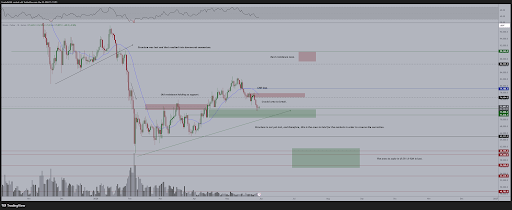
The analyst’s outlook centers on the region around $71,000 to $73,000, which he described as the level that must remain intact to prevent a deeper pullback. His accompanying chart highlights this area as a critical support block, positioned above a broader uptrend line that has guided Bitcoin’s recovery following the sharp correction seen earlier in the year.

According to the chart, the current market structure differs significantly from the breakdown that occurred in February. At that time, a previously established resistance level failed to transition into support, resulting in a rapid loss of momentum and a steep decline. This time, however, the analyst argues that the market is attempting to defend a former resistance zone as support, a development that could preserve the larger bullish framework.

Source: X

The chart also marks a “crucial area to break” near $76,600. Bitcoin recently retreated from that region after encountering resistance, leaving it as the next major hurdle for bulls. Just above it sits a Chicago Mercantile Exchange (CME) gap around $79,000, followed by another resistance cluster near the upper-$80,000 range.

According to the analyst, holding support is only the first step. A successful defense of the $71,000 area would keep the broader structure intact and increase the probability of another advance toward those overhead targets. In that scenario, Bitcoin could regain momentum and position itself for a push toward fresh cycle highs.

Where To Buy If Bitcoin Breaks Down

While the analyst remains constructive on the market, he also mapped out a contingency plan in case support gives way. If Bitcoin loses the $71,000-$73,000 region, his chart points to a significantly lower accumulation zone between roughly $61,000 and $65,000.

That area is notable for several reasons. It aligns with historical support levels established during previous consolidation phases and sits close to the 200-day moving average, a long-term trend indicator closely watched by institutional and retail participants alike. The analyst suggested that a decline into that region would represent an exceptional opportunity to buy in.

For now, the market’s attention remains fixed on two levels. The first is the defense of support near $71,000. The second is a decisive breakout above $76,600. How Bitcoin reacts around those thresholds could determine whether the next chapter brings a renewed surge toward record highs or a final opportunity for buyers to accumulate at significantly lower prices between the $61,000-$65,000 region.

BTC bears crash price | Source: BTCUSD on TradingView.com

Related Questions

QAccording to analyst CryptoMichNL, what are the two key Bitcoin price zones that could determine its next major move?

AThe first is the critical support zone between $71,000 and $73,000 that must hold. The second is the resistance area near $76,600 that Bitcoin needs to break above for another advance.

QWhat is the significance of the support zone around $71,000 to $73,000 for Bitcoin's market structure?

AThis zone is described as the most important support level. Holding this area is crucial to prevent a deeper pullback and to keep the broader bullish structure intact. It represents a former resistance zone now being defended as support.

QIf Bitcoin fails to hold the $71,000-$73,000 support, where does the analyst suggest is an attractive buying opportunity?

AIf Bitcoin breaks down, the analyst points to a significantly lower accumulation zone between roughly $61,000 and $65,000. This area aligns with historical support levels and the 200-day moving average, representing what he considers an exceptional opportunity.

QWhat are the next major resistance levels for Bitcoin mentioned in the article after the $76,600 area?

AJust above the $76,600 level sits a Chicago Mercantile Exchange (CME) gap around $79,000, followed by another resistance cluster near the upper-$80,000 range.

QWhat is the key difference the analyst notes between the current market setup and the breakdown that occurred in February?

AIn February, a previously established resistance level failed to transition into support, leading to a rapid decline. Currently, the market is attempting to defend a former resistance zone ($71,000-$73,000) as support, which is a positive development that could preserve the larger bullish framework.

Related Reads

Microsoft is Afraid of Being Marginalized by AI Giants

Microsoft, once the defining force of the PC era, now faces a familiar challenge in the AI age: the risk of being relegated to a profitable but invisible infrastructure provider. This anxiety was laid bare at Build 2026, where CEO Satya Nadella unveiled a major strategic pivot. The catalyst was a quiet April agreement that dissolved Microsoft's exclusive licensing and cloud-hosting deal with OpenAI, its once-vital partner. This erased Microsoft's key AI moat. With OpenAI and Anthropic defining AI applications and gaining enterprise traction—even within Microsoft's own ranks—Nadella had to answer: without exclusivity, what is Microsoft's role? The answer was a suite of seven in-house AI models, a developer-focused AI workstation (Surface RTX Spark Dev Box), and, most crucially, the Agent 365 platform for enterprise AI governance. The models, notably targeting Anthropic's strengths in coding and enterprise, signal a defensive move. However, the broader strategy is to make the models themselves less decisive. Financially, Microsoft's AI revenue is strong, driven largely by Azure running others' models. Yet its user-facing products like Copilot show weak penetration and engagement. Microsoft earns infrastructure money but lacks direct user mindshare. Nadella's core fear is being "hollowed out." As OpenAI and Anthropic prepare for IPOs and gain financial independence, they may build their own infrastructure, threatening Azure's lucrative AI revenue stream. Microsoft's window is to entrench itself deeper: not as the model creator, but as the indispensable platform for securely deploying, managing, and governing all AI models within the enterprise through Agent 365. Build 2026 revealed Microsoft's bet: in the AI era, the ultimate power lies not in any single model, but in the enterprise "operating system" that controls them. Nadella is determined to ensure Microsoft is the driver of this new era, not just a passenger.

marsbit2m ago

Microsoft is Afraid of Being Marginalized by AI Giants

marsbit2m ago

CPU, Quietly Returning to the Center of the AI Computing Power Stage

Over the past three years, AI computing power narratives have been dominated by GPUs. However, starting in 2026, this story began to shift. While training large models remains GPU-intensive, the rapid growth of inference and AI agent workloads, which require high levels of task orchestration, concurrency, and data flow management, has highlighted a renewed critical role for CPUs. These are tasks GPUs are not designed to handle. Intel's recent launch of the Xeon 6+ processor, built on its Intel 18A process and featuring up to 288 efficiency cores (E-cores), exemplifies this strategic pivot. It is positioned not as a mere companion to GPUs but as the essential "control plane" for AI infrastructure, optimized for high-density, energy-efficient, and high-throughput workloads characteristic of AI agents and inference. This "CPU resurgence" is not about CPUs outperforming GPUs in raw computation. It reflects a systemic bottleneck: as AI scales from training single models to deploying countless intelligent agents, the demand for coordination and data handling surges. Major cloud providers are also developing their own high-density ARM-based server CPUs for similar workloads. However, Intel's success with this strategy faces significant challenges. Competition includes NVIDIA's integrated CPU-GPU solutions, the expanding adoption of cloud vendors' in-house ARM CPUs, and the crucial market test of Intel's 18A manufacturing process against rivals like TSMC's N2. In conclusion, CPUs are indeed reclaiming a central, though redefined, role in AI compute—managing the complex orchestration that enables massive-scale AI deployment. While the trend is clear, which company will ultimately lead this CPU resurgence remains an open question to be decided in the data centers of 2027 and beyond.

marsbit23m ago

CPU, Quietly Returning to the Center of the AI Computing Power Stage

marsbit23m ago

Trading

Spot
Futures

Hot Articles

How to Buy T

Welcome to HTX.com! We've made purchasing Threshold Network Token (T) simple and convenient. Follow our step-by-step guide to embark on your crypto journey.Step 1: Create Your HTX AccountUse your email or phone number to sign up for a free account on HTX. Experience a hassle-free registration journey and unlock all features.Get My AccountStep 2: Go to Buy Crypto and Choose Your Payment MethodCredit/Debit Card: Use your Visa or Mastercard to buy Threshold Network Token (T) instantly.Balance: Use funds from your HTX account balance to trade seamlessly.Third Parties: We've added popular payment methods such as Google Pay and Apple Pay to enhance convenience.P2P: Trade directly with other users on HTX.Over-the-Counter (OTC): We offer tailor-made services and competitive exchange rates for traders.Step 3: Store Your Threshold Network Token (T)After purchasing your Threshold Network Token (T), store it in your HTX account. Alternatively, you can send it elsewhere via blockchain transfer or use it to trade other cryptocurrencies.Step 4: Trade Threshold Network Token (T)Easily trade Threshold Network Token (T) on HTX's spot market. Simply access your account, select your trading pair, execute your trades, and monitor in real-time. We offer a user-friendly experience for both beginners and seasoned traders.

11.8k Total ViewsPublished 2024.03.29Updated 2026.06.02

How to Buy T

Discussions

Welcome to the HTX Community. Here, you can stay informed about the latest platform developments and gain access to professional market insights. Users' opinions on the price of T (T) are presented below.

活动图片