Poland resubmits vetoed crypto bill: ‘Not even a comma’ changed

cointelegraphPublished on 2025-12-11Last updated on 2025-12-11

Abstract

Polish lawmakers from the ruling coalition have resubmitted a crypto asset bill that was recently vetoed by President Karol Nawrocki, unchanged from its previous version. The bill, which designates the Polish Financial Supervision Authority as the primary crypto regulator, has been criticized by opponents as overly restrictive. The political standoff occurs as EU member states prepare to implement the Markets in Crypto-Assets Regulation (MiCA) by 2026. The debate reflects broader tensions within the EU between national and centralized oversight, with some countries advocating for direct supervision by the European Securities and Markets Authority. Despite the president's earlier veto, government officials suggest he may not block the bill again following a security briefing. An alternative draft aligning more closely with MiCA has also been proposed.

Polish lawmakers have doubled down on crypto regulation rejected by President Karol Nawrocki, deepening tensions between the president and Prime Minister Donald Tusk.

Polska2050, part of the ruling coalition in the Sejm — Poland’s lower house of parliament — reintroduced the extensive crypto bill on Tuesday, just days after Nawrocki vetoed an identical bill.

The bill’s backers, including Adam Gomoła — a member of Poland2050 — called Bill 2050 an “improved” successor to the vetoed Bill 1424, but government spokesman Adam Szłapka reportedly declared that “not even a comma” had been changed.

The division over Poland’s crypto bill comes amid the rollout of the European Union’s Markets in Crypto-Assets Regulation (MiCA) across member states ahead of a July 2026 compliance deadline for EU crypto businesses.

Critics say Bill 2050 is “exactly same bill”

The new version of Poland’s draft crypto bill provides an 84-page-long document that essentially replicates the original Bill 1424, aiming to designate the Polish Financial Supervision Authority as the country’s primary crypto asset market regulator.

Crypto advocates like Polish politician Tomasz Mentzen previously criticized Bill 1424 as “118 pages of overregulation,” particularly in comparison to shorter versions in other EU member states like Hungary or Romania.

“The government has once again adopted exactly the same bill on cryptoassets,” Mentzen wrote in an X post on Tuesday.
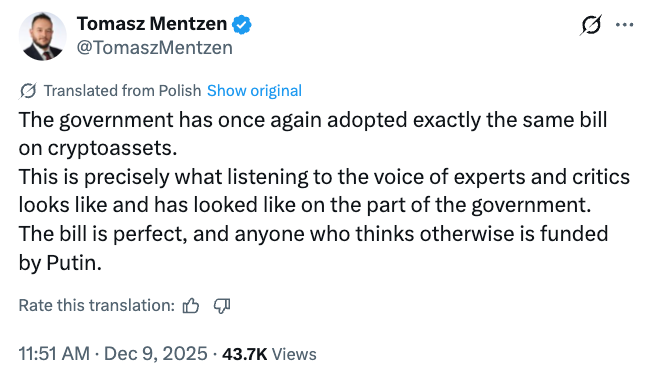
Source: Tomasz Mentzen

He also mocked Tusk’s claim that the president’s earlier veto was tied to the alleged involvement of the “Russian mafia,” saying: “The bill is perfect, and anyone who thinks otherwise is funded by Putin.”

Government spokesman Szłapka reportedly claimed that President Nawrocki will likely not veto the proposed bill this time, following a classified security briefing in parliament last week and “now has full knowledge” of the implications on national security.

The issue with MiCA: Local versus centralized EU oversight

Poland’s debate over its crypto bill sets an important precedent for implementing the EU-wide MiCA regulation, as the proposed legislation would place responsibility for market supervision on the local financial regulator.

The issue is particularly significant amid calls from some member states for more centralized MiCA supervision under the Paris-based European Securities and Markets Authority (ESMA).

In October, the Bank of France urged the EU to give the ESMA direct supervisory powers, warning that a fragmented approach to oversight could undermine the bloc’s financial sovereignty.

Some EU member states have pushed back against centralized oversight under MiCA, with regulators in Malta arguing that it could create additional layers of supervision that might stifle market innovation.

Related: EU plan would boost ESMA powers over crypto and capital markets

Notably, Polish economist Krzysztof Piech — a prominent critic of Poland’s proposed crypto bill — has questioned the need for the local legislation, noting that MiCA protections will take effect in 2026.

While local reports suggest that President Nawrocki may not veto the bill this time, there is also speculation that his office has been presented with an “alternative” draft aimed at creating more favorable market conditions. The proposed alternative is reportedly designed to align with the EU-wide MiCA framework and remove direct oversight from the local regulator.


Related Reads

Gensyn AI: Don't Let AI Repeat the Mistakes of the Internet

In recent months, the rapid growth of the AI industry has attracted significant talent from the crypto sector. A persistent question among researchers intersecting both fields is whether blockchain can become a foundational part of AI infrastructure. While many previous AI and Crypto projects focused on application layers (like AI Agents, on-chain reasoning, data markets, and compute rentals), few achieved viable commercial models. Gensyn differentiates itself by targeting the most critical and expensive layer of AI: model training. Gensyn aims to organize globally distributed GPU resources into an open AI training network. Developers can submit training tasks, nodes provide computational power, and the network verifies results while distributing incentives. The core issue addressed is not decentralization for its own sake, but the increasing centralization of compute power among tech giants. In the era of large models, access to GPUs (like the H100) has become a decisive bottleneck, dictating the pace of AI development. Major AI companies are heavily dependent on large cloud providers for compute resources. Gensyn's approach is significant for several reasons: 1) It operates at the core infrastructure layer (model training), the most resource-intensive and technically demanding part of the AI value chain. 2) It proposes a more open, collaborative model for compute, potentially increasing resource utilization by dynamically pooling idle GPUs, similar to early cloud computing logic. 3) Its technical moat lies in solving complex challenges like verifying training results, ensuring node honesty, and maintaining reliability in a distributed environment—making it more of a deep-tech infrastructure company. 4) It targets a validated, high-growth market with genuine demand, rather than pursuing blockchain integration without purpose. Ultimately, the boundaries between Crypto and AI are blurring. AI requires global resource coordination, incentive mechanisms, and collaborative systems—areas where crypto-native solutions excel. Gensyn represents a step toward making advanced training capabilities more accessible and collaborative, moving beyond a niche controlled by a few giants. If successful, it could evolve into a fundamental piece of AI infrastructure, where the most enduring value in the AI era is often created.

marsbit9h ago

Gensyn AI: Don't Let AI Repeat the Mistakes of the Internet

marsbit9h ago

Why is China's AI Developing So Fast? The Answer Lies Inside the Labs

A US researcher's visit to China's top AI labs reveals distinct cultural and organizational factors driving China's rapid AI development. While talent, data, and compute are similar to the West, Chinese labs excel through a pragmatic, execution-focused culture: less emphasis on individual stardom and conceptual debate, and more on teamwork, engineering optimization, and mastering the full tech stack. A key advantage is the integration of young students and researchers who approach model-building with fresh perspectives and low ego, prioritizing collective progress over personal credit. This contrasts with the US culture of self-promotion and "star scientist" narratives. Chinese labs also exhibit a strong "build, don't buy" mentality, preferring to develop core capabilities—like data pipelines and environments—in-house rather than relying on external services. The ecosystem feels more collaborative than tribal, with mutual respect among labs. While government support exists, its scale is unclear, and technical decisions appear driven by labs, not state mandates. Chinese companies across sectors, from platforms to consumer tech, are building their own foundational models to control their tech destiny, reflecting a broader cultural drive for technological sovereignty. Demand for AI is emerging, with spending patterns potentially mirroring cloud infrastructure more than traditional SaaS. Despite challenges like a less mature data industry and GPU shortages, Chinese labs are propelled by vast talent, rapid iteration, and deep integration with the open-source community. The competition is evolving beyond a pure model race into a contest of organizational execution, developer ecosystems, and industrial pragmatism.

marsbit10h ago

Why is China's AI Developing So Fast? The Answer Lies Inside the Labs

marsbit10h ago

3 Years, 5 Times: The Rebirth of a Century-Old Glass Factory

Corning, a 175-year-old glass company, is experiencing a dramatic revival as a key player in AI infrastructure, driven by surging demand for high-performance optical fiber in data centers. AI data centers require vastly more fiber than traditional ones—5 to 10 times as much per rack—to handle high-speed data transmission between GPUs. This structural demand shift, coupled with supply constraints from the lengthy expansion cycle for fiber preforms, has created a significant supply-demand gap. Nvidia has invested in Corning, along with Lumentum and Coherent, in a $4.5 billion total commitment to secure the optical supply chain for AI. Corning's competitive edge lies in its expertise in producing ultra-low-loss, high-density, and bend-resistant specialty fiber, which is critical for 800G+ and future 1.6T data rates. Its deep involvement in co-packaged optics (CPO) with partners like Nvidia further solidifies its position. While not the largest fiber manufacturer globally, Corning's revenue from enterprise/data center clients now exceeds 40% of its optical communications sales, and it has secured multi-year supply agreements with major hyperscalers including Meta and Nvidia. Financially, Corning's optical communications revenue has surged, doubling from $1.3 billion in 2023 to over $3 billion in 2025. Its stock price has risen nearly 6-fold since late 2023. Key future catalysts include the rollout of Nvidia's CPO products and the scale of undisclosed customer agreements. However, risks include high current valuations and potential disruption from next-generation technologies like hollow-core fiber. The company's long-term bet on light over electricity, maintained even through the telecom bubble crash, is now being validated by the AI boom.

marsbit11h ago

3 Years, 5 Times: The Rebirth of a Century-Old Glass Factory

marsbit11h ago

Trading

Spot
Futures

Hot Articles

What is HPP

I. Project IntroductionBuilt as a Layer 2 on Arbitrum and evolving the proven legacy of Aergo, HPP delivers the infrastructure modern AI applications demand — scalable, trustless, and enterprise-ready.II. Cryptocurrency Information1) Basic InformationName: House Party Protocol (HPP)III. Related LinksOfficial Website:https://www.hpp.io/Whitepaper:https://www.hpp.io/assets/HPP%20Whitepaper_ENG_vF_20250725-Bb-xX5Yd.pdfBlockchain Explorer:https://explorer.hpp.io/Social Media:Twitter: https://x.com/aergo_ioMedium: https://medium.com/aergoTelegram: https://t.me/aergoofficial%22Note: The project introduction comes from the materials published or provided by the official project team, which is for reference only and does not constitute investment advice. HTX does not take responsibility for any resulting direct or indirect losses.

683 Total ViewsPublished 2026.04.29Updated 2026.04.29

What is HPP

How to Buy HPP

Welcome to HTX.com! We've made purchasing House Party Protocol (HPP) simple and convenient. Follow our step-by-step guide to embark on your crypto journey.Step 1: Create Your HTX AccountUse your email or phone number to sign up for a free account on HTX. Experience a hassle-free registration journey and unlock all features.Get My AccountStep 2: Go to Buy Crypto and Choose Your Payment MethodCredit/Debit Card: Use your Visa or Mastercard to buy House Party Protocol (HPP) instantly.Balance: Use funds from your HTX account balance to trade seamlessly.Third Parties: We've added popular payment methods such as Google Pay and Apple Pay to enhance convenience.P2P: Trade directly with other users on HTX.Over-the-Counter (OTC): We offer tailor-made services and competitive exchange rates for traders.Step 3: Store Your House Party Protocol (HPP)After purchasing your House Party Protocol (HPP), store it in your HTX account. Alternatively, you can send it elsewhere via blockchain transfer or use it to trade other cryptocurrencies.Step 4: Trade House Party Protocol (HPP)Easily trade House Party Protocol (HPP) on HTX's spot market. Simply access your account, select your trading pair, execute your trades, and monitor in real-time. We offer a user-friendly experience for both beginners and seasoned traders.

537 Total ViewsPublished 2026.04.29Updated 2026.04.29

How to Buy HPP

What is GENIUS

I. Project IntroductionGenius Terminal is the first private and final onchain terminal.It’s what comes after aggregators, intents bridges, and wallet extensions — a purpose-built trading OS for professional users who want DeFi without DeFi UX.II. Token Information1) Basic InformationToken name: GENIUS (Genius)III. Related LinksWebsite:https://www.tradegenius.com/homeExplorers:https://bscscan.com/address/0x1f12b85aac097e43aa1555b2881e98a51090e9a6Socials:https://x.com/GeniusTerminal Note: The project introduction comes from the materials published or provided by the official project team, which is for reference only and does not constitute investment advice. HTX does not take responsibility for any resulting direct or indirect losses.

845 Total ViewsPublished 2026.04.29Updated 2026.04.29

What is GENIUS

Discussions

Welcome to the HTX Community. Here, you can stay informed about the latest platform developments and gain access to professional market insights. Users' opinions on the price of A (A) are presented below.

活动图片